Trusted by 50K+ Pharmacy StudentsHigh Quality Notes, MCQs, Mock Tests & Study ResourcesGo Premium (Ads Free)
Pharmacy Freak

Sulfonamides – mechanism, resistance, and uses MCQs With Answer
Sulfonamides – mechanism, resistance, and uses MCQs With Answer

Sulfonamides – mechanism, resistance, and uses Sulfonamides are PABA analogues that inhibit bacterial dihydropteroate synthase, blocking folate synthesis and impairing DNA production. In B.Pharm studies, focus on their mechanism (competitive inhibition of folate pathway), synergy with trimethoprim (sequential blockade), resistance mechanisms (mutated DHPS, increased PABA, plasmid-encoded sul genes, efflux), pharmacokinetics (absorption, acetylation, renal excretion), clinical … Read more
General principles of chemotherapy MCQs With Answer

General principles of chemotherapy MCQs With Answer

General principles of chemotherapy are essential for B.Pharm students, covering drug classification, mechanisms of action, pharmacokinetics, dosing strategies, toxicity management, and resistance mechanisms. This concise, exam-oriented introduction and MCQ set examines cytotoxic agents, targeted therapies, alkylating agents, antimetabolites, natural products, and hormonal drugs, with emphasis on cell cycle specificity, therapeutic index, dose-limiting toxicities, combination regimens, … Read more

Emetics and antiemetics – mechanism and clinical use MCQs With Answer

Emetics and antiemetics – mechanism and clinical use MCQs With Answer

Emetics and antiemetics – mechanism and clinical use Understanding emetics and antiemetics is vital for B. Pharm students preparing for clinical pharmacy and therapeutics. This concise guide covers pharmacological mechanisms (CTZ, vomiting centre, 5-HT3, D2, NK1, H1, M1 receptors), major drug classes (5-HT3 antagonists, dopamine antagonists, NK1 antagonists, antihistamines, anticholinergics, cannabinoids, corticosteroids, emetics like apomorphine … Read more

Digestants and carminatives MCQs With Answer

Digestants and carminatives MCQs With Answer

Digestants and carminatives MCQs With Answer This concise, keyword-rich introduction covers digestants and carminatives for B. Pharm students, emphasizing mechanisms, pharmacology, formulation, and quality control. Digestants (enzymes such as pancreatin, pepsin, papain, bromelain) aid macronutrient breakdown, while carminatives (essential oils like peppermint, fennel, caraway, ginger) reduce intestinal gas by antifoaming and antispasmodic actions. Important topics … Read more

Appetite stimulants and suppressants – pharmacological actions MCQs With Answer

Appetite stimulants and suppressants – pharmacological actions MCQs With Answer

Introduction Understanding appetite stimulants and suppressants is essential for B.Pharm students learning pharmacological actions, mechanisms, clinical uses and adverse effects. This topic covers central and peripheral regulators of appetite—hypothalamic neuropeptides (NPY/AgRP, POMC), neurotransmitters (serotonin, norepinephrine, dopamine, histamine, endocannabinoid) and gut hormones (ghrelin, leptin). You will study representative drugs: megestrol, dronabinol, cyproheptadine, mirtazapine, amphetamine-like anorectics, orlistat … Read more

Drugs for diarrhoea – mechanism and examples MCQs With Answer

Drugs for diarrhoea – mechanism and examples MCQs With Answer

Understanding drugs for diarrhoea is essential for B.Pharm students. This concise introduction reviews major antidiarrheal drug classes and their mechanisms — antimotility agents (opioid agonists like loperamide and diphenoxylate), antisecretory drugs (racecadotril, bismuth subsalicylate), adsorbents (kaolin-pectin, activated charcoal), antimicrobials for infectious diarrhoea (azithromycin, ciprofloxacin, nitazoxanide), and adjuncts such as oral rehydration salts and zinc. Emphasis … Read more

Drugs for constipation – classification and uses MCQs With Answer

Drugs for constipation – classification and uses MCQs With Answer

Introduction: Drugs for constipation encompass a range of laxatives and prokinetic agents classified by mechanism: bulk-forming, stool softeners, osmotic, stimulant, lubricant, chloride channel activators, guanylate cyclase‑C agonists, peripherally acting μ‑opioid receptor antagonists (PAMORAs), and prokinetics. B. Pharm students must understand classification, mechanisms of action, clinical uses, onset of action, adverse effects (electrolyte imbalance, cramping, dependence, … Read more

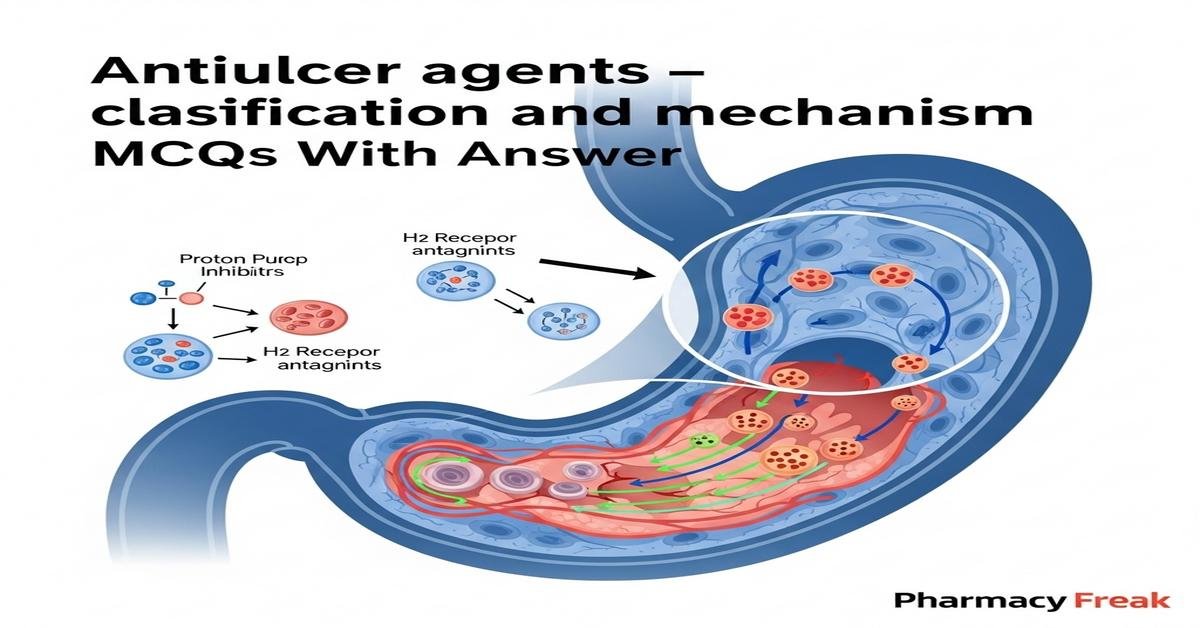
Antiulcer agents – classification and mechanism MCQs With Answer

Antiulcer agents – classification and mechanism MCQs With Answer

Antiulcer agents – classification and mechanism MCQs With Answer This concise introduction reviews antiulcer agents for B. Pharm students, focusing on classification, cellular and molecular mechanisms, examples, pharmacokinetics, and clinically relevant adverse effects. Key topics include antacids, H2 receptor antagonists, proton pump inhibitors (PPIs), prostaglandin analogs, sucralfate, bismuth compounds, mucosal protectants, and Helicobacter pylori eradication … Read more

Pharmacology of drugs acting on the gastrointestinal tract MCQs With Answer

Pharmacology of drugs acting on the gastrointestinal tract MCQs With Answer

Pharmacology of drugs acting on the gastrointestinal tract MCQs With Answer is a focused review for B.Pharm students covering mechanisms, therapeutic uses, adverse effects and interactions of agents used in acid-peptic disorders, motility disturbances, antiemetics, laxatives, antidiarrheals and specific antisecretory therapies. This concise set emphasizes key drug classes—antacids, H2-receptor antagonists, proton pump inhibitors, mucosal protectants, … Read more

Respiratory stimulants – mechanism and uses MCQs With Answer

Respiratory stimulants – mechanism and uses MCQs With Answer

Respiratory stimulants are drugs that increase ventilatory drive by acting on central and peripheral chemoreceptors or by altering acid–base balance. This concise review explains mechanisms and clinical uses of key agents — doxapram, methylxanthines (caffeine, theophylline/aminophylline), acetazolamide, almitrine and progestogens — emphasizing pharmacology, indications such as apnea of prematurity, opioid-induced respiratory depression, and high-altitude breathing … Read more

PRO
Ad-Free Access
$3.99 / month
  • ✓ No Interruptions
  • ✓ Faster Page Loads
  • ✓ Support Content Creators