
Trusted by 50K+ Pharmacy StudentsHigh Quality Notes, MCQs, Mock Tests & Study ResourcesGo Premium (Ads Free)
Pharmacy Freak

Biosensors – working principles and industrial applications MCQs With Answer

Biosensors – working principles and industrial applications MCQs With Answer

Introduction: Biosensors integrate a biological recognition element with a physical transducer to convert biochemical interactions into measurable signals. B. Pharm students must understand working principles — including enzymatic, immunosensor, and nucleic-acid recognition — and common transduction modes such as electrochemical, optical, piezoelectric, and thermal detection. Key topics include bioreceptor immobilization, sensitivity, selectivity, limit of detection, … Read more

Applications of immobilized enzymes in pharmaceutical industries MCQs With Answer

Applications of immobilized enzymes in pharmaceutical industries MCQs With Answer

Applications of immobilized enzymes in pharmaceutical industries explore how enzyme immobilization and biocatalysis revolutionize drug synthesis, offering enhanced enzyme stability, reusability, and process optimization. Immobilized enzymes—attached to carriers like agarose, silica, polymers or nanoparticles via adsorption, covalent binding, entrapment or cross‑linking—enable stereoselective synthesis of chiral intermediates, antibiotic modification, and continuous manufacturing in packed‑bed reactors. Key … Read more

Enzyme biotechnology and methods of enzyme immobilization MCQs With Answer

Enzyme biotechnology and methods of enzyme immobilization MCQs With Answer

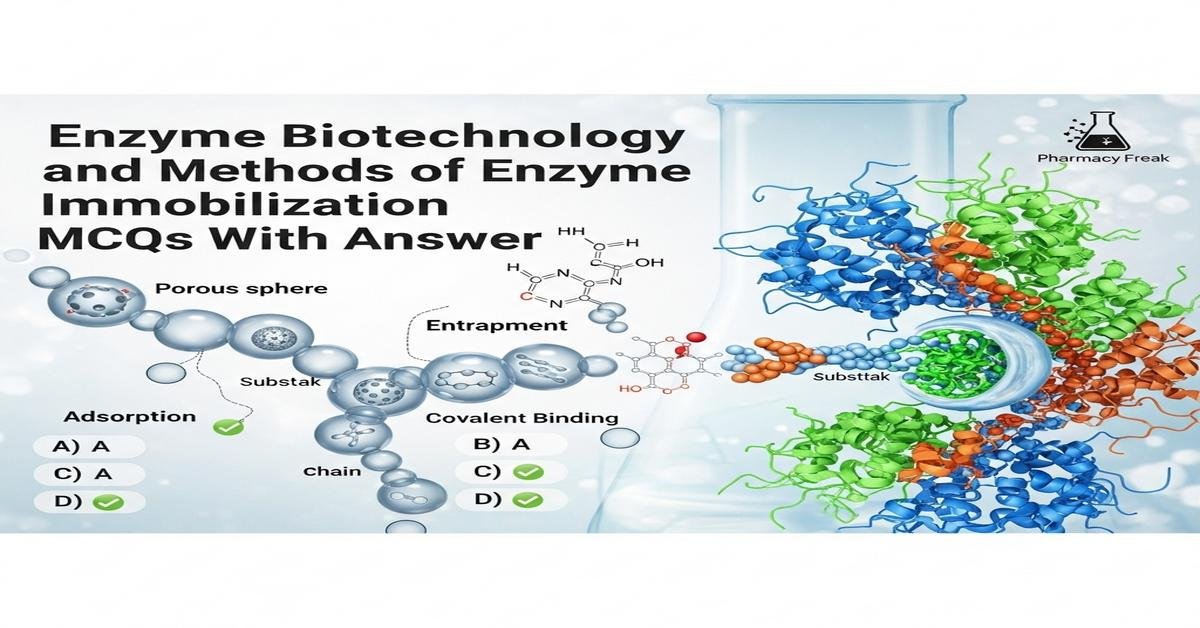
Introduction: Enzyme biotechnology explores the use of enzymes as biocatalysts in pharmaceutical research and production. This introduction covers enzyme immobilization — key methods such as adsorption, covalent binding, entrapment, encapsulation and cross-linking — and highlights carrier materials, immobilization kinetics, stability, reusability, and applications in drug synthesis, bioreactors and biosensors. Understanding immobilization techniques improves enzyme activity … Read more

Applications of biotechnology in pharmaceutical sciences MCQs With Answer

Applications of biotechnology in pharmaceutical sciences MCQs With Answer

Applications of biotechnology in pharmaceutical sciences encompass diverse tools and techniques that transform drug discovery, development, production and quality control for B.Pharm students to master. Key areas include recombinant DNA technology, monoclonal antibodies, vaccine production, gene therapy, pharmacogenomics, and biopharmaceutical manufacturing. Biotechnology enables targeted therapeutics, biologics formulation, advanced diagnostics, and scalable bioprocessing using microbial, mammalian, … Read more

Introduction to Pharmaceutical Biotechnology MCQs With Answer

Introduction to Pharmaceutical Biotechnology MCQs With Answer

Introduction to Pharmaceutical Biotechnology MCQs With Answer This concise set of Pharmaceutical Biotechnology MCQs with answers is designed for B.Pharm students to reinforce core concepts in biologics, recombinant DNA technology, monoclonal antibodies, bioprocessing, downstream processing, cell culture, vaccines, and analytical techniques. Questions emphasize practical applications such as GMP, aseptic technique, quality control assays (ELISA, PCR, … Read more

Examples of drugs showing nonlinear pharmacokinetics MCQs With Answer

Examples of drugs showing nonlinear pharmacokinetics MCQs With Answer

Nonlinear pharmacokinetics occurs when drug absorption, distribution, metabolism or excretion become saturable, producing dose-dependent changes in clearance, half-life and exposure. B. Pharm students must understand key terms such as Michaelis–Menten kinetics, Vmax, Km, protein-binding saturation, and examples including phenytoin, ethanol, salicylates, valproic acid and voriconazole. Grasping mechanisms — enzyme saturation, capacity-limited renal transport, and concentration-dependent … Read more

Michaelis–Menten method of parameter estimation MCQs With Answer

Michaelis–Menten method of parameter estimation MCQs With Answer

Michaelis–Menten method of parameter estimation MCQs With Answer is essential for B. Pharm students studying enzyme kinetics and drug metabolism. This introduction covers key concepts like Michaelis–Menten equation, Km, Vmax, kcat, catalytic efficiency (kcat/Km), steady-state and rapid-equilibrium assumptions, and common linear transforms (Lineweaver–Burk, Eadie–Hofstee, Hanes–Woolf). It also highlights practical aspects of parameter estimation: initial rate … Read more

Factors causing nonlinearity in drug kinetics MCQs With Answer

Factors causing nonlinearity in drug kinetics MCQs With Answer

Understanding factors causing nonlinearity in drug kinetics is essential for B. Pharm students preparing for clinical pharmacology and dosage design. Nonlinear or dose-dependent pharmacokinetics occurs when ADME processes, including absorption, distribution, metabolism and excretion, become capacity-limited or saturable and produce disproportionate changes in plasma concentration with dose. Key contributors include enzyme saturation (Michaelis-Menten metabolism), saturable … Read more

Introduction to nonlinear pharmacokinetics MCQs With Answer

Introduction to nonlinear pharmacokinetics MCQs With Answer

Introduction: Nonlinear pharmacokinetics describes dose-dependent drug behavior where parameters such as clearance, half-life and exposure change with concentration due to saturable processes. Key concepts include Michaelis-Menten kinetics, Vmax, Km, capacity-limited metabolism, zero-order elimination, protein‑binding saturation, transporter saturation and target‑mediated drug disposition. Understanding nonlinear PK is essential for safe dosing, therapeutic drug monitoring, anticipating large changes … Read more

Clinical significance of steady-state dosing MCQs With Answer

Clinical significance of steady-state dosing MCQs With Answer

Introduction Understanding the clinical significance of steady-state dosing is essential for B. Pharm students preparing to manage therapeutic regimens. This topic covers steady-state concentration (Css), time to steady state, accumulation, half-life, loading and maintenance dose calculations, dosing interval effects, bioavailability, clearance, fluctuation between peak and trough, and implications for therapeutic drug monitoring. Mastery of steady-state … Read more

PRO
Ad-Free Access
$3.99 / month
  • ✓ No Interruptions
  • ✓ Faster Page Loads
  • ✓ Support Content Creators