Trusted by 50K+ Pharmacy StudentsHigh Quality Notes, MCQs, Mock Tests & Study ResourcesGo Premium (Ads Free)
Pharmacy Freak

Definition of limit (ε – δ definition) MCQs With Answer
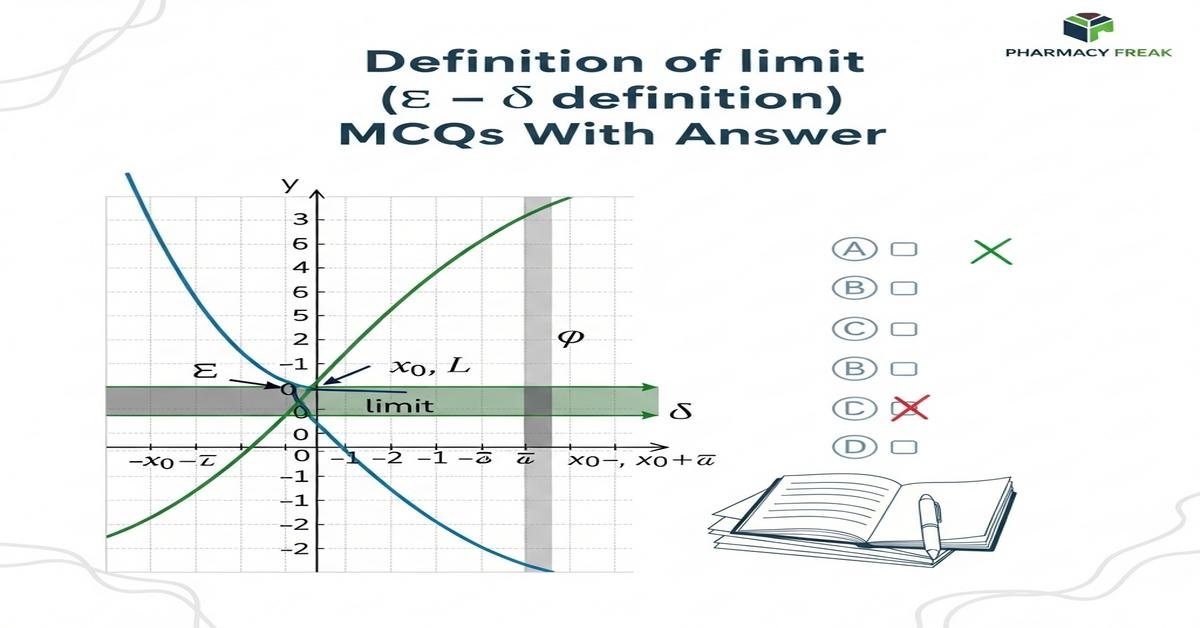
Definition of limit (ε – δ definition) MCQs With Answer The epsilon-delta definition of limit is a formal, rigorous way to describe how a function approaches a value as the input approaches a point. B. Pharm students studying calculus for pharmaceutical modeling must master this concept to analyze rate processes, dissolution curves, and pharmacokinetic functions. … Read more

Limits – Introduction MCQs With Answer

Limits – Introduction MCQs With Answer provides B. Pharm students a concise, exam-oriented review of limit concepts used in pharmacokinetics and pharmaceutical calculations. This introduction covers one-sided limits, limits at infinity, continuity, indeterminate forms, squeeze theorem, and L’Hôpital’s rule with practical examples like drug concentration as t→0 or t→∞ and dose-rate behavior. These MCQs reinforce … Read more

Classification of real valued functions MCQs With Answer

Classification of real valued functions MCQs With Answer is a focused study resource designed for B.Pharm students to master real-valued functions used in pharmaceutical calculations and modeling. This introduction covers classification of real-valued functions, including injective, surjective, bijective, even, odd, continuous, discontinuous, monotonic, polynomial, rational and trigonometric functions, emphasizing domain, range, and graphical interpretation. Targeted … Read more

Real Valued function MCQs With Answer

Real Valued function MCQs With Answer are essential for B. Pharm students to master mathematical foundations used in pharmacokinetics, dose–response modeling, and analytical method calibration. This concise, keyword-rich introduction covers real-valued functions, domain and range, continuity, differentiability, limits, monotonicity, and practical applications in drug concentration–time profiles. These targeted MCQs help B. Pharm students strengthen problem-solving … Read more

Characteristic and Mantissa MCQs With Answer

Understanding Characteristic and Mantissa MCQs With Answer is essential for B. Pharm students tackling pharmaceutical calculations and log-based problems. This focused set explains how the characteristic (the integer part) and the mantissa (the positive fractional part) of common logarithms work, how to use log tables, compute antilogs, and apply rules for numbers greater or less … Read more

Common logarithms MCQs With Answer

Common logarithms MCQs With Answer provide B. Pharm students essential practice in logarithmic calculations used across pharmaceutical sciences. This concise, Student-friendly post covers key topics: common logarithm properties, pH and pKa computations, Beer–Lambert absorbance, first-order kinetics, dilution factors and concentration conversions. Mastering log10 rules helps pharmacy students solve drug stability, buffer design, assay interpretation and … Read more

Theorems/Properties of logarithms MCQs With Answer

Theorems/Properties of Logarithms MCQs With Answer — This concise, Student-friendly post helps B. Pharm students master logarithms and their theorems for pharmacy calculations. Focused on properties of logarithms, logarithmic identities, change of base, product, quotient and power rules, and natural vs common logs, this guide links core log rules to pharmaceutical topics like pH, pKa … Read more

Definition of logarithms MCQs With Answer

Definition of logarithms MCQs With Answer are essential for B. Pharm students to master mathematical tools used in pharmacokinetics, pH calculations, drug concentration decay, and analytical assays. This concise, exam-focused set explains the definition, properties, and applications of logarithms, including base-10 and natural logs, change-of-base formula, and log rules for products, quotients, and powers. Questions … Read more

Logarithms – Introduction MCQs With Answer

Logarithms – Introduction MCQs With Answer are essential for B.Pharm students to master quantitative pharmacy topics such as pH calculations, dilution factors, and pharmacokinetic rate laws. This focused set explains core log rules, antilog use, change-of-base, and the distinction between natural logs (ln) and log base 10, all tied to pharmaceutical examples like pH, pKa, … Read more

Application of Partial Fraction in Pharmacokinetics MCQs With Answer

Application of Partial Fraction in Pharmacokinetics MCQs With Answer The application of partial fraction decomposition is essential for B.Pharm students studying pharmacokinetics, helping to simplify complex rational functions that arise from compartmental models and Laplace transforms. Mastery of partial fractions enables clear derivation of multi-exponential concentration–time profiles, calculation of rate constants, and analytical integration for … Read more

PRO
Ad-Free Access
$3.99 / month
  • No Interruptions
  • Faster Page Loads
  • Support Content Creators