Trusted by 50K+ Pharmacy StudentsHigh Quality Notes, MCQs, Mock Tests & Study ResourcesGo Premium (Ads Free)
Pharmacy Freak

Named Reactions: Ullmann coupling reactions MCQs With Answer
Named Reactions: Ullmann coupling reactions MCQs With Answer

Introduction: Named reactions are cornerstones of advanced organic synthesis, and the Ullmann coupling family plays a vital role in constructing C–C, C–O and C–N bonds in pharmaceutical chemistry. This quiz collection focuses on Ullmann and Ullmann-type reactions, covering mechanistic concepts, catalysts, ligands, substrate scope, limitations and modern improvements that make these reactions relevant for M.Pharm … Read more
Named Reactions: Brook rearrangement and synthetic use MCQs With Answer

Named Reactions: Brook rearrangement and synthetic use MCQs With Answer

Introduction: The Brook rearrangement is a fundamental named reaction in advanced organic chemistry where a silyl group migrates from carbon to oxygen in α-silyl alkoxides, generating a silanolate and a carbon-centered anion. For M.Pharm students, mastering this reaction is important because it exemplifies umpolung (polarity inversion), organosilicon reactivity, and strategic formation of reactive intermediates used … Read more

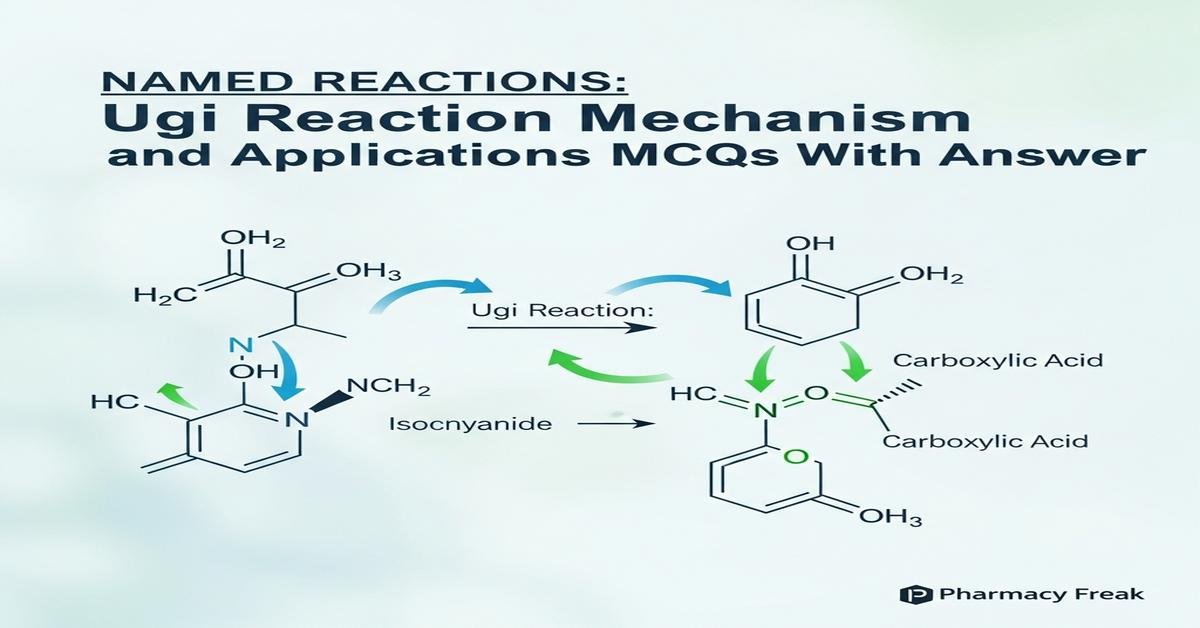
Named Reactions: Ugi reaction mechanism and applications MCQs With Answer

Named Reactions: Ugi reaction mechanism and applications MCQs With Answer

Introduction: The Ugi reaction, a cornerstone multicomponent coupling in modern organic synthesis, assembles an amine, a carbonyl compound, an isocyanide and a carboxylic acid into structurally diverse peptidomimetic scaffolds in a single step. For M.Pharm students, mastering its mechanism — imine/iminium formation, isocyanide addition to give a nitrilium intermediate, and the Mumm rearrangement yielding an … Read more

Rearrangement reactions: mechanisms and synthetic applications MCQs With Answer

Rearrangement reactions: mechanisms and synthetic applications MCQs With Answer

Rearrangement reactions are central to advanced organic synthesis and form a critical part of the M.Pharm curriculum. This quiz-focused blog on “Rearrangement reactions: mechanisms and synthetic applications MCQs With Answer” offers targeted practice for postgraduate students preparing for MPC 102T Advanced Organic Chemistry I. Each question probes mechanistic detail, key intermediates, regiochemical and stereochemical outcomes, … Read more

Elimination reactions: E1 and E2, Hoffman vs Saytzeff rules MCQs With Answer

Elimination reactions: E1 and E2, Hoffman vs Saytzeff rules MCQs With Answer

Introduction This blog presents a focused set of multiple-choice questions on elimination reactions — E1 and E2 mechanisms — and the competition between Hofmann and Saytzeff (Zaitsev) product formation, tailored for M.Pharm students studying MPC 102T Advanced Organic Chemistry I. Questions emphasize mechanistic details, rate laws, stereochemical requirements (anti-periplanar geometry), influence of bases, solvents and … Read more

Nucleophilic substitution: SN1 and SN2 mechanisms and applications MCQs With Answer

Nucleophilic substitution: SN1 and SN2 mechanisms and applications MCQs With Answer

Nucleophilic substitution reactions (SN1 and SN2) are central to organic transformations encountered in pharmaceutical synthesis and drug metabolism. This short quiz set consolidates key mechanistic principles, kinetic criteria, stereochemical outcomes, solvent and leaving-group effects, and practical applications relevant to M.Pharm students. Questions emphasize how substrate structure, nucleophile strength, and reaction medium control whether a substitution … Read more

Reaction Mechanisms: Types and methods to determine mechanisms MCQs With Answer

Reaction Mechanisms: Types and methods to determine mechanisms MCQs With Answer

Introduction: This quiz set on Reaction Mechanisms: Types and Methods to Determine Mechanisms is tailored for M.Pharm students studying MPC 102T Advanced Organic Chemistry I. It focuses on core mechanistic concepts—ionic, radical, concerted and pericyclic pathways—and practical approaches used to identify them, such as kinetics, isotope effects, stereochemical probes, trapping/crossover experiments, Hammett plots, Eyring/Arrhenius analysis, … Read more

Organic Intermediates: Carbenes and nitrenes formation and synthetic uses MCQs With Answer

Organic Intermediates: Carbenes and nitrenes formation and synthetic uses MCQs With Answer

Organic Intermediates: Carbenes and Nitrenes — MCQs With Answer Introduction: This quiz set focuses on carbenes and nitrenes — two highly reactive intermediates central to advanced synthetic organic chemistry. Aimed at M.Pharm students studying MPC 102T Advanced Organic Chemistry I, the questions probe formation methods (diazo compounds, diazirines, azides, iminoiodinanes, Simmons–Smith carbenoids), spin states (singlet … Read more

Organic Intermediates: Free radicals formation, stability and applications MCQs With Answer

Organic Intermediates: Free radicals formation, stability and applications MCQs With Answer

Introduction: Organic Intermediates: Free radicals formation, stability and applications MCQs With Answer is designed to help M.Pharm students master radical chemistry concepts relevant to advanced organic processes and pharmaceutical applications. This set focuses on mechanisms of radical generation, factors governing radical stability (hyperconjugation, resonance, captodative effects, inductive influences), kinetics (rate constants, radical clocks), detection (ESR/EPR), … Read more

Organic Intermediates: Carbanions formation, stability and applications MCQs With Answer

Organic Intermediates: Carbanions formation, stability and applications MCQs With Answer

Introduction: Organic Intermediates: Carbanions formation, stability and applications MCQs With Answer is designed for M.Pharm students preparing for MPC 102T Advanced Organic Chemistry I. This quiz-focused blog emphasizes key concepts: how carbanions are generated, factors controlling their stability (hybridization, resonance, inductive effects, hyperconjugation), and practical applications in synthesis (enolate chemistry, nucleophilic additions, organometallic reagents, E1cb … Read more

PRO
Ad-Free Access
$3.99 / month
  • ✓ No Interruptions
  • ✓ Faster Page Loads
  • ✓ Support Content Creators