Trusted by 50K+ Pharmacy StudentsHigh Quality Notes, MCQs, Mock Tests & Study ResourcesGo Premium (Ads Free)
Pharmacy Freak

Combined effects of drugs MCQs With Answer
Combined effects of drugs MCQs With Answer

Combined effects of drugs describe how two or more drugs interact to alter therapeutic outcomes and adverse effects. For B.Pharm students, understanding drug interactions is essential: pharmacodynamic interactions (synergism, antagonism, potentiation) and pharmacokinetic interactions (absorption, distribution, metabolism, excretion) affect efficacy and safety. Key concepts include cytochrome P450 modulation, enzyme induction/inhibition, protein binding displacement, and changes … Read more
Therapeutic index MCQs With Answer

Therapeutic index MCQs With Answer

The therapeutic index is a core concept for B. Pharm students linking pharmacokinetics and pharmacodynamics to patient safety. This introduction explains how the therapeutic index, therapeutic window, and narrow therapeutic index drugs determine dosing decisions, adverse effect risk, and the need for therapeutic drug monitoring. You will review calculations (LD50/ED50 or TD50/ED50), factors that alter … Read more

Dose–response relationship MCQs With Answer

Dose–response relationship MCQs With Answer

Understanding the dose–response relationship is fundamental for B. Pharm students studying pharmacodynamics and therapeutics. This concept explains how varying drug doses influence the magnitude of biological effect, linking potency, efficacy, EC50/ED50 values, and maximal response (Emax). Graded and quantal dose–response curves, receptor occupancy, spare receptors, Hill coefficient, therapeutic index, and safety margin are essential keywords … Read more

Transcription factor-regulated receptors MCQs With Answer

Transcription factor-regulated receptors MCQs With Answer

Introduction: Transcription factor-regulated receptors are central to pharmacology and gene regulation, linking extracellular signals to changes in receptor expression and function. This topic covers ligand-activated nuclear receptors (eg, steroid, thyroid, PPAR), DNA response elements, transcription factors (STATs, NF-κB, AP-1), co‑activators and co‑repressors, chromatin remodeling, and post‑translational modifications that modulate receptor transcription. Understanding receptor gene regulation, … Read more

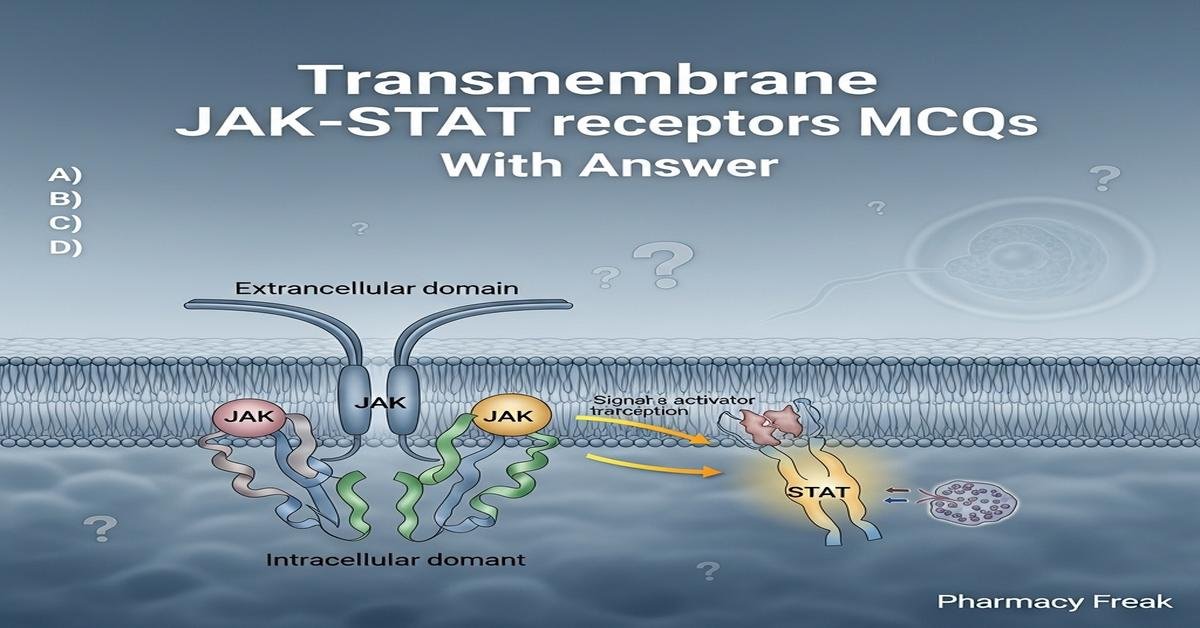
Transmembrane JAK-STAT receptors MCQs With Answer

Transmembrane JAK-STAT receptors MCQs With Answer

Transmembrane JAK-STAT receptors MCQs With AnswerTransmembrane JAK-STAT receptors mediate critical cytokine and growth factor signaling in cells, linking extracellular ligand binding to nuclear gene regulation via Janus kinases (JAKs) and Signal Transducers and Activators of Transcription (STATs). This concise, focused introduction for B. Pharm students covers receptor architecture, JAK-STAT activation, phosphorylation sites, negative regulators (SOCS, … Read more

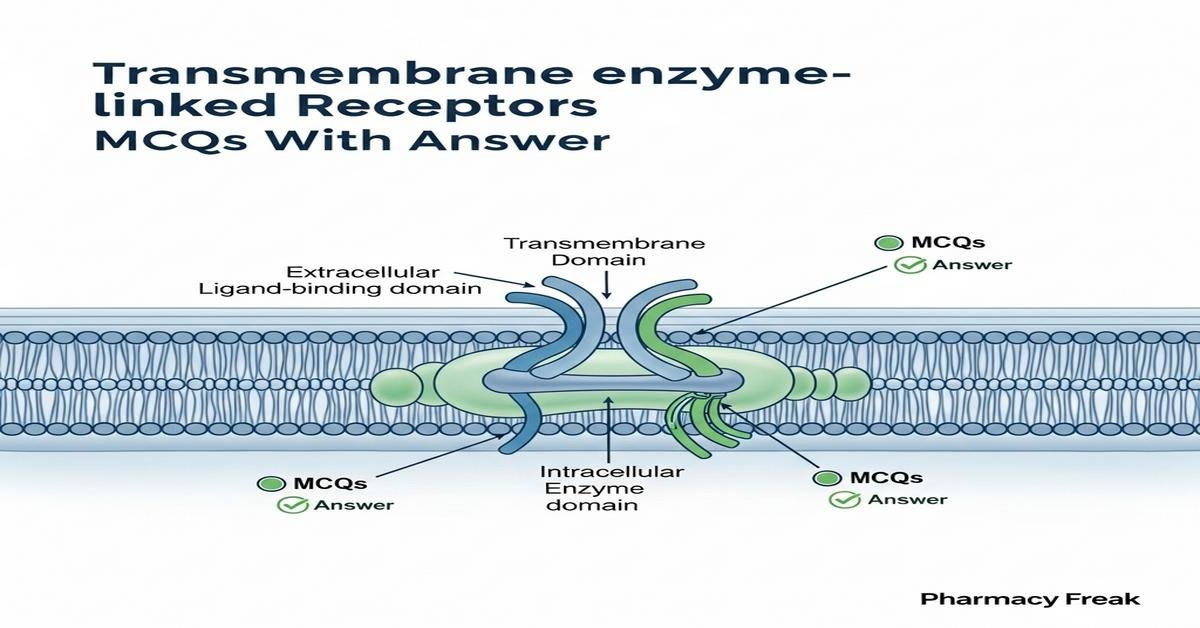
Transmembrane enzyme-linked receptors MCQs With Answer

Transmembrane enzyme-linked receptors MCQs With Answer

Introduction Transmembrane enzyme-linked receptors are integral membrane proteins that couple extracellular ligand binding to intrinsic or associated enzymatic activity, initiating signal transduction cascades. Key families include receptor tyrosine kinases (RTKs), receptor serine/threonine kinases and particulate guanylyl cyclases. Understanding ligand-induced dimerization, autophosphorylation, downstream pathways (MAPK, PI3K–Akt), and pharmacological modulation is essential for B. Pharm students studying … Read more

Ion channel receptors MCQs With Answer

Ion channel receptors MCQs With Answer

Understanding ion channel receptors is essential for B.Pharm students because these membrane proteins control ionic flux, neuronal excitability, synaptic transmission and are major drug targets. This topic covers ligand-gated and voltage-gated ion channels, ion selectivity, gating mechanisms, kinetics, modulation by drugs (agonists, antagonists, allosteric modulators), channelopathies, and experimental techniques such as patch-clamp. Emphasis is placed … Read more

G-protein coupled receptors MCQs With Answer

G-protein coupled receptors MCQs With Answer

G-protein coupled receptors (GPCRs) are a vast family of seven-transmembrane (7TM) proteins central to pharmacology and cellular signal transduction. For B.Pharm students, a firm grasp of GPCR structure, ligand binding, G-protein coupling (Gs, Gi, Gq), second messengers (cAMP, IP3/DAG, Ca2+), receptor desensitization, arrestin biology, biased agonism and therapeutic targeting is essential for rational drug design … Read more

Signal transduction mechanisms MCQs With Answer

Signal transduction mechanisms MCQs With Answer

Signal transduction mechanisms form the basis of cellular communication and are essential to understanding pharmacology and drug action. For B. Pharm students, mastering receptor types (GPCRs, RTKs, ion channels, nuclear receptors), intracellular pathways (G-proteins, second messengers like cAMP, IP3, DAG, Ca2+), kinases and phosphatases, and cascade regulation is critical for identifying drug targets and predicting … Read more

Drug–receptor interactions MCQs With Answer

Drug–receptor interactions MCQs With Answer

Understanding drug–receptor interactions is central to pharmacodynamics and essential for B. Pharm students preparing for therapeutics and research. This concise guide reviews how drugs bind receptors, definitions of affinity and efficacy, distinctions between agonists, partial agonists, antagonists, inverse agonists, and mechanisms of competitive and noncompetitive inhibition. Key concepts include dose–response curves, EC50 and Kd, receptor … Read more

PRO
Ad-Free Access
$3.99 / month
  • ✓ No Interruptions
  • ✓ Faster Page Loads
  • ✓ Support Content Creators