Trusted by 50K+ Pharmacy StudentsHigh Quality Notes, MCQs, Mock Tests & Study ResourcesGo Premium (Ads Free)
Pharmacy Freak

Processing of herbal raw materials MCQs With Answer

Processing of herbal raw materials MCQs With Answer

Processing of herbal raw materials involves critical operations—collection, authentication, drying, milling, extraction, purification and storage—ensuring phytochemical integrity and therapeutic efficacy. For B.Pharm students, mastering concepts like Good Agricultural and Collection Practices (GACP), moisture control, particle size, extraction techniques (maceration, percolation, Soxhlet, supercritical fluid), standardization, chromatographic fingerprinting, and quality control tests (ash values, loss on drying, … Read more

Sources of herbs and their selection, identification and authentication MCQs With Answer

Sources of herbs and their selection, identification and authentication MCQs With Answer

Introduction: Sources of herbs and their selection, identification and authentication are core topics in pharmacognosy for B.Pharm students. This study covers botanical sources, plant parts (leaf, root, rhizome, bark), geographical and seasonal influences, criteria for selection, and methods of identification and authentication including macroscopic, microscopic, organoleptic, physicochemical, phytochemical and DNA barcoding techniques. Emphasis is placed … Read more

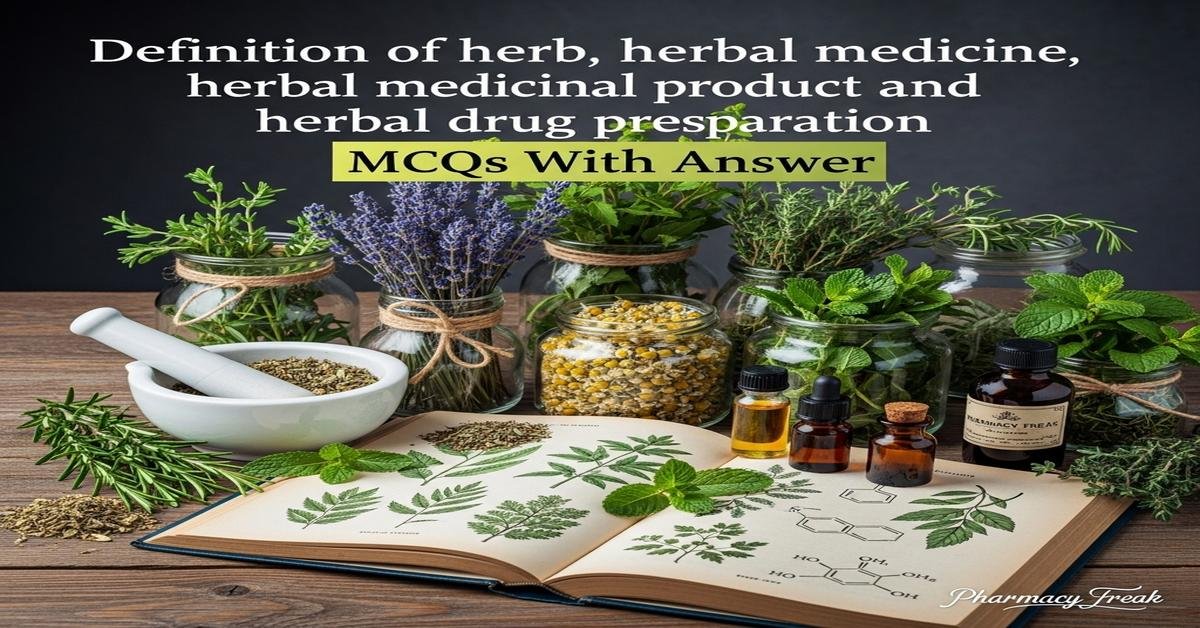
Definition of herb, herbal medicine, herbal medicinal product and herbal drug preparation MCQs With Answer

Definition of herb, herbal medicine, herbal medicinal product and herbal drug preparation MCQs With Answer

Introduction Understanding the definition of herb, herbal medicine, herbal medicinal product and herbal drug preparation is essential for B. Pharm students specializing in pharmacognosy and phytopharmacy. This concise guide clarifies key keywords: herb (plant or plant part with therapeutic value), herbal medicine (traditional or modern preparations used for treatment), herbal medicinal product (finished, standardized marketed … Read more

Chronotherapy – application in drug administration MCQs With Answer

Chronotherapy – application in drug administration MCQs With Answer

Chronotherapy applies circadian biology to optimize drug administration timing for better therapeutic outcomes and fewer side effects. For B. Pharm students, understanding chronopharmacology — the interaction of circadian rhythms with pharmacokinetics and pharmacodynamics — is essential for designing dosing schedules, time-controlled formulations, and clinical studies. Key concepts include circadian rhythms, clock genes (CLOCK, PER, BMAL1), … Read more

Biological clock – significance and relation to chronotherapy MCQs With Answer

Biological clock – significance and relation to chronotherapy MCQs With Answer

The biological clock governs circadian rhythms that coordinate physiology, behavior and molecular processes across a ~24-hour cycle. Understanding clock genes, the suprachiasmatic nucleus, peripheral clocks, and Zeitgebers is essential for B.Pharm students learning chronopharmacology and chronotherapy. Drug absorption, distribution, metabolism and excretion show time-of-day variation, affecting pharmacokinetics and pharmacodynamics. Chronotherapy and chrono-drug delivery aim to … Read more

Biological rhythms and cycles MCQs With Answer

Biological rhythms and cycles MCQs With Answer

B. Pharm students must understand biological rhythms and cycles because they profoundly influence drug pharmacokinetics, pharmacodynamics, dosing time, and chronotherapy. This concise guide covers circadian, ultradian, and infradian rhythms; central and peripheral clocks; molecular clock genes (CLOCK, BMAL1, PER, CRY); zeitgebers like light; and key outcomes such as melatonin and cortisol patterns. Emphasis is on … Read more

Chronopharmacology – definition and concepts MCQs With Answer

Chronopharmacology – definition and concepts MCQs With Answer

Chronopharmacology studies how biological timing and circadian rhythms influence drug action, pharmacokinetics and pharmacodynamics. For B. Pharm students, understanding chronopharmacology, chronotherapy, circadian clock genes (CLOCK, BMAL1, PER, CRY) and the role of the suprachiasmatic nucleus (SCN) is essential for optimizing dosing times, reducing toxicity and improving therapeutic outcomes. Time-dependent variation in absorption, distribution, hepatic metabolism … Read more

Heavy metal poisoning – lead, mercury, arsenic – management MCQs With Answer

Heavy metal poisoning – lead, mercury, arsenic – management MCQs With Answer

Heavy metal poisoning – lead, mercury, arsenic – management MCQs With Answer Heavy metal poisoning is a critical topic for B.Pharm students covering lead, mercury and arsenic toxicity, clinical features, diagnosis and pharmacological management. This introduction highlights key terms: lead poisoning, mercury toxicity, arsenic poisoning, chelation therapy, EDTA, dimercaprol (BAL), succimer (DMSA), DMPS, pharmacokinetics, biomarkers … Read more

Organophosphorus compound poisoning – mechanism and treatment MCQs With Answer

Organophosphorus compound poisoning – mechanism and treatment MCQs With Answer

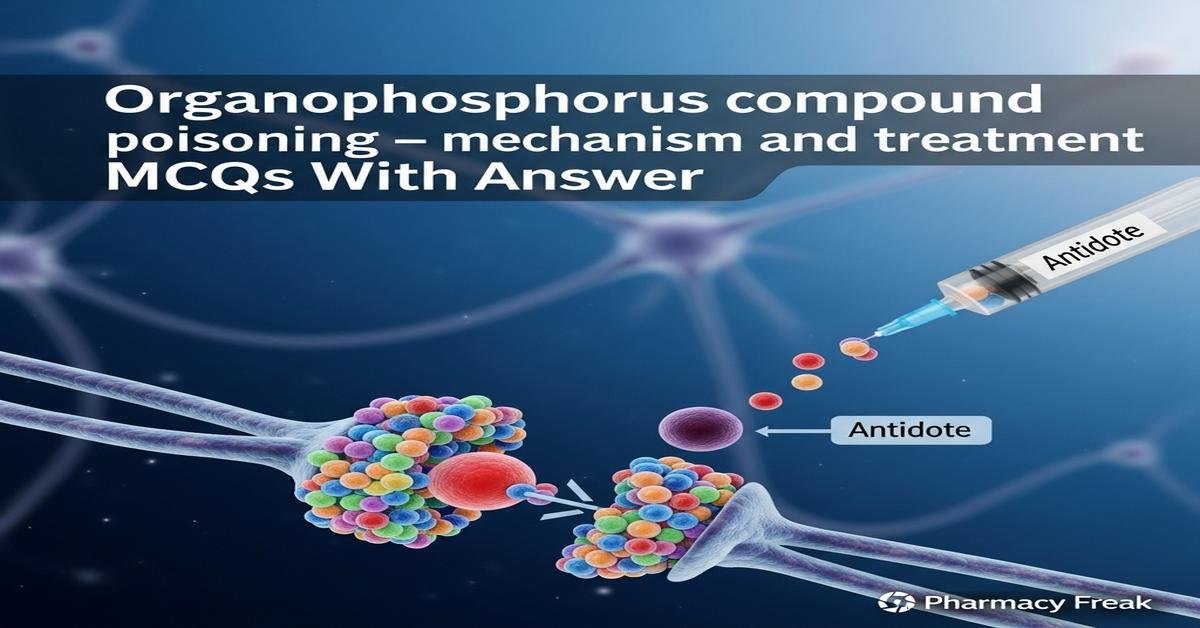
Organophosphorus compound poisoning – mechanism and treatment MCQs With Answer Organophosphorus (OP) poisoning, a critical topic for B. Pharm students, involves acetylcholinesterase inhibition leading to cholinergic overstimulation. Understanding the mechanism—AChE phosphorylation, “aging,” and resultant muscarinic and nicotinic signs—is essential for clinical pharmacology. Key treatments include atropine for muscarinic effects, oximes (pralidoxime) to reactivate phosphorylated AChE … Read more

Morphine poisoning – symptoms and management MCQs With Answer

Morphine poisoning – symptoms and management MCQs With Answer

Morphine poisoning – symptoms and management is a vital topic for B. Pharm students, covering opioid pharmacology, overdose recognition, and emergency care. This introduction reviews the opioid toxidrome—respiratory depression, miosis, reduced consciousness, and hypoventilation—alongside mechanisms (mu receptor agonism), key investigations, and management principles including airway support, naloxone reversal, activated charcoal, and monitoring for recurrent toxicity. … Read more

PRO
Ad-Free Access
$3.99 / month
  • ✓ No Interruptions
  • ✓ Faster Page Loads
  • ✓ Support Content Creators