Trusted by 50K+ Pharmacy StudentsHigh Quality Notes, MCQs, Mock Tests & Study ResourcesGo Premium (Ads Free)
Pharmacy Freak

Estimation, significance and clinical application of pharmacokinetic parameters MCQs With Answer

Estimation, significance and clinical application of pharmacokinetic parameters MCQs With Answer

Introduction: Estimation, significance and clinical application of pharmacokinetic parameters are core topics for B.Pharm students, linking drug concentration-time data to safe and effective therapy. This module covers estimation methods (compartmental and non-compartmental), key parameters such as AUC, Cmax, Tmax, t1/2, clearance (CL) and volume of distribution (Vd), and their clinical significance in dose adjustment, therapeutic … Read more
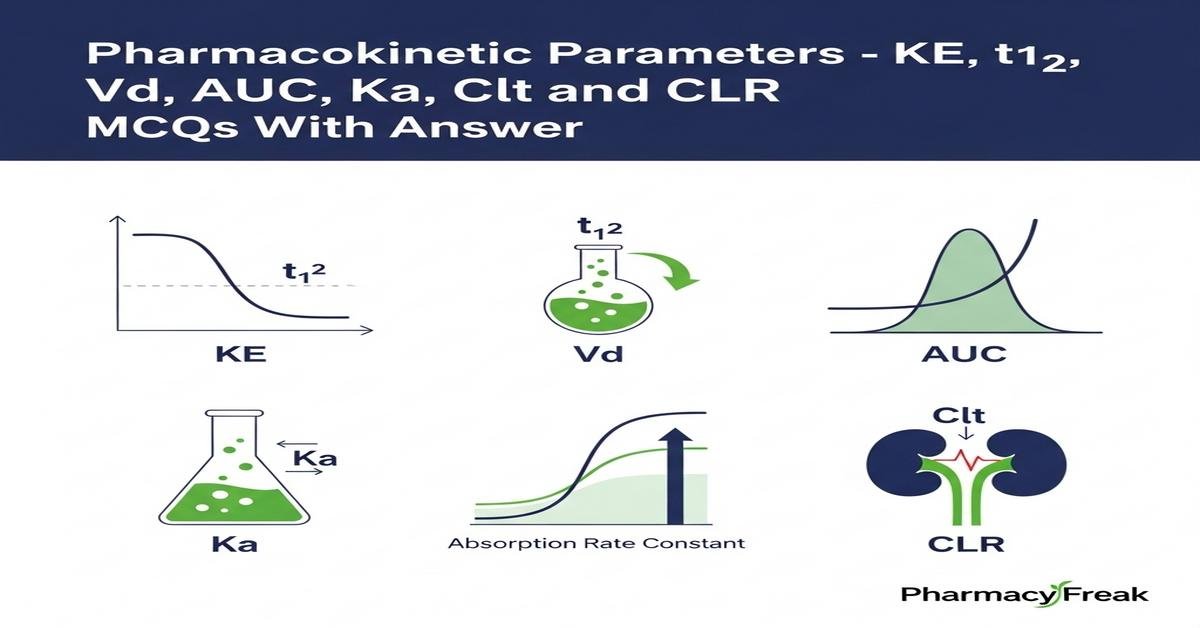
Pharmacokinetic parameters – KE, t½, Vd, AUC, Ka, Clt and CLR MCQs With Answer

Pharmacokinetic parameters – KE, t½, Vd, AUC, Ka, Clt and CLR MCQs With Answer

Pharmacokinetic parameters such as KE, t½, Vd, AUC, Ka, Clt and CLR form the quantitative foundation for drug dosing, therapeutic monitoring, and formulation design. B.Pharm students must grasp elimination rate constant (KE) and half‑life (t½) to predict drug persistence; volume of distribution (Vd) to infer tissue distribution; absorption rate constant (Ka) to assess onset of … Read more

One-compartment open model – extravascular administration MCQs With Answer

One-compartment open model – extravascular administration MCQs With Answer

Introduction: The one-compartment open model with extravascular administration describes how a drug is absorbed into systemic circulation, distributes uniformly in a single body compartment, and is eliminated. Key pharmacokinetic terms include absorption rate constant (ka), elimination rate constant (ke), bioavailability (F), peak concentration (Cmax), time to peak (Tmax), area under the curve (AUC), and half-life … Read more

One-compartment open model – IV infusion MCQs With Answer

One-compartment open model – IV infusion MCQs With Answer

One-compartment open model – IV infusion MCQs With Answer The one-compartment open model for IV infusion is a core pharmacokinetic framework describing constant-rate intravenous drug administration into a single, well-mixed compartment. Key concepts and keywords include infusion rate (k0), elimination rate constant (ke), clearance (Cl), volume of distribution (Vd), steady-state concentration (Css), half-life (t1/2), loading … Read more

One-compartment open model – IV bolus administration MCQs With Answer

One-compartment open model – IV bolus administration MCQs With Answer

Understanding the One-compartment open model with IV bolus administration is essential for B. Pharm students studying pharmacokinetics. This model assumes instantaneous distribution into a single, well-mixed compartment and monoexponential elimination described by the elimination rate constant (kel). Key concepts include calculation of initial concentration (C0), volume of distribution (Vd), half-life (t1/2), clearance (CL), AUC and … Read more

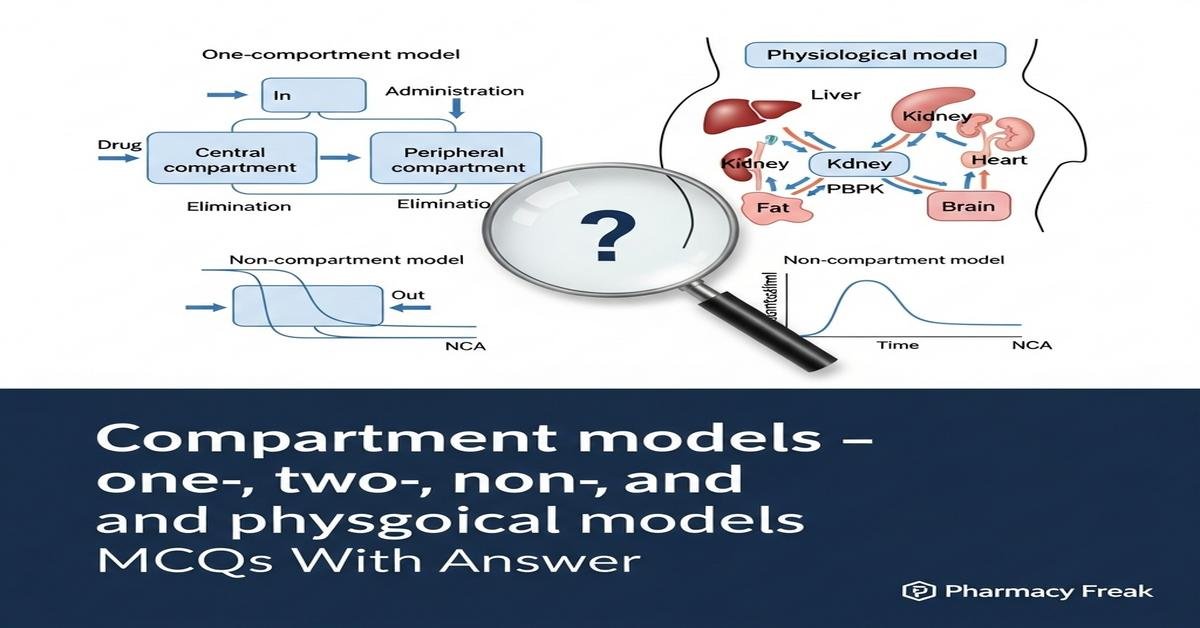
Compartment models – one-, two-, non- and physiological models MCQs With Answer

Compartment models – one-, two-, non- and physiological models MCQs With Answer

Compartment models — one-compartment, two-compartment, non-compartmental and physiological (PBPK) models — are essential pharmacokinetic tools for B. Pharm students. These models describe absorption, distribution, metabolism and elimination (ADME) and predict plasma concentration–time profiles after IV bolus, oral dosing, infusion or multiple dosing. Key concepts include volume of distribution, clearance, elimination rate constant, half-life, micro- and … Read more

Introduction and definition of Pharmacokinetics MCQs With Answer

Introduction and definition of Pharmacokinetics MCQs With Answer

Pharmacokinetics studies the time course of drugs in the body — absorption, distribution, metabolism and excretion (ADME). For B.Pharm students, mastering pharmacokinetics is essential to predict drug concentration, dose regimen, bioavailability, clearance, half-life and volume of distribution. This curated set of MCQs covers compartmental and non-compartmental models, first-order versus zero-order kinetics, hepatic and renal elimination, … Read more

Methods to enhance dissolution rate and bioavailability of poorly soluble drugs MCQs With Answer

Methods to enhance dissolution rate and bioavailability of poorly soluble drugs MCQs With Answer

Introduction Improving the dissolution rate and bioavailability of poorly soluble drugs is a core challenge in pharmaceutics. B. Pharm students must understand solubility enhancement strategies such as particle size reduction, solid dispersions, amorphous conversion, salt formation, cyclodextrin complexation, surfactants, lipid-based formulations (SEDDS/SMEDDS), and nanotechnology. Key concepts include BCS classification, wettability, dissolution testing, permeability interplay, and … Read more

Bioequivalence studies and regulatory aspects MCQs With Answer

Bioequivalence studies and regulatory aspects MCQs With Answer

Bioequivalence studies and regulatory aspects MCQs With Answer Bioequivalence studies assess whether two drug products (usually a generic and a reference) have comparable pharmacokinetics — mainly AUC and Cmax — ensuring equivalent rate and extent of absorption. B.Pharm students should understand study designs (crossover, replicate), statistical concepts (log-transformation, 90% CI, TOST), regulatory criteria (80–125% limits, … Read more

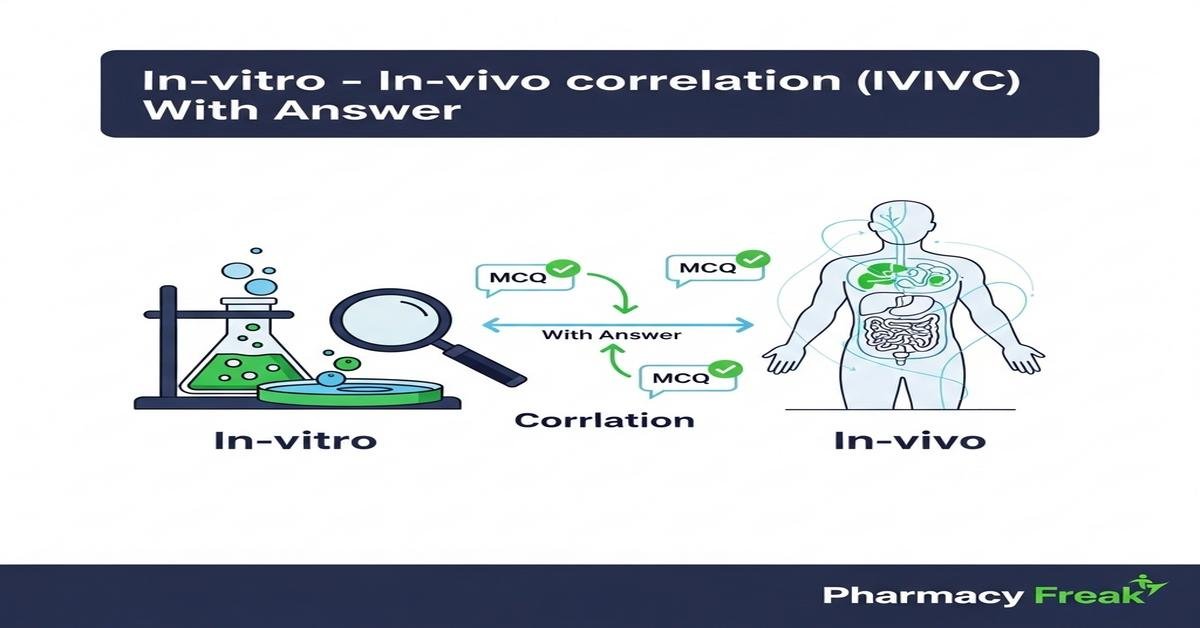
In-vitro – in-vivo correlation (IVIVC) MCQs With Answer

In-vitro – in-vivo correlation (IVIVC) MCQs With Answer

Introduction: In-vitro–in-vivo correlation (IVIVC) is a predictive scientific approach that links in vitro dissolution data with in vivo bioavailability and pharmacokinetic responses. IVIVC concepts — including Level A, B, and C correlations, deconvolution, Wagner–Nelson and Loo–Riegelman methods — are central to biopharmaceutics and formulation development. Mastery of IVIVC helps B. Pharm students understand bioavailability, dissolution … Read more

PRO
Ad-Free Access
$3.99 / month
  • ✓ No Interruptions
  • ✓ Faster Page Loads
  • ✓ Support Content Creators