Trusted by 50K+ Pharmacy StudentsHigh Quality Notes, MCQs, Mock Tests & Study ResourcesGo Premium (Ads Free)
Pharmacy Freak

Applications of microencapsulation in pharmaceuticals MCQs With Answer
Applications of microencapsulation in pharmaceuticals MCQs With Answer

Microencapsulation is a key technology in modern pharmaceuticals for improving drug stability, controlled release, targeted delivery, taste masking, and enhanced bioavailability. B. Pharm students should understand common encapsulation techniques such as spray drying, coacervation, solvent evaporation, liposomal and polymeric microsphere methods, and materials like PLGA, alginate and chitosan. Knowledge of characterization (particle size, encapsulation efficiency, … Read more
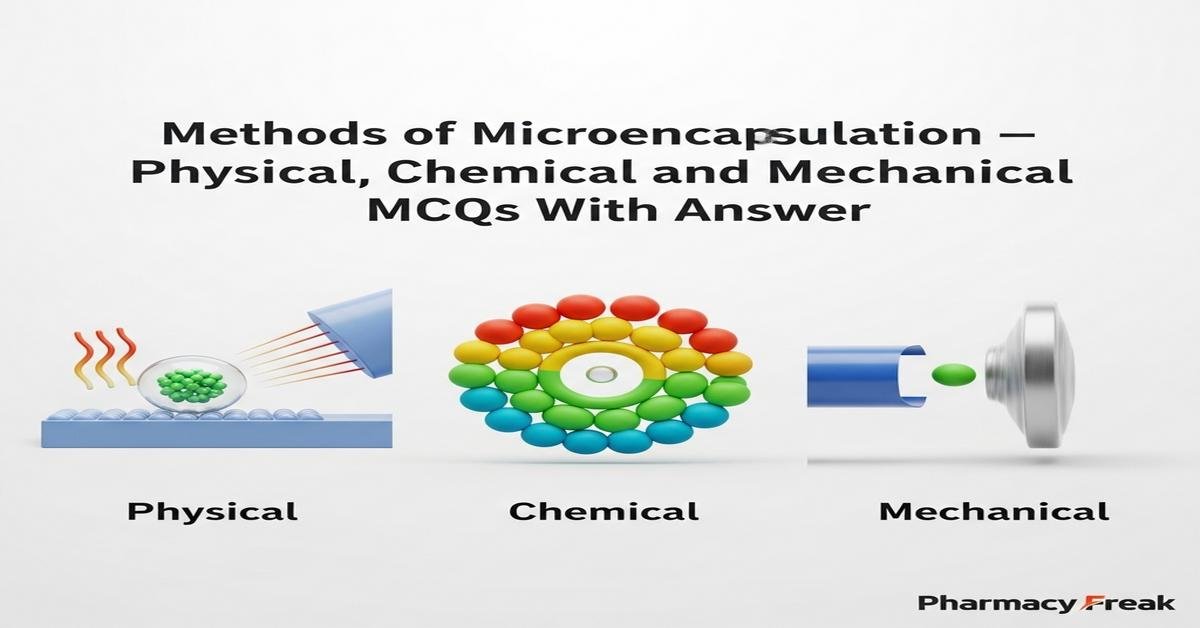
Methods of microencapsulation – physical, chemical and mechanical MCQs With Answer

Methods of microencapsulation – physical, chemical and mechanical MCQs With Answer

Introduction: Microencapsulation is a set of techniques used to entrap active pharmaceutical ingredients within microscopic carriers to improve stability, control release, mask taste, and enable targeted delivery. B. Pharm students should understand key physical methods (spray drying, spray congealing, fluid-bed coating), chemical methods (coacervation, interfacial polymerization, ionic cross-linking), and mechanical methods (pan coating, extrusion, milling). … Read more

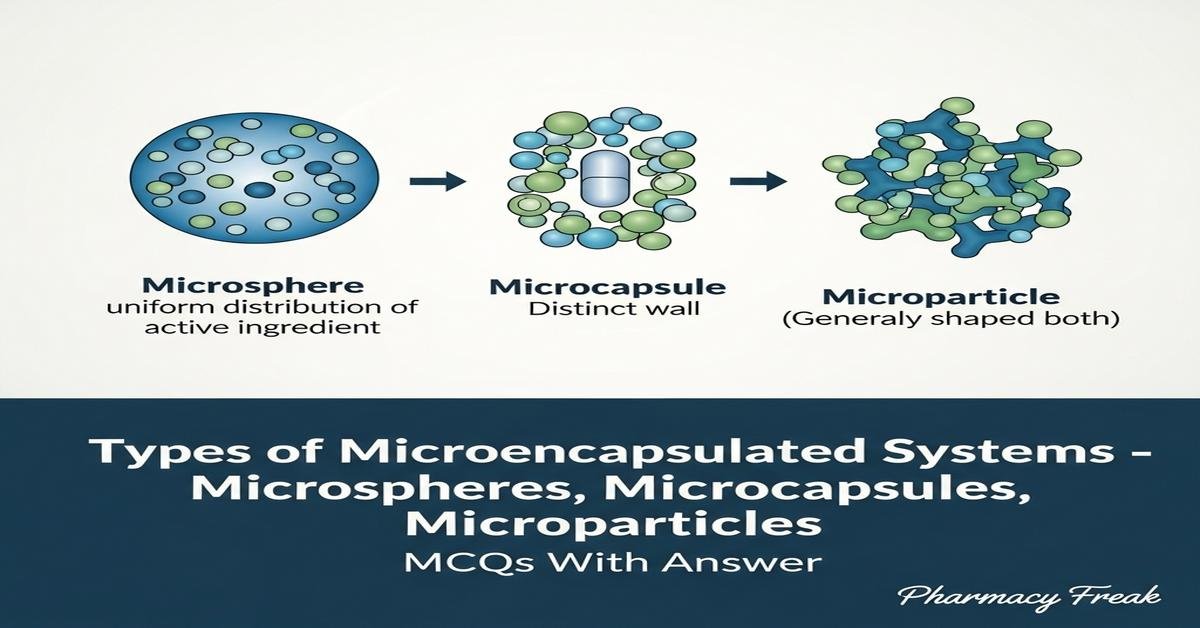
Types of microencapsulated systems – microspheres, microcapsules, microparticles MCQs With Answer

Types of microencapsulated systems – microspheres, microcapsules, microparticles MCQs With Answer

Microencapsulation covers a range of technologies for enclosing drugs within microspheres, microcapsules, and microparticles to control release, improve stability, enable targeted delivery, and modify pharmacokinetics. This overview explains types of microencapsulated systems—matrix and reservoir microspheres, single-core microcapsules, multi-particulate microparticles—plus common polymers (PLGA, ethylcellulose, alginate, chitosan), formulation techniques (spray-drying, solvent evaporation, coacervation, interfacial polymerization, ionic gelation), … Read more

Advantages and disadvantages of microencapsulation MCQs With Answer

Advantages and disadvantages of microencapsulation MCQs With Answer

Introduction Microencapsulation is a vital technique in pharmaceutical technology that entraps active drug molecules within protective polymeric or lipidic shells to improve stability, control release, mask taste, and enable targeted delivery. B. Pharm students should understand common encapsulation techniques (spray drying, coacervation, solvent evaporation, liposomes), core and coating materials (PLGA, alginate, chitosan, gelatin), and key … Read more

Microencapsulation – definition and significance MCQs With Answer

Microencapsulation – definition and significance MCQs With Answer

Microencapsulation is the technique of entrapping active pharmaceutical ingredients within microscopic coatings to form microcapsules, enhancing stability, controlled release, taste masking, targeted delivery and handling. This short overview explains microencapsulation definition and significance, major preparation techniques (spray-drying, coacervation, solvent evaporation, interfacial polymerization), common polymers and excipients, encapsulation efficiency, particle size and drug release kinetics. Analytical … Read more

Advantages and limitations of polymer-based delivery systems MCQs With Answer

Advantages and limitations of polymer-based delivery systems MCQs With Answer

Polymer-based delivery systems offer versatile platforms for controlled, targeted, and sustained drug release. For B. Pharm students, understanding advantages and limitations of polymer-based delivery systems MCQs With Answer helps consolidate concepts like biodegradable polymers (PLGA, PLA, chitosan), mechanisms (diffusion, erosion, swelling), formulation techniques (emulsion-solvent evaporation, nanoprecipitation), and characterization parameters (encapsulation efficiency, particle size, zeta potential). … Read more

Applications of polymers in controlled release formulations MCQs With Answer

Applications of polymers in controlled release formulations MCQs With Answer

Polymers play a central role in controlled release formulations, enabling precise modulation of drug delivery for oral, transdermal, injectable and implantable systems. In B.Pharm curricula, understanding biodegradable and non-biodegradable polymers, matrix and reservoir systems, release kinetics (zero‑order, first‑order, Higuchi, Korsmeyer‑Peppas), polymer‑drug interactions, and processing methods (solvent evaporation, hot‑melt extrusion, ionic gelation) is essential. Key materials … Read more

Classification and properties of pharmaceutical polymers MCQs With Answer

Classification and properties of pharmaceutical polymers MCQs With Answer

Introduction: Pharmaceutical polymers play a central role in formulation science, encompassing classification, physicochemical properties, and applications in drug delivery. For B.Pharm students, understanding natural, semi‑synthetic and synthetic polymers, plus key properties—molecular weight, glass transition temperature (Tg), crystallinity, hydrophilicity, biodegradability and mucoadhesion—is essential. Polymer characterization techniques (GPC/SEC, DSC, TGA, FTIR, viscometry) and examples such as HPMC, … Read more

Introduction to polymers in novel drug delivery MCQs With Answer

Introduction to polymers in novel drug delivery MCQs With Answer

Introduction to polymers in novel drug delivery Polymers are versatile macromolecules widely used in novel drug delivery systems to achieve targeted, sustained, and controlled release. B. Pharm students must understand types of polymers—natural and synthetic—along with biodegradable polymers like PLGA and PEGylated systems, mucoadhesive carriers such as chitosan, and smart stimuli-responsive hydrogels and micelles. Key … Read more

Biological factors influencing controlled release formulations MCQs With Answer

Biological factors influencing controlled release formulations MCQs With Answer

Introduction: Understanding biological factors influencing controlled release formulations is essential for B. Pharm students developing safe, effective sustained- and modified-release medicines. Key concepts include gastrointestinal (GI) physiology, pH variations, gastric emptying and intestinal transit time, enzymatic degradation, gut microflora, mucosal permeability, transporters (e.g., P-gp), first-pass metabolism, and disease- or age-related changes that alter drug absorption … Read more

PRO
Ad-Free Access
$3.99 / month
  • ✓ No Interruptions
  • ✓ Faster Page Loads
  • ✓ Support Content Creators