
Trusted by 50K+ Pharmacy StudentsHigh Quality Notes, MCQs, Mock Tests & Study ResourcesGo Premium (Ads Free)
Pharmacy Freak

Instrumentation and applications of DSC MCQs With Answer
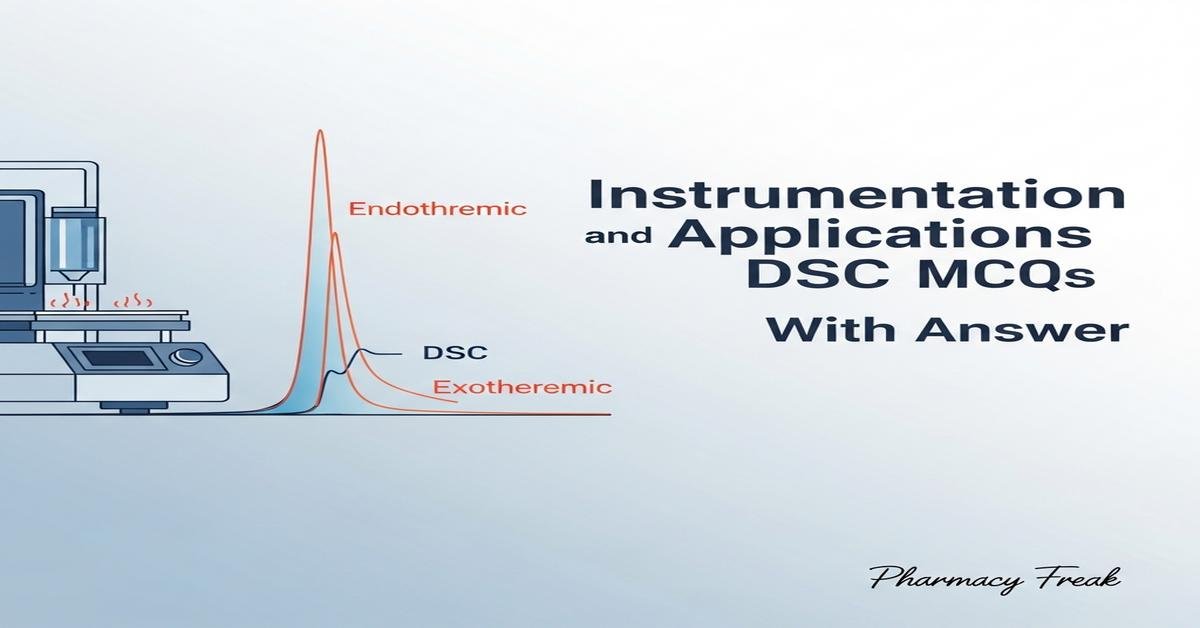
Instrumentation and applications of DSC MCQs With Answer

Introduction: Differential Scanning Calorimetry (DSC) is a core thermal analysis technique for B. Pharm students, covering instrumentation, heat flow measurement, and pharmaceutical applications such as polymorphism, stability, compatibility, and purity analysis. This introduction outlines DSC principles (heat flux vs. power-compensated designs), key components (furnace, sensors, reference, sealed pans), experimental variables (heating rate, atmosphere, sample mass), … Read more
Principles of Differential Scanning Calorimetry (DSC) MCQs With Answer

Principles of Differential Scanning Calorimetry (DSC) MCQs With Answer

Principles of Differential Scanning Calorimetry (DSC) MCQs With Answer — Differential Scanning Calorimetry (DSC) is a core thermal analysis technique in pharmaceutical analysis, allowing measurement of heat flow associated with physical and chemical transitions in drugs and excipients. This introduction covers DSC principles, instrumentation, heat flux vs power-compensated systems, thermogram interpretation, glass transition, melting, crystallization, … Read more

Instrumentation and applications of DTA MCQs With Answer

Instrumentation and applications of DTA MCQs With Answer

Introduction: Differential Thermal Analysis (DTA) is a key thermal analysis technique widely used in pharmaceutical research to study phase transitions, polymorphism, stability, compatibility, and excipient behavior. Instrumentation and applications of DTA combine precise components—furnace, sample/reference holders, thermocouples, atmosphere control, and data acquisition—to record temperature differences during controlled heating or cooling. For B.Pharm students, mastering DTA … Read more

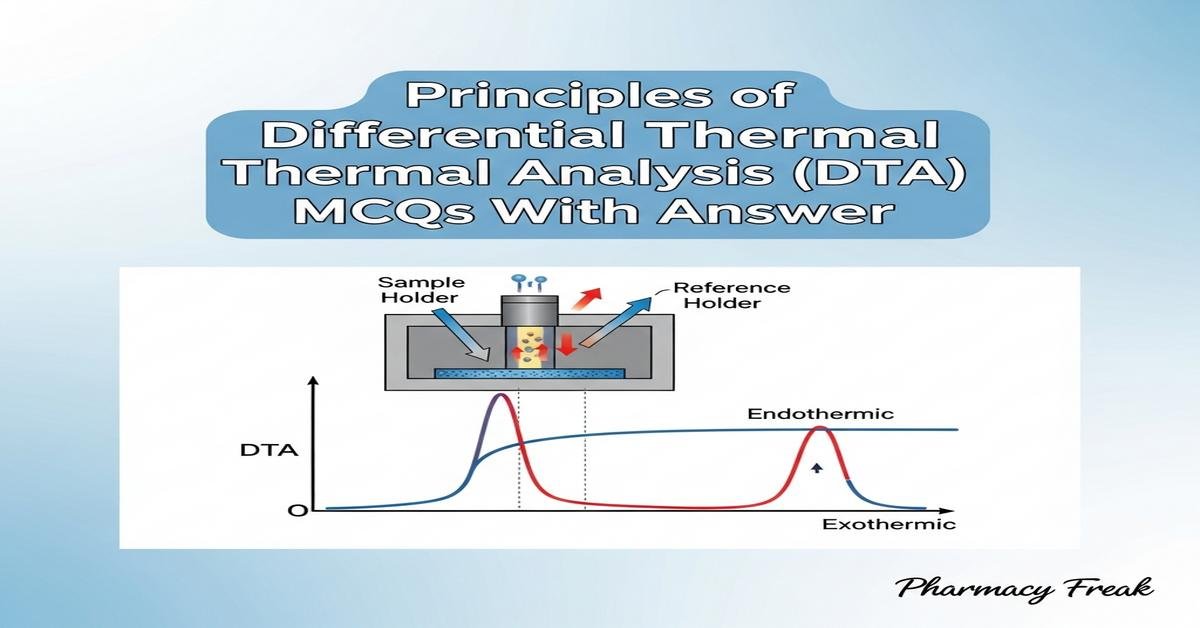
Principles of Differential Thermal Analysis (DTA) MCQs With Answer

Principles of Differential Thermal Analysis (DTA) MCQs With Answer

Principles of Differential Thermal Analysis (DTA) MCQs With Answer is a focused review for B. Pharm students covering core concepts of thermal analysis. DTA measures the temperature difference between a sample and an inert reference during controlled heating, producing thermograms that reveal phase transitions, melting points, polymorphism, and decomposition. Key principles include heat flow, enthalpy … Read more

Instrumentation and applications of TGA MCQs With Answer

Instrumentation and applications of TGA MCQs With Answer

Thermogravimetric analysis (TGA) is a key thermal technique that measures mass changes of pharmaceutical materials as a function of temperature or time. For B. Pharm students, understanding TGA instrumentation—furnace, microbalance, crucible, thermocouple, purge gas and software—and operational parameters like heating rate, atmosphere, sample mass and calibration is essential. TGA helps assess thermal stability, moisture/volatile loss, … Read more

Principles of Thermal Gravimetric Analysis (TGA) MCQs With Answer

Principles of Thermal Gravimetric Analysis (TGA) MCQs With Answer

Principles of Thermal Gravimetric Analysis (TGA) MCQs With Answer — Thermal Gravimetric Analysis (TGA) is a core thermal technique in pharmaceutical analysis that measures mass change of a sample as a function of temperature or time under controlled atmosphere. This introduction covers the principles of TGA—mass loss, decomposition, evaporation, and residual ash—instrument components (balance, furnace, … Read more

New Drug Approvals 2025: The Top 5 Revolutionary Drugs Approved by CDSCO This Year and Why They Are Game-Changers.

New Drug Approvals 2025: The Top 5 Revolutionary Drugs Approved by CDSCO This Year and Why They Are Game-Changers.

India’s drug regulator, the CDSCO, has been clearing a slate of high-impact therapies in 2025. What counts as “revolutionary” is not just a clever mechanism. It’s a therapy that changes outcomes in a big, practical way for Indian patients—by curing or slowing serious disease, reducing hospital load, or enabling care at scale. Below, I explain … Read more

Instrumentation and applications of mass spectrometry MCQs With Answer

Instrumentation and applications of mass spectrometry MCQs With Answer

Introduction: Mass spectrometry is a core analytical tool in pharmaceutical sciences, combining ionization techniques, mass analyzers and detectors to identify and quantify drugs, metabolites and biomolecules. This introduction covers instrumentation and applications relevant to B. Pharm students: ion sources (EI, ESI, MALDI, APCI), mass analyzers (quadrupole, TOF, Orbitrap, ion trap, FT‑ICR), tandem MS for structural … Read more

Mass analyzers – Time-of-Flight and Quadrupole MCQs With Answer

Mass analyzers – Time-of-Flight and Quadrupole MCQs With Answer

Introduction: Mass analyzers are central to mass spectrometry in pharmaceutical analysis. Time-of-Flight (TOF) and Quadrupole analyzers offer complementary strengths for B. Pharm students: TOF provides high resolution, wide mass range, and rapid acquisition using pulsed ion beams and flight-time measurement, while Quadrupole analyzers use oscillating RF/DC fields to filter ions by mass-to-charge ratio (m/z) with … Read more

Ionization techniques – MALDI and FAB MCQs With Answer

Ionization techniques – MALDI and FAB MCQs With Answer

Ionization techniques – MALDI and FAB MCQs With Answer Understanding ionization techniques like matrix-assisted laser desorption/ionization (MALDI) and fast atom bombardment (FAB) is essential for B. Pharm students working with mass spectrometry of drugs, peptides, polymers and biomolecules. This introduction explains principles, sample preparation, matrices, ion formation (proton transfer, cationization), instrumentation (MALDI-TOF), common matrices (DHB, … Read more

PRO
Ad-Free Access
$3.99 / month
  • ✓ No Interruptions
  • ✓ Faster Page Loads
  • ✓ Support Content Creators