
Trusted by 50K+ Pharmacy StudentsHigh Quality Notes, MCQs, Mock Tests & Study ResourcesGo Premium (Ads Free)
Pharmacy Freak

Principle and procedure of Solid Phase Extraction MCQs With Answer
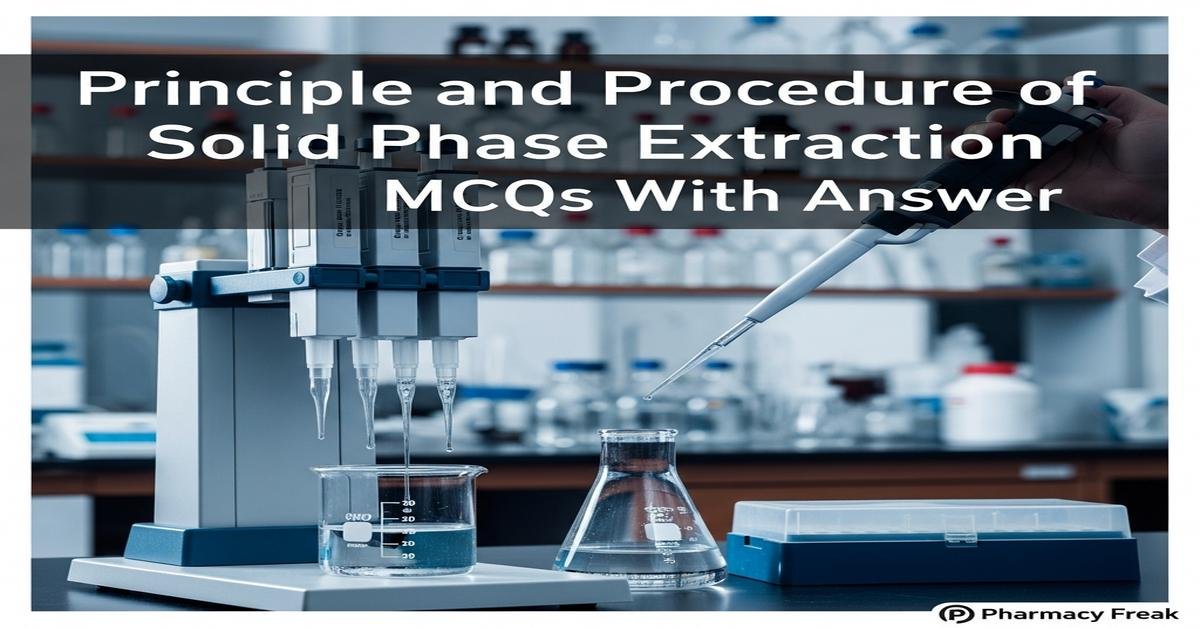
Principle and procedure of Solid Phase Extraction MCQs With Answer

Introduction: Solid Phase Extraction (SPE) is a powerful sample-preparation technique widely used in pharmaceutical analysis to isolate, concentrate, and purify analytes from complex matrices. This introduction covers the principle — selective adsorption and desorption on sorbents (C18, HLB, ion-exchange, mixed-mode) — and the stepwise procedure: conditioning, sample loading, washing, drying, and elution. Key factors such … Read more


Methods, limitations, and applications of Radio-Immunoassay MCQs With Answer

Methods, limitations, and applications of Radio-Immunoassay MCQs With Answer

Introduction Radioimmunoassay (RIA) is a highly sensitive immunoanalytical technique used in B.Pharm to quantify hormones, drugs and biomarkers by competitive binding between a radiolabelled tracer and unlabeled analyte for a limited antibody. Key methods include competitive and solid‑phase separation, using radiolabels such as iodine‑125 and gamma counting to measure counts per minute (CPM). Important concepts … Read more

Pseudoephedrine (Sudafed) Logs: The Combat Methamphetamine Epidemic Act (CMEA) Explained, Your Legal Duty in Tracking Sales

Pseudoephedrine (Sudafed) Logs: The Combat Methamphetamine Epidemic Act (CMEA) Explained, Your Legal Duty in Tracking Sales

Pseudoephedrine (PSE) products like Sudafed relieve congestion, but they are also a key ingredient used to make methamphetamine. That dual use is why Congress passed the Combat Methamphetamine Epidemic Act (CMEA). If you sell PSE at a pharmacy, grocery, or convenience store, you have a legal duty to track sales and verify buyers. This article … Read more

Principles and components of Radio-Immunoassay (RIA) MCQs With Answer

Principles and components of Radio-Immunoassay (RIA) MCQs With Answer

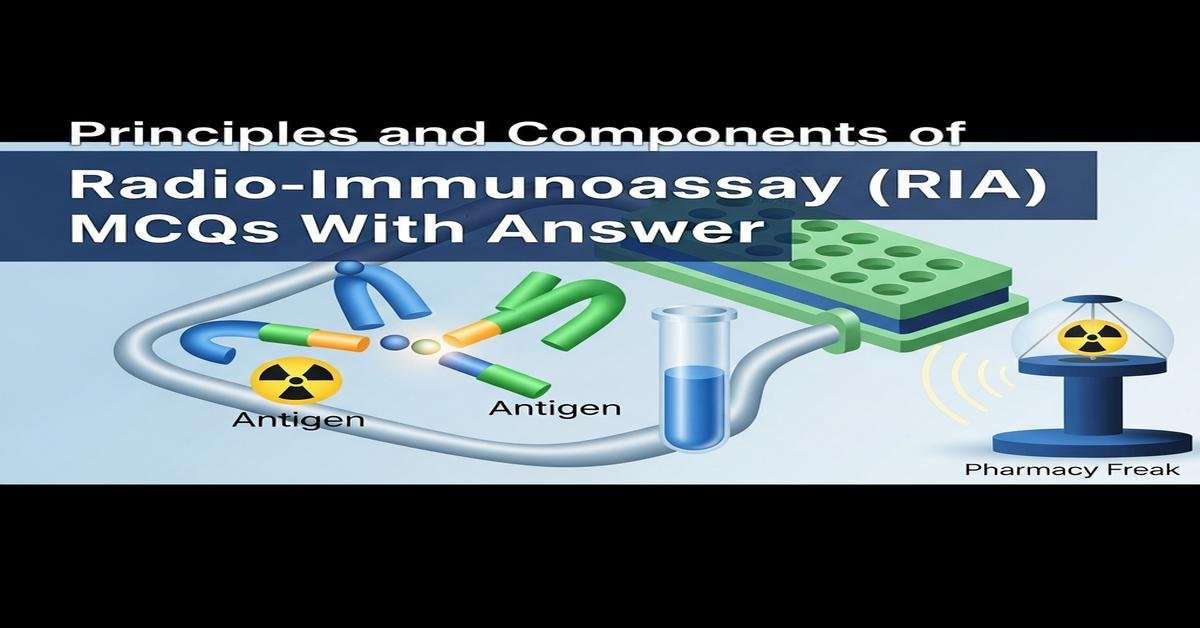
Radio-Immunoassay (RIA) is a highly sensitive analytical method that quantifies trace amounts of hormones, drugs, and biomolecules by competitive binding between radiolabeled tracers and unlabeled analytes for a specific antibody. Principles and components of RIA include antigen–antibody interactions, radiolabeled tracer, separation techniques, detectors, standard curves, and quality control. B. Pharm students should understand radioisotopes (e.g., … Read more

Calibration of Gas Chromatograph (GC) MCQs With Answer

Calibration of Gas Chromatograph (GC) MCQs With Answer

Calibration of Gas Chromatograph (GC) is a critical skill for B. Pharm students involved in pharmaceutical analysis. This introduction covers key concepts like GC calibration, calibration curve, response factor, internal and external standards, linearity, LOD, LOQ, and system suitability. Proper calibration ensures accurate, precise, and traceable quantitative results by relating detector response to known concentrations, … Read more

Calibration of HPLC MCQs With Answer

Calibration of HPLC MCQs With Answer

Calibration of HPLC is essential for reliable quantitative analysis in pharmaceutical laboratories. This introduction covers HPLC calibration, calibration curves, system suitability, linearity, accuracy, precision, sensitivity, limit of detection (LOD) and limit of quantification (LOQ), retention time, resolution, and detector response. B.Pharm students will learn practical steps for standard preparation, instrument performance checks, use of internal … Read more

Calibration of Flame Photometer MCQs With Answer

Calibration of Flame Photometer MCQs With Answer

Calibration of Flame Photometer is a critical skill for B. Pharm students learning quantitative analysis of alkali and alkaline earth metals. This introduction covers principles of instrument calibration, preparation of standard solutions, construction of calibration curves, linear range, sensitivity, limit of detection, matrix effects, standard addition, and routine quality checks. Understanding drift, interference, correct burner … Read more

Calibration of Fluorimeter MCQs With Answer

Calibration of Fluorimeter MCQs With Answer

Calibration of Fluorimeter MCQs With Answer Calibration of fluorimeter instruments is essential for reliable fluorescence intensity measurements in pharmaceutical analysis. This introduction covers key concepts such as fluorimeter calibration, fluorescence intensity, quantum yield standards, spectral correction, instrument response, sensitivity, linear range, blank correction, and sources of error. B. Pharm students will learn practical steps: selecting … Read more

Schedule H1 Drugs: Why You Can’t Sell These Drugs Without a Prescription, The Legal Consequences Can Land You in Jail.

Schedule H1 Drugs: Why You Can't Sell These Drugs Without a Prescription, The Legal Consequences Can Land You in Jail.

“Schedule H1” is a special list of prescription-only medicines under India’s Drugs and Cosmetics Rules, 1945. These drugs include powerful antibiotics, anti‑tuberculosis medicines, and certain sedatives. They can save lives when used correctly, but they also carry real risks: drug‑resistant infections, treatment failure, and dependence. That is why the law is strict. Selling a Schedule … Read more

Calibration of IR spectrophotometer MCQs With Answer

Calibration of IR spectrophotometer MCQs With Answer

Calibration of IR spectrophotometer MCQs With Answer Calibration of IR spectrophotometer is essential for reliable qualitative and quantitative analysis in pharmaceutical practice. This introduction covers key concepts such as wavelength accuracy, photometric accuracy, resolution, stray light, baseline stability, use of reference standards (e.g., polystyrene film), instrument qualification (IQ/OQ/PQ), validation, and routine performance verification. B.Pharm students … Read more

PRO
Ad-Free Access
$3.99 / month
  • ✓ No Interruptions
  • ✓ Faster Page Loads
  • ✓ Support Content Creators