Table of Contents
Introduction
Ribavirin is a broad-spectrum antiviral drug used in combination therapy for chronic hepatitis C infection and in certain viral respiratory infections such as respiratory syncytial virus (RSV). It is a synthetic guanosine analog that interferes with viral RNA synthesis and replication through multiple mechanisms.
Mechanism of Action (Step-wise)
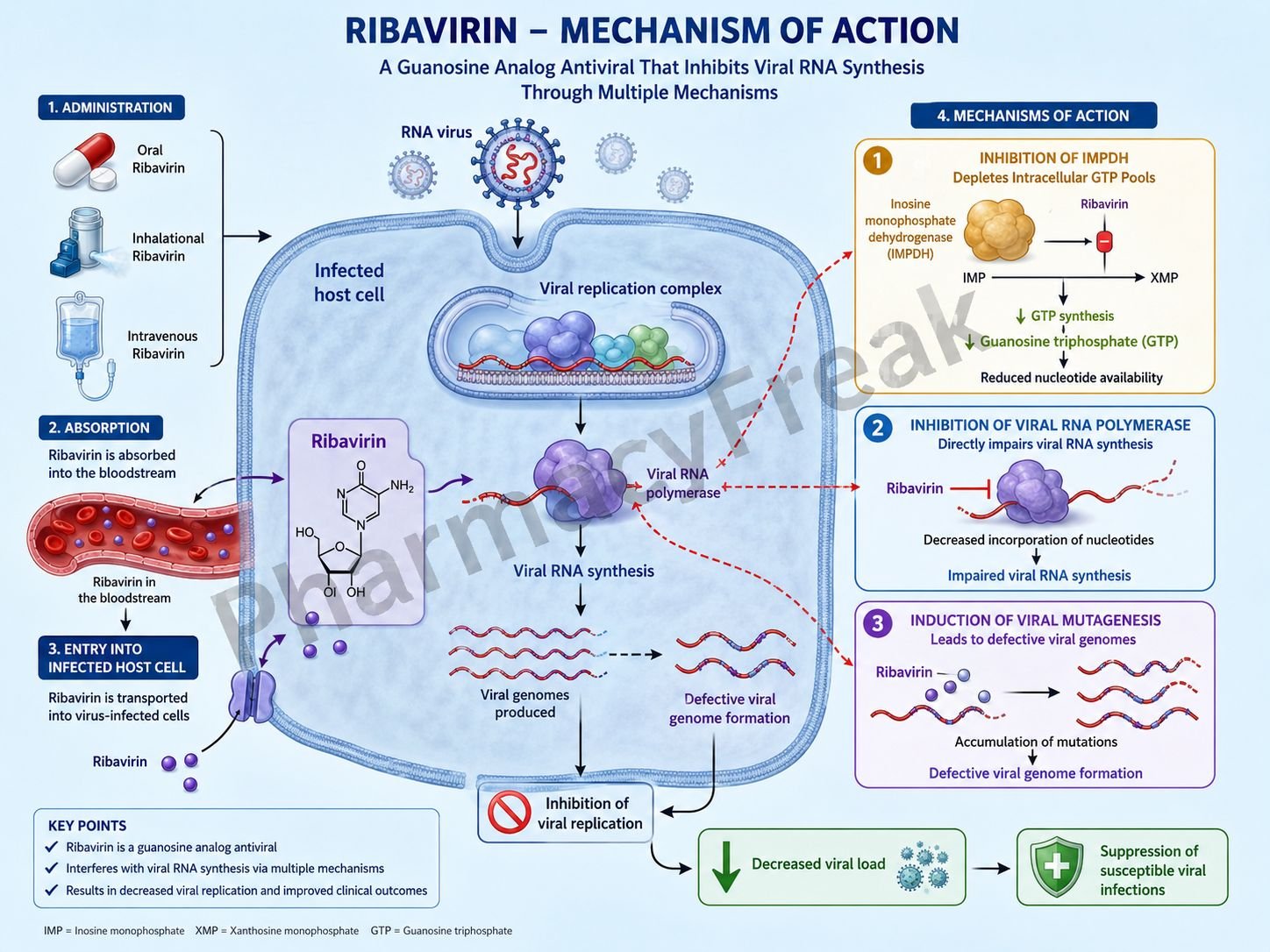
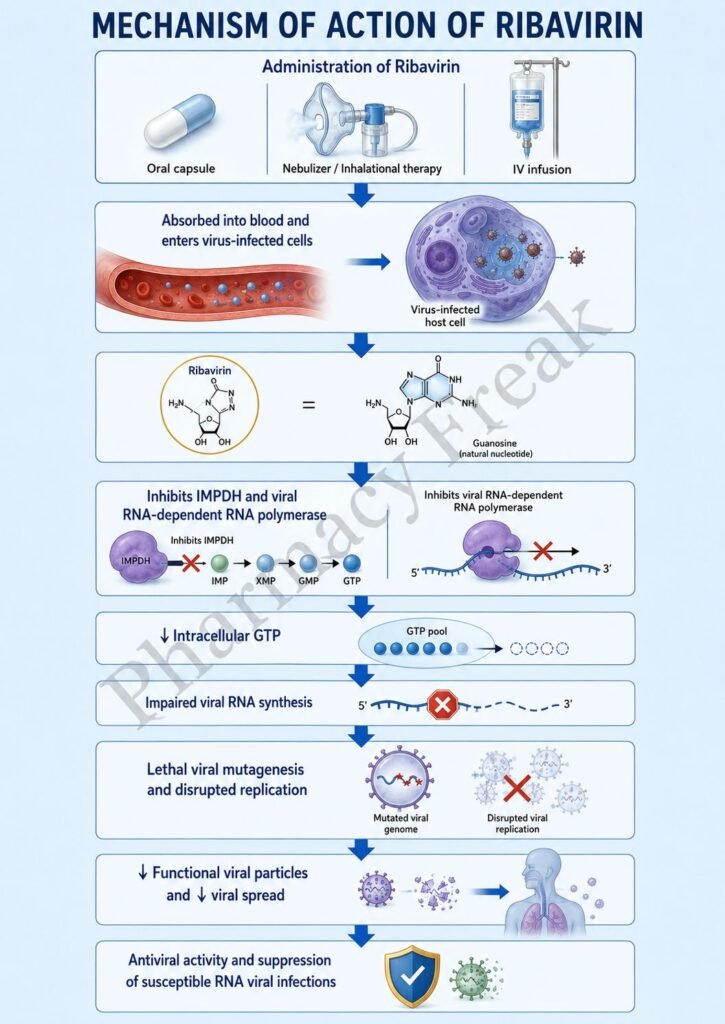
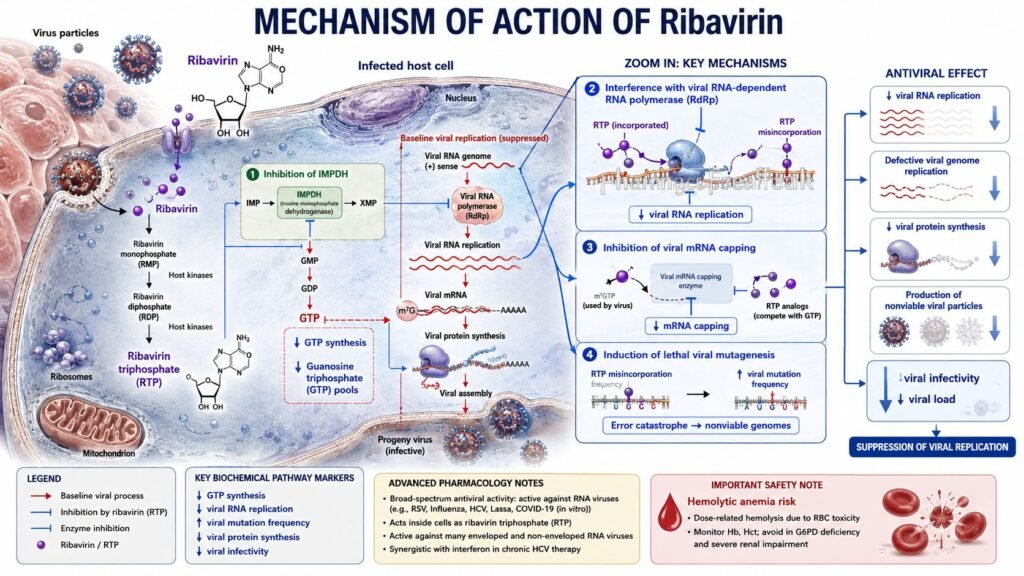
- Ribavirin enters virus-infected cells and undergoes intracellular phosphorylation.
- It is converted into active mono-, di-, and triphosphate metabolites.
- Ribavirin triphosphate acts as a guanosine nucleotide analog.
- It inhibits viral RNA-dependent RNA polymerase.
- Inhibition of viral polymerase interferes with viral RNA synthesis.
- Ribavirin also inhibits inosine monophosphate dehydrogenase (IMPDH).
- IMPDH inhibition decreases intracellular guanosine triphosphate (GTP) synthesis.
- Reduced GTP levels impair viral nucleic acid production.
- Ribavirin may also induce lethal mutagenesis in viral genomes.
- Excess mutations reduce production of viable viral particles.
- In some viruses, ribavirin interferes with viral mRNA capping.
- The overall effect is suppression of viral replication and decreased viral load.
A key exam point is that ribavirin is a guanosine analog that inhibits viral RNA synthesis and depletes intracellular GTP.
Pharmacokinetics
Ribavirin may be administered orally, intravenously, or by inhalation depending on indication. It is widely distributed in tissues and accumulates in erythrocytes. The drug has a long half-life due to intracellular trapping. Ribavirin is eliminated mainly through the kidneys.
Clinical Uses
Ribavirin is used with other antiviral agents in chronic hepatitis C infection. Inhaled ribavirin may be used in severe RSV infection. It has also been used experimentally for certain viral hemorrhagic fevers.
Adverse Effects
The most important adverse effect is hemolytic anemia due to accumulation in red blood cells. Other adverse effects include fatigue, cough, rash, and teratogenicity. Ribavirin is contraindicated during pregnancy because of risk of fetal harm.
Comparative Analysis
| Feature | Ribavirin | Acyclovir | Oseltamivir |
|---|---|---|---|
| Drug type | Guanosine analog | Guanosine analog | Neuraminidase inhibitor |
| Main target | Viral RNA synthesis | Viral DNA polymerase | Viral neuraminidase |
| Spectrum | Broad RNA viruses | Herpes viruses | Influenza virus |
| Main use | Hepatitis C, RSV | HSV, VZV | Influenza |
| Hemolytic anemia risk | High | Rare | Rare |
| Pregnancy risk | Significant | Lower | Moderate |
Ribavirin differs from acyclovir because it targets RNA viruses rather than DNA viruses. Compared with oseltamivir, ribavirin acts on viral RNA synthesis instead of viral release.
MCQs
- Ribavirin is classified as a:
a) Protease inhibitor
b) Guanosine analog
c) Neuraminidase inhibitor
d) β-lactam antibiotic
Answer: b) Guanosine analog
- Ribavirin mainly inhibits:
a) Viral RNA synthesis
b) Cell wall synthesis
c) Protein translation only
d) Histamine release
Answer: a) Viral RNA synthesis
- Ribavirin inhibits which viral enzyme?
a) DNA gyrase
b) RNA-dependent RNA polymerase
c) Reverse transcriptase only
d) Integrase
Answer: b) RNA-dependent RNA polymerase
- Ribavirin also inhibits:
a) Cyclooxygenase
b) IMP dehydrogenase
c) Acetylcholinesterase
d) Carbonic anhydrase
Answer: b) IMP dehydrogenase
- Inhibition of IMPDH decreases synthesis of:
a) ATP
b) GTP
c) cAMP
d) Histamine
Answer: b) GTP
- Ribavirin is commonly used in combination therapy for:
a) HIV
b) Hepatitis C
c) Tuberculosis
d) Malaria
Answer: b) Hepatitis C
- Ribavirin may cause lethal:
a) Vasoconstriction
b) Mutagenesis in viral genomes
c) Calcium loss
d) Histamine release
Answer: b) Mutagenesis in viral genomes
- A major adverse effect is:
a) Hemolytic anemia
b) Hypercalcemia
c) Bradycardia
d) Severe hypertension
Answer: a) Hemolytic anemia
- Ribavirin is contraindicated in:
a) Hypertension
b) Pregnancy
c) Migraine
d) Asthma
Answer: b) Pregnancy
- Ribavirin accumulates significantly in:
a) Hepatocytes only
b) Red blood cells
c) Bone tissue
d) Skeletal muscle only
Answer: b) Red blood cells
- Ribavirin has activity mainly against:
a) RNA viruses
b) Gram-positive bacteria
c) Fungi
d) Protozoa
Answer: a) RNA viruses
- Compared with acyclovir, ribavirin primarily targets:
a) DNA viruses only
b) RNA viruses
c) Bacterial enzymes
d) Host ribosomes only
Answer: b) RNA viruses
FAQs
What is the mechanism of action of ribavirin?
Ribavirin inhibits viral RNA synthesis and depletes intracellular GTP levels.
Why is ribavirin called a guanosine analog?
Because it structurally resembles guanosine nucleotides.
What is the major adverse effect of ribavirin?
Hemolytic anemia.
Why is ribavirin contraindicated in pregnancy?
Because it is teratogenic and can harm the fetus.
What infections is ribavirin commonly used for?
Chronic hepatitis C and severe RSV infection.
How does ribavirin reduce viral replication?
By interfering with RNA polymerase activity and inducing viral mutagenesis.
References
Goodman & Gilman’s The Pharmacological Basis of Therapeutics – Antiviral Agents
https://accessmedicine.mhmedical.com/book.aspx?bookid=3191
Katzung: Basic and Clinical Pharmacology – Antiviral Drugs
https://accessmedicine.mhmedical.com/content.aspx?bookid=3382
Tripathi: Essentials of Medical Pharmacology – Antiviral Drugs
https://www.jaypeedigital.com
Harrison’s Principles of Internal Medicine – Viral Hepatitis and Respiratory Viral Infections
https://accessmedicine.mhmedical.com