Table of Contents
Introduction
Propofol is a rapidly acting intravenous anesthetic agent widely used for induction and maintenance of general anesthesia as well as procedural sedation. It produces hypnosis and sedation through potentiation of inhibitory neurotransmission in the central nervous system. Due to its rapid onset and short duration of action, propofol is commonly used in operating rooms and intensive care settings.
Mechanism of Action (Step-wise)
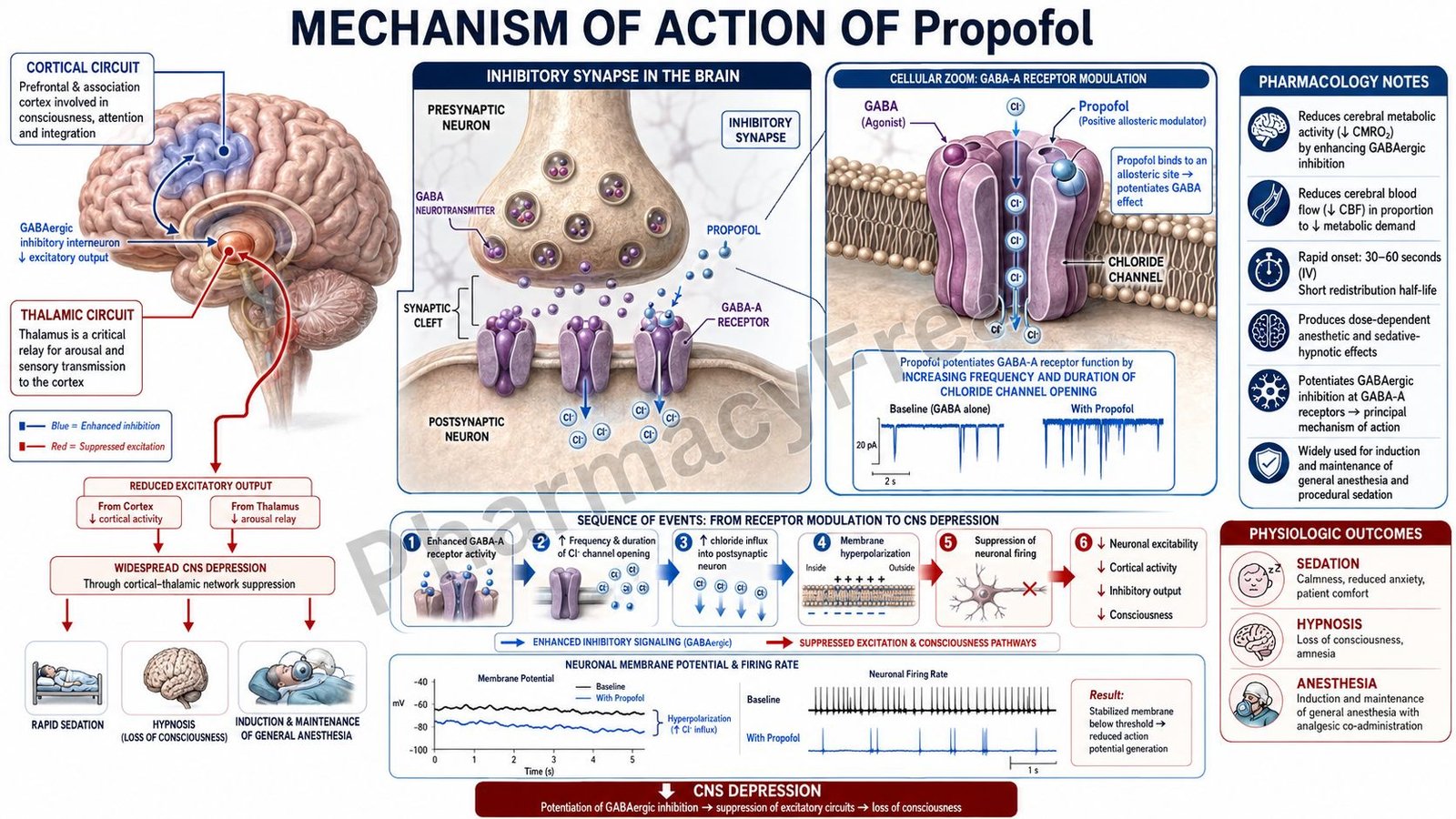
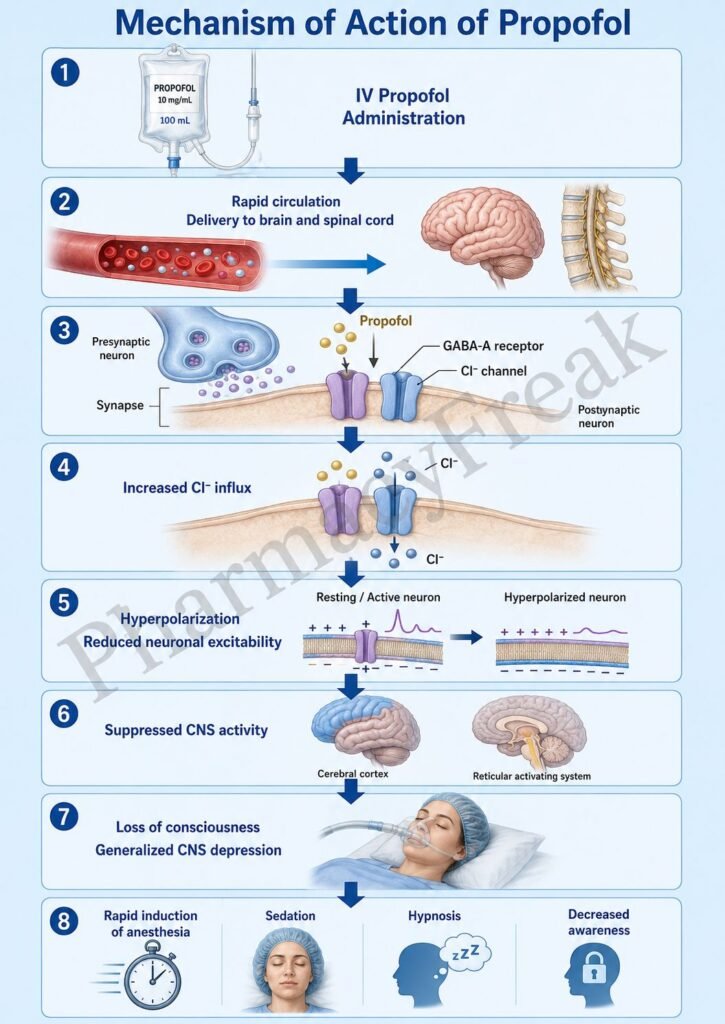
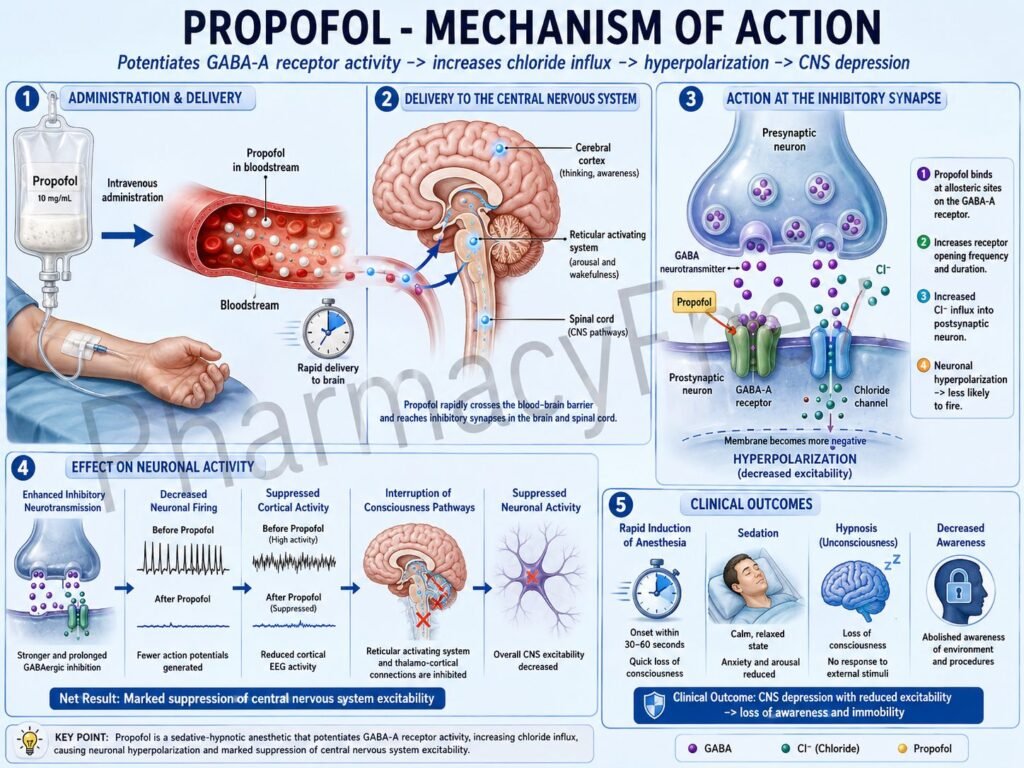
- Propofol acts primarily on the GABA-A receptor complex in the central nervous system.
- GABA-A receptors are ligand-gated chloride ion channels.
- Propofol enhances the inhibitory effect of gamma-aminobutyric acid (GABA).
- It increases chloride ion influx into neurons.
- Increased chloride influx causes neuronal hyperpolarization.
- Hyperpolarized neurons become less excitable.
- Propofol suppresses synaptic transmission in the brain.
- This leads to sedation, hypnosis, and loss of consciousness.
- Propofol also decreases cerebral metabolic activity and cerebral blood flow.
- At higher concentrations, it may directly activate GABA-A receptors.
- The overall effect is rapid CNS depression and anesthesia induction.
A key exam point is that propofol enhances GABA-A receptor-mediated chloride influx causing neuronal hyperpolarization.
Pharmacokinetics
Propofol is administered intravenously because it is highly lipid soluble and unsuitable for oral use. It has rapid onset due to quick penetration into the brain. Redistribution from the CNS to peripheral tissues leads to short duration of action. Propofol is extensively metabolized in the liver and excreted mainly via the kidneys.
Clinical Uses
Propofol is used for induction and maintenance of general anesthesia, procedural sedation, and sedation in mechanically ventilated ICU patients. It is preferred for short procedures because of rapid recovery and reduced postoperative nausea.
Adverse Effects
Common adverse effects include hypotension, respiratory depression, apnea, and pain at the injection site. Prolonged high-dose infusion may rarely cause propofol infusion syndrome, characterized by metabolic acidosis, rhabdomyolysis, and cardiovascular collapse.
Comparative Analysis
| Feature | Propofol | Ketamine | Thiopental |
|---|---|---|---|
| Main mechanism | GABA-A potentiation | NMDA receptor blockade | GABA-A potentiation |
| Route | IV | IV/IM | IV |
| Onset | Rapid | Rapid | Rapid |
| Recovery | Rapid | Moderate | Slower |
| Blood pressure effect | Decreases BP | Increases BP | Decreases BP |
| Hallucinations | Rare | Common | Rare |
Propofol differs from ketamine because it produces CNS depression through GABA-A receptor potentiation rather than NMDA receptor blockade. Compared to thiopental, propofol provides faster recovery and less postoperative nausea.
MCQs
- Propofol primarily acts on which receptor?
a) NMDA receptor
b) GABA-A receptor
c) Dopamine receptor
d) Histamine receptor
Answer: b) GABA-A receptor
- GABA-A receptors are:
a) GPCRs
b) Ligand-gated chloride channels
c) Enzymes
d) Sodium transporters
Answer: b) Ligand-gated chloride channels
- Propofol increases influx of:
a) Sodium
b) Calcium
c) Chloride
d) Potassium
Answer: c) Chloride
- Increased chloride influx causes:
a) Depolarization
b) Hyperpolarization
c) Tachycardia
d) Calcium release
Answer: b) Hyperpolarization
- Propofol is mainly used for:
a) Hypertension
b) Anesthesia induction
c) Diabetes
d) Epilepsy
Answer: b) Anesthesia induction
- Propofol is administered by which route?
a) Oral
b) Intravenous
c) Intramuscular only
d) Sublingual
Answer: b) Intravenous
- A common adverse effect is:
a) Hypertension
b) Respiratory depression
c) Hyperglycemia
d) Bradykinesia
Answer: b) Respiratory depression
- Propofol decreases:
a) Cerebral metabolic activity
b) Blood glucose
c) Sodium excretion
d) Platelet aggregation
Answer: a) Cerebral metabolic activity
- Propofol has a short duration because of:
a) Renal excretion only
b) Redistribution from CNS
c) Protein binding only
d) Slow metabolism
Answer: b) Redistribution from CNS
- Propofol infusion syndrome may include:
a) Hypercalcemia
b) Metabolic acidosis
c) Hypoglycemia
d) Hyperthyroidism
Answer: b) Metabolic acidosis
- Compared to ketamine, propofol usually:
a) Raises blood pressure
b) Lowers blood pressure
c) Causes hallucinations commonly
d) Blocks NMDA receptors
Answer: b) Lowers blood pressure
- Propofol recovery is generally:
a) Very slow
b) Rapid
c) Delayed for days
d) Unpredictable only
Answer: b) Rapid
FAQs
What is the mechanism of action of propofol?
Propofol enhances GABA-A receptor-mediated chloride influx causing neuronal hyperpolarization and CNS depression.
Why does propofol act rapidly?
Because it is highly lipid soluble and rapidly enters the brain.
What is a major adverse effect of propofol?
Respiratory depression and hypotension.
Why is recovery from propofol rapid?
Due to rapid redistribution away from the CNS.
What is propofol infusion syndrome?
A rare but severe complication involving metabolic acidosis and cardiovascular collapse.
Does propofol reduce cerebral metabolism?
Yes, it decreases cerebral metabolic activity and cerebral blood flow.
References
Goodman & Gilman’s The Pharmacological Basis of Therapeutics – General Anesthetics
https://accessmedicine.mhmedical.com/book.aspx?bookid=3191
Katzung: Basic and Clinical Pharmacology – Intravenous Anesthetics
https://accessmedicine.mhmedical.com/content.aspx?bookid=3382
Tripathi: Essentials of Medical Pharmacology – General Anesthetics
https://www.jaypeedigital.com
Harrison’s Principles of Internal Medicine – Anesthesia and Sedation
https://accessmedicine.mhmedical.com