Table of Contents
Introduction
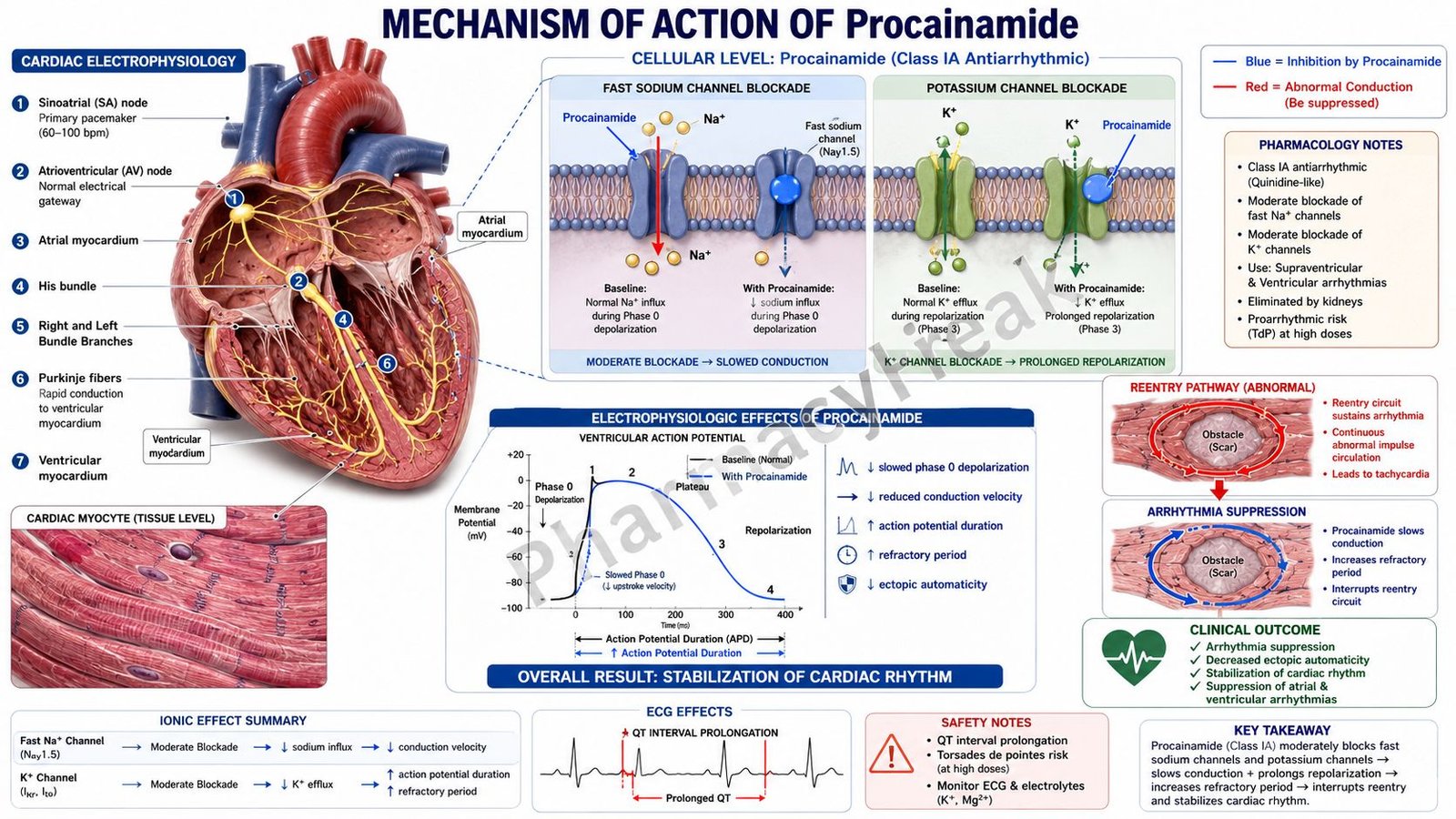
Procainamide is a class IA antiarrhythmic drug used in the management of atrial and ventricular arrhythmias. It works by blocking sodium channels in cardiac tissue, thereby slowing impulse conduction and prolonging repolarization. Procainamide is particularly useful in ventricular tachycardia and certain supraventricular arrhythmias, including arrhythmias associated with Wolff-Parkinson-White syndrome.
Mechanism of Action (Step-wise)
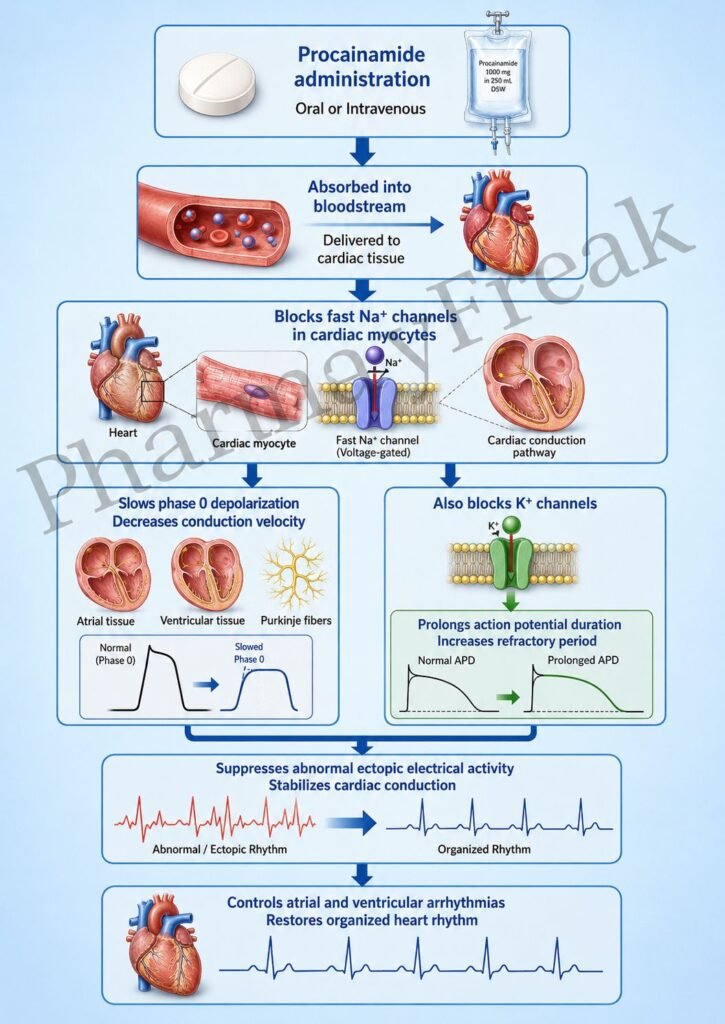
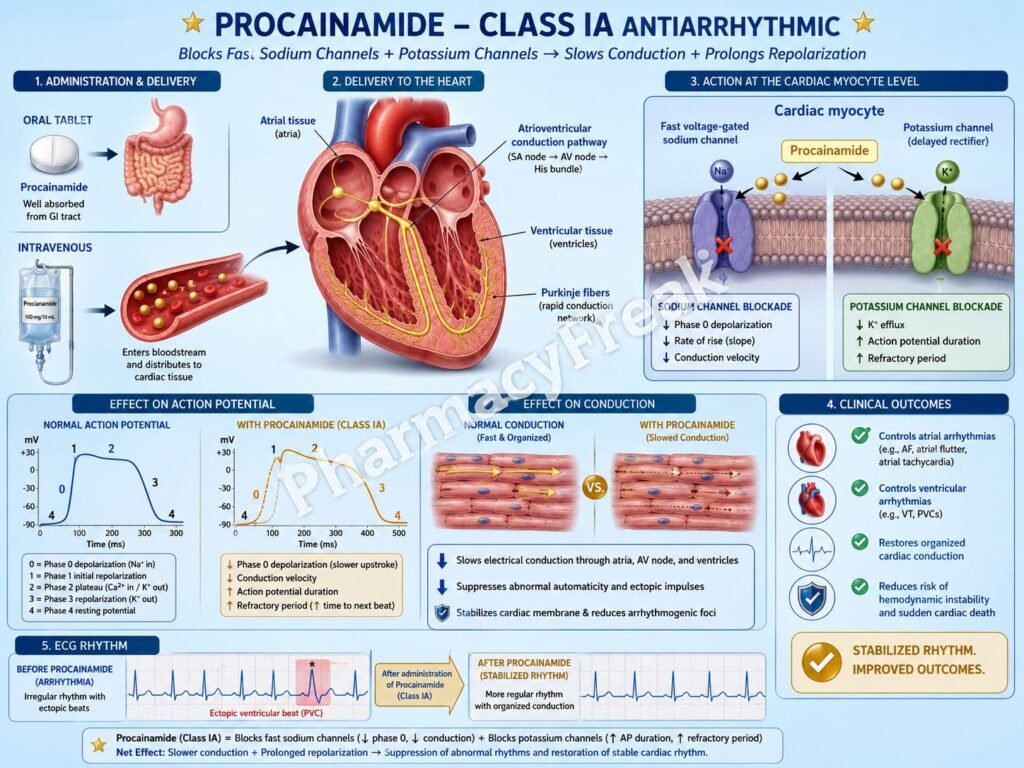
- Procainamide blocks fast voltage-gated sodium (Na⁺) channels in cardiac myocytes.
- Sodium channel blockade reduces the rate of phase 0 depolarization in the cardiac action potential.
- Slower depolarization decreases conduction velocity through atrial and ventricular myocardium.
- Procainamide also prolongs the effective refractory period.
- It inhibits potassium channel-mediated repolarization to some extent.
- Prolonged repolarization increases action potential duration.
- This reduces the ability of abnormal impulses to propagate.
- Suppression of ectopic pacemaker activity helps stabilize cardiac rhythm.
- Procainamide decreases automaticity in abnormal cardiac tissues.
- The overall effect is prevention and termination of reentrant and ectopic arrhythmias.
A key exam point is that procainamide is a class IA antiarrhythmic that blocks sodium channels and prolongs action potential duration.
Pharmacokinetics
Procainamide may be administered orally or intravenously. It is metabolized in the liver to N-acetylprocainamide (NAPA), an active metabolite with class III antiarrhythmic properties. Both procainamide and NAPA are excreted mainly via the kidneys. Dose adjustment may be required in renal impairment.
Clinical Uses
Procainamide is used in ventricular tachycardia, atrial arrhythmias, and arrhythmias associated with Wolff-Parkinson-White syndrome. Intravenous procainamide is commonly used in acute arrhythmia management.
Adverse Effects
Common adverse effects include hypotension, dizziness, and gastrointestinal upset. A major long-term adverse effect is drug-induced lupus erythematosus. Procainamide may also prolong the QT interval, increasing the risk of torsades de pointes.
Comparative Analysis
| Feature | Procainamide | Lidocaine | Quinidine |
|---|---|---|---|
| Antiarrhythmic class | IA | IB | IA |
| Main effect | Na⁺ channel blockade + ↑ AP duration | Na⁺ channel blockade | Na⁺ channel blockade + ↑ AP duration |
| QT prolongation | Yes | Minimal | Significant |
| Main use | Atrial and ventricular arrhythmias | Ventricular arrhythmias | Atrial and ventricular arrhythmias |
| Lupus risk | Yes | No | Rare |
| Active metabolite | NAPA | No | No |
Procainamide differs from lidocaine because it prolongs action potential duration and QT interval. Compared to quinidine, it has a higher association with drug-induced lupus.
MCQs
- Procainamide belongs to which antiarrhythmic class?
a) Class IIB
b) Class IA
c) Class III
d) Class IV
Answer: b) Class IA
- Procainamide primarily blocks:
a) Calcium channels
b) Sodium channels
c) Potassium channels only
d) β receptors
Answer: b) Sodium channels
- Procainamide slows which phase of cardiac action potential?
a) Phase 0
b) Phase 1
c) Phase 2
d) Phase 4
Answer: a) Phase 0
- Procainamide prolongs:
a) Action potential duration
b) Blood glucose
c) Sodium excretion
d) Calcium storage
Answer: a) Action potential duration
- Procainamide increases risk of:
a) Hypoglycemia
b) Torsades de pointes
c) Hypercalcemia
d) Bradykinesia
Answer: b) Torsades de pointes
- Procainamide is used in:
a) Asthma
b) Cardiac arrhythmias
c) Diabetes mellitus
d) Hyperthyroidism
Answer: b) Cardiac arrhythmias
- Procainamide may cause:
a) Drug-induced lupus
b) Hyperactivity
c) Hypocalcemia
d) Mydriasis
Answer: a) Drug-induced lupus
- Procainamide is metabolized into:
a) NAPA
b) Acetylcholine
c) Digoxin
d) Dopamine
Answer: a) NAPA
- Procainamide reduces:
a) Cardiac conduction velocity
b) Calcium absorption
c) Sodium excretion
d) Blood glucose
Answer: a) Cardiac conduction velocity
- Compared with lidocaine, procainamide:
a) Shortens QT interval
b) Prolongs QT interval
c) Has no sodium channel effect
d) Blocks β receptors only
Answer: b) Prolongs QT interval
- Procainamide and NAPA are excreted mainly by the:
a) Liver
b) Kidney
c) Lung
d) Skin
Answer: b) Kidney
- Procainamide is especially useful in:
a) Wolff-Parkinson-White syndrome
b) Hyperthyroidism
c) Parkinson disease
d) Migraine
Answer: a) Wolff-Parkinson-White syndrome
FAQs
What is the mechanism of action of procainamide?
It blocks sodium channels and prolongs cardiac action potential duration.
Which antiarrhythmic class does procainamide belong to?
Class IA.
Why does procainamide prolong QT interval?
Because it delays repolarization.
What is a major adverse effect of long-term use?
Drug-induced lupus erythematosus.
What is NAPA?
An active metabolite of procainamide with antiarrhythmic activity.
What arrhythmias are commonly treated with procainamide?
Atrial arrhythmias, ventricular tachycardia, and WPW-associated arrhythmias.
References
Goodman & Gilman’s The Pharmacological Basis of Therapeutics – Antiarrhythmic Drugs
https://accessmedicine.mhmedical.com/book.aspx?bookid=3191
Katzung: Basic and Clinical Pharmacology – Antiarrhythmic Drugs
https://accessmedicine.mhmedical.com/content.aspx?bookid=3382
Tripathi: Essentials of Medical Pharmacology – Antiarrhythmic Drugs
https://www.jaypeedigital.com
Harrison’s Principles of Internal Medicine – Cardiac Arrhythmias
https://accessmedicine.mhmedical.com