
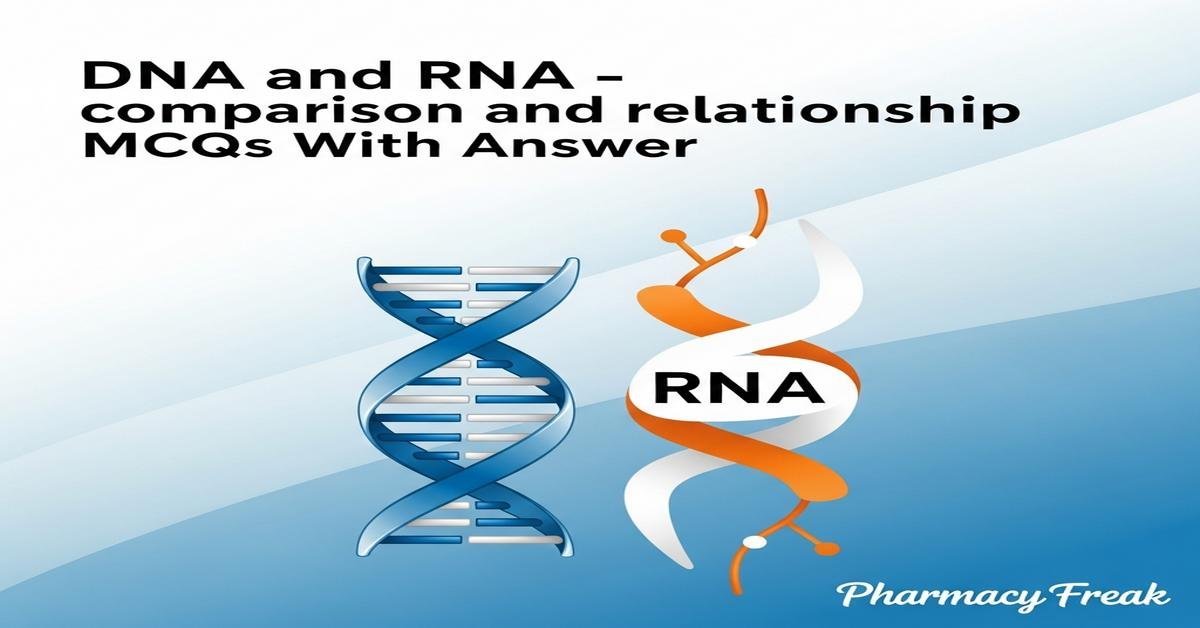
Understanding the comparison and relationship between DNA and RNA is essential for B. Pharm students as it underpins pharmacogenomics, drug design, and molecular diagnostics. This concise, focused study explores structural differences (sugar type, strandness, bases), functional roles (genetic storage vs information transfer), biosynthetic pathways (replication, transcription, translation), major RNA types (mRNA, tRNA, rRNA, miRNA), and biochemical properties affecting stability and drug targeting. Key concepts include base pairing, codons, reverse transcription, nucleic acid enzymes, and therapeutic implications such as antisense oligonucleotides and RNA vaccines. Targeted MCQs reinforce learning and application in pharmaceutical contexts. Now let’s test your knowledge with 30 MCQs on this topic.
Q1. Which sugar is present in RNA and distinguishes it from DNA?
- Deoxyribose
- Ribose
- Fructose
- Glucose
Correct Answer: Ribose
Q2. What base in RNA replaces thymine found in DNA?
- Adenine
- Uracil
- Cytosine
- Guanine
Correct Answer: Uracil
Q3. Which statement best describes the typical strand structure of DNA vs RNA?
- DNA is single-stranded; RNA is double-stranded
- Both DNA and RNA are always double-stranded
- DNA is typically double-stranded; RNA is typically single-stranded
- Both DNA and RNA are always single-stranded
Correct Answer: DNA is typically double-stranded; RNA is typically single-stranded
Q4. Chargaff’s rules state that in double-stranded DNA, the amount of adenine equals the amount of:
- Guanine
- Thymine
- Cytosine
- Uracil
Correct Answer: Thymine
Q5. How many hydrogen bonds form between guanine and cytosine?
- One
- Two
- Three
- Four
Correct Answer: Three
Q6. Which RNA type carries amino acids to the ribosome during translation?
- mRNA
- rRNA
- tRNA
- snRNA
Correct Answer: tRNA
Q7. The 5′ cap and 3′ poly-A tail of eukaryotic mRNA are important for:
- DNA replication fidelity
- mRNA stability and translation initiation
- tRNA charging
- Protein folding in ribosomes
Correct Answer: mRNA stability and translation initiation
Q8. Which enzyme synthesizes new DNA using an RNA primer during replication?
- RNA polymerase
- DNA ligase
- DNA polymerase
- Topoisomerase
Correct Answer: DNA polymerase
Q9. Okazaki fragments are a feature of which DNA replication process?
- Leading strand synthesis
- Lagging strand synthesis
- Transcription
- DNA repair via base excision
Correct Answer: Lagging strand synthesis
Q10. Which enzyme removes RNA primers and fills gaps with DNA in replication?
- Primase
- DNA ligase
- RNase H and DNA polymerase I (in prokaryotes)
- Helicase
Correct Answer: RNase H and DNA polymerase I (in prokaryotes)
Q11. Reverse transcriptase is an enzyme used by retroviruses to synthesize:
- DNA from RNA
- RNA from DNA
- Protein from RNA
- RNA from protein
Correct Answer: DNA from RNA
Q12. Which chemical difference contributes most to RNA being less chemically stable than DNA?
- Presence of thymine
- 2′-hydroxyl group on ribose
- Double-stranded helical structure
- Phosphate backbone
Correct Answer: 2′-hydroxyl group on ribose
Q13. The wobble hypothesis explains variability at which position of the codon?
- First base
- Second base
- Third base
- Fourth base (nonsense)
Correct Answer: Third base
Q14. Which form of DNA is the most common under physiological conditions and has distinct major and minor grooves?
- A-form
- B-form
- Z-form
- Triple helix
Correct Answer: B-form
Q15. Which of the following RNAs is primarily a structural and catalytic component of the ribosome?
- mRNA
- tRNA
- rRNA
- siRNA
Correct Answer: rRNA
Q16. Antisense oligonucleotide therapeutics act mainly by:
- Blocking ribosome assembly globally
- Binding complementary mRNA to alter splicing or block translation
- Intercalating into genomic DNA to cause mutations
- Inhibiting tRNA charging enzymes
Correct Answer: Binding complementary mRNA to alter splicing or block translation
Q17. Which factor increases DNA melting temperature (Tm)?
- Higher AT content
- Higher GC content
- Lower salt concentration
- Shorter DNA strands
Correct Answer: Higher GC content
Q18. In eukaryotic pre-mRNA processing, introns are removed by:
- Ribosomes
- Spliceosomes
- Topoisomerases
- RNA polymerase II proofreading
Correct Answer: Spliceosomes
Q19. MicroRNAs (miRNAs) regulate gene expression primarily by:
- Converting DNA to RNA
- Promoting mRNA translation
- Base-pairing with mRNA to inhibit translation or promote degradation
- Catalyzing peptide bond formation
Correct Answer: Base-pairing with mRNA to inhibit translation or promote degradation
Q20. A synonymous mutation in a coding sequence results in:
- A different amino acid
- A premature stop codon
- No change in the amino acid sequence
- Frameshift downstream
Correct Answer: No change in the amino acid sequence
Q21. Which enzyme relieves supercoiling ahead of a replication fork?
- Helicase
- Topoisomerase
- DNA polymerase
- Ligase
Correct Answer: Topoisomerase
Q22. The hyperchromic effect observed during DNA denaturation refers to:
- Decrease in absorbance at 260 nm upon strand separation
- Increase in absorbance at 260 nm upon strand separation
- Shift of absorbance from 260 nm to 280 nm
- Complete loss of absorbance after denaturation
Correct Answer: Increase in absorbance at 260 nm upon strand separation
Q23. Which nucleoside analogue is commonly associated with chain termination in reverse transcriptase and used as an antiretroviral?
- 5-Fluorouracil
- AZT (azidothymidine)
- Ribavirin
- Imatinib
Correct Answer: AZT (azidothymidine)
Q24. Which process directly produces an RNA copy of a DNA gene?
- Translation
- Reverse transcription
- Transcription
- Replication
Correct Answer: Transcription
Q25. Shine-Dalgarno sequence is important in prokaryotes for:
- Terminating transcription
- Initiating translation by aligning the ribosome with start codon
- RNA splicing
- DNA replication origin recognition
Correct Answer: Initiating translation by aligning the ribosome with start codon
Q26. Telomerase extends chromosome ends using which template?
- DNA template from opposite strand
- Internal RNA template within telomerase
- mRNA template from telomeric genes
- tRNA template from mitochondria
Correct Answer: Internal RNA template within telomerase
Q27. In PCR, the step where primers anneal to single-stranded DNA occurs during:
- Denaturation
- Annealing
- Extension
- Electrophoresis
Correct Answer: Annealing
Q28. Small interfering RNA (siRNA) primarily functions to:
- Enhance translation of target mRNAs
- Degrade complementary mRNA to silence gene expression
- Modify DNA methylation patterns directly
- Serve as ribosomal RNA precursors
Correct Answer: Degrade complementary mRNA to silence gene expression
Q29. Which structural feature of tRNA pairs with the mRNA codon during translation?
- Anticodon loop
- Acceptor stem
- D arm
- TψC arm
Correct Answer: Anticodon loop
Q30. mRNA vaccines deliver which of the following into host cells to produce antigenic proteins?
- Live attenuated viruses
- Purified protein antigens
- mRNA encoding the antigen packaged in lipid nanoparticles
- DNA plasmids integrated into the genome
Correct Answer: mRNA encoding the antigen packaged in lipid nanoparticles


