Trusted by 50K+ Pharmacy StudentsHigh Quality Notes, MCQs, Mock Tests & Study ResourcesGo Premium (Ads Free)
Pharmacy Freak

Solvents used in non-aqueous titrations MCQs With Answer
Solvents used in non-aqueous titrations MCQs With Answer

Non-aqueous titrations are essential in pharmaceutical analysis for determining weak acids and bases that are insoluble or poorly ionized in water. Choosing the right solvent—glacial acetic acid, methanol, DMF, pyridine or mixtures—controls ionization, indicator response and titrant behavior. Key solvent properties include protic vs. aprotic character, dielectric constant, donor/acceptor numbers and autoprotolysis. Common titrants are … Read more

Non-aqueous titration – principles and applications MCQs With Answer

Non-aqueous titration – principles and applications MCQs With Answer

Non-aqueous titration is an essential analytical technique in pharmaceutical analysis where titrations are carried out in solvents other than water to determine weak acids or bases, or substances insoluble in aqueous media. Key principles include careful solvent selection (protic vs. aprotic), control of moisture, understanding protolytic equilibria, choice of suitable titrants (e.g., perchloric acid in … Read more

Interpretation of neutralization curves MCQs With Answer

Interpretation of neutralization curves MCQs With Answer

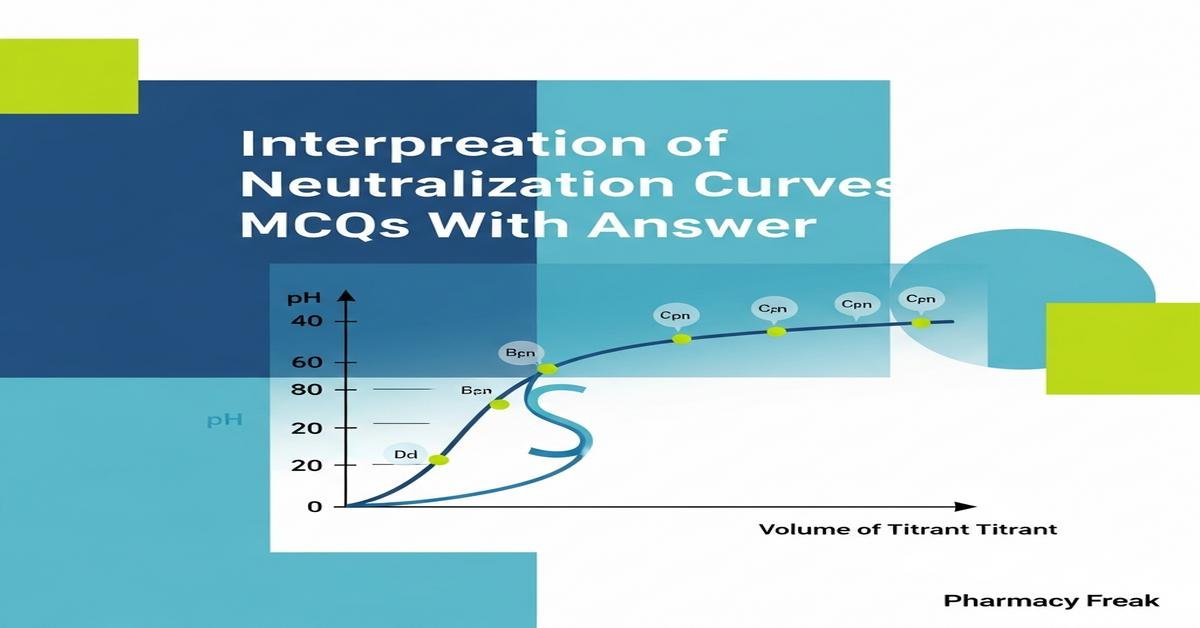
Interpretation of neutralization curves MCQs With Answer is a focused study tool for B.Pharm students to master titration and pH curve analysis. This introduction explains neutralization curves, equivalence and end points, buffer regions, steep vertical sections, half-equivalence and its use to find pKa, and selection of appropriate indicators. Emphasis is on acid-base titrations, titration curves, … Read more

Theory of titration of very weak acids and bases MCQs With Answer

Theory of titration of very weak acids and bases MCQs With Answer

Theory of titration of very weak acids and bases MCQs With Answer Understanding titration theory for very weak acids and bases is essential for B. Pharm students studying analytical chemistry, pharmacokinetics, and formulation science. This topic covers titration curves, buffer regions, half‑equivalence and equivalence points, pKa/pKb determination, conjugate salt hydrolysis, indicator selection, activity vs concentration … Read more

Theory of titration of weak acids and bases MCQs With Answer

Theory of titration of weak acids and bases MCQs With Answer

Theory of titration of weak acids and bases MCQs With Answer Theory of titration of weak acids and bases is a core topic in pharmaceutical analysis for B.Pharm students. It covers titration curves, equivalence point, half-equivalence point, pKa/pKb relationships, buffer regions, indicator selection, and volumetric calculations. Understanding acid–base equilibria, Henderson–Hasselbalch equation, salt hydrolysis, ionic strength … Read more

Theory of titration of strong acids and bases MCQs With Answer

Theory of titration of strong acids and bases MCQs With Answer

Theory of titration of strong acids and bases MCQs With Answer Theory of titration of strong acids and bases is essential for B.Pharm students learning volumetric analysis, neutralization, pH curves, equivalence point and indicator selection. This concise introduction covers titration principles, titrant and titrate behaviour, calculation using MaVa = MbVb, the characteristic steep titration curve, … Read more

Classification of acid–base titrations MCQs With Answer

Classification of acid–base titrations MCQs With Answer

Classification of acid–base titrations MCQs With Answer provides B.Pharm students a focused review of titration types, titration curves, and indicator selection. This concise guide covers strong acid–strong base, strong acid–weak base, weak acid–strong base, and weak acid–weak base titrations, plus polyprotic systems, buffer regions, half‑equivalence concepts, and salt hydrolysis effects. Emphasis is on equivalence point … Read more

Theories of acid–base indicators MCQs With Answer

Theories of acid–base indicators MCQs With Answer

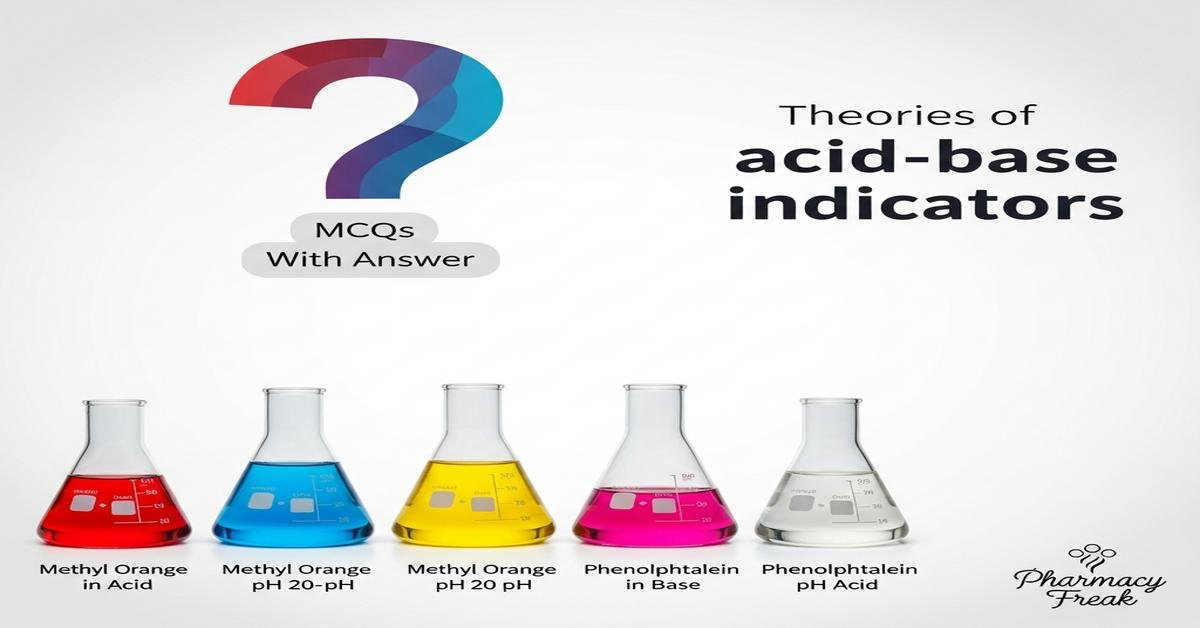
Theories of acid–base indicators MCQs With Answer Understanding acid–base indicators is essential for B. Pharm students studying analytical chemistry and pharmaceutical analysis. This introduction explores indicator behavior, including indicator dissociation, pKa, Henderson–Hasselbalch explanation of color change, transition range (pKa ±1), structural basis of color (conjugation, protonation), and practical selection for titrations (strong/weak acid–base systems). You … Read more

Limit tests for impurities in drugs MCQs With Answer

Limit tests for impurities in drugs MCQs With Answer

Introduction: Limit tests for impurities in drugs are essential qualitative and semi‑quantitative checks used in pharmaceutical quality control to ensure safety and compliance with pharmacopeial standards. These tests screen for specific impurities—such as heavy metals, chlorides, sulfates, arsenic and sulfides—using classical analytical principles (precipitation, colorimetry, gravimetry and titrimetry). B.Pharm students must understand test principles, common … Read more

Sources of impurities in medicinal agents MCQs With Answer

Sources of impurities in medicinal agents MCQs With Answer

Introduction: Sources of impurities in medicinal agents MCQs With Answer is a focused review for B.Pharm students on pharmaceutical impurities, their origins, detection and control. Understanding sources of impurities—such as synthetic by‑products, degradation products, residual solvents, heavy metals, catalysts, microbial contamination, and packaging leachables—is essential for drug quality, safety and regulatory compliance. This topic links … Read more

PRO
Ad-Free Access
$3.99 / month
  • No Interruptions
  • Faster Page Loads
  • Support Content Creators