
ATI TEAS 7 Exam Format and Syllabus
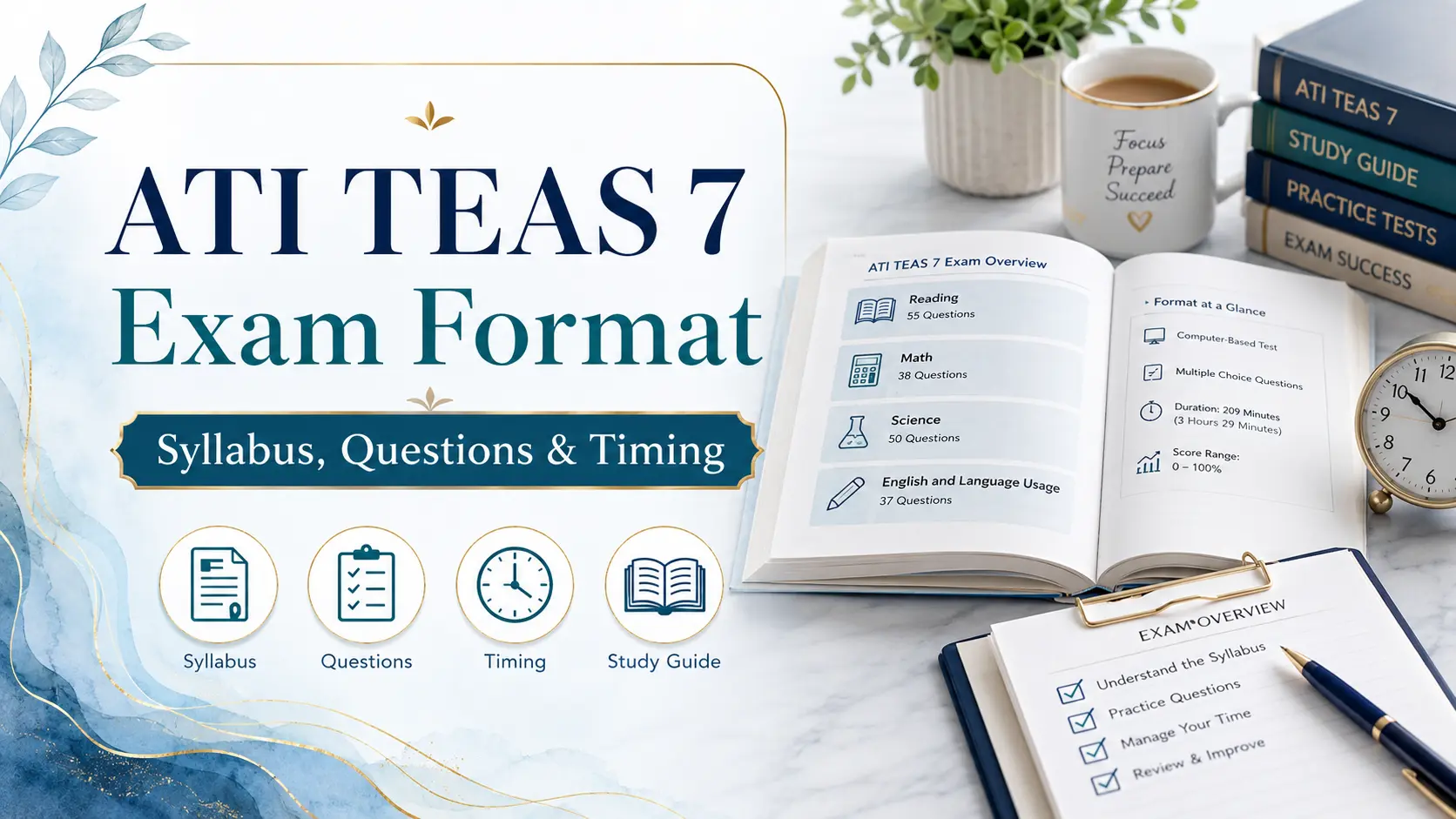
The ATI TEAS 7 contains 170 questions divided among Reading, Mathematics, Science, and English and Language Usage. You receive 209 minutes of testing time, with a separate timer for each section. Of the 170 questions, 150 are scored and 20 are unidentified pretest questions that don’t affect your score.
This guide explains the section order, timing, scored-question distribution, question formats, tested topics, calculator rules, and the type of practice that makes sense at each stage of preparation.
Last reviewed: July 12, 2026
ATI TEAS 7 exam format at a glance
| Section | Questions delivered | Scored questions | Unscored questions | Time limit |
|---|---|---|---|---|
| Reading | 45 | 39 | 6 | 55 minutes |
| Mathematics | 38 | 34 | 4 | 57 minutes |
| Science | 50 | 44 | 6 | 60 minutes |
| English and Language Usage | 37 | 33 | 4 | 37 minutes |
| Total | 170 | 150 | 20 | 209 minutes |
The ATI TEAS 7 uses four separately timed sections. The official content outline lists 150 scored questions and 20 additional unscored pretest questions distributed across the four sections.
The total allocated testing time is 3 hours and 29 minutes. Check-in, instructions, technical setup, and any permitted break time can make the full appointment longer.
What order are the ATI TEAS 7 sections given in?
The sections appear in this order:
- Reading
- Mathematics
- Science
- English and Language Usage
You can move backward and forward among questions while the current section remains open. Once you submit that section and continue, you can’t return to it.
That rule changes how you should review. Don’t submit a section simply because you have answered the last question. Check the question list first, deal with any blanks, and then return to items you marked or found uncertain.
Reading comes first
The exam begins with 45 Reading questions and a 55-minute timer.
Starting with Reading can catch students off guard. You need to settle into passages, evidence questions, charts, and author-purpose questions immediately rather than relying on an easy warm-up.
Mathematics comes second
Mathematics contains 38 questions and allows 57 minutes.
This is the most generous section in terms of average time per question, but multi-step problems can still use several minutes. Your pace needs to leave room for checking units, calculator entries, and unanswered questions.
A break follows Mathematics
ATI permits a short 10-minute break after the Mathematics section. The break is available for both remote and in-person testing, and the Science timer does not start until you begin that section.
Use the break to reset. Don’t spend it replaying Math questions that you can no longer change.
Science comes third
Science contains 50 questions and allows 60 minutes.
It is the largest section by delivered question count. By this point, you have already completed 83 questions, so concentration matters as much as content knowledge.
English and Language Usage comes last
English and Language Usage contains 37 questions and allows 37 minutes.
The one-minute-per-question pace is the fastest of the four sections. Sentence structure, punctuation, word choice, and paragraph-organization questions may look short, but they still require careful reading.
How much time do you get per question?
The table below shows the average pace if time were divided evenly.
| Section | Approximate average time per question |
|---|---|
| Reading | 73 seconds |
| Mathematics | 90 seconds |
| Science | 72 seconds |
| English and Language Usage | 60 seconds |
These averages are planning guides, not limits for individual questions.
A Reading passage may take two minutes to read but support several questions. A short grammar item may take 20 seconds. A Math word problem may require more than 90 seconds, while a straightforward conversion may take far less.
A better pacing rule is to check your progress at intervals rather than watching the clock after every item.
What are the 20 unscored TEAS questions?
The exam delivers 170 questions, but only 150 contribute to your score. The remaining 20 are pretest questions used to gather information for possible future exams.
They are mixed into the test and aren’t labelled. You won’t know which questions are scored and which are not.
Treat every question the same way.
A difficult or unfamiliar item isn’t necessarily unscored. Assuming that it is can lead to a careless answer on a question that counts.
How the unscored questions are distributed
ATI lists the following delivered and scored counts:
- Reading: 45 delivered, 39 scored
- Mathematics: 38 delivered, 34 scored
- Science: 50 delivered, 44 scored
- English and Language Usage: 37 delivered, 33 scored
That leaves six unscored questions in Reading, four in Math, six in Science, and four in English and Language Usage.
What question types appear on the ATI TEAS 7?
The ATI TEAS 7 includes standard multiple-choice questions and alternate item formats. ATI states that up to 15 percent of questions may use an alternate format.
The five main response formats are:
- Multiple choice
- Multiple select
- Fill in the blank
- Ordered response
- Hot spot
Multiple-choice questions
A multiple-choice question presents several options with one correct answer.
Example format:
Which structure carries blood away from the heart?
You select one option.
These questions may test direct knowledge, interpretation, calculation, or application. A multiple-choice format doesn’t necessarily mean the question is simple.
Multiple-select questions
These are often labelled “Select all that apply.”
More than one option may be correct. You must select every correct answer and avoid incorrect choices. ATI does not award partial credit when only part of the response is correct.
The safest approach is to judge each option independently. Don’t stop after finding two answers just because two seems like a reasonable number.
Fill-in-the-blank questions
A fill-in-the-blank item asks you to enter an answer rather than choose from a list.
This format often appears in Mathematics, where you may need to enter a number or decimal. Read the entry instructions closely. They may specify rounding, a leading zero, or the required format.
Ordered-response questions
An ordered-response question asks you to arrange steps, events, or processes in the correct sequence.
The answer must be in the correct order. ATI does not award partial credit when part of the sequence is misplaced.
Before arranging the choices, identify the fixed first and last steps. Then work through the middle.
Hot-spot questions
A hot-spot question asks you to select a location on an image, chart, diagram, graph, or other visual.
You might need to identify:
- An anatomical structure
- A point on a number line
- A section of a graph
- A location in a diagram
- The area that matches a stated condition
Check labels and orientation before clicking. On an anatomical image, for example, left and right may refer to the subject’s body rather than your viewing position.
ATI TEAS 7 Reading syllabus
Reading accounts for 39 scored questions, or 26 percent of the scored exam.
The section has three content areas:
| Reading content area | Scored questions |
|---|---|
| Key Ideas and Details | 15 |
| Craft and Structure | 9 |
| Integration of Knowledge and Ideas | 15 |
Key Ideas and Details
This area covers the information stated or implied in a text.
Skills include:
- Summarizing a multi-paragraph passage
- Finding the main idea
- Locating a specific detail
- Making an inference
- Drawing a supported conclusion
- Following written directions
- Interpreting sequence
- Reading charts, graphs, and other visuals
The answer should come from the passage. Outside knowledge can be a distraction when the subject feels familiar.
Craft and Structure
This area looks at how the writer communicates.
You may need to identify:
- Author’s purpose
- Point of view
- Tone
- Fact versus opinion
- Bias or misconception
- The meaning of a word in context
- The effect of a particular phrase or structure
A common mistake is choosing a purpose based on one sentence rather than the passage as a whole.
Integration of Knowledge and Ideas
These questions ask you to work with claims, evidence, multiple sources, and different formats.
Skills include:
- Selecting the strongest textual evidence
- Comparing two passages
- Comparing themes
- Evaluating an argument
- Judging the relevance of evidence
- Combining information from text and visuals
After reviewing the Reading syllabus, you can use Reading Practice Test 1 and Reading Practice Test 2 for focused practice.
Each test has 30 questions, a 37-minute timer, instant results, explanations, skill-wise analysis, and a downloadable PDF review. No login is required.
ATI TEAS 7 Mathematics syllabus
Mathematics accounts for 34 scored questions, or 23 percent of the scored exam.
| Mathematics content area | Scored questions |
|---|---|
| Numbers and Algebra | 18 |
| Measurement and Data | 16 |
Numbers and Algebra
This area includes:
- Fractions, decimals, and percentages
- Rational-number operations
- Comparing and ordering numbers
- Ratios and proportions
- Rates
- One-variable equations
- Algebraic expressions
- Percentage increase and decrease
- Multi-step word problems
- Estimation
The difficult part is often setting up the problem correctly. A calculator can process an expression, but it can’t decide which operation the question requires.
Measurement and Data
This area includes:
- Reading tables and graphs
- Mean, median, mode, and range
- Relationships between variables
- Perimeter, area, and volume
- Standard and metric measurement
- Unit conversions
Units matter. A correct calculation with the wrong unit is still wrong.
Is a calculator allowed?
ATI provides a calculator during the exam. For online testing, the calculator is built into the exam. For applicable paper-and-pencil testing, the proctor provides one.
You cannot bring and use your own calculator.
Practise with a basic four-function calculator. Learn when it saves time and when mental arithmetic is quicker.
You can apply these topics in Math Practice Test 1 and Math Practice Test 2.
Each free test includes 30 questions, a 45-minute timer, topic-wise results, answer explanations, and PDF review.
ATI TEAS 7 Science syllabus
Science accounts for 44 scored questions, or 29 percent of the scored exam. It is the largest scored content area.
| Science content area | Scored questions |
|---|---|
| Human Anatomy and Physiology | 18 |
| Biology | 9 |
| Chemistry | 8 |
| Scientific Reasoning | 9 |
Human Anatomy and Physiology
This is the largest Science sub-content area.
It covers:
- Anatomical orientation
- Cardiovascular system
- Respiratory system
- Digestive system
- Nervous system
- Endocrine system
- Urinary system
- Immune system
- Skeletal system
- Muscular system
- Integumentary system
- Male and female reproductive systems
- Interactions among body systems
Memorizing names is only part of the work. You also need to understand direction, sequence, function, and how one body system affects another.
Biology
Biology topics include:
- Cell structure and function
- DNA and RNA
- Protein synthesis
- Mendelian inheritance
- Macromolecules
- Microorganisms and disease
Questions may ask you to connect steps in a process rather than recall one isolated fact.
Chemistry
Chemistry includes:
- Atomic structure
- Physical properties of matter
- Changes of matter
- Chemical reactions
- Solutions
- Acids, bases, and pH
- Factors that affect reactions
Focus on the relationships among the concepts. For example, pH questions require you to understand direction on the scale, not just the definitions of acid and base.
Scientific Reasoning
Scientific Reasoning covers:
- Hypotheses
- Independent and dependent variables
- Controls and constants
- Measurement tools
- Experimental design
- Accuracy and precision
- Data interpretation
- Evidence-based conclusions
- Correlation and causation
Read the experiment before looking at the options. Identify what changed, what was measured, and what stayed constant.
For focused practice, use Science Practice Test 1 and Science Practice Test 2.
Each free Science test contains 30 questions with a 36-minute timer. The blueprint includes 12 Anatomy and Physiology questions and six questions each from Biology, Chemistry, and Scientific Reasoning.
ATI TEAS 7 English and Language Usage syllabus
English and Language Usage accounts for 33 scored questions, or 22 percent of the scored exam.
| English content area | Scored questions |
|---|---|
| Conventions of Standard English | 12 |
| Knowledge of Language | 11 |
| Using Language and Vocabulary to Express Ideas in Writing | 10 |
Conventions of Standard English
This area covers:
- Spelling
- Punctuation
- Sentence structure
- Complete sentences
- Fragments
- Run-on sentences
- Agreement
- Correct word forms
Read the entire sentence before changing the underlined portion. The error may depend on a subject, verb, or pronoun elsewhere in the sentence.
Knowledge of Language
These questions examine whether writing fits its purpose and audience.
Topics include:
- Grammar for clarity
- Formal and informal language
- Paragraph organization
- Topic sentences
- Supporting details
- Transitions
- Concision
- Logical order
The longest option is rarely better simply because it sounds formal. Clear writing often uses fewer words.
Language and vocabulary in writing
This area includes:
- The writing process
- Prefixes
- Suffixes
- Roots
- Word meaning
- Context clues
- Precise word choice
Word-part knowledge helps, but context still decides which meaning fits.
Use English and Language Usage Practice Test 1 and English and Language Usage Practice Test 2 after reviewing the main rules.
Both tests are free, use a 30-minute timer for 30 questions, and include explanations, skill analysis, and PDF review.
Online and in-person ATI TEAS testing options
ATI lists four main testing arrangements:
- TEAS Online, proctored by ATI
- TEAS Online, proctored by an institution
- In-person testing at an institution
- In-person testing at a PSI testing center
The exam content and core structure remain the same, but registration, identification, technical requirements, score delivery, scratch-paper rules, and rescheduling terms can depend on the testing arrangement.
Check the requirements of the school or program receiving your score before registering. A school may require a particular testing location or proctoring method.
How should you practise for the TEAS format?
The best practice format depends on what you’re trying to learn.
A student who is still reviewing Anatomy and Physiology doesn’t need the same test as someone whose official exam is one week away.
Start with a free mixed test
A mixed test is useful when you want a quick look at all four subjects.
Pharmacy Freak’s free mixed sets include:
- 50 questions
- A 61-minute timer
- Reading, Math, Science, and English
- Multiple response formats
- Instant scoring
- Per-question explanations
- Section-wise performance
- Downloadable PDF review
- No login
You can start with:
- TEAS Practice Test 1
- TEAS Practice Test 2
- TEAS Practice Test 3
- TEAS Practice Test 4
- TEAS Practice Test 5
Use the first test as a baseline. Review the explanations before moving to the next set.
Use subject-wise tests for a specific weakness
A subject test makes sense when your result shows a clear problem in Reading, Math, Science, or English.
Each Pharmacy Freak subject test has 30 questions and follows a timer based on the pace of that TEAS section. The results break performance down by topic or skill.
This is more useful than repeatedly taking mixed quizzes when one subject is holding your score down.
Use a full-length test for timing and endurance
A short practice test can reveal content gaps. It cannot fully show how you will handle 170 questions, separate section timers, a fixed section order, and several hours of testing.
Pharmacy Freak’s full-length ATI TEAS 7 practice-test package includes 10 complete practice exams for $9.
Each test contains:
- 170 delivered questions
- 150 scored and 20 unidentified unscored questions
- Four separately timed sections
- Server-controlled timing
- Automatic progress saving
- A question navigator
- Mark for Review
- A built-in Math calculator
- A break after Mathematics
- Locked submitted sections
- Detailed section results
- Results sent by email
- A downloadable PDF report
- Saved account history
Take these after you have reviewed your main content weaknesses. A full-length attempt is far more useful when you spend time studying the result before starting another one.
How Pharmacy Freak tests compare with basic online quizzes
Many free quizzes end with a percentage and little else. That format can tell you how many questions you answered correctly, but it gives you limited help with the next step.
Pharmacy Freak’s free mixed and subject-wise tests include explanations, question-level review, performance by section or topic, and a downloadable PDF. They also work without an account.
For a student who wants to diagnose weaknesses, those features make Pharmacy Freak’s tests more useful than a basic score-only quiz.
The full-length tests serve a different purpose. They practise the complete section order, timing, endurance, review decisions, and locked-section flow. A 20-question quiz can’t recreate that experience.
That doesn’t mean one format should replace all others. Use:
- Subject tests to repair a weak area
- Mixed tests to check balance across subjects
- Full-length tests to rehearse the complete exam
Which TEAS practice format should you choose?
| Your current situation | Best next step |
|---|---|
| You have just started preparing | Read the exam format and take one free mixed test |
| One subject is much weaker than the others | Review that subject and take a subject-wise test |
| You want to check all four subjects quickly | Take a 50-question mixed test |
| You have completed most content review | Take a full-length timed test |
| You struggle with pacing or fatigue | Use a full-length simulation |
| You are retaking the TEAS | Diagnose with a mixed test, repair weak subjects, then rehearse full length |
| You want all available practice options | Visit the TEAS practice-test hub |
Pharmacy Freak practice percentages are study tools. They are not official ATI equated scores and don’t predict admission decisions.
Frequently asked questions
How many questions are on the ATI TEAS 7?
The exam contains 170 questions. Of these, 150 are scored and 20 are unidentified pretest questions that don’t contribute to the score.
How long is the ATI TEAS 7?
The four sections provide 209 minutes of allocated testing time, equal to 3 hours and 29 minutes. Appointment time may be longer because of check-in, instructions, setup, and the permitted break.
What order are the TEAS sections in?
The order is Reading, Mathematics, Science, and English and Language Usage.
Can I return to a completed section?
No. You can move among questions within the active section, but once you submit it and continue, the section is closed.
Are all ATI TEAS questions scored?
No. The exam contains 150 scored questions and 20 unscored pretest questions. The unscored questions aren’t identified.
What question types appear on the ATI TEAS 7?
The exam uses multiple choice, multiple select, fill in the blank, ordered response, and hot-spot questions. Up to 15 percent may use alternate item formats.
Is a calculator available on the TEAS?
Yes. ATI provides the calculator. Online tests use a built-in calculator, while applicable paper-and-pencil tests use a calculator supplied by the proctor. Personal calculators aren’t permitted.
Is there a break during the ATI TEAS?
ATI allows a 10-minute break after the Mathematics section. The next section’s timer does not begin until you start Science.
Is the online ATI TEAS different from the in-person exam?
The core subject areas, question count, and timing follow the same TEAS 7 structure. Registration, proctoring, identification, workspace, technical checks, and test-day procedures vary by testing format.
Which TEAS section has the most questions?
Science has the most delivered questions at 50 and the largest share of scored questions at 44.
Are Pharmacy Freak questions official ATI questions?
No. Pharmacy Freak creates independent practice material designed around the published TEAS 7 structure and content areas. The questions aren’t official ATI exam items.
Is a Pharmacy Freak practice score an official TEAS score?
No. Pharmacy Freak reports a practice percentage for study tracking. It isn’t an official ATI equated score and shouldn’t be used as an admission prediction.
ATI TEAS 7 format checklist
Before test day, make sure you understand:
- The four-section order
- The question count for each section
- The separate section timers
- The 150 scored and 20 unscored question structure
- The five main question formats
- How multiple-select scoring works
- How to enter fill-in responses
- How to arrange ordered-response items
- How to use the supplied calculator
- When the 10-minute break occurs
- That completed sections can’t be reopened
- How you will review marked and unanswered questions
- Which subject needs the most practice
- When you will take a full-length rehearsal
Sources and independence statement
Exam structure, section timing, scored-question distribution, question types, section order, break rules, and calculator information were checked against official ATI exam pages, the ATI Help Center, and the ATI TEAS Version 7 content outline on July 12, 2026.
Pharmacy Freak is an independent educational resource and is not affiliated with or endorsed by Assessment Technologies Institute. ATI and TEAS are trademarks of their respective owner.
