Table of Contents
Introduction
Quinolones, also known as fluoroquinolones, are broad-spectrum antibacterial agents used to treat various bacterial infections including urinary tract infections, respiratory tract infections, gastrointestinal infections, and certain sexually transmitted diseases. These drugs act by inhibiting bacterial DNA replication and transcription through interference with bacterial topoisomerase enzymes.
Mechanism of Action (Step-wise)
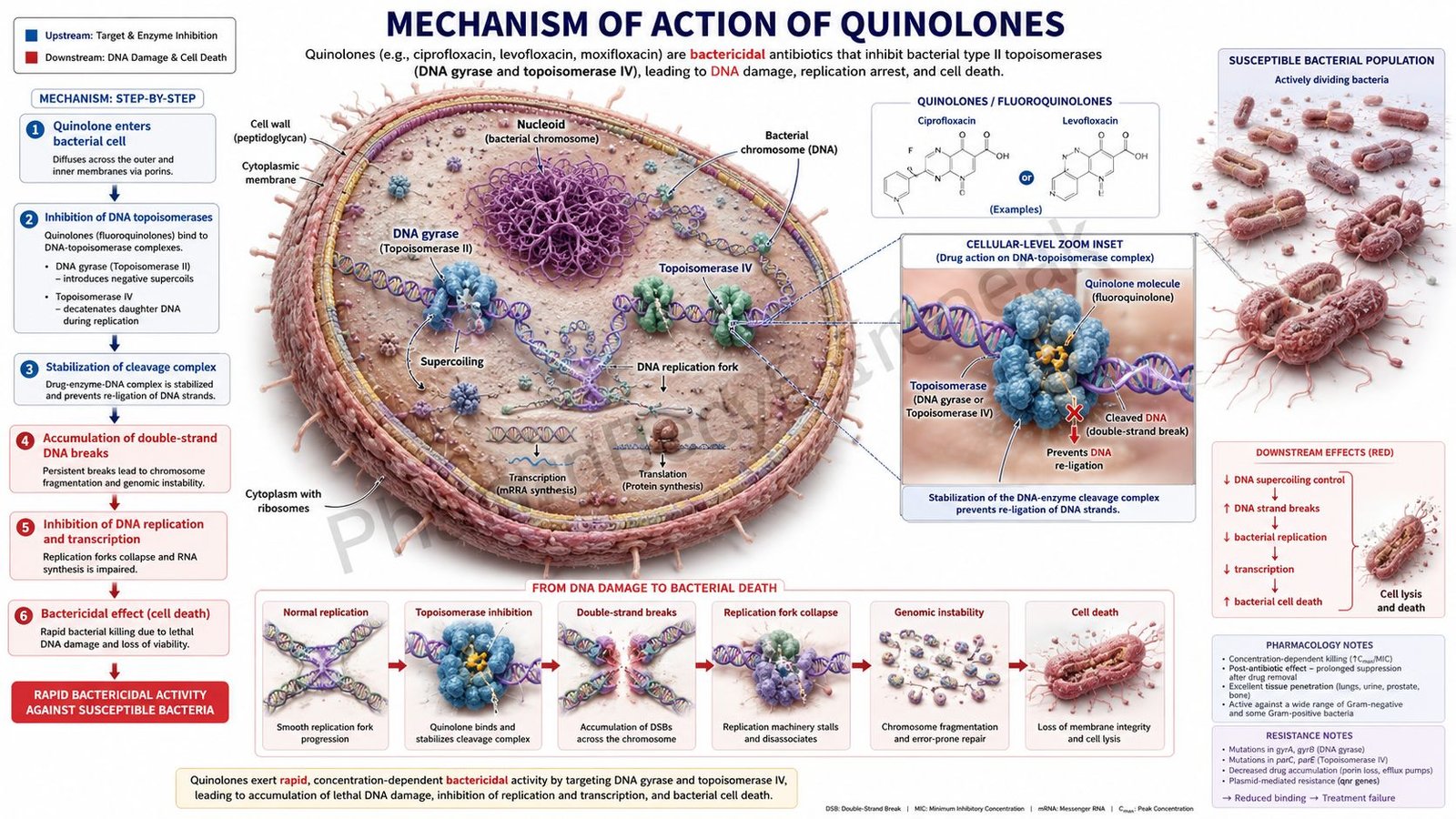
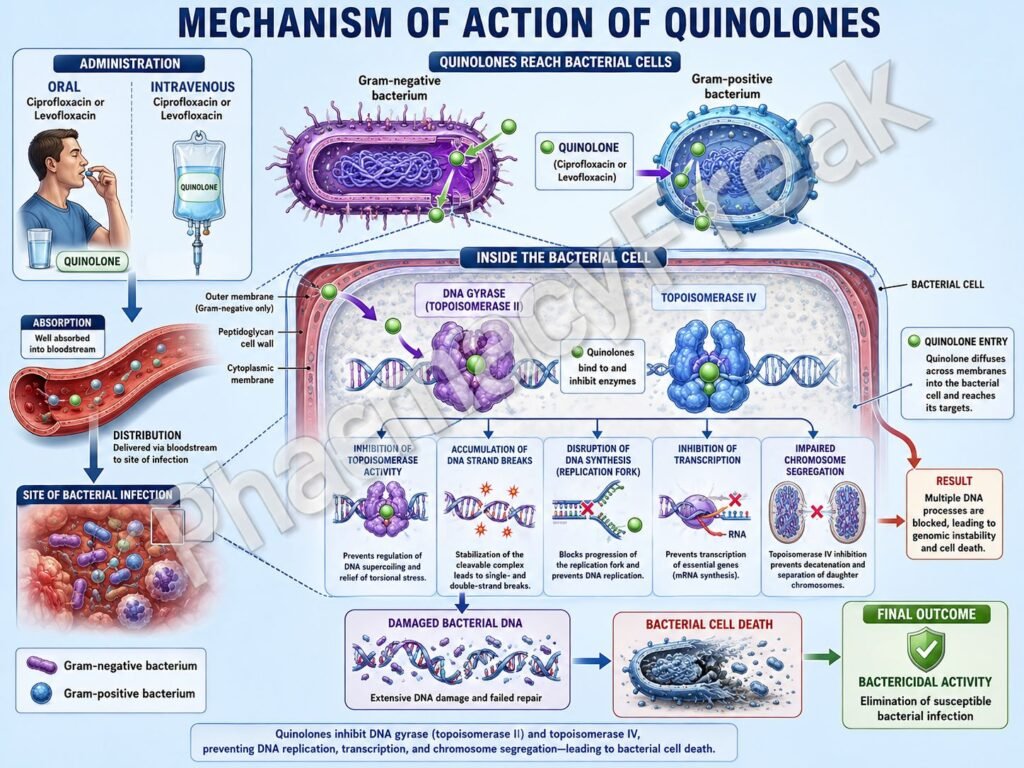
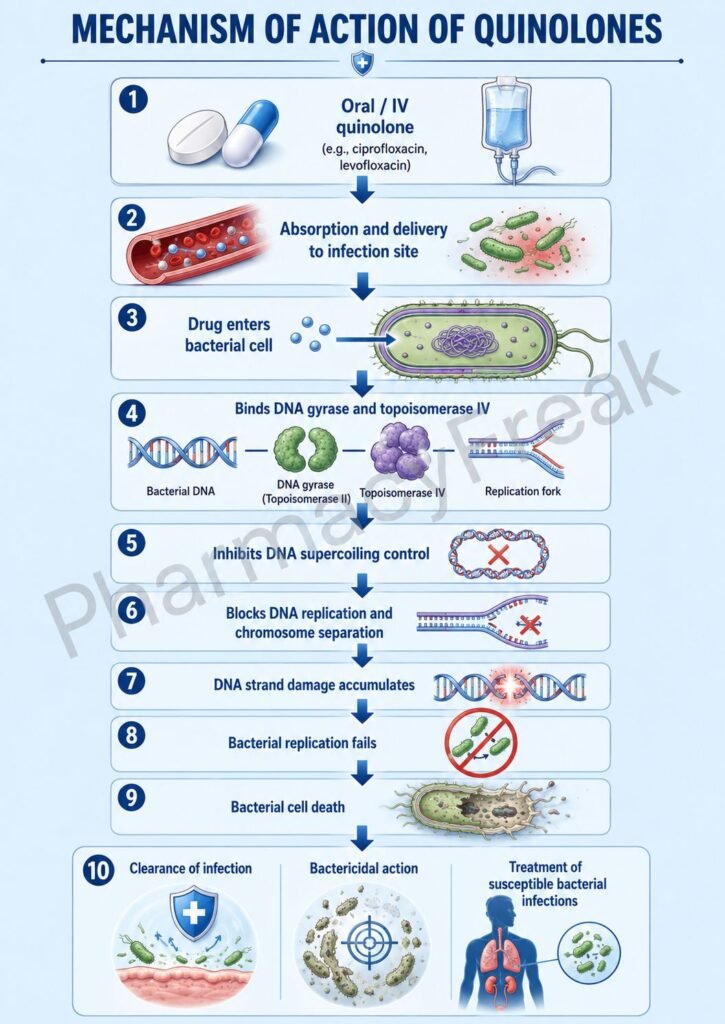
- Quinolones enter bacterial cells through porin channels or diffusion.
- They target bacterial DNA gyrase (topoisomerase II) and topoisomerase IV enzymes.
- DNA gyrase normally introduces negative supercoils into bacterial DNA.
- Negative supercoiling is essential for DNA replication and transcription.
- Topoisomerase IV helps separate replicated bacterial chromosomes during cell division.
- Quinolones bind to the DNA-enzyme complex formed by these topoisomerases.
- This stabilizes the complex after DNA strand cleavage.
- DNA strands cannot be resealed properly.
- Accumulation of DNA breaks disrupts replication and transcription.
- Bacterial cell division stops and chromosomal damage increases.
- The overall effect is rapid bactericidal activity and bacterial cell death.
A key exam point is that quinolones inhibit bacterial DNA gyrase and topoisomerase IV, blocking DNA replication.
Pharmacokinetics
Most quinolones are administered orally and have excellent bioavailability. Some are also available intravenously. They are widely distributed in tissues including lungs, kidneys, and prostate. Elimination occurs mainly through the kidneys, although some agents undergo hepatic metabolism. Absorption is reduced by antacids containing calcium, magnesium, or aluminum.
Clinical Uses
Quinolones are used in urinary tract infections, community-acquired pneumonia, gastrointestinal infections, prostatitis, skin infections, and certain sexually transmitted infections. Ciprofloxacin is commonly used against gram-negative organisms, while levofloxacin and moxifloxacin have better respiratory coverage.
Adverse Effects
Common adverse effects include nausea, diarrhea, headache, and dizziness. Serious effects include tendinitis, tendon rupture, QT prolongation, peripheral neuropathy, and CNS toxicity. They should be used cautiously in children and pregnant women because of potential cartilage toxicity.
Comparative Analysis
| Feature | Quinolones | β-Lactams | Macrolides |
|---|---|---|---|
| Main target | DNA gyrase/topoisomerase IV | Cell wall synthesis | 50S ribosome |
| Effect | Bactericidal | Bactericidal | Mostly bacteriostatic |
| DNA replication inhibition | Yes | No | No |
| Protein synthesis inhibition | No | No | Yes |
| Common use | UTI, respiratory infections | Broad bacterial infections | Respiratory infections |
| Major toxicity | Tendon injury | Allergy | QT prolongation |
Quinolones differ from β-lactams and macrolides because they directly inhibit bacterial DNA replication rather than cell wall or protein synthesis.
MCQs
- Quinolones primarily inhibit which enzymes?
a) Cyclooxygenase
b) DNA gyrase and topoisomerase IV
c) β-lactamase
d) RNA polymerase only
Answer: b) DNA gyrase and topoisomerase IV
- DNA gyrase is also known as:
a) Topoisomerase II
b) Topoisomerase I
c) RNA polymerase
d) DNA helicase
Answer: a) Topoisomerase II
- Quinolones mainly inhibit bacterial:
a) Protein synthesis
b) DNA replication
c) Cell wall synthesis
d) Folate synthesis
Answer: b) DNA replication
- Quinolones are generally:
a) Antifungal agents
b) Bactericidal antibiotics
c) Antiviral drugs
d) Antiparasitic agents
Answer: b) Bactericidal antibiotics
- Topoisomerase IV is involved in:
a) Cell wall formation
b) Chromosome separation
c) Protein translation
d) ATP synthesis
Answer: b) Chromosome separation
- Ciprofloxacin is commonly used for:
a) Viral infections
b) Urinary tract infections
c) Fungal infections
d) Hyperthyroidism
Answer: b) Urinary tract infections
- Quinolones may cause:
a) Tendon rupture
b) Hypercalcemia
c) Bradycardia only
d) Hypoglycemia only
Answer: a) Tendon rupture
- A serious cardiac adverse effect is:
a) QT prolongation
b) Hypertension
c) Heart block only
d) Bradykinesia
Answer: a) QT prolongation
- Absorption of quinolones is reduced by:
a) Vitamin C
b) Antacids containing calcium or magnesium
c) Water
d) Sodium chloride
Answer: b) Antacids containing calcium or magnesium
- Quinolones act by stabilizing:
a) Ribosomal subunits
b) DNA-enzyme cleavage complexes
c) Cell wall proteins
d) ATP channels
Answer: b) DNA-enzyme cleavage complexes
- Compared with macrolides, quinolones primarily inhibit:
a) Protein synthesis
b) DNA replication
c) Histamine release
d) Cell membrane permeability only
Answer: b) DNA replication
- Quinolones should be used cautiously in children because of risk of:
a) Cartilage toxicity
b) Liver failure only
c) Cataracts
d) Renal agenesis
Answer: a) Cartilage toxicity
FAQs
What is the mechanism of action of quinolones?
They inhibit bacterial DNA gyrase and topoisomerase IV, preventing DNA replication and transcription.
Are quinolones bactericidal or bacteriostatic?
They are bactericidal antibiotics.
Why do quinolones cause tendon injury?
The exact mechanism is unclear, but they can damage connective tissue and tendons.
Which infections are commonly treated with quinolones?
UTIs, respiratory infections, gastrointestinal infections, and prostatitis.
Why should antacids be avoided with quinolones?
Because calcium and magnesium reduce drug absorption.
What is the major bacterial target of ciprofloxacin?
DNA gyrase in gram-negative bacteria.
References
Goodman & Gilman’s The Pharmacological Basis of Therapeutics – Antibacterial Drugs
https://accessmedicine.mhmedical.com/book.aspx?bookid=3191
Katzung: Basic and Clinical Pharmacology – Fluoroquinolones
https://accessmedicine.mhmedical.com/content.aspx?bookid=3382
Tripathi: Essentials of Medical Pharmacology – Fluoroquinolones
https://www.jaypeedigital.com
Harrison’s Principles of Internal Medicine – Bacterial Infections and Antibiotic Therapy
https://accessmedicine.mhmedical.com