Table of Contents
Introduction
Phenobarbital is a long-acting barbiturate used primarily as an anticonvulsant and sedative-hypnotic. It is widely used in the management of generalized tonic-clonic seizures and status epilepticus. Phenobarbital enhances inhibitory neurotransmission in the central nervous system, leading to decreased neuronal excitability and seizure control.
Mechanism of Action (Step-wise)
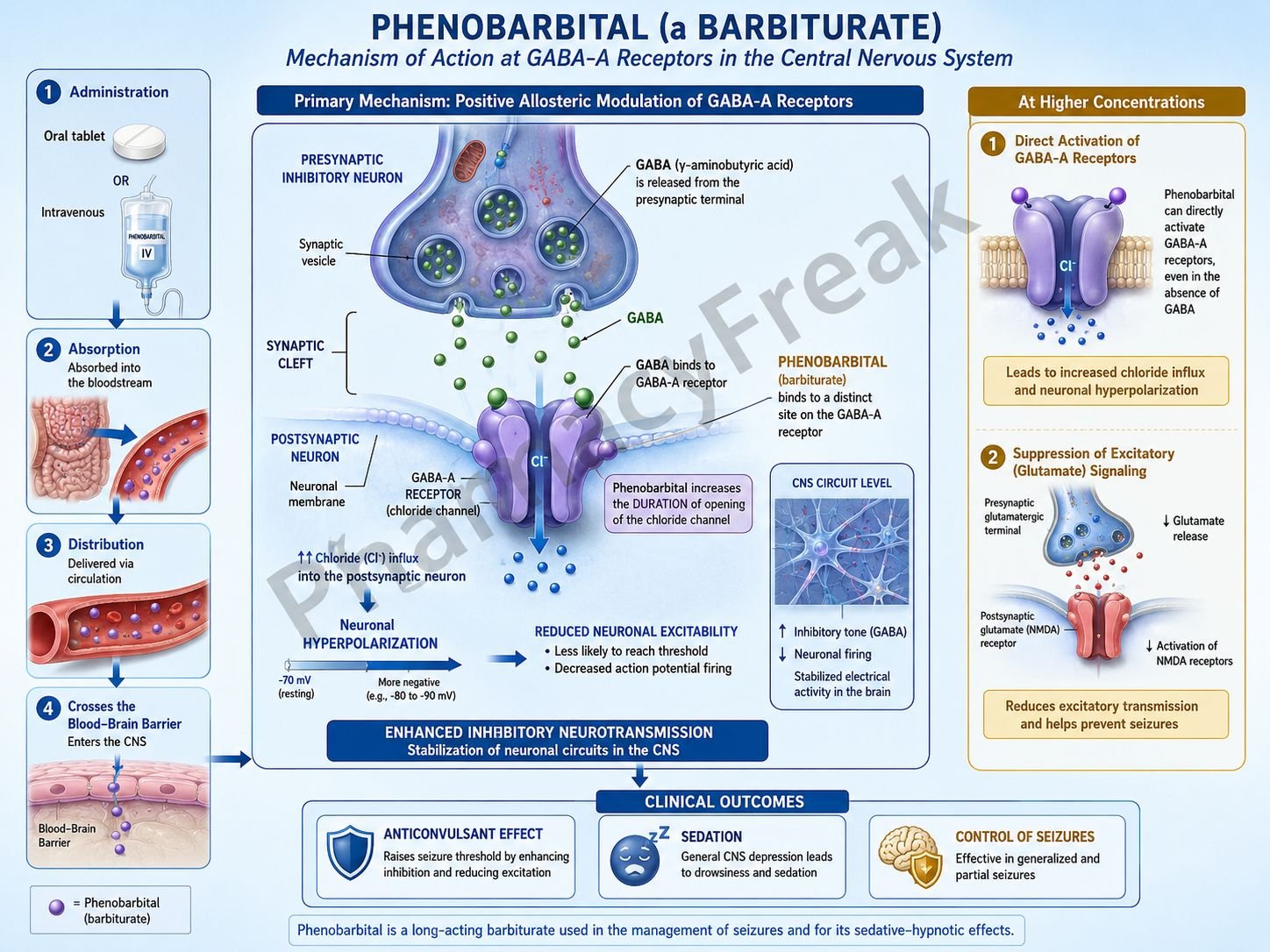
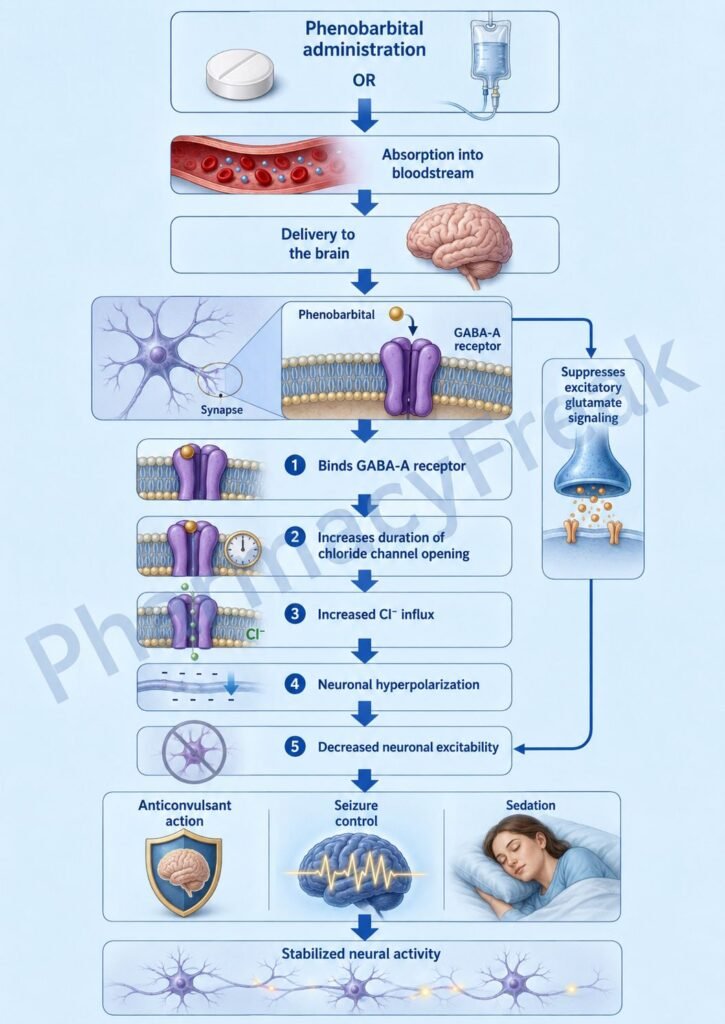
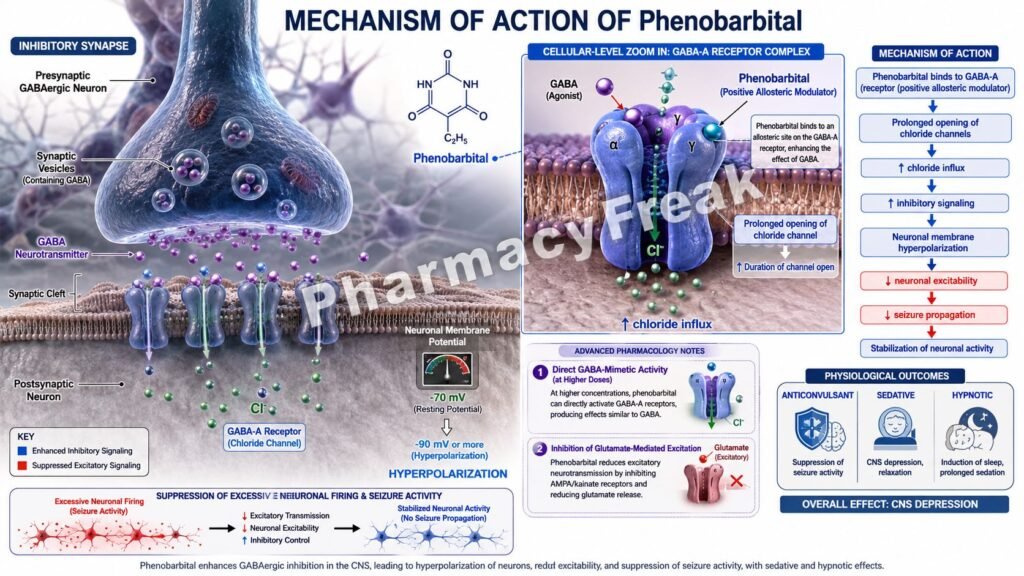
- Phenobarbital binds to the GABA-A receptor complex on neuronal membranes.
- It acts at a distinct site different from benzodiazepines.
- The GABA-A receptor is a ligand-gated chloride channel.
- Phenobarbital increases the duration of chloride channel opening.
- This allows increased influx of chloride ions (Cl⁻) into neurons.
- Increased chloride influx causes hyperpolarization of neuronal membranes.
- Hyperpolarization reduces neuronal excitability.
- Phenobarbital also inhibits excitatory neurotransmission by suppressing glutamate activity.
- At higher concentrations, it can directly activate GABA-A receptors even in the absence of GABA.
- The overall effect is enhanced inhibitory signaling and reduced neuronal firing.
- This leads to anticonvulsant, sedative, and hypnotic effects.
A key exam point is that phenobarbital increases the duration of GABA-A receptor chloride channel opening.
Pharmacokinetics
Phenobarbital is administered orally or intravenously. It is well absorbed and widely distributed, including penetration into the central nervous system. It has a long half-life, allowing once-daily dosing in many cases. It is metabolized in the liver and induces hepatic enzymes, which can affect the metabolism of other drugs. It is excreted via the kidneys.
Clinical Uses
Phenobarbital is used in the management of generalized tonic-clonic and focal seizures. It is also used in status epilepticus and neonatal seizures. Due to its sedative effects, it may also be used as a hypnotic, although this use is less common today.
Adverse Effects
Common adverse effects include sedation, drowsiness, cognitive impairment, and respiratory depression. Long-term use may lead to tolerance and dependence. It induces hepatic enzymes, leading to drug interactions. In children, it may cause behavioral changes. Overdose can result in severe CNS depression and coma.
Comparative Analysis
| Feature | Phenobarbital | Diazepam | Phenytoin |
|---|---|---|---|
| Class | Barbiturate | Benzodiazepine | Antiepileptic |
| GABA effect | ↑ duration of Cl⁻ channel opening | ↑ frequency of Cl⁻ channel opening | No direct GABA effect |
| Sedation | High | Moderate | Low |
| Enzyme induction | Yes | No | Yes |
| Use | Seizures | Status epilepticus, anxiety | Seizures |
| Dependence | High | Moderate | Low |
Phenobarbital differs from diazepam by increasing the duration rather than frequency of chloride channel opening. Compared to phenytoin, it acts via GABA-mediated inhibition rather than sodium channel blockade.
MCQs
- Phenobarbital acts on which receptor?
a) NMDA receptor
b) GABA-A receptor
c) Dopamine receptor
d) Serotonin receptor
Answer: b) GABA-A receptor
- Phenobarbital increases:
a) Frequency of channel opening
b) Duration of channel opening
c) Sodium influx
d) Calcium influx
Answer: b) Duration of channel opening
- The GABA-A receptor is a:
a) GPCR
b) Ligand-gated ion channel
c) Enzyme
d) Transporter
Answer: b) Ligand-gated ion channel
- Phenobarbital causes:
a) Depolarization
b) Hyperpolarization
c) No change
d) Sodium influx
Answer: b) Hyperpolarization
- Chloride influx leads to:
a) Increased excitability
b) Decreased excitability
c) Increased sodium
d) Increased calcium
Answer: b) Decreased excitability
- Phenobarbital is used in:
a) Asthma
b) Seizures
c) Diabetes
d) Anemia
Answer: b) Seizures
- A common adverse effect is:
a) Hyperactivity
b) Sedation
c) Hypercalcemia
d) Hypertension
Answer: b) Sedation
- Phenobarbital can directly activate:
a) NMDA receptors
b) GABA-A receptors
c) Dopamine receptors
d) Histamine receptors
Answer: b) GABA-A receptors
- Phenobarbital induces:
a) Renal enzymes
b) Hepatic enzymes
c) Cardiac enzymes
d) Brain enzymes
Answer: b) Hepatic enzymes
- Compared to benzodiazepines, phenobarbital:
a) Increases frequency
b) Increases duration
c) Same effect
d) No effect
Answer: b) Increases duration
- Phenobarbital is excreted via:
a) Liver
b) Kidney
c) Lung
d) Skin
Answer: b) Kidney
- Phenobarbital overdose causes:
a) Hyperactivity
b) CNS depression
c) Hypercalcemia
d) Tachycardia
Answer: b) CNS depression
FAQs
What is the mechanism of action of phenobarbital?
It enhances GABA-mediated inhibition by increasing the duration of chloride channel opening.
How does phenobarbital control seizures?
By reducing neuronal excitability through hyperpolarization.
What is a key difference from benzodiazepines?
Phenobarbital increases duration, while benzodiazepines increase frequency of channel opening.
Does phenobarbital induce enzymes?
Yes, it induces hepatic enzymes.
What is a major side effect?
Sedation and CNS depression.
Can phenobarbital cause dependence?
Yes, with prolonged use.
References
Goodman & Gilman’s The Pharmacological Basis of Therapeutics – Antiepileptic Drugs
https://accessmedicine.mhmedical.com/book.aspx?bookid=3191
Katzung: Basic and Clinical Pharmacology – Antiepileptic Drugs
https://accessmedicine.mhmedical.com/content.aspx?bookid=3382
Tripathi: Essentials of Medical Pharmacology – Antiepileptic Drugs
https://www.jaypeedigital.com
Harrison’s Principles of Internal Medicine – Seizure Disorders
https://accessmedicine.mhmedical.com