Table of Contents
Introduction
Phenylephrine is a selective α1-adrenergic receptor agonist used as a vasopressor, nasal decongestant, and mydriatic agent. It produces vasoconstriction by stimulating α1 receptors on vascular smooth muscle. Due to its minimal β-adrenergic activity, phenylephrine primarily affects vascular tone with little direct effect on the heart.
Mechanism of Action (Step-wise)
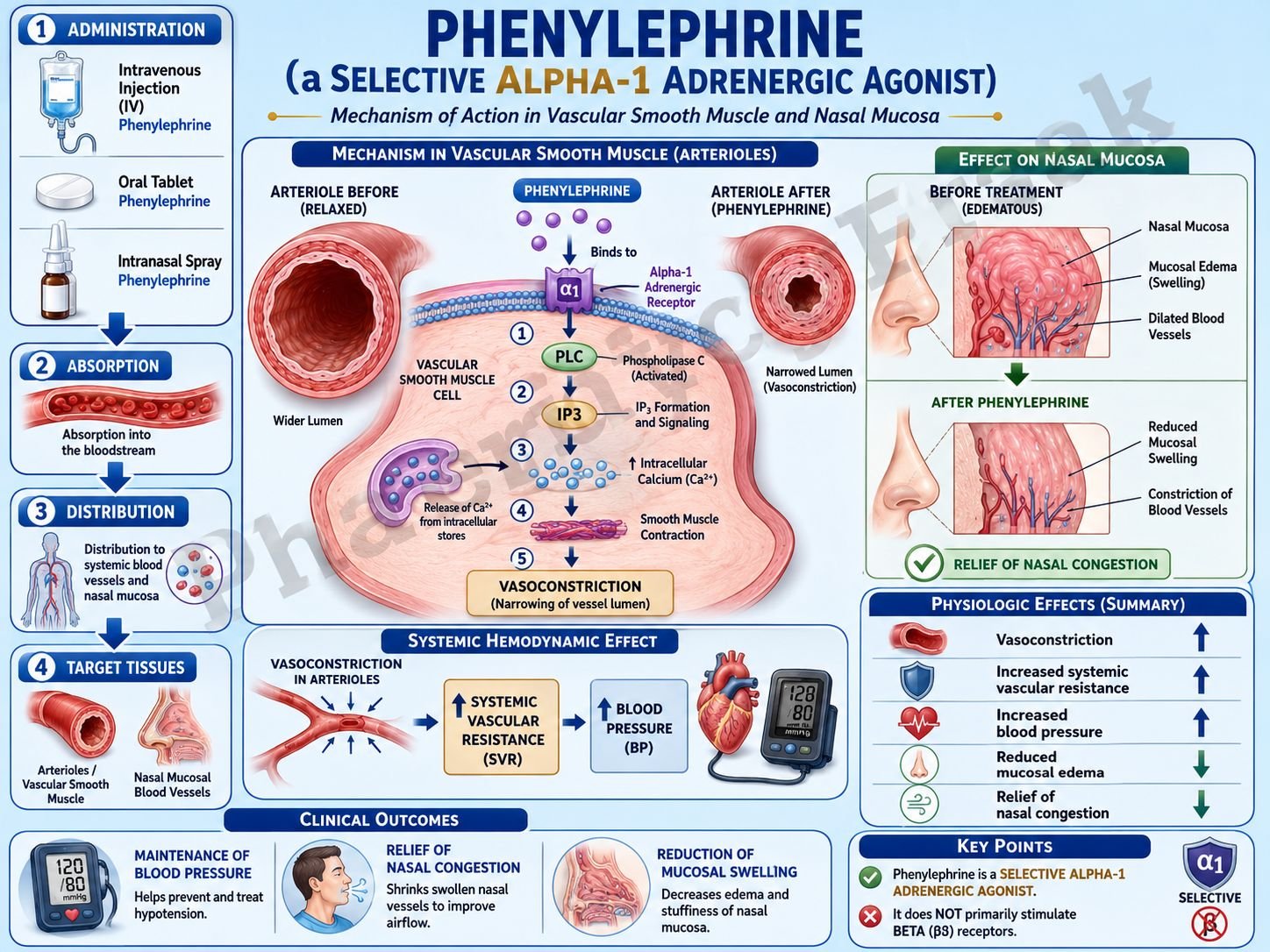
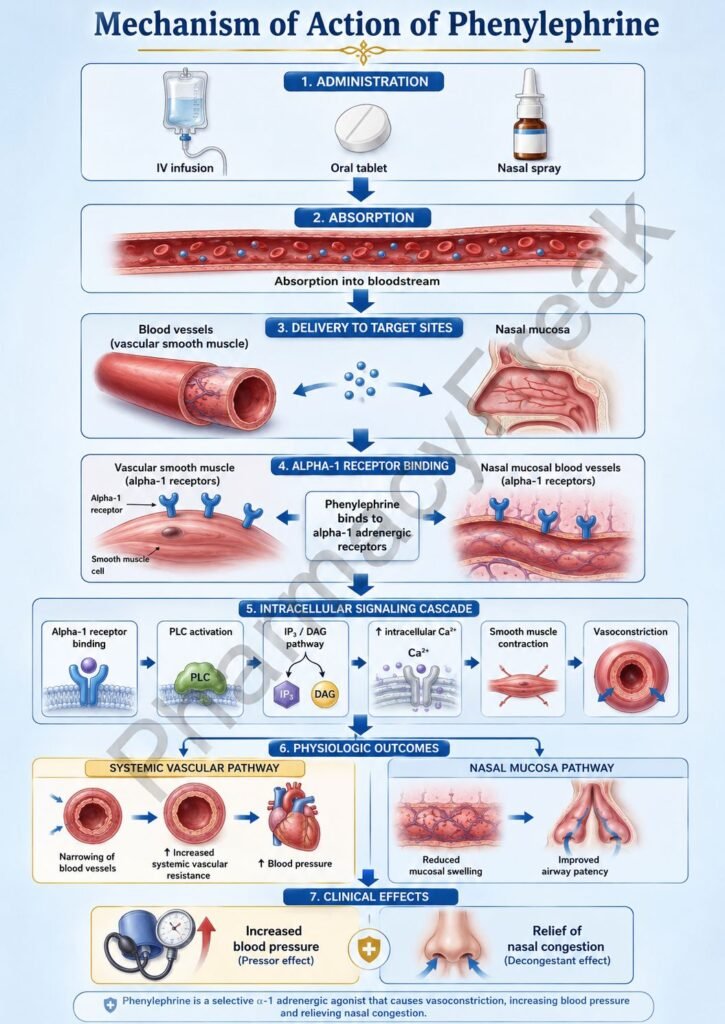
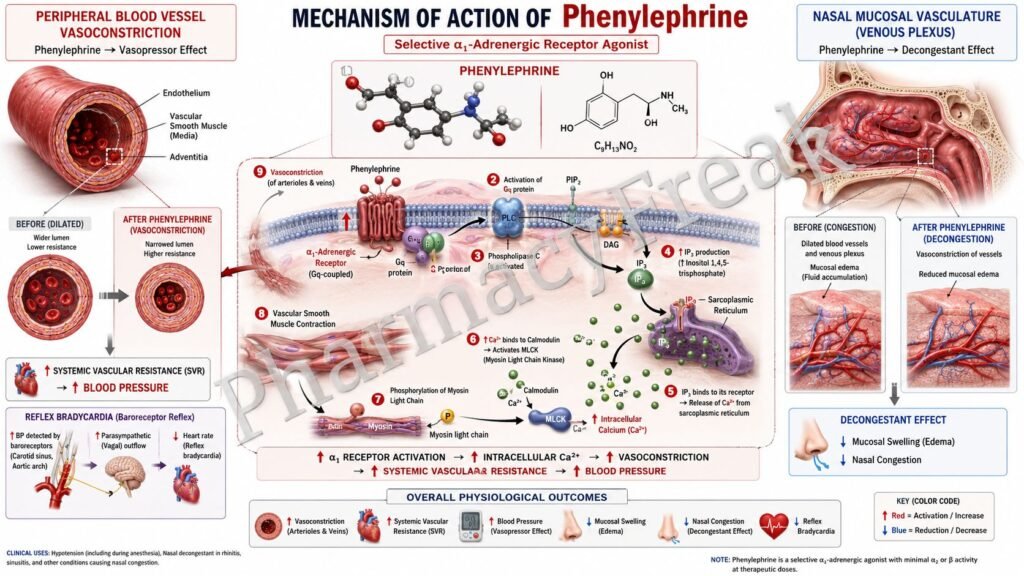
- Phenylephrine selectively binds to α1-adrenergic receptors on vascular smooth muscle.
- α1 receptors are coupled to Gq proteins.
- Activation of Gq stimulates phospholipase C (PLC).
- PLC converts PIP2 into IP3 and DAG.
- IP3 increases intracellular calcium release from the sarcoplasmic reticulum.
- Increased intracellular calcium activates smooth muscle contraction.
- This causes vasoconstriction of blood vessels.
- Vasoconstriction increases systemic vascular resistance (SVR).
- Increased SVR raises blood pressure.
- In nasal mucosa, vasoconstriction decreases edema and congestion.
- In the eye, contraction of the radial muscle causes mydriasis.
- Reflex bradycardia may occur due to elevated blood pressure.
A key exam point is that phenylephrine is a selective α1-adrenergic agonist producing vasoconstriction.
Pharmacokinetics
Phenylephrine can be administered orally, intravenously, topically, or intranasally. Oral bioavailability is reduced by first-pass metabolism via monoamine oxidase (MAO). Intravenous administration produces rapid vasopressor effects. It is metabolized mainly in the liver and gastrointestinal tract and excreted via urine.
Clinical Uses
Phenylephrine is used in hypotension and shock to increase blood pressure. It is commonly used as a nasal decongestant to reduce mucosal swelling. Ophthalmic preparations are used to induce mydriasis during eye examinations. It may also be used during anesthesia-induced hypotension.
Adverse Effects
Common adverse effects include hypertension, reflex bradycardia, headache, and nervousness. Excessive vasoconstriction may reduce tissue perfusion. Prolonged nasal use can cause rebound congestion. Patients with cardiovascular disease should use it cautiously.
Comparative Analysis
| Feature | Phenylephrine | Noradrenaline | Pseudoephedrine |
|---|---|---|---|
| Receptor activity | α1 selective | α1 + β1 | Mixed indirect + α |
| Main effect | Vasoconstriction | Vasoconstriction + cardiac stimulation | Decongestion |
| Cardiac effect | Minimal direct | Moderate | Mild |
| Use | Hypotension, decongestion | Septic shock | Nasal congestion |
| Reflex bradycardia | Common | Common | Less common |
| CNS stimulation | Minimal | Minimal | Moderate |
Phenylephrine differs from noradrenaline by lacking significant β1 activity, resulting in minimal direct cardiac stimulation. Compared to pseudoephedrine, it has more selective α1-mediated vasoconstrictive action.
MCQs
- Phenylephrine primarily stimulates which receptor?
a) β1 receptor
b) α1 receptor
c) β2 receptor
d) Dopamine receptor
Answer: b) α1 receptor
- α1 receptors are coupled to:
a) Gi proteins
b) Gq proteins
c) Gs proteins
d) None
Answer: b) Gq proteins
- Activation of α1 receptors stimulates:
a) Adenylate cyclase
b) Phospholipase C
c) ATP synthase
d) DNA polymerase
Answer: b) Phospholipase C
- IP3 increases:
a) Sodium
b) Calcium
c) Potassium
d) Chloride
Answer: b) Calcium
- Phenylephrine causes:
a) Vasodilation
b) Vasoconstriction
c) Bronchodilation
d) Cardiac depression
Answer: b) Vasoconstriction
- Phenylephrine is used in:
a) Asthma
b) Hypotension
c) Diabetes
d) Epilepsy
Answer: b) Hypotension
- A common adverse effect is:
a) Hypotension
b) Reflex bradycardia
c) Hypoglycemia
d) Hypercalcemia
Answer: b) Reflex bradycardia
- Phenylephrine relieves nasal congestion by:
a) Increasing mucus
b) Vasoconstriction
c) Bronchodilation
d) Histamine blockade
Answer: b) Vasoconstriction
- In the eye, phenylephrine causes:
a) Miosis
b) Mydriasis
c) Cycloplegia
d) Blurred vision only
Answer: b) Mydriasis
- Phenylephrine has minimal activity on:
a) α1 receptors
b) β1 receptors
c) Gq proteins
d) Calcium channels
Answer: b) β1 receptors
- Prolonged nasal use may cause:
a) Hypertension only
b) Rebound congestion
c) Hyperglycemia
d) Sedation
Answer: b) Rebound congestion
- Phenylephrine raises blood pressure by increasing:
a) Cardiac output only
b) Systemic vascular resistance
c) Insulin secretion
d) Sodium excretion
Answer: b) Systemic vascular resistance
FAQs
What is the mechanism of action of phenylephrine?
It selectively stimulates α1-adrenergic receptors causing vasoconstriction.
Why does phenylephrine increase blood pressure?
Because vasoconstriction increases systemic vascular resistance.
Why can phenylephrine cause reflex bradycardia?
Due to baroreceptor-mediated vagal response to increased blood pressure.
How does phenylephrine act as a decongestant?
By constricting blood vessels in nasal mucosa and reducing edema.
Does phenylephrine stimulate β receptors significantly?
No, it is primarily α1 selective.
What ophthalmic effect does phenylephrine produce?
Mydriasis without cycloplegia.
References
Goodman & Gilman’s The Pharmacological Basis of Therapeutics – Adrenergic Drugs
https://accessmedicine.mhmedical.com/book.aspx?bookid=3191
Katzung: Basic and Clinical Pharmacology – Sympathomimetics
https://accessmedicine.mhmedical.com/content.aspx?bookid=3382
Tripathi: Essentials of Medical Pharmacology – Adrenergic Drugs
https://www.jaypeedigital.com
Harrison’s Principles of Internal Medicine – Shock and Hypotension
https://accessmedicine.mhmedical.com