Table of Contents
Introduction
Nitrous oxide is an inhalational anesthetic gas with analgesic and sedative properties. It is widely used in anesthesia practice and procedural sedation, especially for short procedures. It has a rapid onset and recovery due to low blood solubility. Nitrous oxide provides good analgesia but relatively weak anesthetic potency, so it is often used in combination with other anesthetic agents.
Mechanism of Action (Step-wise)
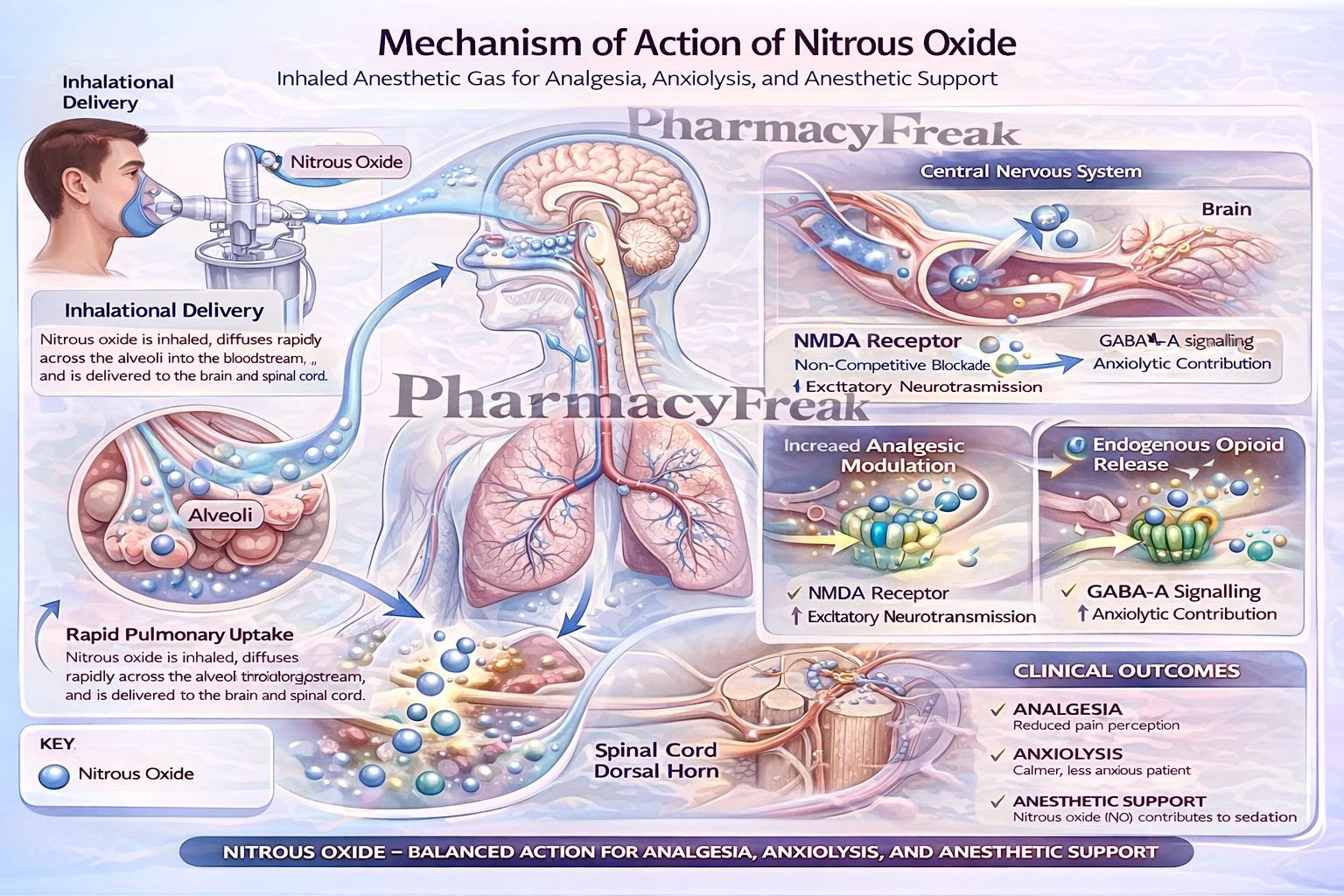
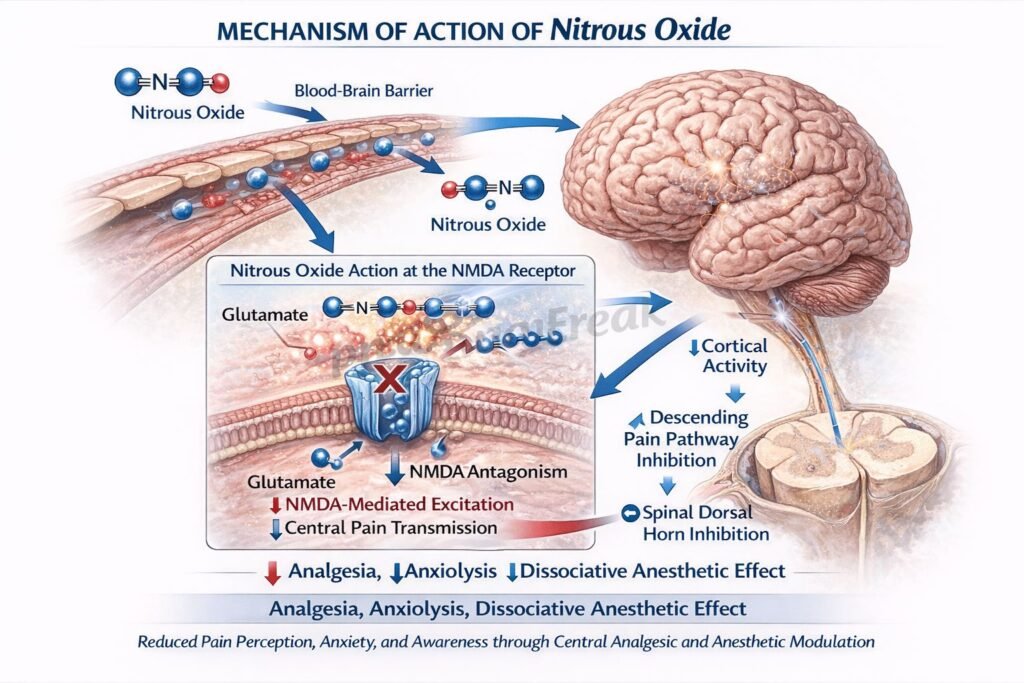
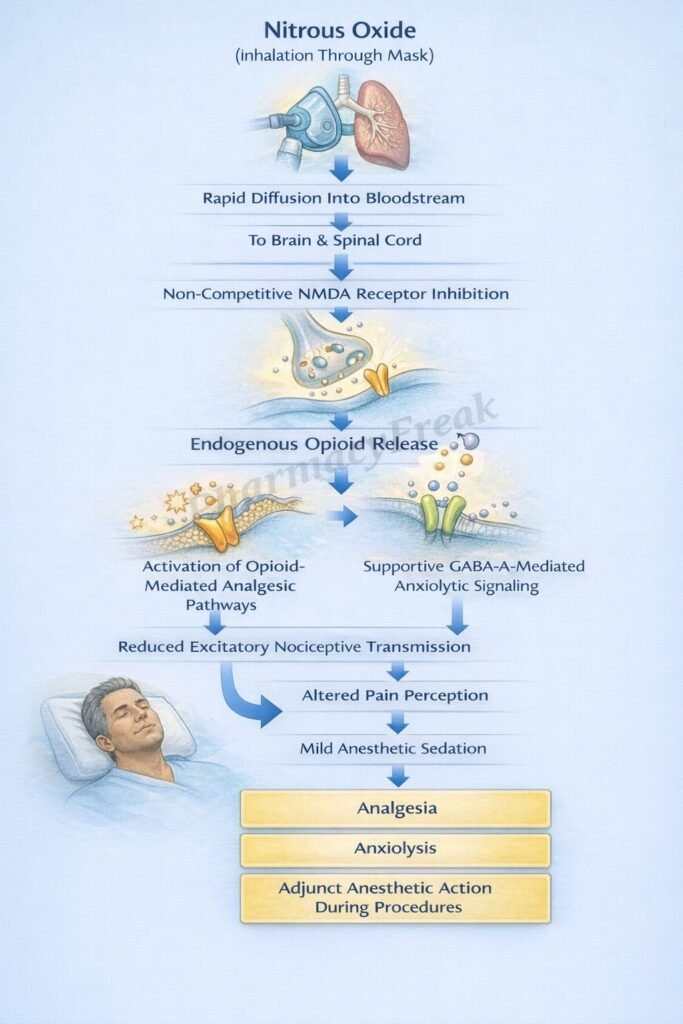
- Nitrous oxide acts as an antagonist at N-methyl-D-aspartate (NMDA) receptors.
- NMDA receptors are involved in excitatory glutamatergic neurotransmission.
- Blocking NMDA receptors reduces excitatory neuronal activity.
- This contributes to analgesia and sedation.
- Nitrous oxide also stimulates release of endogenous opioid peptides.
- These opioids activate μ-opioid receptors in the central nervous system.
- Activation of opioid receptors enhances analgesic effects.
- It increases activity of descending inhibitory pain pathways from the brainstem.
- Nitrous oxide may also modulate GABAergic neurotransmission indirectly.
- The combined effects produce analgesia, mild anesthesia, and sedation.
A key exam point is that nitrous oxide produces analgesia primarily through NMDA receptor antagonism and endogenous opioid release.
Pharmacokinetics
Nitrous oxide is administered via inhalation. It has very low blood-gas partition coefficient, leading to rapid onset and recovery. It is not significantly metabolized and is excreted unchanged via the lungs. Because of its rapid elimination, its effects wear off quickly after discontinuation. It can diffuse into air-filled spaces, which is clinically important.
Clinical Uses
Nitrous oxide is used for procedural sedation, dental procedures, and as an adjunct to general anesthesia. It provides analgesia in labor and minor surgical procedures. It is often combined with other anesthetic agents to reduce the required dose of more potent drugs.
Adverse Effects
Common adverse effects include nausea, vomiting, dizziness, and euphoria. Prolonged exposure can inactivate vitamin B12, leading to megaloblastic anemia and neurological effects. It can expand air-filled spaces, making it contraindicated in conditions such as pneumothorax or bowel obstruction. Diffusion hypoxia may occur after discontinuation.
Comparative Analysis
| Feature | Nitrous Oxide | Halothane | Propofol |
|---|---|---|---|
| Type | Inhalational anesthetic | Inhalational anesthetic | Intravenous anesthetic |
| Analgesia | Strong | Weak | Minimal |
| Onset | Very rapid | Moderate | Rapid |
| Recovery | Rapid | Moderate | Rapid |
| Potency | Low | High | High |
| Special effect | NMDA blockade | Cardiac depression | CNS depression |
Nitrous oxide differs from halothane by having strong analgesic effects but lower anesthetic potency. Compared to propofol, it is inhalational and provides better analgesia.
MCQs
- Nitrous oxide primarily blocks which receptor?
a) GABA receptor
b) NMDA receptor
c) Dopamine receptor
d) Histamine receptor
Answer: b) NMDA receptor
- NMDA receptor blockade leads to:
a) Increased excitation
b) Reduced excitation
c) Increased calcium
d) Increased sodium
Answer: b) Reduced excitation
- Nitrous oxide increases release of:
a) Insulin
b) Endogenous opioids
c) Calcium
d) Sodium
Answer: b) Endogenous opioids
- Nitrous oxide is administered via:
a) Oral route
b) Intravenous route
c) Inhalation
d) Intramuscular route
Answer: c) Inhalation
- Nitrous oxide has:
a) High blood solubility
b) Low blood solubility
c) No solubility
d) Variable solubility
Answer: b) Low blood solubility
- Nitrous oxide is used in:
a) Hypertension
b) Anesthesia
c) Diabetes
d) Asthma
Answer: b) Anesthesia
- A common adverse effect is:
a) Hypoglycemia
b) Nausea
c) Hypercalcemia
d) Bradycardia
Answer: b) Nausea
- Nitrous oxide can cause deficiency of:
a) Vitamin A
b) Vitamin B12
c) Vitamin C
d) Vitamin D
Answer: b) Vitamin B12
- Nitrous oxide is contraindicated in:
a) Hypertension
b) Pneumothorax
c) Diabetes
d) Asthma
Answer: b) Pneumothorax
- Nitrous oxide is excreted via:
a) Kidney
b) Liver
c) Lungs
d) Skin
Answer: c) Lungs
- Nitrous oxide has which onset?
a) Slow
b) Moderate
c) Rapid
d) Delayed
Answer: c) Rapid
- Nitrous oxide produces analgesia mainly by:
a) COX inhibition
b) NMDA blockade
c) Beta blockade
d) ACE inhibition
Answer: b) NMDA blockade
FAQs
What is the mechanism of action of nitrous oxide?
It blocks NMDA receptors and enhances endogenous opioid activity to produce analgesia and sedation.
Why does nitrous oxide act rapidly?
Due to its low blood solubility.
What is diffusion hypoxia?
A decrease in oxygen levels after discontinuation due to rapid elimination of nitrous oxide.
Why does nitrous oxide affect vitamin B12?
It inactivates vitamin B12, affecting DNA synthesis.
Where is nitrous oxide excreted?
Via the lungs.
Why is nitrous oxide contraindicated in pneumothorax?
It expands air-filled spaces.
References
Goodman & Gilman’s The Pharmacological Basis of Therapeutics – General Anesthetics
https://accessmedicine.mhmedical.com/book.aspx?bookid=3191
Katzung: Basic and Clinical Pharmacology – Anesthetic Agents
https://accessmedicine.mhmedical.com/content.aspx?bookid=3382
Tripathi: Essentials of Medical Pharmacology – General Anesthetics
https://www.jaypeedigital.com
Harrison’s Principles of Internal Medicine – Anesthesia and Sedation
https://accessmedicine.mhmedical.com