Table of Contents
Introduction
Nitroglycerin is an organic nitrate widely used in the management of angina pectoris and acute coronary syndromes. It acts as a potent vasodilator, primarily affecting venous capacitance vessels, thereby reducing cardiac workload. It also improves coronary blood flow and relieves ischemic chest pain. Nitroglycerin is considered a cornerstone drug for rapid relief of angina.
Mechanism of Action (Step-wise)
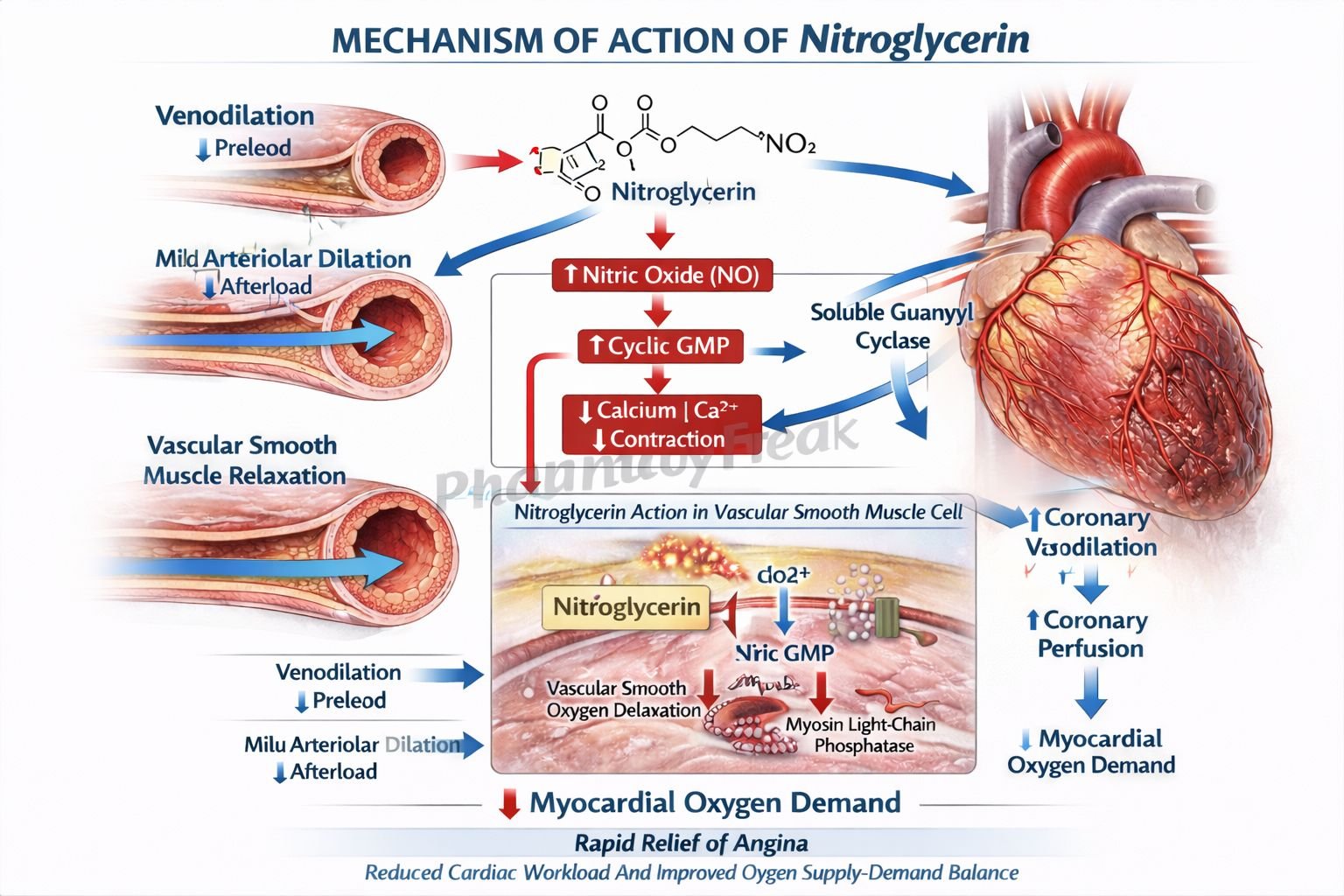
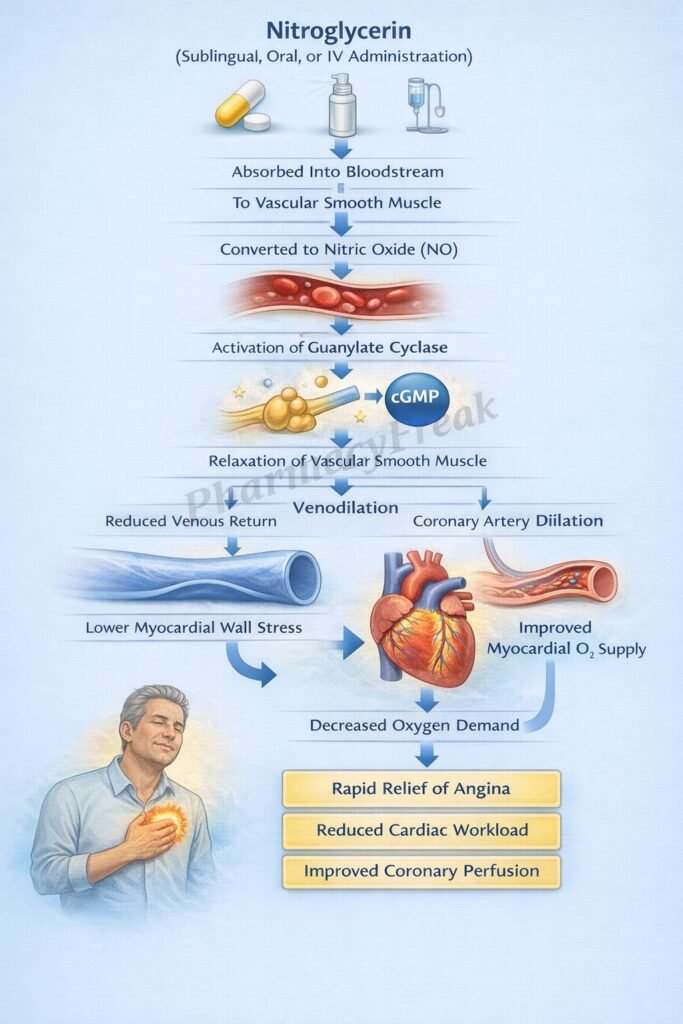
- Nitroglycerin is converted to nitric oxide (NO) in vascular smooth muscle cells.
- This conversion is mediated by mitochondrial aldehyde dehydrogenase (ALDH2).
- Nitric oxide activates soluble guanylate cyclase.
- This increases cyclic GMP (cGMP) levels inside smooth muscle cells.
- Elevated cGMP activates protein kinase G (PKG).
- PKG promotes dephosphorylation of myosin light chains.
- This leads to relaxation of vascular smooth muscle.
- Venous dilation predominates, reducing venous return (preload).
- Reduced preload decreases left ventricular wall stress and oxygen demand.
- At higher doses, arterial dilation reduces afterload.
- Coronary vasodilation improves blood flow to ischemic myocardium.
- The net effect is reduced myocardial oxygen demand and relief of angina.
A key exam point is that nitroglycerin releases nitric oxide, increasing cGMP and causing venodilation.
Pharmacokinetics
Nitroglycerin is administered via multiple routes including sublingual, oral, transdermal, and intravenous. Sublingual administration provides rapid onset by bypassing first-pass metabolism. It has a short half-life, making it suitable for acute relief. It undergoes extensive hepatic metabolism and is excreted via urine. Continuous use may lead to tolerance, requiring nitrate-free intervals.
Clinical Uses
Nitroglycerin is used for acute relief of angina pectoris and in prophylaxis of anginal attacks. It is also used in acute coronary syndromes, heart failure, and pulmonary edema due to its preload-reducing effect. Intravenous nitroglycerin is used in hypertensive emergencies and perioperative settings.
Adverse Effects
Common adverse effects include headache, flushing, dizziness, and hypotension due to vasodilation. Reflex tachycardia may occur. Tolerance develops with continuous use. Severe hypotension can occur, especially when combined with phosphodiesterase-5 inhibitors such as sildenafil. This interaction is a critical exam point.
Comparative Analysis
| Feature | Nitroglycerin | Isosorbide Dinitrate | Nicorandil |
|---|---|---|---|
| Mechanism | NO donor | NO donor | NO donor + K⁺ channel opener |
| Primary effect | Venodilation | Venodilation | Arterial + venous dilation |
| Onset | Rapid (sublingual) | Moderate | Moderate |
| Duration | Short | Longer | Moderate |
| Use | Acute angina relief | Chronic angina | Chronic angina |
| Tolerance | Common | Common | Less common |
Nitroglycerin differs from isosorbide dinitrate by having a faster onset of action, making it ideal for acute relief. Compared to nicorandil, it lacks potassium channel–opening activity and primarily acts as a nitric oxide donor.
MCQs
- Nitroglycerin acts by releasing:
a) Dopamine
b) Nitric oxide
c) Serotonin
d) Histamine
Answer: b) Nitric oxide
- Nitric oxide increases:
a) cAMP
b) cGMP
c) ATP
d) ADP
Answer: b) cGMP
- cGMP causes:
a) Contraction
b) Relaxation
c) No effect
d) Sodium influx
Answer: b) Relaxation
- Nitroglycerin primarily dilates:
a) Arteries
b) Veins
c) Capillaries
d) Lymphatics
Answer: b) Veins
- Venodilation reduces:
a) Afterload
b) Preload
c) Heart rate
d) Calcium
Answer: b) Preload
- Nitroglycerin is used in:
a) Asthma
b) Angina
c) Diabetes
d) Anemia
Answer: b) Angina
- A common adverse effect is:
a) Bradycardia
b) Headache
c) Hypoglycemia
d) Hypercalcemia
Answer: b) Headache
- Nitroglycerin may cause:
a) Bradycardia
b) Reflex tachycardia
c) Hyperglycemia
d) Hypocalcemia
Answer: b) Reflex tachycardia
- Nitroglycerin is metabolized in the:
a) Kidney
b) Liver
c) Lung
d) Brain
Answer: b) Liver
- Tolerance develops due to:
a) Increased receptors
b) Continuous exposure
c) Decreased metabolism
d) Increased excretion
Answer: b) Continuous exposure
- Nitroglycerin should not be combined with:
a) ACE inhibitors
b) Beta blockers
c) PDE-5 inhibitors
d) Diuretics
Answer: c) PDE-5 inhibitors
- Nitroglycerin reduces oxygen demand by:
a) Increasing heart rate
b) Reducing preload
c) Increasing calcium
d) Increasing sodium
Answer: b) Reducing preload
FAQs
What is the mechanism of action of nitroglycerin?
It releases nitric oxide, which increases cGMP and causes vascular smooth muscle relaxation.
Why does nitroglycerin primarily affect veins?
Veins are more sensitive to nitrates, leading to reduced preload.
What is nitrate tolerance?
Reduced drug response with continuous use.
Why is nitroglycerin given sublingually?
To bypass first-pass metabolism and provide rapid relief.
What is a dangerous drug interaction?
Combination with PDE-5 inhibitors causing severe hypotension.
How does nitroglycerin relieve angina?
By reducing myocardial oxygen demand and improving blood flow.
References
Goodman & Gilman’s The Pharmacological Basis of Therapeutics – Antianginal Drugs
https://accessmedicine.mhmedical.com/book.aspx?bookid=3191
Katzung: Basic and Clinical Pharmacology – Cardiovascular Drugs
https://accessmedicine.mhmedical.com/content.aspx?bookid=3382
Tripathi: Essentials of Medical Pharmacology – Antianginal Drugs
https://www.jaypeedigital.com
Harrison’s Principles of Internal Medicine – Ischemic Heart Disease
https://accessmedicine.mhmedical.com