Table of Contents
Introduction
Nefopam is a centrally acting non-opioid analgesic used for the management of moderate acute pain. It is distinct from NSAIDs and opioids, as it does not possess anti-inflammatory or opioid receptor activity. Nefopam is commonly used postoperatively and in musculoskeletal pain due to its analgesic properties without causing respiratory depression.
Mechanism of Action (Step-wise)
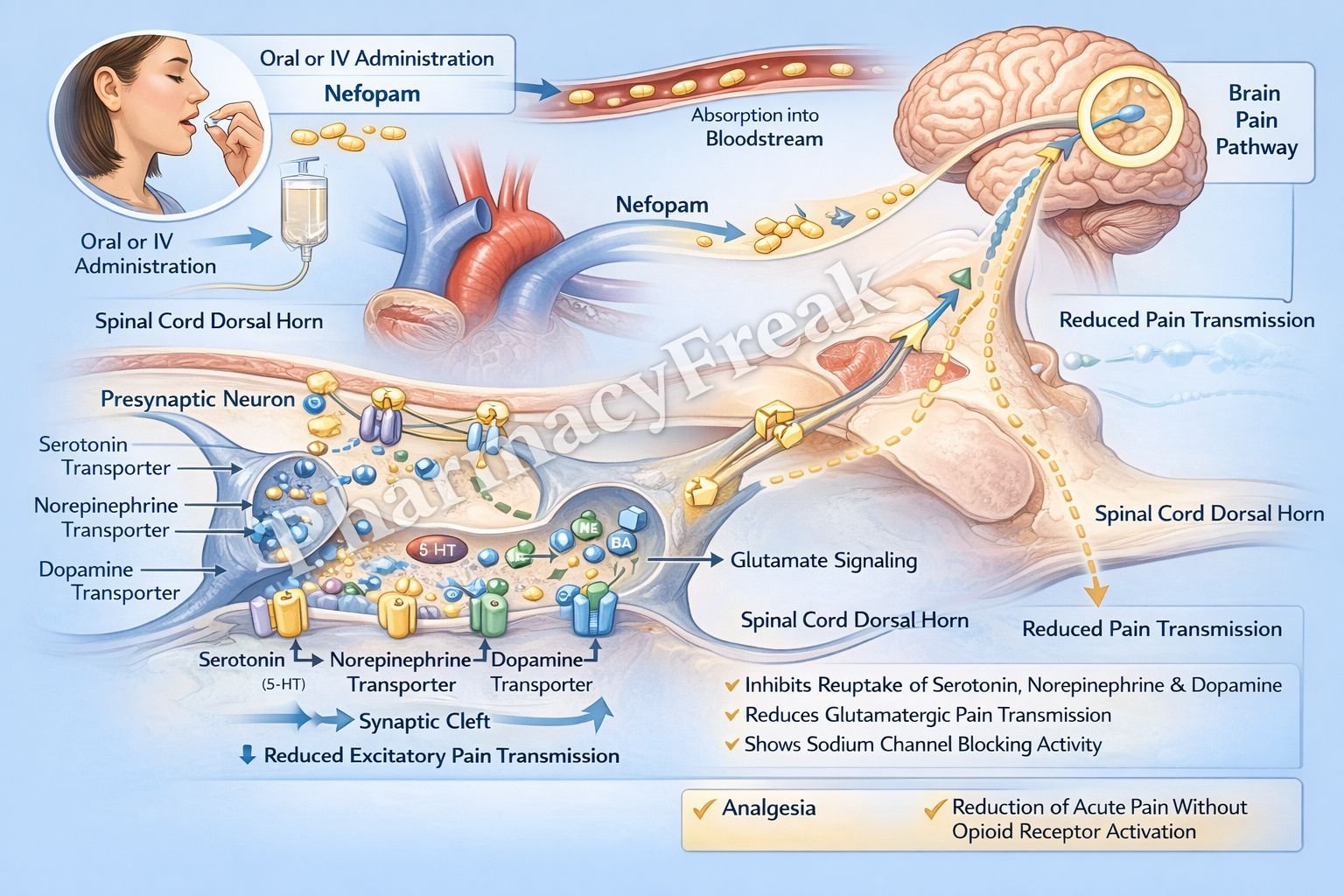
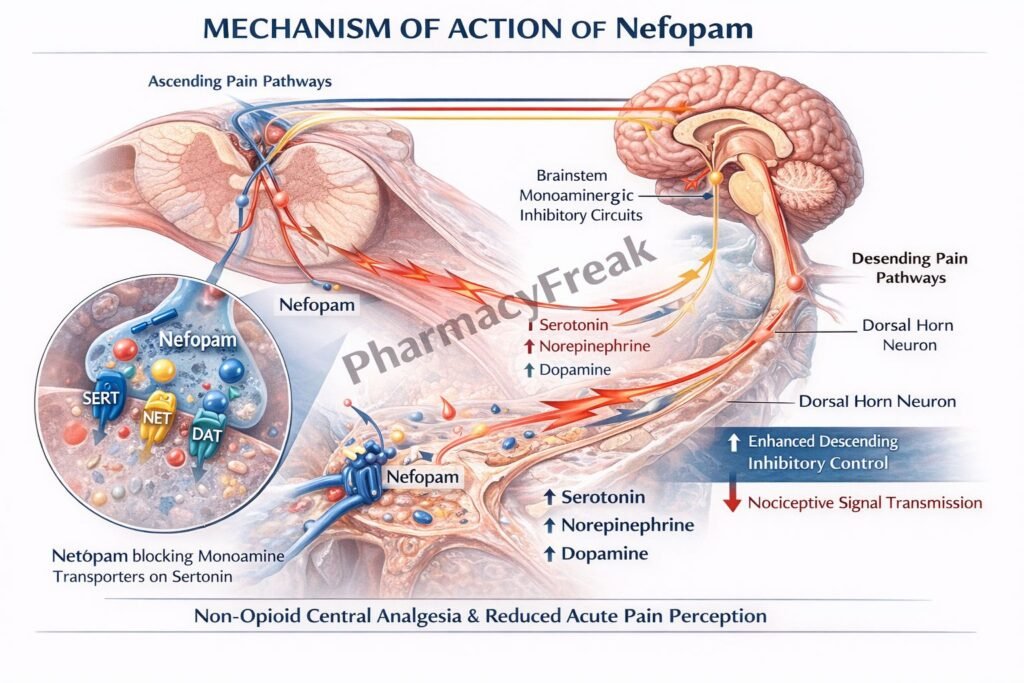
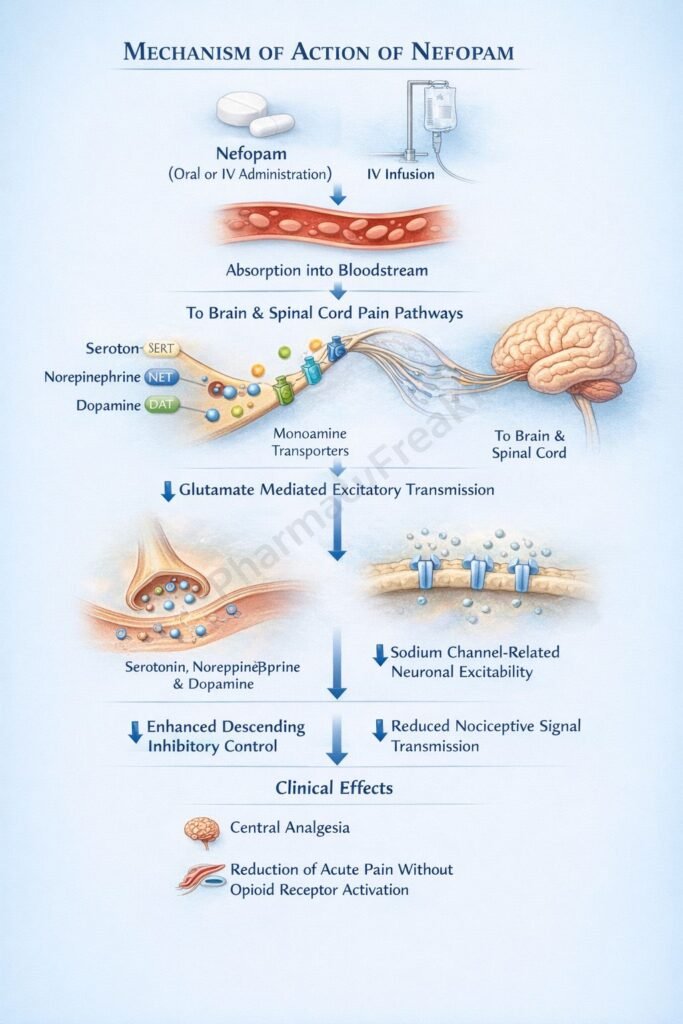
- Nefopam inhibits reuptake of monoamines including serotonin (5-HT), norepinephrine (NE), and dopamine (DA).
- This increases the concentration of these neurotransmitters in the synaptic cleft.
- Enhanced monoaminergic transmission contributes to modulation of pain pathways in the CNS.
- Nefopam also inhibits voltage-gated sodium channels.
- This reduces neuronal excitability and transmission of pain signals.
- It may modulate glutamatergic transmission by reducing NMDA receptor–mediated activity.
- This contributes to decreased central sensitization to pain.
- It acts at spinal and supraspinal levels to reduce pain perception.
- Unlike opioids, it does not act on μ-opioid receptors.
- The overall effect is analgesia without respiratory depression.
A key exam point is that nefopam inhibits monoamine reuptake and sodium channels to produce central analgesia.
Pharmacokinetics
Nefopam is administered orally or intravenously. It is well absorbed and widely distributed in the body. It is metabolized in the liver and excreted mainly via the kidneys. It has a moderate half-life and requires multiple daily dosing depending on the route of administration.
Clinical Uses
Nefopam is used for the treatment of moderate acute pain, including postoperative pain and musculoskeletal pain. It is particularly useful as an alternative to opioids in patients where respiratory depression is a concern. It may also be used as part of multimodal analgesia to reduce opioid requirements.
Adverse Effects
Common adverse effects include nausea, sweating, dizziness, and tachycardia. CNS-related effects such as confusion, hallucinations, or agitation may occur, especially at higher doses. It may also cause urinary retention. Unlike opioids, it does not cause significant respiratory depression but should still be used cautiously.
Comparative Analysis
| Feature | Nefopam | Morphine | NSAIDs |
|---|---|---|---|
| Mechanism | Monoamine reuptake inhibition | μ-opioid receptor agonist | COX inhibition |
| Analgesic type | Central | Central | Peripheral + central |
| Anti-inflammatory | No | No | Yes |
| Respiratory depression | No | Yes | No |
| Dependence risk | Low | High | None |
| Use | Moderate pain | Severe pain | Mild–moderate pain |
Nefopam differs from morphine by lacking opioid receptor activity and respiratory depression. Compared to NSAIDs, it does not have anti-inflammatory effects but works centrally to reduce pain.
MCQs
- Nefopam is classified as:
a) Opioid analgesic
b) NSAID
c) Non-opioid central analgesic
d) Antidepressant
Answer: c) Non-opioid central analgesic
- Nefopam inhibits reuptake of:
a) Insulin
b) Monoamines
c) Calcium
d) Sodium only
Answer: b) Monoamines
- Nefopam increases levels of:
a) Serotonin
b) Norepinephrine
c) Dopamine
d) All of the above
Answer: d) All of the above
- Nefopam also blocks:
a) Calcium channels
b) Sodium channels
c) Potassium channels
d) Chloride channels
Answer: b) Sodium channels
- Nefopam acts mainly in the:
a) Liver
b) CNS
c) Kidney
d) Heart
Answer: b) CNS
- Nefopam does NOT act on:
a) Opioid receptors
b) Monoamine transporters
c) Sodium channels
d) CNS
Answer: a) Opioid receptors
- Nefopam is used for:
a) Severe chronic pain only
b) Moderate acute pain
c) Diabetes
d) Asthma
Answer: b) Moderate acute pain
- A common adverse effect is:
a) Bradycardia
b) Tachycardia
c) Hypoglycemia
d) Hypercalcemia
Answer: b) Tachycardia
- Nefopam does not cause:
a) Analgesia
b) Respiratory depression
c) CNS effects
d) Nausea
Answer: b) Respiratory depression
- Nefopam reduces pain by:
a) Blocking prostaglandins
b) Enhancing monoamines
c) Blocking insulin
d) Increasing calcium
Answer: b) Enhancing monoamines
- Nefopam is metabolized in the:
a) Kidney
b) Liver
c) Lung
d) Brain
Answer: b) Liver
- Nefopam is useful in reducing:
a) Inflammation
b) Opioid requirement
c) Blood sugar
d) Calcium levels
Answer: b) Opioid requirement
FAQs
What is the mechanism of action of nefopam?
It inhibits reuptake of serotonin, norepinephrine, and dopamine and blocks sodium channels to reduce pain.
Is nefopam an opioid?
No, it is a non-opioid analgesic.
Does nefopam cause respiratory depression?
No, unlike opioids.
What type of pain is nefopam used for?
Moderate acute pain, including postoperative pain.
Does nefopam have anti-inflammatory effects?
No, it does not reduce inflammation.
What is a common cardiovascular side effect?
Tachycardia.
References
Goodman & Gilman’s The Pharmacological Basis of Therapeutics – Analgesics
https://accessmedicine.mhmedical.com/book.aspx?bookid=3191
Katzung: Basic and Clinical Pharmacology – Analgesic Drugs
https://accessmedicine.mhmedical.com/content.aspx?bookid=3382
Tripathi: Essentials of Medical Pharmacology – Analgesics
https://www.jaypeedigital.com
Harrison’s Principles of Internal Medicine – Pain Management
https://accessmedicine.mhmedical.com