Table of Contents
Introduction
N-Acetylcysteine (NAC) is a mucolytic and antioxidant drug widely used in the management of acetaminophen (paracetamol) toxicity and respiratory conditions with thick mucus. It serves as a precursor to glutathione and plays a crucial role in detoxification and reduction of oxidative stress. NAC has both pulmonary and hepatic protective effects.
Mechanism of Action (Step-wise)
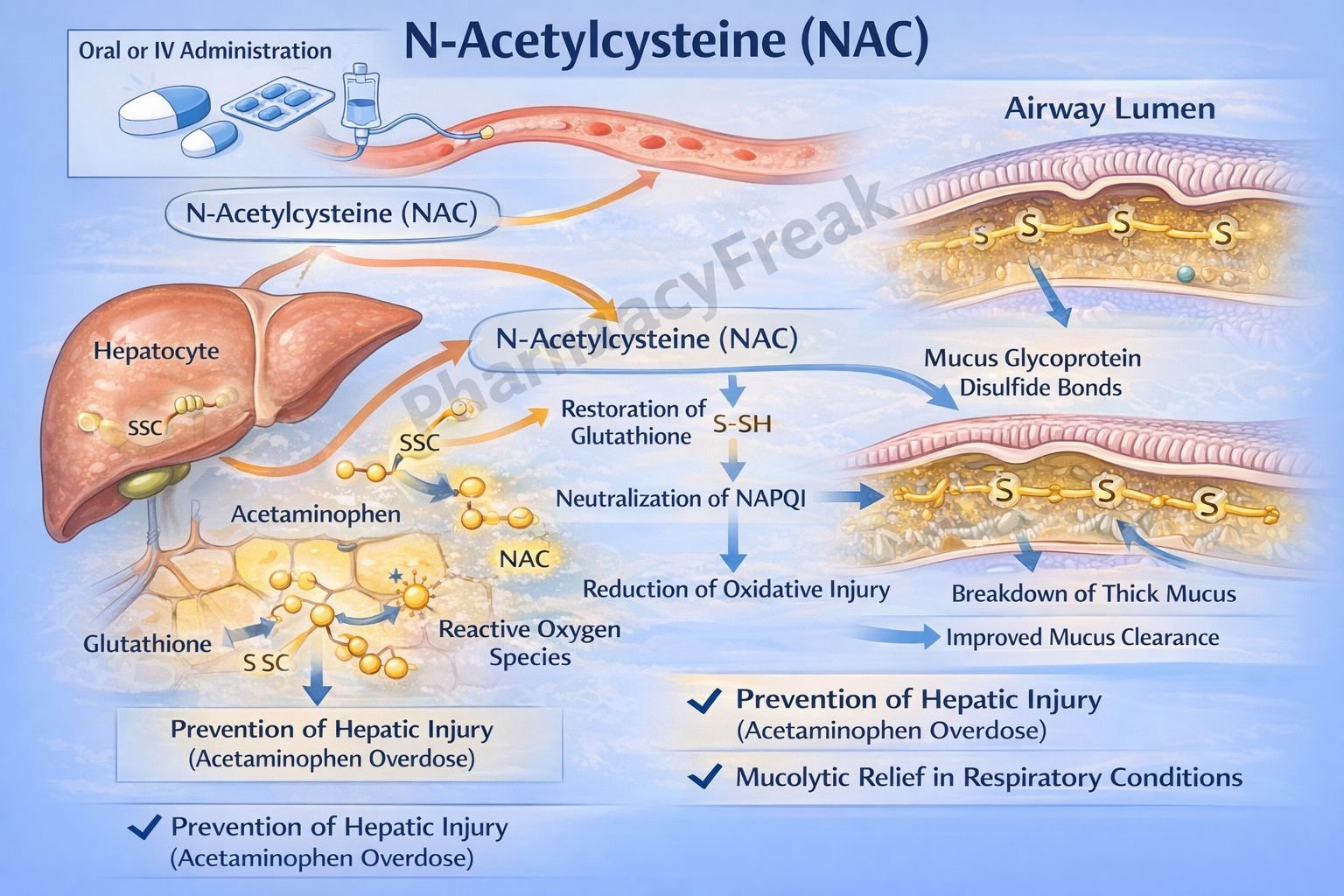
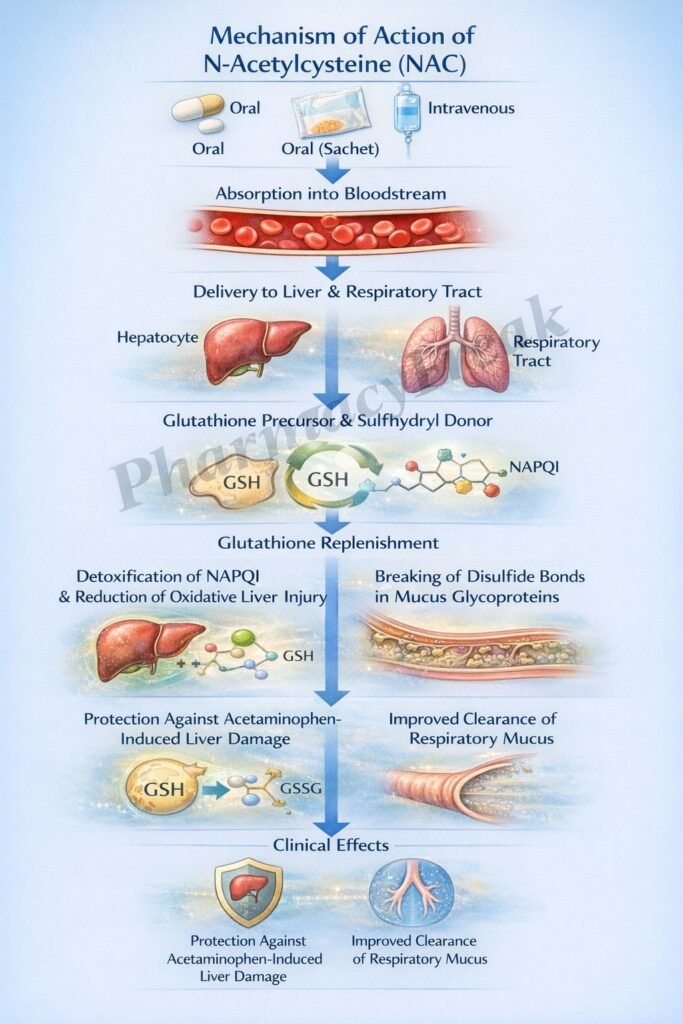
- NAC acts as a precursor of cysteine, an essential amino acid for glutathione synthesis.
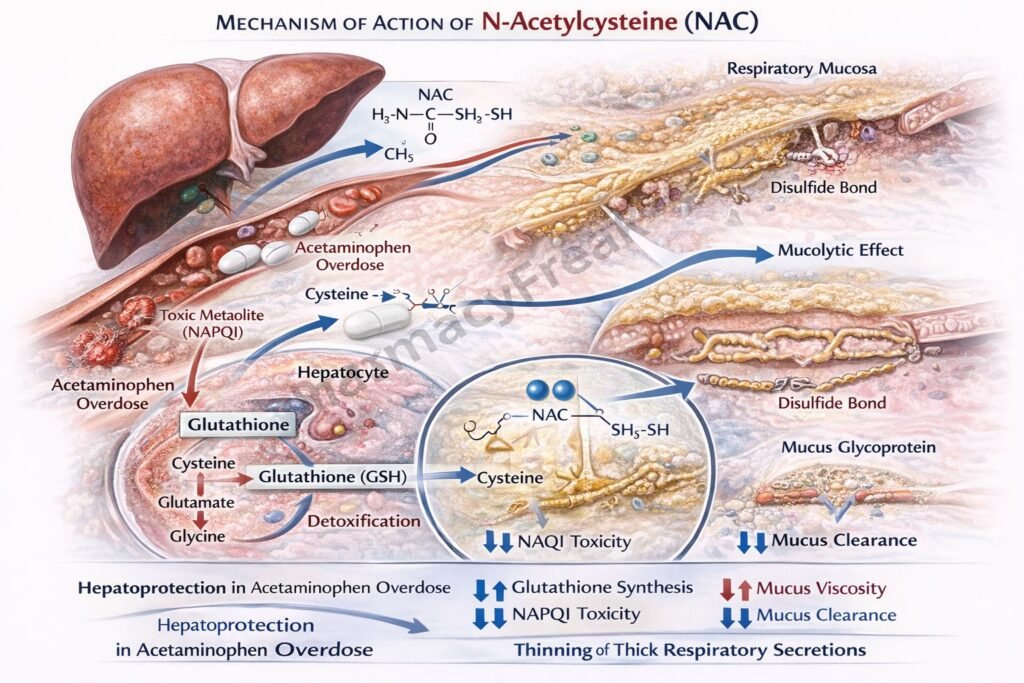
- It increases intracellular glutathione (GSH) levels.
- Glutathione detoxifies reactive metabolites such as N-acetyl-p-benzoquinone imine (NAPQI).
- In acetaminophen overdose, NAC replenishes depleted glutathione stores.
- This allows safe conjugation and elimination of toxic metabolites.
- NAC can also directly bind and neutralize NAPQI.
- In the respiratory tract, NAC breaks disulfide bonds in mucoproteins.
- This reduces mucus viscosity and improves clearance.
- NAC also has antioxidant properties, scavenging free radicals.
- It reduces inflammation and oxidative damage in tissues.
A key exam point is that NAC replenishes glutathione and acts as a mucolytic by breaking disulfide bonds.
Pharmacokinetics
NAC can be administered orally, intravenously, or via inhalation. Oral NAC undergoes first-pass metabolism in the liver, while intravenous administration ensures rapid availability in acute toxicity. It is widely distributed in body tissues and contributes to intracellular glutathione synthesis. It is metabolized in the liver and excreted via urine.
Clinical Uses
NAC is the drug of choice in acetaminophen (paracetamol) poisoning, where it prevents liver damage by replenishing glutathione. It is also used as a mucolytic in chronic respiratory conditions such as chronic bronchitis and COPD. In some settings, it is used for contrast-induced nephropathy and as an antioxidant in various conditions.
Adverse Effects
Common adverse effects include nausea, vomiting, and unpleasant odor or taste (especially with oral formulations). Intravenous administration may cause hypersensitivity reactions such as rash, bronchospasm, or anaphylactoid reactions. Inhaled NAC may cause cough or bronchospasm.
Comparative Analysis
| Feature | N-Acetylcysteine | Activated Charcoal | Methionine |
|---|---|---|---|
| Mechanism | Glutathione precursor | Adsorbs toxins | Glutathione precursor |
| Use in poisoning | Acetaminophen overdose | Various toxins | Alternative in overdose |
| Route | Oral, IV, inhalation | Oral | Oral |
| Additional effect | Mucolytic | None | None |
| Antioxidant effect | Yes | No | Yes |
NAC differs from activated charcoal, which prevents toxin absorption, whereas NAC detoxifies toxic metabolites. Compared to methionine, NAC is faster acting and more commonly used in acetaminophen poisoning.
MCQs
- NAC is primarily used in:
a) Hypertension
b) Acetaminophen poisoning
c) Diabetes
d) Asthma
Answer: b) Acetaminophen poisoning
- NAC increases levels of:
a) Insulin
b) Glutathione
c) Dopamine
d) Calcium
Answer: b) Glutathione
- NAC detoxifies which metabolite?
a) NAPQI
b) Glucose
c) Urea
d) Lactate
Answer: a) NAPQI
- NAC acts as a precursor of:
a) Tyrosine
b) Cysteine
c) Glycine
d) Alanine
Answer: b) Cysteine
- In lungs, NAC acts by:
a) Increasing mucus
b) Breaking disulfide bonds
c) Increasing inflammation
d) Blocking histamine
Answer: b) Breaking disulfide bonds
- NAC reduces mucus:
a) Volume
b) Viscosity
c) Production
d) Color
Answer: b) Viscosity
- NAC can be given via:
a) Oral only
b) IV only
c) Oral, IV, inhalation
d) Intramuscular only
Answer: c) Oral, IV, inhalation
- NAC has which property?
a) Anticoagulant
b) Antioxidant
c) Antidiabetic
d) Antipsychotic
Answer: b) Antioxidant
- A common adverse effect is:
a) Hyperglycemia
b) Nausea
c) Hypercalcemia
d) Bradycardia
Answer: b) Nausea
- NAC directly binds:
a) Glucose
b) NAPQI
c) Calcium
d) Sodium
Answer: b) NAPQI
- NAC is used as a mucolytic in:
a) Diabetes
b) COPD
c) Hypertension
d) Thyroid disease
Answer: b) COPD
- IV NAC may cause:
a) Hypoglycemia
b) Anaphylactoid reactions
c) Hyperkalemia
d) Bradycardia
Answer: b) Anaphylactoid reactions
FAQs
What is the mechanism of action of NAC?
It replenishes glutathione and detoxifies reactive metabolites while also acting as a mucolytic.
Why is NAC used in acetaminophen poisoning?
It restores glutathione levels to neutralize toxic metabolites.
How does NAC act as a mucolytic?
By breaking disulfide bonds in mucus proteins, reducing viscosity.
What is the toxic metabolite in acetaminophen overdose?
NAPQI.
Can NAC be given intravenously?
Yes, especially in acute poisoning.
What is a serious adverse effect of IV NAC?
Anaphylactoid reactions.
References
Goodman & Gilman’s The Pharmacological Basis of Therapeutics – Antidotes
https://accessmedicine.mhmedical.com/book.aspx?bookid=3191
Katzung: Basic and Clinical Pharmacology – Toxicology
https://accessmedicine.mhmedical.com/content.aspx?bookid=3382
Tripathi: Essentials of Medical Pharmacology – Antidotes
https://www.jaypeedigital.com
Harrison’s Principles of Internal Medicine – Drug Toxicity
https://accessmedicine.mhmedical.com