Table of Contents
Introduction
Mycophenolate mofetil is an immunosuppressive drug widely used in organ transplantation and autoimmune diseases. It is a prodrug that is converted to mycophenolic acid (MPA), its active form. It selectively inhibits lymphocyte proliferation, making it highly effective in preventing graft rejection and treating immune-mediated disorders.
Mechanism of Action (Step-wise)
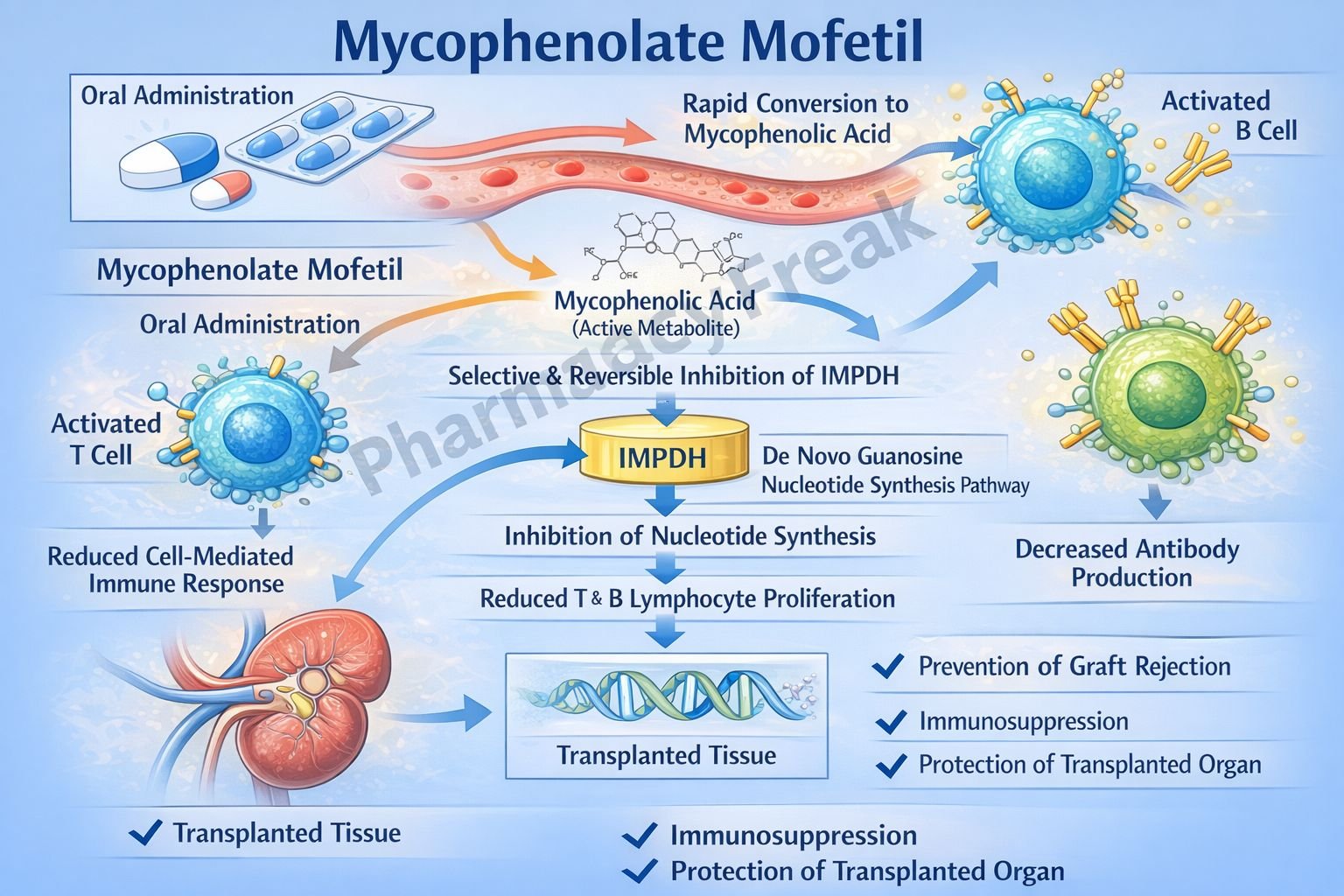
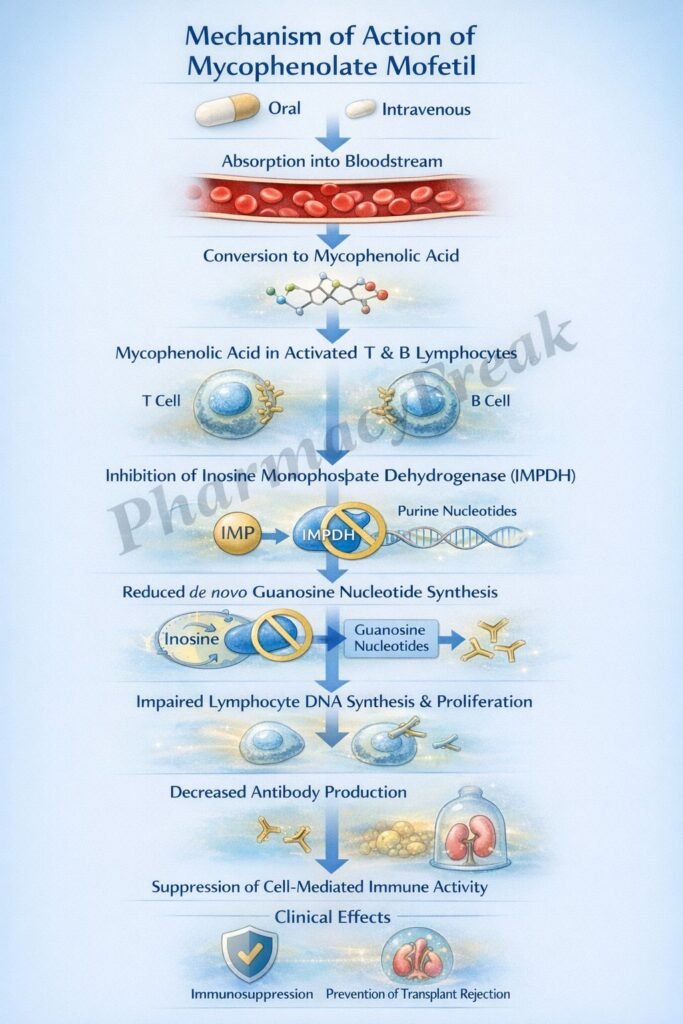
- Mycophenolate mofetil is a prodrug that is converted to mycophenolic acid (MPA) in the body.
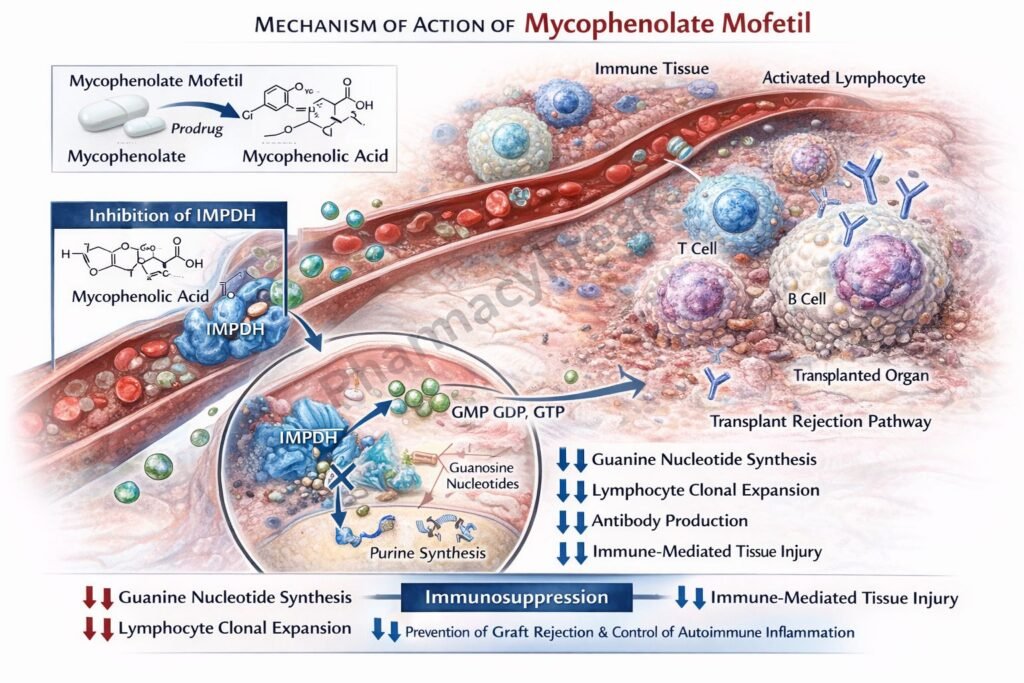
- MPA selectively inhibits inosine monophosphate dehydrogenase (IMPDH).
- IMPDH is a key enzyme in the de novo synthesis of guanine nucleotides.
- Inhibition of IMPDH reduces production of guanosine monophosphate (GMP).
- This leads to decreased DNA and RNA synthesis.
- T and B lymphocytes rely heavily on de novo purine synthesis.
- Other cells can use salvage pathways, but lymphocytes cannot effectively do so.
- Therefore, lymphocyte proliferation is selectively inhibited.
- This reduces clonal expansion of immune cells.
- It also decreases antibody production by B cells.
- The overall effect is suppression of immune response and prevention of graft rejection.
A key exam point is that mycophenolate inhibits IMPDH, blocking guanine nucleotide synthesis and lymphocyte proliferation.
Pharmacokinetics
Mycophenolate mofetil is administered orally or intravenously. It is rapidly absorbed and converted to mycophenolic acid. It undergoes hepatic metabolism and enterohepatic recirculation, which prolongs its effect. It is excreted mainly in urine as inactive metabolites. It has good bioavailability and is commonly used in combination with other immunosuppressants.
Clinical Uses
Mycophenolate mofetil is primarily used to prevent organ transplant rejection, especially in kidney, heart, and liver transplantation. It is also used in autoimmune diseases such as systemic lupus erythematosus and rheumatoid arthritis. It is often part of combination therapy with calcineurin inhibitors and corticosteroids.
Adverse Effects
Common adverse effects include gastrointestinal symptoms such as diarrhea, nausea, and vomiting. Bone marrow suppression may occur, leading to leukopenia, anemia, and increased risk of infections. It is teratogenic and contraindicated in pregnancy. Long-term use may increase the risk of malignancies due to immunosuppression.
Comparative Analysis
| Feature | Mycophenolate Mofetil | Azathioprine | Cyclosporine |
|---|---|---|---|
| Mechanism | IMPDH inhibition | Purine analog (DNA synthesis inhibition) | Calcineurin inhibition |
| Target cells | T and B lymphocytes | Rapidly dividing cells | T lymphocytes |
| Selectivity | High for lymphocytes | Less selective | T-cell specific |
| Use | Transplant, autoimmune diseases | Transplant, autoimmune | Transplant |
| Bone marrow suppression | Moderate | High | Minimal |
| Nephrotoxicity | No | No | Yes |
Mycophenolate differs from azathioprine by being more selective for lymphocytes and having less bone marrow toxicity. Compared to cyclosporine, it does not cause nephrotoxicity and acts on nucleotide synthesis rather than T-cell activation.
MCQs
- Mycophenolate mofetil is a:
a) Direct active drug
b) Prodrug
c) Enzyme activator
d) Hormone
Answer: b) Prodrug
- It is converted to:
a) Mycophenolic acid
b) Methotrexate
c) Cyclosporine
d) Azathioprine
Answer: a) Mycophenolic acid
- Mycophenolate inhibits which enzyme?
a) DNA polymerase
b) IMPDH
c) RNA polymerase
d) ATP synthase
Answer: b) IMPDH
- IMPDH is involved in synthesis of:
a) Pyrimidines
b) Guanine nucleotides
c) Proteins
d) Lipids
Answer: b) Guanine nucleotides
- Mycophenolate mainly affects:
a) Liver cells
b) Muscle cells
c) Lymphocytes
d) Neurons
Answer: c) Lymphocytes
- Lymphocytes rely on:
a) Salvage pathway only
b) De novo synthesis
c) Glycolysis
d) Krebs cycle
Answer: b) De novo synthesis
- Mycophenolate is used in:
a) Hypertension
b) Organ transplantation
c) Diabetes
d) Asthma
Answer: b) Organ transplantation
- A common adverse effect is:
a) Hypertension
b) Diarrhea
c) Hypercalcemia
d) Bradycardia
Answer: b) Diarrhea
- Mycophenolate may cause:
a) Leukocytosis
b) Leukopenia
c) Hyperglycemia
d) Hypokalemia
Answer: b) Leukopenia
- Mycophenolate is contraindicated in:
a) Diabetes
b) Pregnancy
c) Hypertension
d) Asthma
Answer: b) Pregnancy
- Compared to cyclosporine, mycophenolate:
a) Causes nephrotoxicity
b) Does not cause nephrotoxicity
c) Has same effect
d) Is less effective
Answer: b) Does not cause nephrotoxicity
- Mycophenolate reduces immune response by:
a) Increasing antibodies
b) Inhibiting lymphocyte proliferation
c) Stimulating T cells
d) Increasing cytokines
Answer: b) Inhibiting lymphocyte proliferation
FAQs
What is the mechanism of action of mycophenolate mofetil?
It inhibits IMPDH, blocking guanine nucleotide synthesis and lymphocyte proliferation.
Why is mycophenolate selective for lymphocytes?
Because lymphocytes rely on de novo purine synthesis.
What is the active form of the drug?
Mycophenolic acid.
What is a major adverse effect?
Bone marrow suppression and increased infection risk.
Why is it contraindicated in pregnancy?
Because it is teratogenic.
What is its main clinical use?
Prevention of organ transplant rejection.
References
Goodman & Gilman’s The Pharmacological Basis of Therapeutics – Immunosuppressants
https://accessmedicine.mhmedical.com/book.aspx?bookid=3191
Katzung: Basic and Clinical Pharmacology – Immunosuppressive Agents
https://accessmedicine.mhmedical.com/content.aspx?bookid=3382
Tripathi: Essentials of Medical Pharmacology – Immunosuppressants
https://www.jaypeedigital.com
Harrison’s Principles of Internal Medicine – Transplantation
https://accessmedicine.mhmedical.com