Table of Contents
Introduction
Glucocorticoids are steroid hormones that regulate metabolism, immune responses, inflammation, and stress adaptation. Endogenous glucocorticoids such as cortisol are produced by the adrenal cortex, while synthetic glucocorticoids like prednisone, dexamethasone, and hydrocortisone are widely used in clinical medicine.
Glucocorticoids exert their effects primarily through intracellular glucocorticoid receptors, altering gene transcription and protein synthesis. Their anti inflammatory and immunosuppressive properties make them essential in the treatment of autoimmune diseases, allergic disorders, inflammatory conditions, and organ transplantation.
The mechanism of glucocorticoids is a high yield pharmacology topic for examinations such as USMLE, NEET PG, FMGE, PLAB, INICET, NCLEX, and MCCQE.
Mechanism of Action (Step-wise)
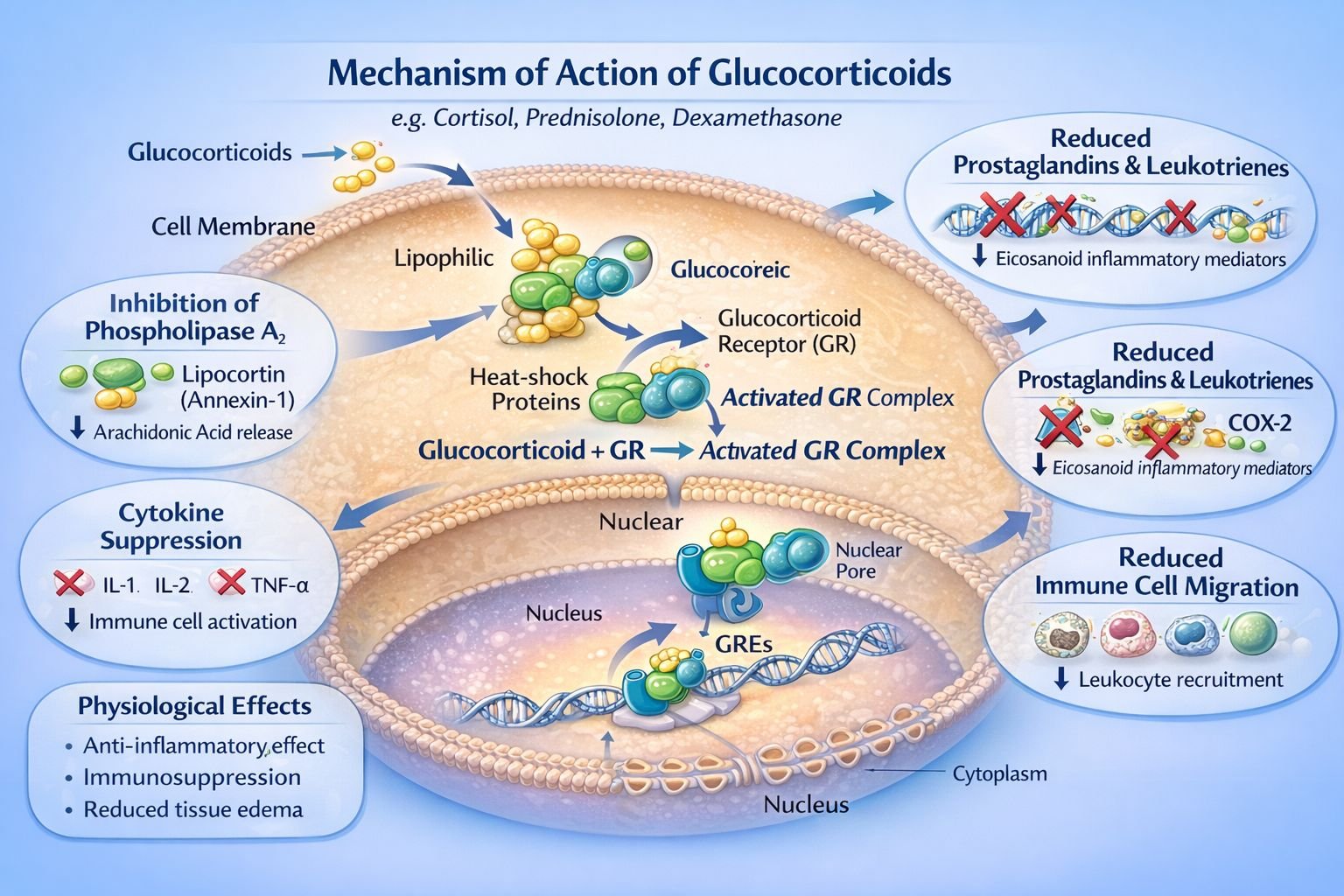
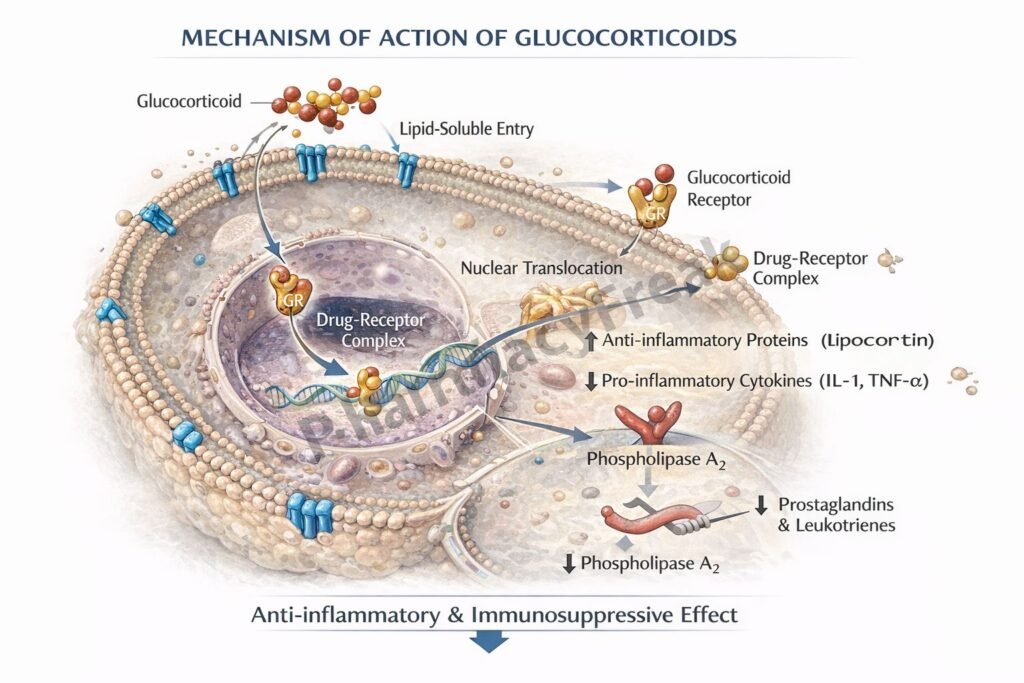
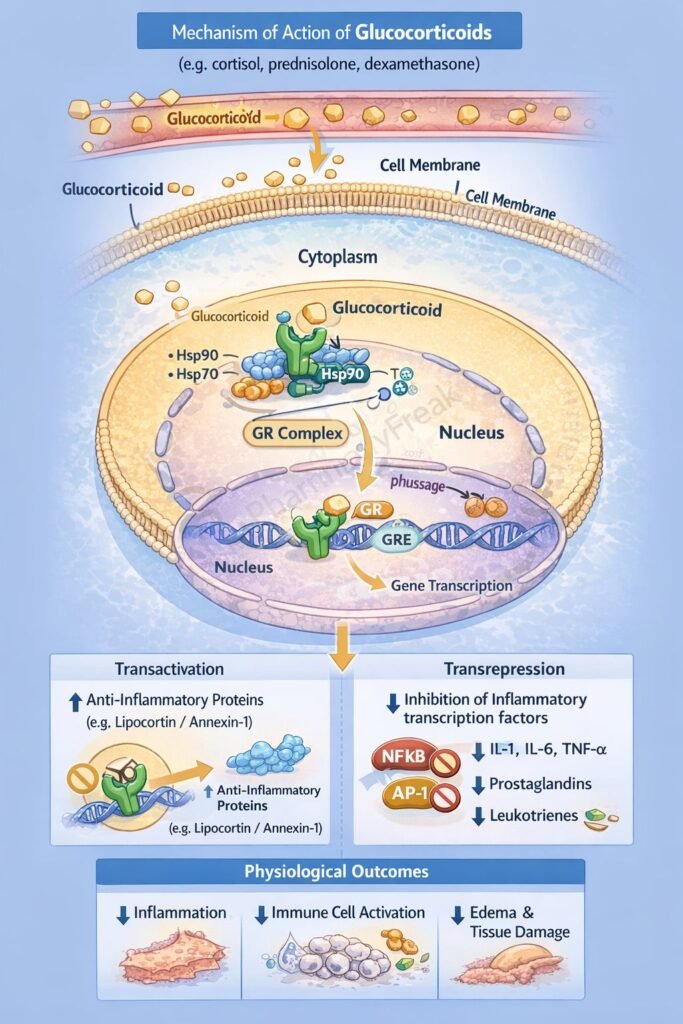
Glucocorticoids act mainly through genomic mechanisms that regulate transcription of inflammatory and metabolic genes.
Step 1: Cellular entry
Glucocorticoids are lipophilic and easily diffuse across the cell membrane into the cytoplasm.
Step 2: Binding to glucocorticoid receptor
Inside the cytoplasm, glucocorticoids bind to glucocorticoid receptors (GR), which are intracellular nuclear receptors bound to heat shock proteins.
Step 3: Activation of receptor complex
Drug binding causes dissociation of heat shock proteins and activation of the glucocorticoid receptor.
Step 4: Nuclear translocation
The activated glucocorticoid receptor complex translocates into the nucleus.
Step 5: Regulation of gene transcription
The receptor complex binds to glucocorticoid response elements (GREs) on DNA, altering transcription of specific genes.
Step 6: Anti inflammatory protein synthesis
Glucocorticoids increase production of anti inflammatory proteins such as lipocortin (annexin A1), which inhibits phospholipase A2.
Step 7: Suppression of inflammatory mediators
They reduce expression of pro inflammatory cytokines, prostaglandins, leukotrienes, and adhesion molecules.
Overall effect:
Powerful anti inflammatory and immunosuppressive actions through modulation of gene transcription.
Key pharmacology concept:
Glucocorticoids inhibit phospholipase A2 and reduce arachidonic acid production, thereby decreasing both prostaglandin and leukotriene synthesis.
Pharmacokinetics
Absorption:
Well absorbed orally; also available via intravenous, topical, inhalational, and intraarticular routes.
Distribution:
Widely distributed in tissues and bound to plasma proteins such as corticosteroid binding globulin.
Metabolism:
Metabolized primarily in the liver.
Excretion:
Excreted mainly in urine as inactive metabolites.
Duration:
Half life varies depending on the drug; dexamethasone has a longer duration compared to hydrocortisone.
Clinical Uses
- Autoimmune diseases such as rheumatoid arthritis and systemic lupus erythematosus
- Allergic disorders including asthma and anaphylaxis
- Inflammatory diseases such as inflammatory bowel disease
- Prevention of organ transplant rejection
- Replacement therapy in adrenal insufficiency
- Cerebral edema and severe infections
Adverse Effects
Short term adverse effects:
- Hyperglycemia
- Fluid retention
- Mood changes
Long term adverse effects:
- Osteoporosis
- Cushingoid features
- Muscle wasting
- Immunosuppression
- Growth suppression in children
Important complication:
- Sudden withdrawal may cause adrenal insufficiency due to suppression of the hypothalamic pituitary adrenal axis.
Comparative Analysis
| Feature | Glucocorticoids | NSAIDs | Antihistamines |
|---|---|---|---|
| Primary mechanism | Gene transcription regulation | COX inhibition | H1 receptor blockade |
| Anti inflammatory potency | Very high | Moderate | Mild |
| Effect on immune system | Strong suppression | Minimal | Minimal |
| Effect on prostaglandins | Decrease synthesis | Decrease synthesis | No direct effect |
| Clinical use | Autoimmune and inflammatory diseases | Pain and inflammation | Allergic conditions |
Explanation:
Glucocorticoids act at the genomic level, regulating gene transcription and inhibiting inflammatory mediators upstream in the arachidonic acid pathway. NSAIDs act downstream by inhibiting cyclooxygenase enzymes responsible for prostaglandin synthesis. Antihistamines primarily block histamine H1 receptors and have a limited anti inflammatory role compared to glucocorticoids.
MCQs
- Glucocorticoids act primarily by:
a) Blocking ion channels
b) Regulating gene transcription
c) Inhibiting DNA replication
d) Blocking ribosomes
Answer: b) Regulating gene transcription
- Glucocorticoid receptors are located in the:
a) Cell membrane
b) Cytoplasm
c) Mitochondria
d) Lysosome
Answer: b) Cytoplasm
- Lipocortin inhibits:
a) Cyclooxygenase
b) Phospholipase A2
c) Lipoxygenase
d) DNA polymerase
Answer: b) Phospholipase A2
- Decreased arachidonic acid leads to reduced synthesis of:
a) Cytokines only
b) Prostaglandins only
c) Prostaglandins and leukotrienes
d) Histamine
Answer: c) Prostaglandins and leukotrienes
- Glucocorticoids suppress release of:
a) Pro inflammatory cytokines
b) Insulin
c) Growth hormone
d) Thyroxine
Answer: a) Pro inflammatory cytokines
- Long term glucocorticoid therapy may cause:
a) Hypoglycemia
b) Osteoporosis
c) Hypotension
d) Bradycardia
Answer: b) Osteoporosis
- Sudden withdrawal of glucocorticoids can cause:
a) Hypertension
b) Adrenal crisis
c) Hyperthyroidism
d) Renal failure
Answer: b) Adrenal crisis
- Glucocorticoids reduce inflammation mainly by:
a) Increasing prostaglandins
b) Inhibiting phospholipase A2
c) Activating histamine receptors
d) Increasing leukotrienes
Answer: b) Inhibiting phospholipase A2
- Which pathway is suppressed by glucocorticoids?
a) Arachidonic acid pathway
b) Glycolysis
c) TCA cycle
d) Electron transport chain
Answer: a) Arachidonic acid pathway
- Example of a synthetic glucocorticoid:
a) Insulin
b) Prednisone
c) Metformin
d) Propranolol
Answer: b) Prednisone
FAQs
- How do glucocorticoids reduce inflammation?
By regulating gene transcription and suppressing production of inflammatory mediators. - What enzyme is inhibited by glucocorticoid induced lipocortin?
Phospholipase A2. - Why should glucocorticoids be tapered gradually?
Because sudden withdrawal may lead to adrenal insufficiency due to suppression of the HPA axis. - Do glucocorticoids suppress the immune system?
Yes, they inhibit cytokine production and immune cell activation. - What is the difference between glucocorticoids and NSAIDs?
Glucocorticoids act upstream by inhibiting phospholipase A2, while NSAIDs inhibit cyclooxygenase enzymes. - Can glucocorticoids cause metabolic effects?
Yes, they can increase blood glucose, promote protein breakdown, and redistribute fat.
References
Goodman & Gilman’s Pharmacological Basis of Therapeutics
https://accessmedicine.mhmedical.com/book.aspx?bookID=2189
Katzung BG. Basic and Clinical Pharmacology
https://accessmedicine.mhmedical.com/book.aspx?bookID=2249
Tripathi KD. Essentials of Medical Pharmacology
https://jaypeedigital.com/book/9789354651970
Harrison’s Principles of Internal Medicine
https://accessmedicine.mhmedical.com/book.aspx?bookID=3095