Table of Contents
Introduction
Timolol is a nonselective β-adrenergic receptor blocker widely used in glaucoma, ocular hypertension, hypertension, angina pectoris, migraine prophylaxis, and certain cardiac arrhythmias. In ophthalmology, timolol is particularly important because it lowers intraocular pressure by reducing aqueous humor production. Unlike many glaucoma medications, it does not significantly affect pupil size or accommodation.
Mechanism of Action (Step-wise)
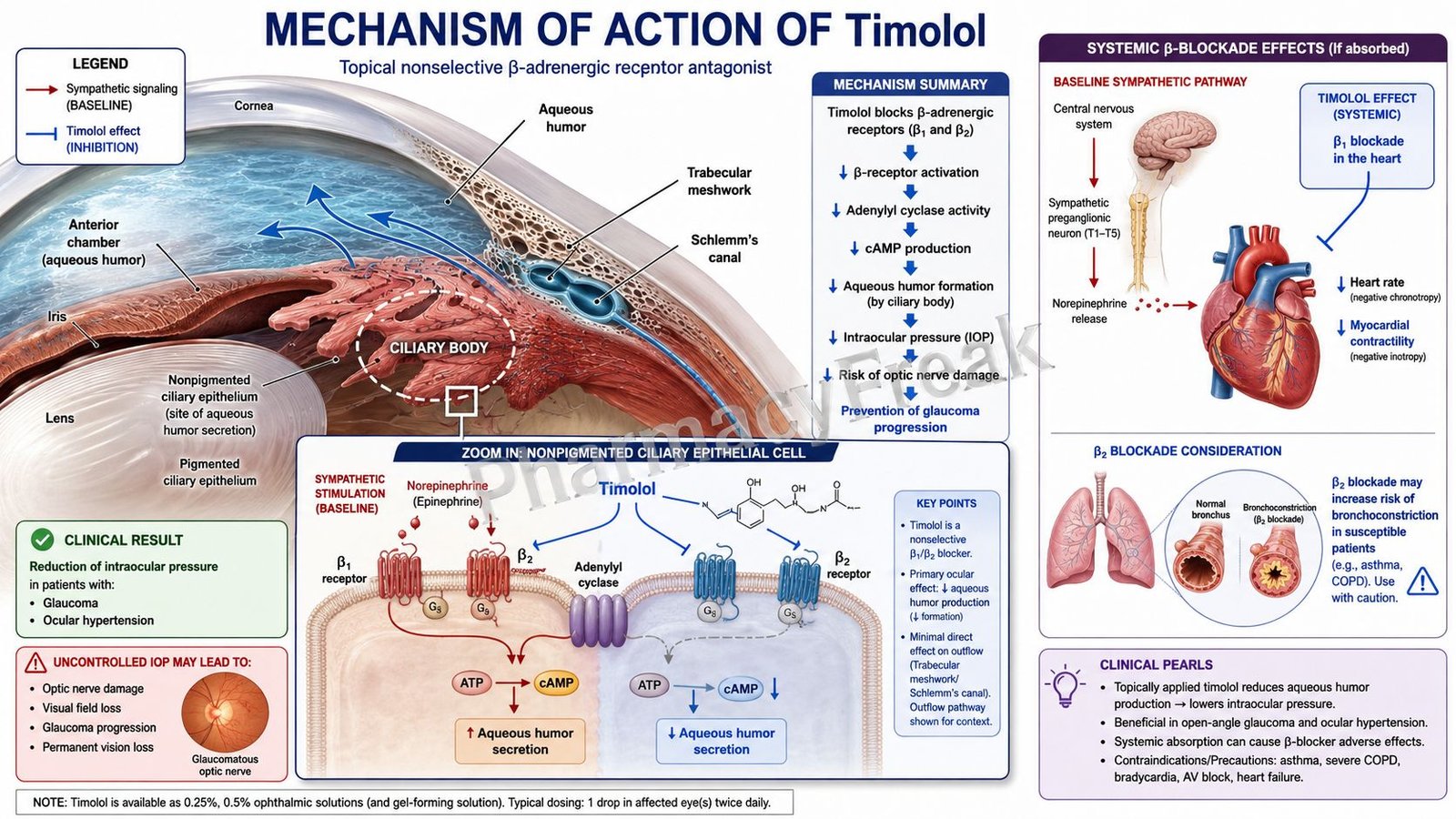
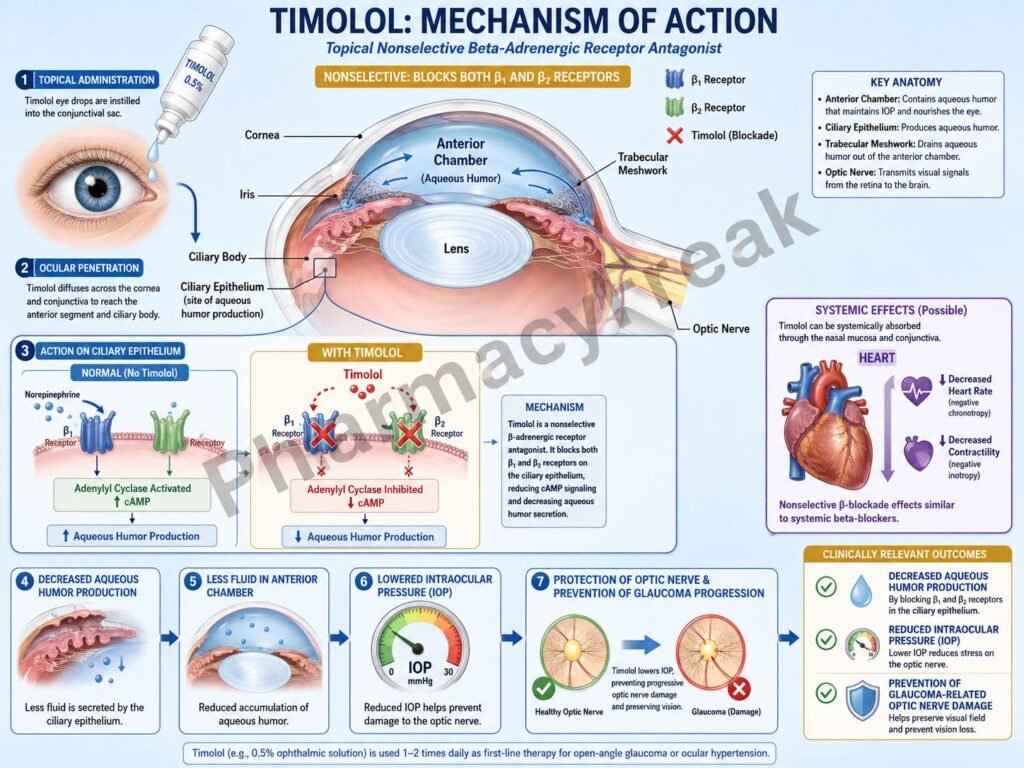
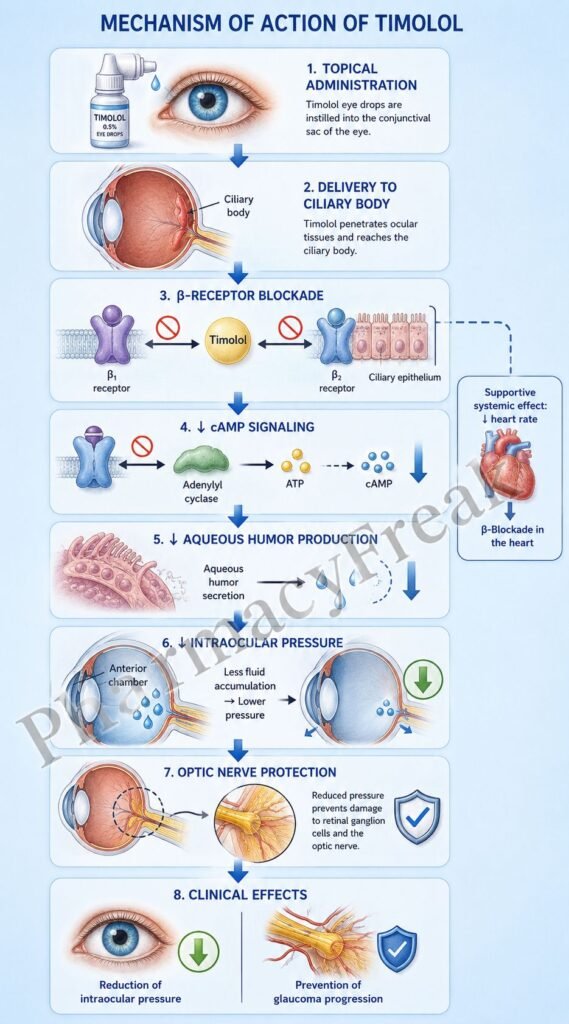
- Timolol competitively blocks both β1 and β2 adrenergic receptors.
- In the eye, β receptors are present on the non-pigmented epithelium of the ciliary body.
- Normally, stimulation of β receptors increases cyclic AMP (cAMP) production.
- Increased cAMP promotes aqueous humor secretion into the posterior chamber.
- Timolol blocks β receptor activation.
- Intracellular cAMP production decreases.
- Aqueous humor formation by the ciliary epithelium decreases.
- Intraocular pressure (IOP) falls due to reduced aqueous humor production.
- In the cardiovascular system, β1 receptor blockade decreases heart rate and myocardial contractility.
- Cardiac output decreases.
- Renin release from the kidneys is reduced.
- Reduced renin suppresses activation of the renin-angiotensin-aldosterone system (RAAS).
- Blood pressure decreases.
- The overall effect is reduction of intraocular pressure and suppression of sympathetic cardiovascular activity.
A key exam point is that timolol lowers intraocular pressure by decreasing aqueous humor production through β-receptor blockade in the ciliary body.
Pharmacokinetics
Timolol is available as ophthalmic drops and oral formulations. After ocular administration, a portion of the drug may be systemically absorbed through the nasolacrimal duct. Timolol undergoes hepatic metabolism and is eliminated primarily through the kidneys.
Clinical Uses
Timolol is used in:
- Open-angle glaucoma
- Ocular hypertension
- Hypertension
- Angina pectoris
- Migraine prophylaxis
- Post-myocardial infarction therapy
- Certain tachyarrhythmias
Adverse Effects
Common adverse effects include:
- Bradycardia
- Fatigue
- Dizziness
- Hypotension
- Cold extremities
Ophthalmic adverse effects include:
- Eye irritation
- Dry eyes
- Blurred vision
Serious adverse effects may include:
- Bronchospasm
- Heart block
- Severe bradycardia
- Worsening heart failure
Because timolol is nonselective, it should be used cautiously in patients with asthma or COPD.
Comparative Analysis
| Feature | Timolol | Betaxolol | Latanoprost |
|---|---|---|---|
| Drug class | Nonselective β blocker | Selective β1 blocker | Prostaglandin analog |
| Main glaucoma mechanism | ↓ Aqueous humor production | ↓ Aqueous humor production | ↑ Aqueous humor outflow |
| β1 blockade | Yes | Yes | No |
| β2 blockade | Yes | Minimal | No |
| Bronchospasm risk | Higher | Lower | None |
| First-line glaucoma use | Common | Alternative | Very common |
Timolol differs from latanoprost because it decreases aqueous humor production, whereas latanoprost increases aqueous humor outflow. Compared with betaxolol, timolol has greater β2 blockade and therefore a higher risk of bronchospasm.
MCQs
1. Timolol belongs to which drug class?
a) Calcium channel blockers
b) β blockers
c) ACE inhibitors
d) α agonists
Answer: b) β blockers
2. Timolol blocks:
a) β1 receptors only
b) β2 receptors only
c) Both β1 and β2 receptors
d) α1 receptors
Answer: c) Both β1 and β2 receptors
3. Timolol lowers intraocular pressure by:
a) Increasing aqueous humor production
b) Increasing aqueous humor outflow only
c) Decreasing aqueous humor production
d) Causing miosis
Answer: c) Decreasing aqueous humor production
4. The site of aqueous humor production is the:
a) Retina
b) Cornea
c) Ciliary body
d) Optic nerve
Answer: c) Ciliary body
5. Timolol is commonly used in:
a) Open-angle glaucoma
b) Cataracts
c) Retinal detachment
d) Conjunctivitis
Answer: a) Open-angle glaucoma
6. β1 receptor blockade causes:
a) Increased heart rate
b) Decreased heart rate
c) Bronchodilation
d) Increased renin release
Answer: b) Decreased heart rate
7. Timolol reduces release of:
a) Histamine
b) Renin
c) Insulin
d) Thyroxine
Answer: b) Renin
8. A common adverse effect is:
a) Bradycardia
b) Hypercalcemia
c) Hyperthyroidism
d) Polycythemia
Answer: a) Bradycardia
9. A serious adverse effect is:
a) Bronchospasm
b) Hypernatremia
c) Cataracts
d) Glaucoma
Answer: a) Bronchospasm
10. Timolol should be used cautiously in patients with:
a) Asthma
b) Migraine
c) Diabetes insipidus
d) Hyperlipidemia
Answer: a) Asthma
11. Compared with latanoprost, timolol:
a) Increases aqueous humor outflow
b) Decreases aqueous humor production
c) Causes pupillary constriction
d) Blocks prostaglandin receptors
Answer: b) Decreases aqueous humor production
12. The primary ophthalmic effect of timolol is:
a) Reduction of intraocular pressure
b) Retinal repair
c) Corneal anesthesia
d) Lens clarification
Answer: a) Reduction of intraocular pressure
FAQs
What is the mechanism of action of timolol?
Timolol blocks β receptors in the ciliary body, reducing aqueous humor production and lowering intraocular pressure.
Why is timolol used in glaucoma?
Because it effectively lowers intraocular pressure and helps prevent optic nerve damage.
Is timolol a selective β blocker?
No, timolol is a nonselective β1 and β2 receptor blocker.
What are common side effects of timolol?
Bradycardia, fatigue, dizziness, eye irritation, and hypotension.
Why can timolol cause bronchospasm?
Because blockade of β2 receptors in the airways can cause bronchoconstriction.
How does timolol differ from latanoprost?
Timolol decreases aqueous humor production, whereas latanoprost increases aqueous humor outflow.
References
Goodman & Gilman’s The Pharmacological Basis of Therapeutics
https://accessmedicine.mhmedical.com/book.aspx?bookid=3191
Katzung’s Basic and Clinical Pharmacology
https://accessmedicine.mhmedical.com/content.aspx?bookid=3382
Tripathi KD. Essentials of Medical Pharmacology
https://www.jaypeedigital.com
Harrison’s Principles of Internal Medicine
https://accessmedicine.mhmedical.com