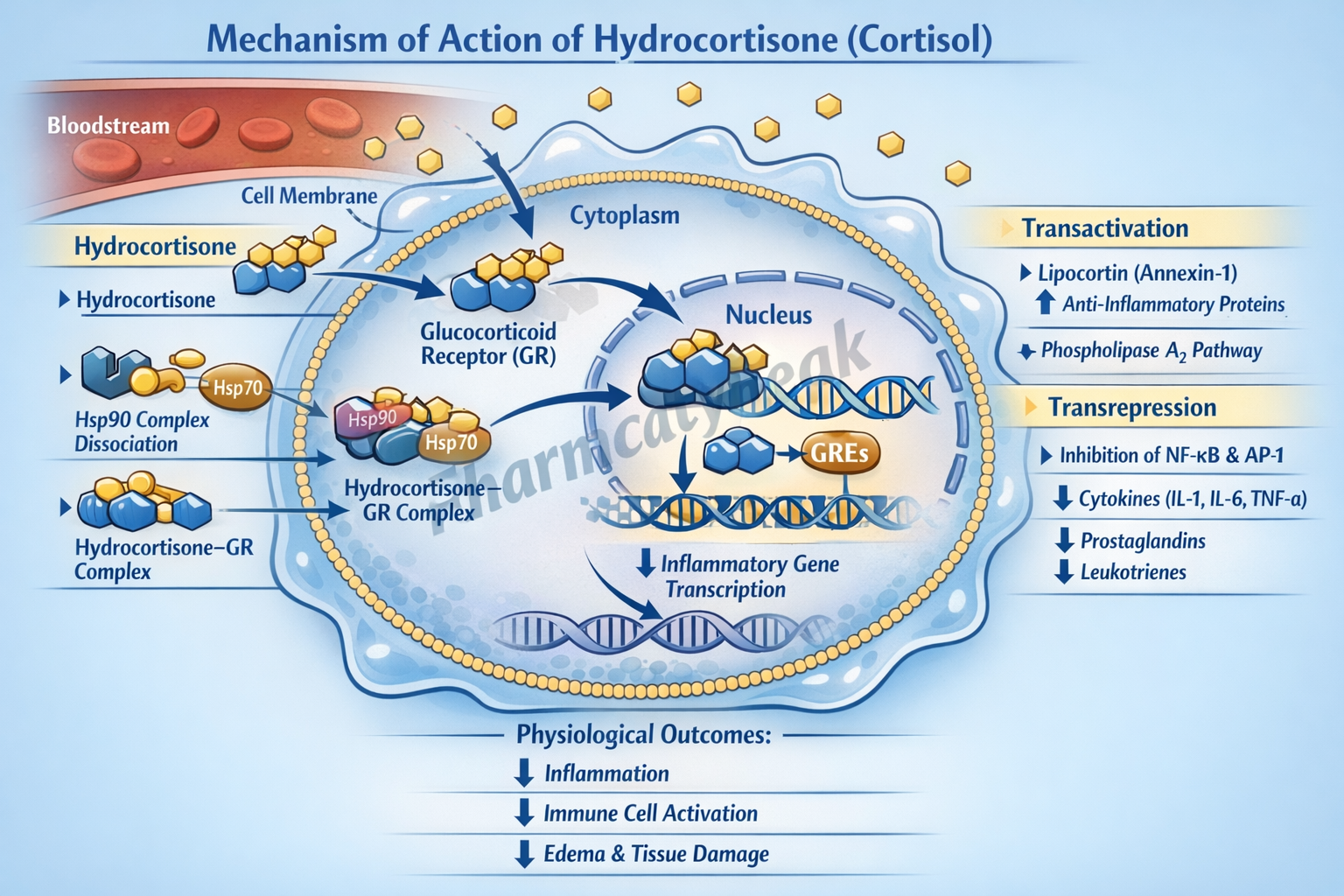
Table of Contents
Introduction
Hydrocortisone is a naturally occurring glucocorticoid hormone that is identical to cortisol produced by the adrenal cortex. It exhibits both glucocorticoid and mild mineralocorticoid activity and is widely used for its anti-inflammatory, immunosuppressive, and metabolic effects. Hydrocortisone is used clinically in conditions such as adrenal insufficiency, allergic reactions, autoimmune diseases, inflammatory disorders, and dermatologic conditions.
Hydrocortisone works primarily by binding to intracellular glucocorticoid receptors and regulating gene transcription. Through this genomic mechanism, it suppresses inflammatory mediators and immune responses.
Understanding this mechanism is important for pharmacology and medical licensing examinations such as USMLE, NEET PG, FMGE, PLAB, INICET, NCLEX, and MCCQE.
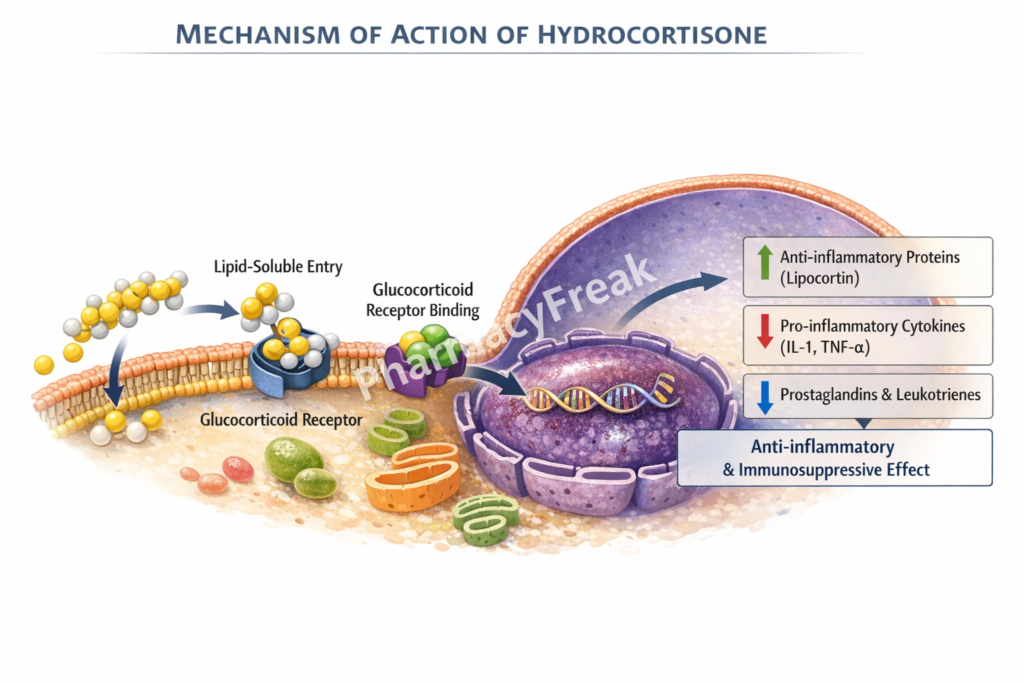
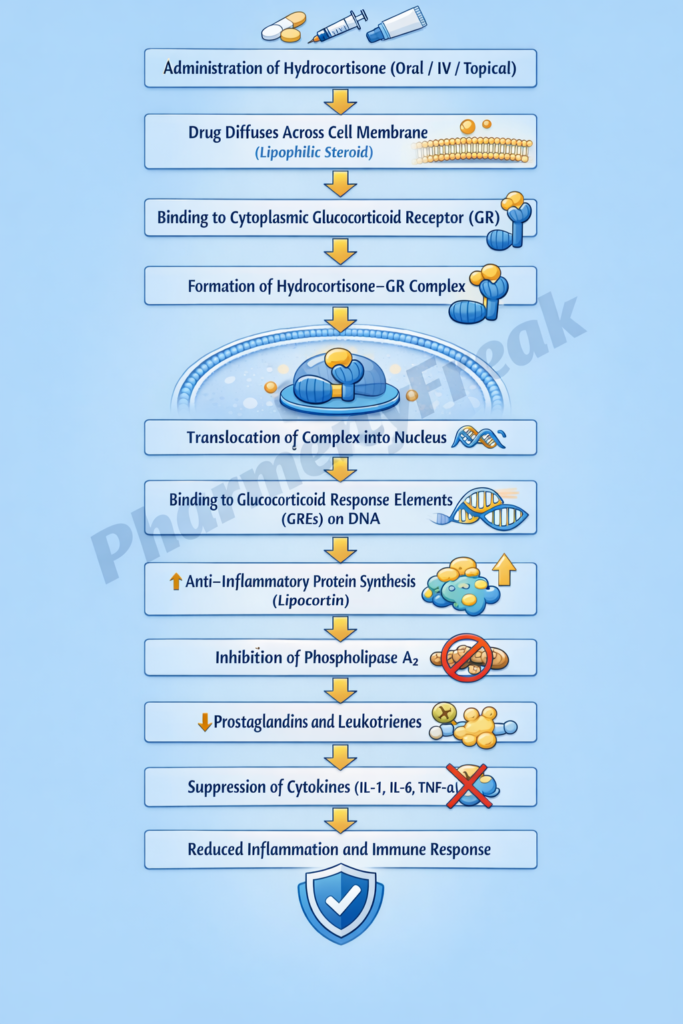
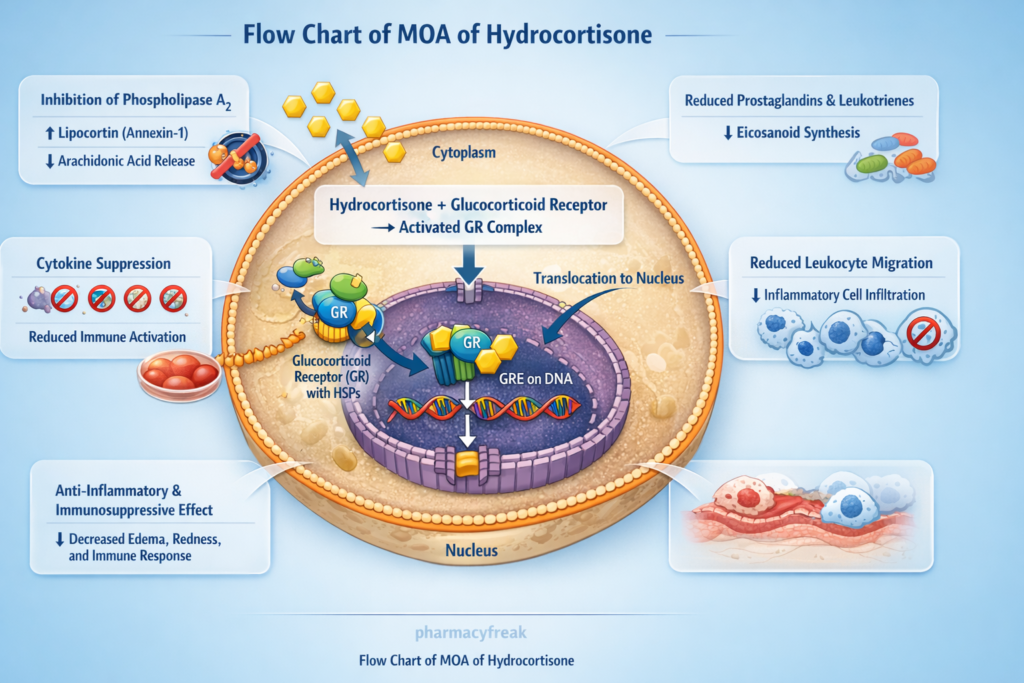
Mechanism of Action (Step-wise)
Hydrocortisone exerts its pharmacological effects by regulating gene transcription through intracellular glucocorticoid receptors.
Step 1: Diffusion across the cell membrane
Hydrocortisone is lipophilic and easily diffuses through the cell membrane into the cytoplasm.
Step 2: Binding to glucocorticoid receptor
Inside the cytoplasm, hydrocortisone binds to glucocorticoid receptors (GR), which are associated with heat shock proteins.
Step 3: Activation of receptor complex
Binding causes dissociation of heat shock proteins and activation of the hydrocortisone–receptor complex.
Step 4: Nuclear translocation
The activated glucocorticoid receptor complex moves into the nucleus.
Step 5: Binding to glucocorticoid response elements
The complex binds to glucocorticoid response elements (GREs) on DNA, regulating transcription of multiple genes.
Step 6: Increased synthesis of anti-inflammatory proteins
Hydrocortisone increases production of proteins such as lipocortin (annexin A1), which inhibits phospholipase A2.
Step 7: Suppression of inflammatory mediators
The drug decreases production of prostaglandins, leukotrienes, cytokines, and inflammatory enzymes.
Step 8: Immunosuppressive effects
Hydrocortisone suppresses migration and activity of immune cells including lymphocytes, macrophages, and neutrophils.
Overall effect:
Powerful anti-inflammatory and immunosuppressive effects through genomic regulation of inflammatory pathways.
Important pharmacology concept:
Hydrocortisone blocks the arachidonic acid pathway upstream by inhibiting phospholipase A2, thereby reducing both prostaglandin and leukotriene synthesis.
Pharmacokinetics
Absorption:
Well absorbed orally and available as intravenous, intramuscular, topical, and rectal formulations.
Distribution:
Widely distributed in body tissues and bound to corticosteroid-binding globulin in plasma.
Metabolism:
Metabolized mainly in the liver.
Excretion:
Excreted in urine as inactive metabolites.
Duration:
Hydrocortisone is considered a short-acting glucocorticoid compared with dexamethasone or betamethasone.
Clinical Uses
- Adrenal insufficiency (Addison disease)
- Severe allergic reactions and anaphylaxis
- Autoimmune diseases such as rheumatoid arthritis
- Inflammatory skin disorders
- Asthma and allergic airway diseases
- Septic shock and severe inflammatory conditions
Hydrocortisone is also commonly used as replacement therapy in adrenal insufficiency.
Adverse Effects
Short-term adverse effects:
- Hyperglycemia
- Fluid retention
- Mood changes
Long-term adverse effects:
- Osteoporosis
- Cushingoid features
- Muscle wasting
- Immunosuppression
- Growth suppression in children
Important complication:
Abrupt discontinuation after prolonged therapy may cause adrenal insufficiency due to suppression of the hypothalamic–pituitary–adrenal axis.
Comparative Analysis
| Feature | Hydrocortisone | Dexamethasone | NSAIDs |
|---|---|---|---|
| Drug class | Glucocorticoid | Potent glucocorticoid | Nonsteroidal anti-inflammatory |
| Mechanism | Gene transcription regulation | Gene transcription regulation | COX inhibition |
| Anti-inflammatory potency | Moderate | Very high | Moderate |
| Mineralocorticoid activity | Present | Minimal | None |
| Pathway inhibition | Phospholipase A2 | Phospholipase A2 | Cyclooxygenase |
Explanation:
Hydrocortisone regulates gene transcription through glucocorticoid receptors and inhibits phospholipase A2 via lipocortin induction, suppressing inflammatory mediator production. Dexamethasone acts through a similar mechanism but is significantly more potent and has minimal mineralocorticoid activity. NSAIDs act further downstream by inhibiting cyclooxygenase enzymes responsible for prostaglandin synthesis.
MCQs
- Hydrocortisone primarily acts through which receptor?
a) Dopamine receptor
b) Glucocorticoid receptor
c) Histamine receptor
d) NMDA receptor
Answer: b) Glucocorticoid receptor
- Hydrocortisone regulates:
a) Ion channels
b) Gene transcription
c) DNA replication
d) Protein degradation
Answer: b) Gene transcription
- Lipocortin inhibits which enzyme?
a) Cyclooxygenase
b) Phospholipase A2
c) Lipoxygenase
d) DNA polymerase
Answer: b) Phospholipase A2
- Inhibition of phospholipase A2 reduces synthesis of:
a) Prostaglandins and leukotrienes
b) Insulin
c) Glucagon
d) Histamine
Answer: a) Prostaglandins and leukotrienes
- Hydrocortisone suppresses production of:
a) Inflammatory cytokines
b) Thyroid hormones
c) Insulin
d) Growth hormone
Answer: a) Inflammatory cytokines
- Hydrocortisone is identical to:
a) Aldosterone
b) Cortisol
c) Progesterone
d) Testosterone
Answer: b) Cortisol
- Long-term glucocorticoid therapy may cause:
a) Hypoglycemia
b) Osteoporosis
c) Hypotension
d) Bradycardia
Answer: b) Osteoporosis
- Sudden withdrawal of glucocorticoids may lead to:
a) Hypertension
b) Adrenal insufficiency
c) Hyperthyroidism
d) Renal failure
Answer: b) Adrenal insufficiency
- Hydrocortisone reduces inflammation mainly by inhibiting:
a) Phospholipase A2
b) Sodium channels
c) Calcium channels
d) DNA polymerase
Answer: a) Phospholipase A2
- Hydrocortisone belongs to which drug class?
a) Antihistamines
b) Glucocorticoids
c) Beta blockers
d) Antidepressants
Answer: b) Glucocorticoids
FAQs
- How does hydrocortisone reduce inflammation?
By regulating gene transcription and suppressing production of inflammatory mediators. - Which enzyme is inhibited by hydrocortisone induced lipocortin?
Phospholipase A2. - Why should glucocorticoids be tapered gradually?
Because abrupt withdrawal may cause adrenal insufficiency. - Does hydrocortisone have mineralocorticoid effects?
Yes, it has mild mineralocorticoid activity. - What inflammatory pathway is suppressed by hydrocortisone?
The arachidonic acid pathway. - Is hydrocortisone used for adrenal insufficiency?
Yes, it is commonly used as replacement therapy.
References
Goodman & Gilman’s Pharmacological Basis of Therapeutics
https://accessmedicine.mhmedical.com/book.aspx?bookID=2189
Katzung BG. Basic and Clinical Pharmacology
https://accessmedicine.mhmedical.com/book.aspx?bookID=2249
Tripathi KD. Essentials of Medical Pharmacology
https://jaypeedigital.com/book/9789354651970
Harrison’s Principles of Internal Medicine
https://accessmedicine.mhmedical.com/book.aspx?bookID=3095