Table of Contents
Introduction
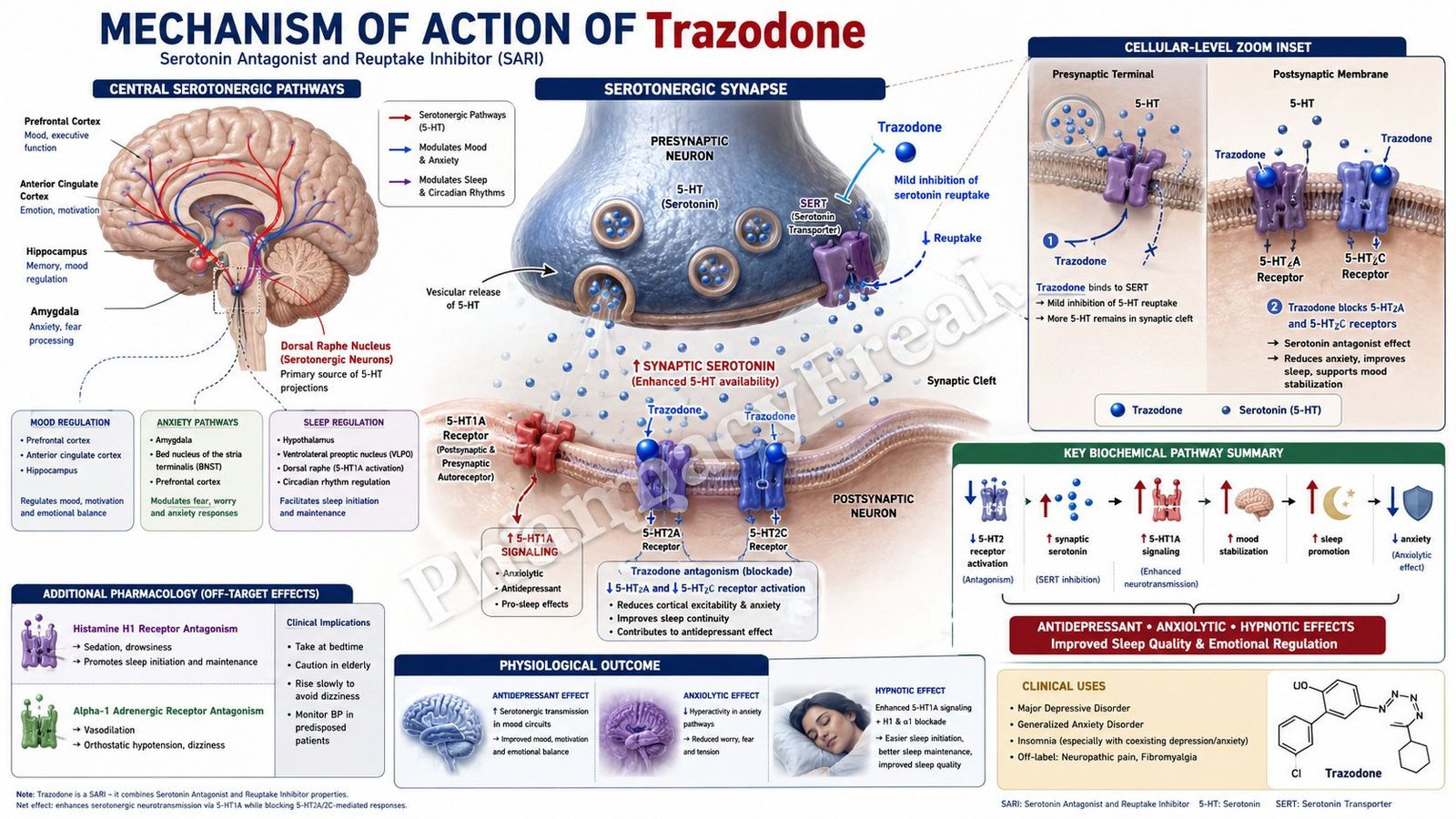
Trazodone is an atypical antidepressant classified as a serotonin antagonist and reuptake inhibitor (SARI). It is commonly used for major depressive disorder, anxiety disorders, and insomnia. Unlike SSRIs, trazodone combines serotonin reuptake inhibition with serotonin receptor antagonism, producing antidepressant, anxiolytic, and sedative effects.
Mechanism of Action (Step-wise)
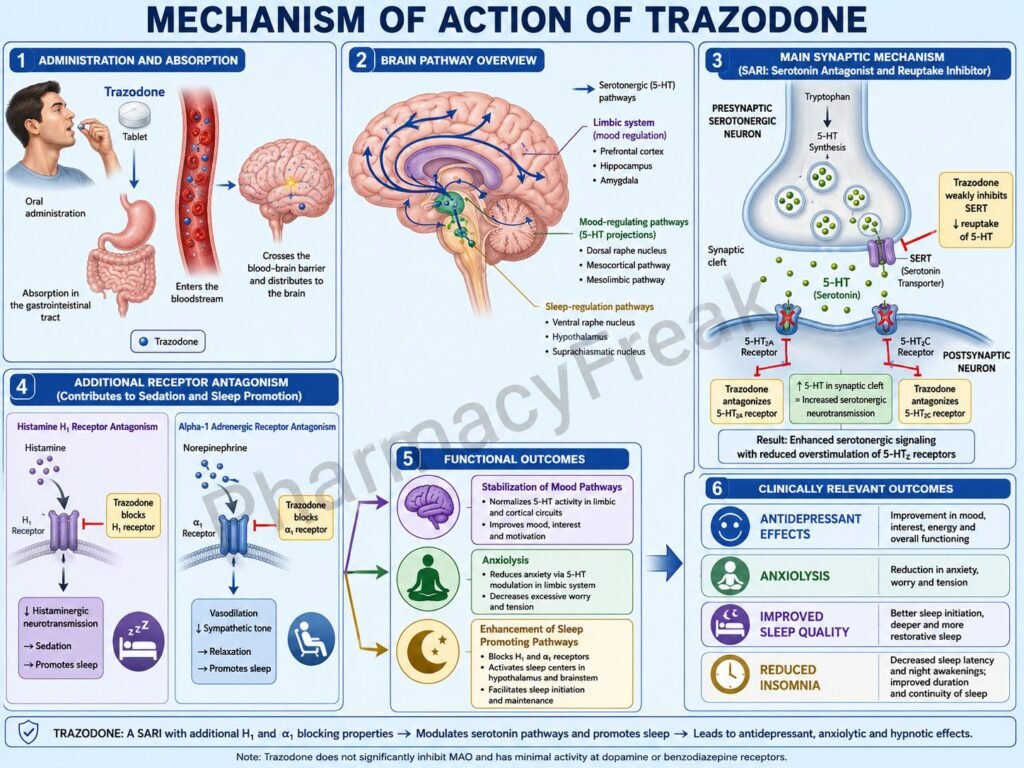
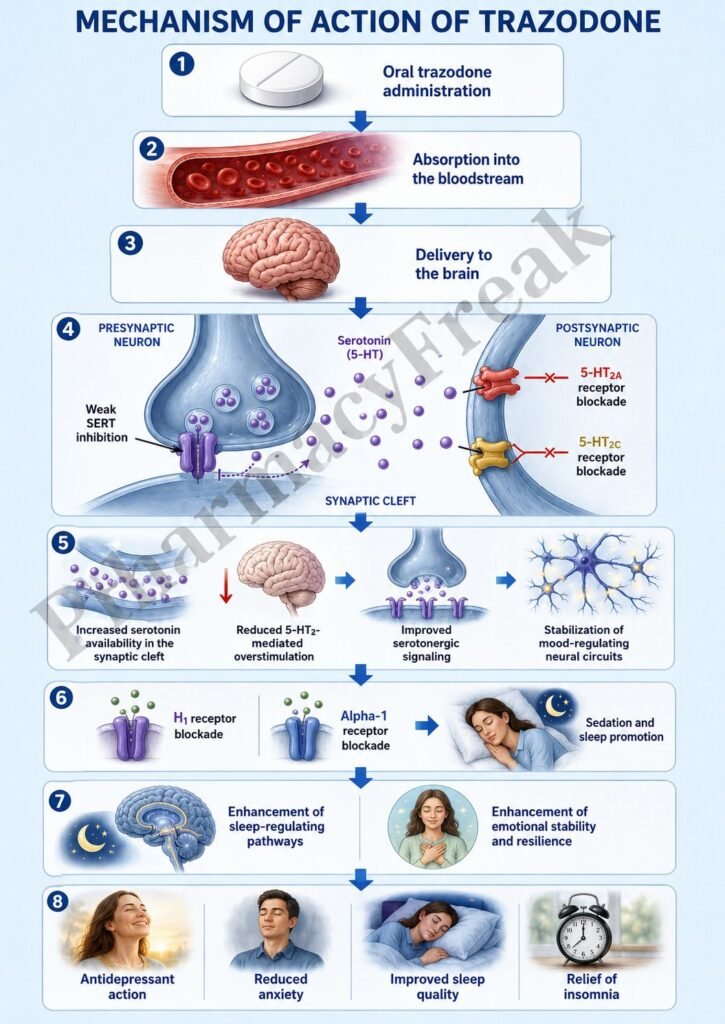
- Trazodone enters the central nervous system after oral administration.
- It inhibits the serotonin transporter (SERT) on presynaptic neurons.
- SERT normally reuptakes serotonin (5-HT) from the synaptic cleft.
- Inhibition of SERT increases serotonin concentration in the synaptic cleft.
- Enhanced serotonin availability improves serotonergic neurotransmission.
- Trazodone simultaneously blocks serotonin 5-HT2A and 5-HT2C receptors.
- Antagonism of 5-HT2 receptors reduces anxiety, agitation, and insomnia often associated with increased serotonin levels.
- Blockade of 5-HT2A receptors contributes significantly to its sedative properties.
- Trazodone also antagonizes histamine H1 receptors.
- H1 receptor blockade further promotes sedation and sleep induction.
- Mild α1-adrenergic receptor blockade causes vasodilation.
- Reduced α1 receptor activity contributes to orthostatic hypotension.
- Increased serotonergic transmission combined with 5-HT2 antagonism produces antidepressant effects.
- The overall effect is improvement of mood, reduction of anxiety, and enhancement of sleep quality.
A key exam point is that trazodone acts as a serotonin antagonist and reuptake inhibitor (SARI), blocking 5-HT2A/5-HT2C receptors while inhibiting serotonin reuptake.
Pharmacokinetics
Trazodone is administered orally and is well absorbed from the gastrointestinal tract. It undergoes hepatic metabolism primarily through CYP3A4. The drug has an intermediate half-life and is eliminated mainly through urine and feces as metabolites.
Clinical Uses
Trazodone is used in:
- Major depressive disorder
- Insomnia
- Generalized anxiety disorder
- Depression associated with anxiety
- Sleep disturbances in psychiatric disorders
Adverse Effects
Common adverse effects include:
- Drowsiness
- Dizziness
- Dry mouth
- Headache
- Fatigue
Serious adverse effects include:
- Orthostatic hypotension
- Cardiac arrhythmias
- Serotonin syndrome
- Priapism (rare but characteristic)
Priapism is a classic examination association with trazodone.
Comparative Analysis
| Feature | Trazodone | Fluoxetine | Mirtazapine |
|---|---|---|---|
| Drug class | SARI | SSRI | NaSSA |
| SERT inhibition | Yes | Yes | No |
| 5-HT2 blockade | Yes | No | Indirect |
| Sedation | High | Low | High |
| H1 blockade | Moderate | Minimal | Strong |
| Insomnia treatment | Common | Rare | Common |
Trazodone differs from SSRIs because it blocks 5-HT2 receptors in addition to inhibiting serotonin reuptake. Compared with mirtazapine, trazodone has stronger serotonin reuptake inhibition but generally less antihistaminic activity.
MCQs
1. Trazodone belongs to which antidepressant class?
a) SSRI
b) MAOI
c) SARI
d) TCA
Answer: c) SARI
2. SARI stands for:
a) Serotonin agonist reuptake inhibitor
b) Serotonin antagonist and reuptake inhibitor
c) Selective adrenergic reuptake inhibitor
d) Serotonin activating receptor inhibitor
Answer: b) Serotonin antagonist and reuptake inhibitor
3. Trazodone inhibits:
a) NET only
b) SERT
c) DAT only
d) MAO
Answer: b) SERT
4. Trazodone blocks which serotonin receptors?
a) 5-HT1A only
b) 5-HT2A and 5-HT2C
c) 5-HT3 only
d) 5-HT4 only
Answer: b) 5-HT2A and 5-HT2C
5. The sedative effect of trazodone is mainly related to:
a) 5-HT2A blockade and H1 antagonism
b) Dopamine stimulation
c) β receptor blockade
d) Acetylcholine release
Answer: a) 5-HT2A blockade and H1 antagonism
6. Trazodone is commonly prescribed for:
a) Insomnia
b) Hyperthyroidism
c) Asthma
d) Parkinson disease
Answer: a) Insomnia
7. Trazodone also blocks:
a) Histamine H1 receptors
b) Dopamine D2 receptors only
c) Muscarinic receptors only
d) GABA receptors
Answer: a) Histamine H1 receptors
8. A common adverse effect is:
a) Drowsiness
b) Hypercalcemia
c) Hypernatremia
d) Polycythemia
Answer: a) Drowsiness
9. A characteristic serious adverse effect is:
a) Priapism
b) Cataracts
c) Glaucoma
d) Hyperthyroidism
Answer: a) Priapism
10. α1 receptor blockade may cause:
a) Orthostatic hypotension
b) Severe hypertension
c) Hyperglycemia
d) Tachyphylaxis
Answer: a) Orthostatic hypotension
11. Trazodone is metabolized mainly by:
a) CYP3A4
b) CYP2D6 only
c) MAO-A
d) Xanthine oxidase
Answer: a) CYP3A4
12. The antidepressant effect of trazodone is primarily due to:
a) Enhanced serotonergic neurotransmission
b) Dopamine blockade
c) GABA inhibition
d) Histamine stimulation
Answer: a) Enhanced serotonergic neurotransmission
FAQs
What is the mechanism of action of trazodone?
Trazodone inhibits serotonin reuptake and blocks 5-HT2A/5-HT2C receptors, enhancing serotonergic neurotransmission while reducing anxiety and insomnia.
Why is trazodone commonly used for insomnia?
Because it blocks 5-HT2A and H1 receptors, producing significant sedative effects.
What makes trazodone different from SSRIs?
It combines serotonin reuptake inhibition with serotonin receptor antagonism.
What are common side effects of trazodone?
Drowsiness, dizziness, dry mouth, fatigue, and headache.
What is the classic serious adverse effect associated with trazodone?
Priapism.
Can trazodone cause orthostatic hypotension?
Yes, due to α1-adrenergic receptor blockade.
References
Goodman & Gilman’s The Pharmacological Basis of Therapeutics
https://accessmedicine.mhmedical.com/book.aspx?bookid=3191
Katzung’s Basic and Clinical Pharmacology
https://accessmedicine.mhmedical.com/content.aspx?bookid=3382
Tripathi KD. Essentials of Medical Pharmacology
https://www.jaypeedigital.com
Harrison’s Principles of Internal Medicine
https://accessmedicine.mhmedical.com