Table of Contents
Introduction
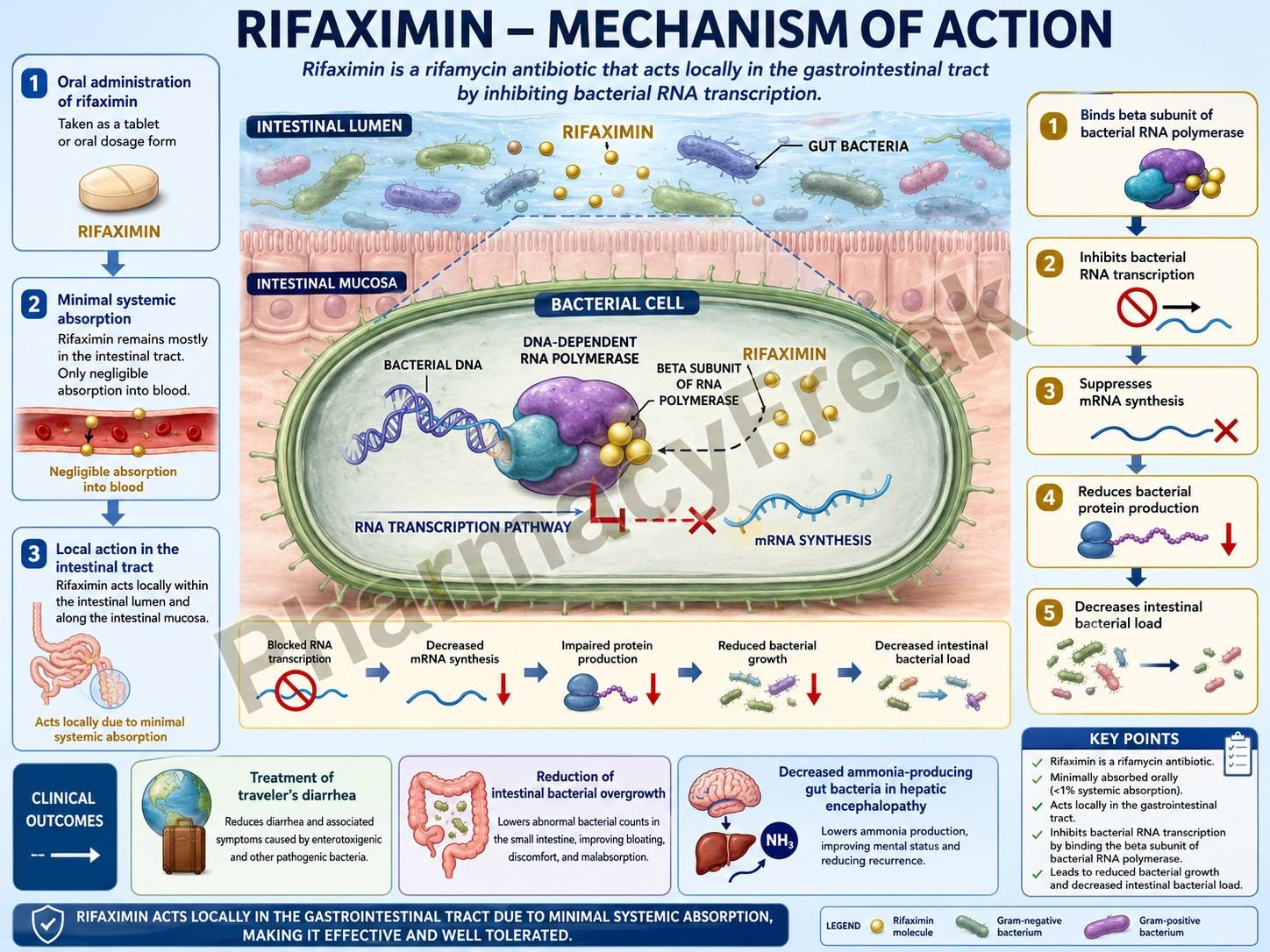
Rifaximin is a poorly absorbed rifamycin antibiotic primarily used for gastrointestinal infections and disorders. It acts locally within the gastrointestinal tract and is commonly prescribed for traveler’s diarrhea, hepatic encephalopathy, and irritable bowel syndrome with diarrhea (IBS-D). Rifaximin inhibits bacterial RNA synthesis, leading to suppression of intestinal bacterial growth.
Mechanism of Action (Step-wise)
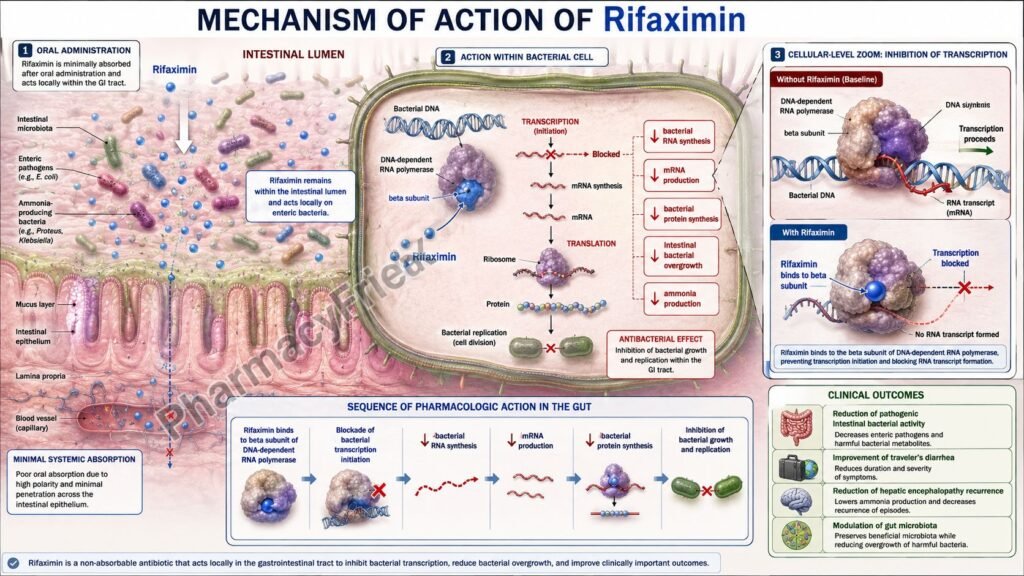
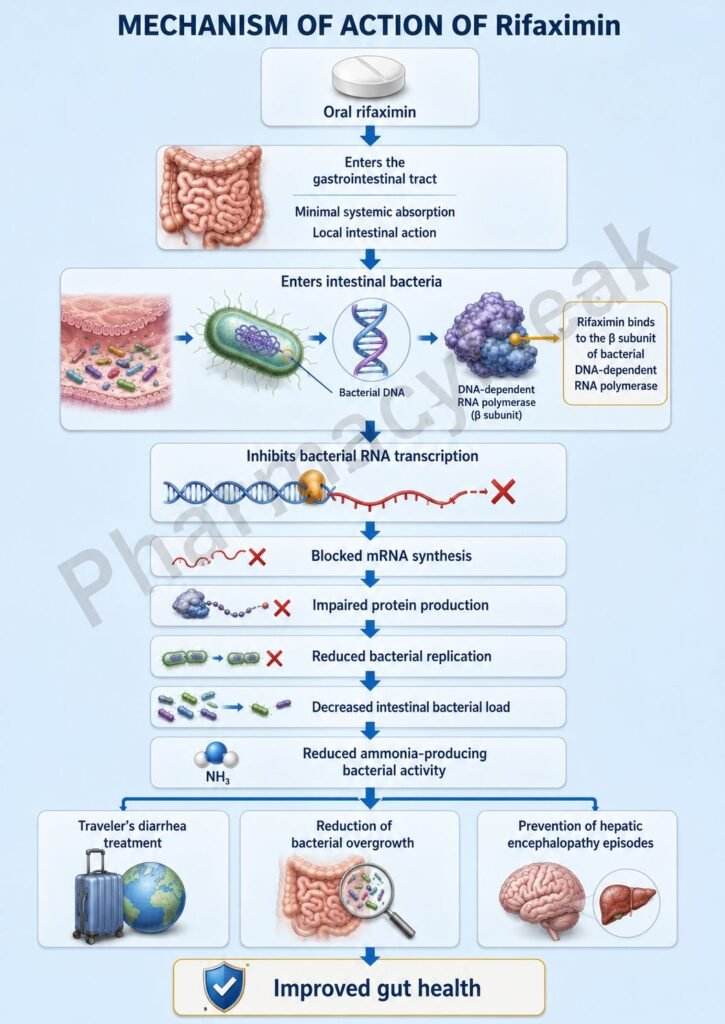
- Rifaximin remains primarily within the gastrointestinal lumen after oral administration because of minimal systemic absorption.
- It enters susceptible bacterial cells in the intestine.
- Rifaximin binds to the β-subunit of bacterial DNA-dependent RNA polymerase.
- RNA polymerase normally catalyzes transcription of bacterial DNA into messenger RNA (mRNA).
- Binding of rifaximin inhibits initiation of bacterial RNA synthesis.
- mRNA production decreases significantly.
- Reduced mRNA prevents bacterial protein synthesis.
- Bacterial growth and replication are inhibited.
- In hepatic encephalopathy, suppression of ammonia-producing gut bacteria reduces ammonia generation.
- In IBS-D, alteration of intestinal bacterial flora may reduce bloating and diarrhea symptoms.
- The overall effect is localized antibacterial activity within the gastrointestinal tract.
A key exam point is that rifaximin inhibits bacterial DNA-dependent RNA polymerase and acts mainly within the gastrointestinal lumen.
Pharmacokinetics
Rifaximin is administered orally and has minimal systemic absorption. Most of the drug remains in the intestine, where it exerts local antibacterial effects. It is excreted mainly unchanged in feces. Because systemic exposure is low, systemic adverse effects are less common.
Clinical Uses
Rifaximin is used in traveler’s diarrhea caused by noninvasive Escherichia coli, prevention of recurrent hepatic encephalopathy, and irritable bowel syndrome with diarrhea (IBS-D). It is also used in some cases of small intestinal bacterial overgrowth (SIBO).
Adverse Effects
Common adverse effects include nausea, abdominal pain, flatulence, headache, and dizziness. Serious adverse effects are uncommon because systemic absorption is minimal. Long-term use may rarely contribute to bacterial resistance.
Comparative Analysis
| Feature | Rifaximin | Rifampicin | Metronidazole |
|---|---|---|---|
| Drug class | Rifamycin antibiotic | Rifamycin antibiotic | Nitroimidazole |
| Main target | RNA polymerase | RNA polymerase | DNA damage in anaerobes |
| Systemic absorption | Minimal | Significant | Significant |
| Main site of action | Gastrointestinal tract | Systemic tissues | Systemic + GI |
| Main uses | IBS-D, traveler’s diarrhea, hepatic encephalopathy | Tuberculosis | Anaerobic infections |
| CYP450 induction | Minimal | Strong | Minimal |
Rifaximin differs from rifampicin because it acts mainly within the intestine and has minimal systemic absorption. Compared with metronidazole, it inhibits bacterial RNA synthesis rather than causing DNA damage.
MCQs
- Rifaximin primarily inhibits:
a) DNA gyrase
b) RNA polymerase
c) Ribosomal proteins
d) Cell wall synthesis
Answer: b) RNA polymerase
- Rifaximin belongs to which antibiotic class?
a) Macrolides
b) Rifamycins
c) Aminoglycosides
d) Tetracyclines
Answer: b) Rifamycins
- Rifaximin mainly acts in the:
a) Central nervous system
b) Gastrointestinal tract
c) Kidneys
d) Lungs
Answer: b) Gastrointestinal tract
- Rifaximin has:
a) High systemic absorption
b) Minimal systemic absorption
c) Intravenous absorption only
d) No intestinal activity
Answer: b) Minimal systemic absorption
- Rifaximin inhibits bacterial synthesis of:
a) DNA only
b) RNA
c) Cell wall peptidoglycan
d) Folic acid
Answer: b) RNA
- Rifaximin is commonly used in:
a) Traveler’s diarrhea
b) Tuberculosis meningitis
c) Severe pneumonia
d) Malaria
Answer: a) Traveler’s diarrhea
- In hepatic encephalopathy, rifaximin reduces production of:
a) Histamine
b) Ammonia
c) Dopamine
d) Insulin
Answer: b) Ammonia
- Rifaximin is also used in:
a) IBS with diarrhea
b) Hyperthyroidism
c) Asthma
d) Epilepsy
Answer: a) IBS with diarrhea
- Compared with rifampicin, rifaximin has:
a) Greater CYP450 induction
b) Minimal systemic effects
c) Higher tissue penetration
d) Greater hepatotoxicity
Answer: b) Minimal systemic effects
- A common adverse effect is:
a) Abdominal pain
b) Hypercalcemia
c) Severe nephrotoxicity
d) Bradycardia
Answer: a) Abdominal pain
- Rifaximin binds to which bacterial enzyme subunit?
a) α-subunit
b) β-subunit of RNA polymerase
c) γ-subunit
d) Ribosomal 30S subunit
Answer: b) β-subunit of RNA polymerase
- Most rifaximin is excreted in:
a) Urine
b) Feces
c) Sweat
d) Saliva
Answer: b) Feces
FAQs
What is the mechanism of action of rifaximin?
Rifaximin inhibits bacterial DNA-dependent RNA polymerase, blocking bacterial RNA synthesis.
Why does rifaximin mainly act in the intestine?
Because it has minimal systemic absorption after oral administration.
What conditions are commonly treated with rifaximin?
Traveler’s diarrhea, hepatic encephalopathy, and IBS-D.
How does rifaximin help in hepatic encephalopathy?
It decreases ammonia-producing intestinal bacteria.
Does rifaximin cause many systemic side effects?
No, because very little of the drug enters the bloodstream.
How does rifaximin differ from rifampicin?
Rifaximin acts locally in the GI tract, while rifampicin is systemically absorbed.
References
Goodman & Gilman’s The Pharmacological Basis of Therapeutics – Antibacterial Drugs
https://accessmedicine.mhmedical.com/book.aspx?bookid=3191
Katzung: Basic and Clinical Pharmacology – Antibiotics Affecting RNA Synthesis
https://accessmedicine.mhmedical.com/content.aspx?bookid=3382
Tripathi: Essentials of Medical Pharmacology – Gastrointestinal Antimicrobial Drugs
https://www.jaypeedigital.com
Harrison’s Principles of Internal Medicine – Hepatic Encephalopathy and Infectious Diarrhea
https://accessmedicine.mhmedical.com