Table of Contents
Introduction
Racecadotril is an antidiarrheal drug used mainly in acute secretory diarrhea. Unlike opioid-based antidiarrheal agents, it does not significantly reduce intestinal motility. Racecadotril acts by inhibiting enkephalinase, thereby enhancing endogenous enkephalin activity in the gastrointestinal tract and reducing excessive intestinal secretion.
Mechanism of Action (Step-wise)
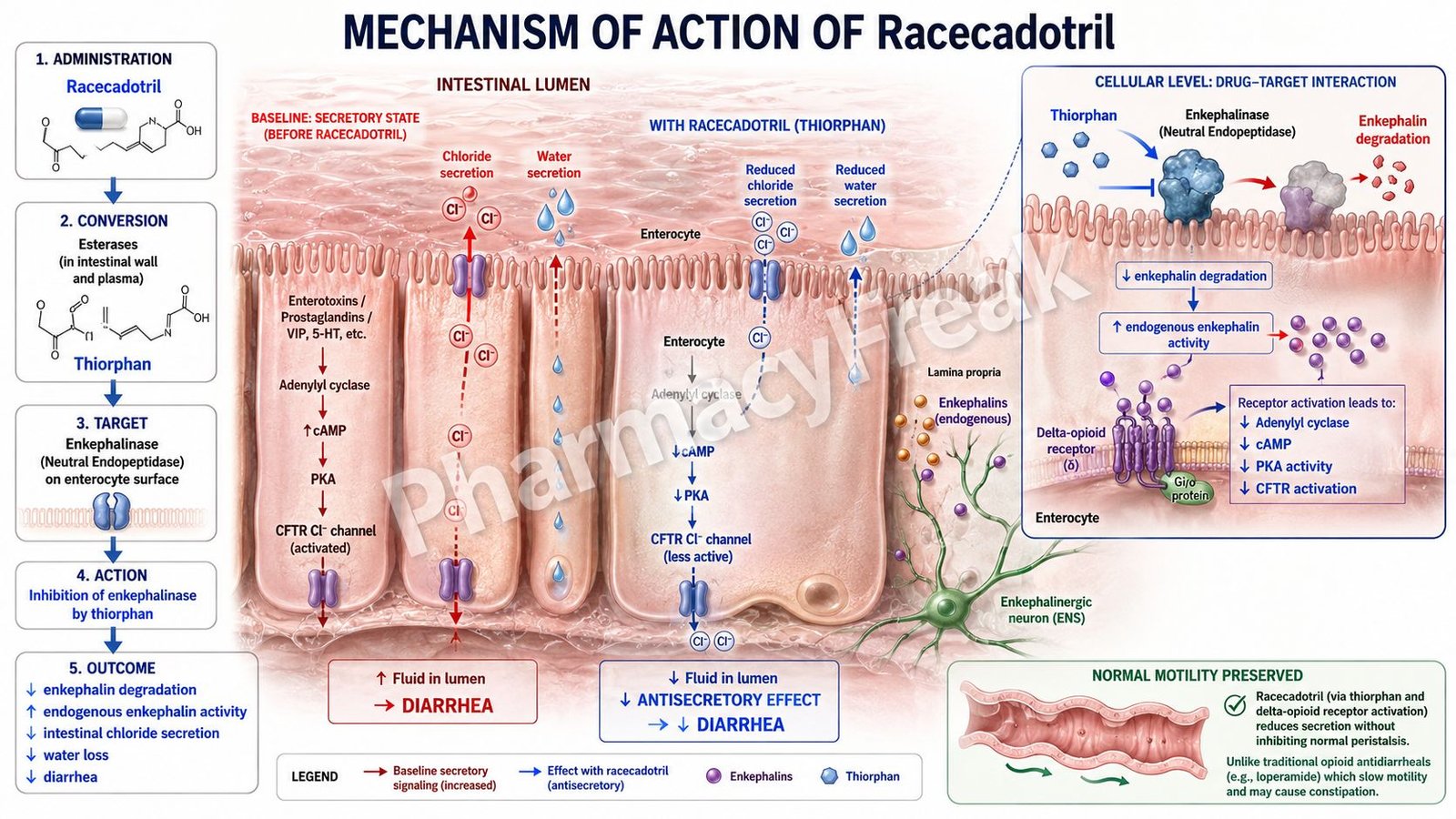
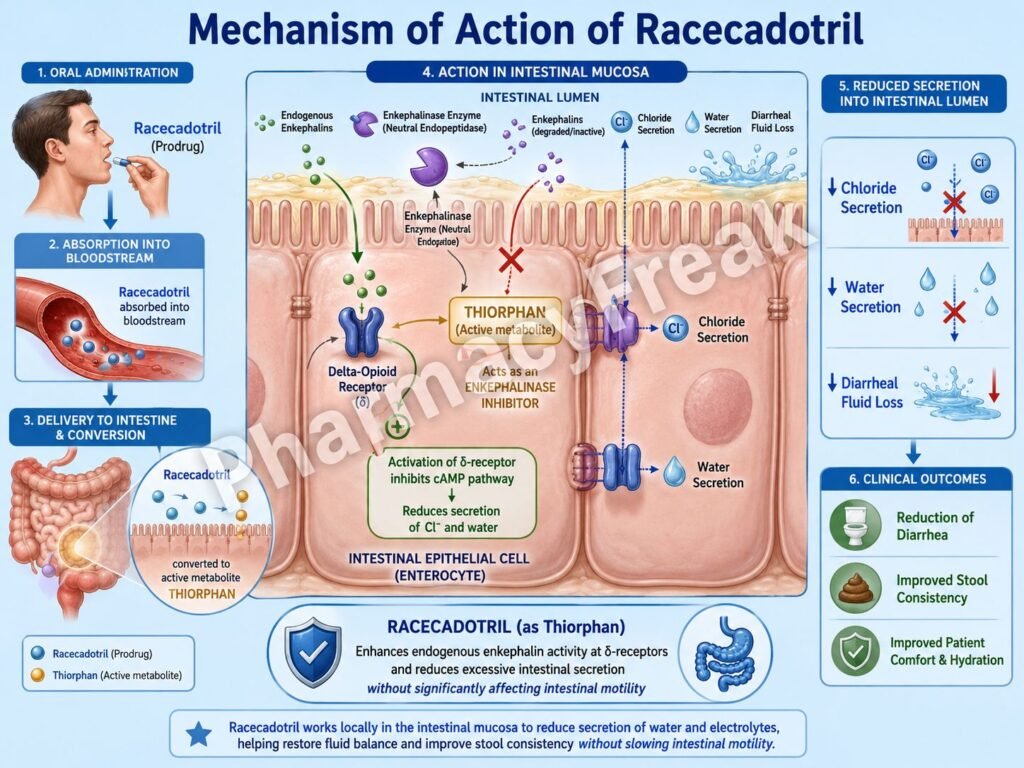
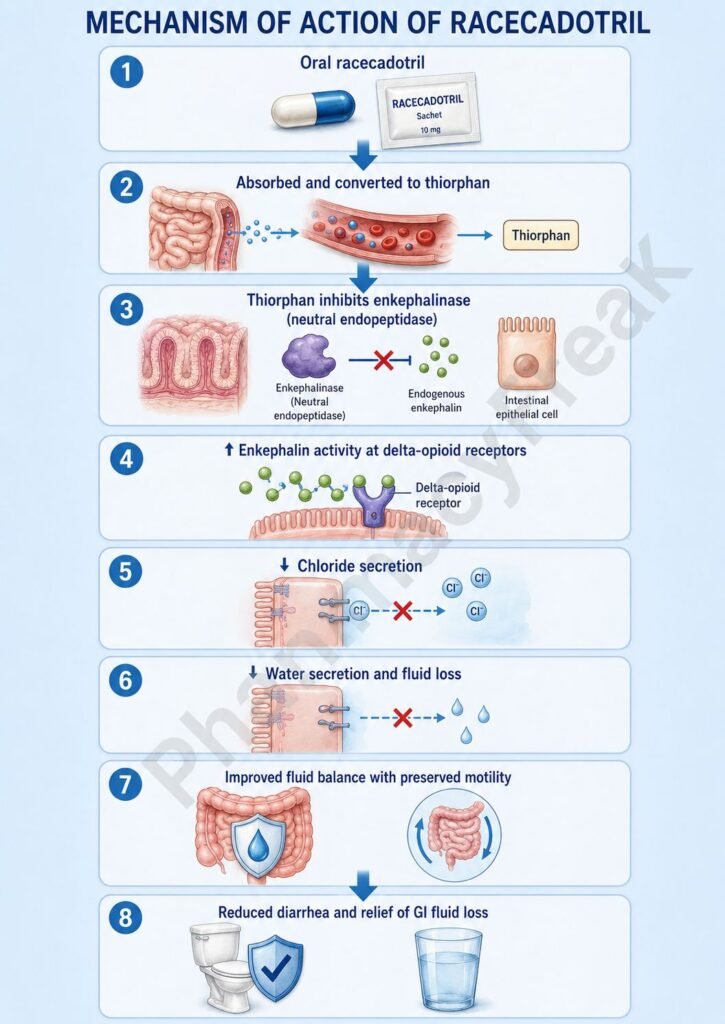
- Racecadotril is administered orally as a prodrug.
- It is rapidly converted into its active metabolite, thiorphan.
- Thiorphan inhibits the enzyme neutral endopeptidase (enkephalinase).
- Enkephalinase normally degrades endogenous enkephalins in the intestinal mucosa.
- Inhibition of enkephalinase increases levels of endogenous enkephalins.
- Enkephalins activate δ-opioid receptors in the intestinal epithelium.
- Activation of these receptors decreases intracellular cyclic AMP (cAMP).
- Reduced cAMP lowers secretion of chloride ions into the intestinal lumen.
- Reduced chloride secretion decreases passive water secretion into the intestine.
- This decreases intestinal fluid loss and stool volume.
- Racecadotril does not significantly reduce gastrointestinal motility.
- The overall effect is reduction of secretory diarrhea without marked constipation.
A key exam point is that racecadotril inhibits enkephalinase, increasing endogenous enkephalins and reducing intestinal secretion.
Pharmacokinetics
Racecadotril is administered orally and is rapidly absorbed. It is converted to the active metabolite thiorphan after absorption. The drug acts mainly in peripheral tissues with minimal central opioid effects. Metabolites are excreted primarily through urine.
Clinical Uses
Racecadotril is used in acute diarrhea in adults and children, particularly secretory diarrhea. It is commonly used alongside oral rehydration therapy to reduce stool output and fluid loss.
Adverse Effects
Racecadotril is generally well tolerated. Common adverse effects include nausea, headache, abdominal discomfort, and rash. Since it has minimal effect on gut motility, constipation is less common compared with opioid antidiarrheal drugs.
Comparative Analysis
| Feature | Racecadotril | Loperamide | Bismuth Subsalicylate |
|---|---|---|---|
| Main mechanism | Enkephalinase inhibition | μ-opioid receptor agonist | Antisecretory + antimicrobial |
| Effect on secretion | Decreases secretion | Mild reduction | Moderate reduction |
| Effect on motility | Minimal | Significant reduction | Minimal |
| Constipation risk | Low | Higher | Low |
| CNS opioid effect | Minimal | Minimal | None |
| Main use | Acute secretory diarrhea | Traveler’s diarrhea | Mild diarrhea |
Racecadotril differs from loperamide because it primarily reduces intestinal secretion rather than intestinal motility. This leads to lower risk of constipation and bowel stasis.
MCQs
- Racecadotril is mainly used as a:
a) Antiemetic
b) Antidiarrheal
c) Antacid
d) Laxative
Answer: b) Antidiarrheal
- Racecadotril inhibits which enzyme?
a) Acetylcholinesterase
b) Enkephalinase
c) Cyclooxygenase
d) Monoamine oxidase
Answer: b) Enkephalinase
- The active metabolite of racecadotril is:
a) Morphine
b) Thiorphan
c) Codeine
d) Naloxone
Answer: b) Thiorphan
- Enkephalinase normally degrades:
a) Histamine
b) Enkephalins
c) Dopamine
d) Serotonin
Answer: b) Enkephalins
- Increased enkephalins activate which receptors?
a) β receptors
b) δ-opioid receptors
c) H1 receptors
d) Muscarinic receptors
Answer: b) δ-opioid receptors
- Racecadotril decreases intestinal secretion of:
a) Potassium
b) Chloride
c) Calcium
d) Magnesium
Answer: b) Chloride
- Reduced chloride secretion decreases:
a) Water secretion
b) Sodium reabsorption
c) Gastric acid secretion
d) Insulin release
Answer: a) Water secretion
- Racecadotril mainly treats:
a) Constipation
b) Acute secretory diarrhea
c) Peptic ulcer disease
d) GERD
Answer: b) Acute secretory diarrhea
- Compared with loperamide, racecadotril has less effect on:
a) Intestinal secretion
b) Intestinal motility
c) Water balance
d) Electrolyte transport
Answer: b) Intestinal motility
- A common adverse effect is:
a) Severe constipation
b) Headache
c) Bradycardia
d) Hyperglycemia
Answer: b) Headache
- Racecadotril is usually combined with:
a) Chemotherapy
b) Oral rehydration therapy
c) Anticoagulants
d) Insulin
Answer: b) Oral rehydration therapy
- Racecadotril acts mainly in:
a) CNS opioid receptors
b) Peripheral intestinal tissues
c) Thyroid gland
d) Renal glomeruli
Answer: b) Peripheral intestinal tissues
FAQs
What is the mechanism of action of racecadotril?
It inhibits enkephalinase, increasing endogenous enkephalins and reducing intestinal secretion.
How does racecadotril reduce diarrhea?
By decreasing chloride and water secretion into the intestinal lumen.
Does racecadotril reduce intestinal motility significantly?
No, it mainly affects secretion rather than motility.
What is the active metabolite of racecadotril?
Thiorphan.
Why is racecadotril preferred over some opioid antidiarrheals?
Because it has lower risk of constipation and bowel stasis.
What is racecadotril commonly combined with?
Oral rehydration therapy.
References
Goodman & Gilman’s The Pharmacological Basis of Therapeutics – Drugs for Gastrointestinal Disorders
https://accessmedicine.mhmedical.com/book.aspx?bookid=3191
Katzung: Basic and Clinical Pharmacology – Antidiarrheal Drugs
https://accessmedicine.mhmedical.com/content.aspx?bookid=3382
Tripathi: Essentials of Medical Pharmacology – Drugs for Diarrhea
https://www.jaypeedigital.com
Harrison’s Principles of Internal Medicine – Acute Diarrheal Diseases
https://accessmedicine.mhmedical.com

