Table of Contents
Introduction
Propylthiouracil (PTU) is an antithyroid drug used in the treatment of hyperthyroidism and thyrotoxicosis, especially Graves disease. It belongs to the thioamide class and works by inhibiting thyroid hormone synthesis. PTU also decreases peripheral conversion of thyroxine (T4) to triiodothyronine (T3), making it particularly useful in thyroid storm.
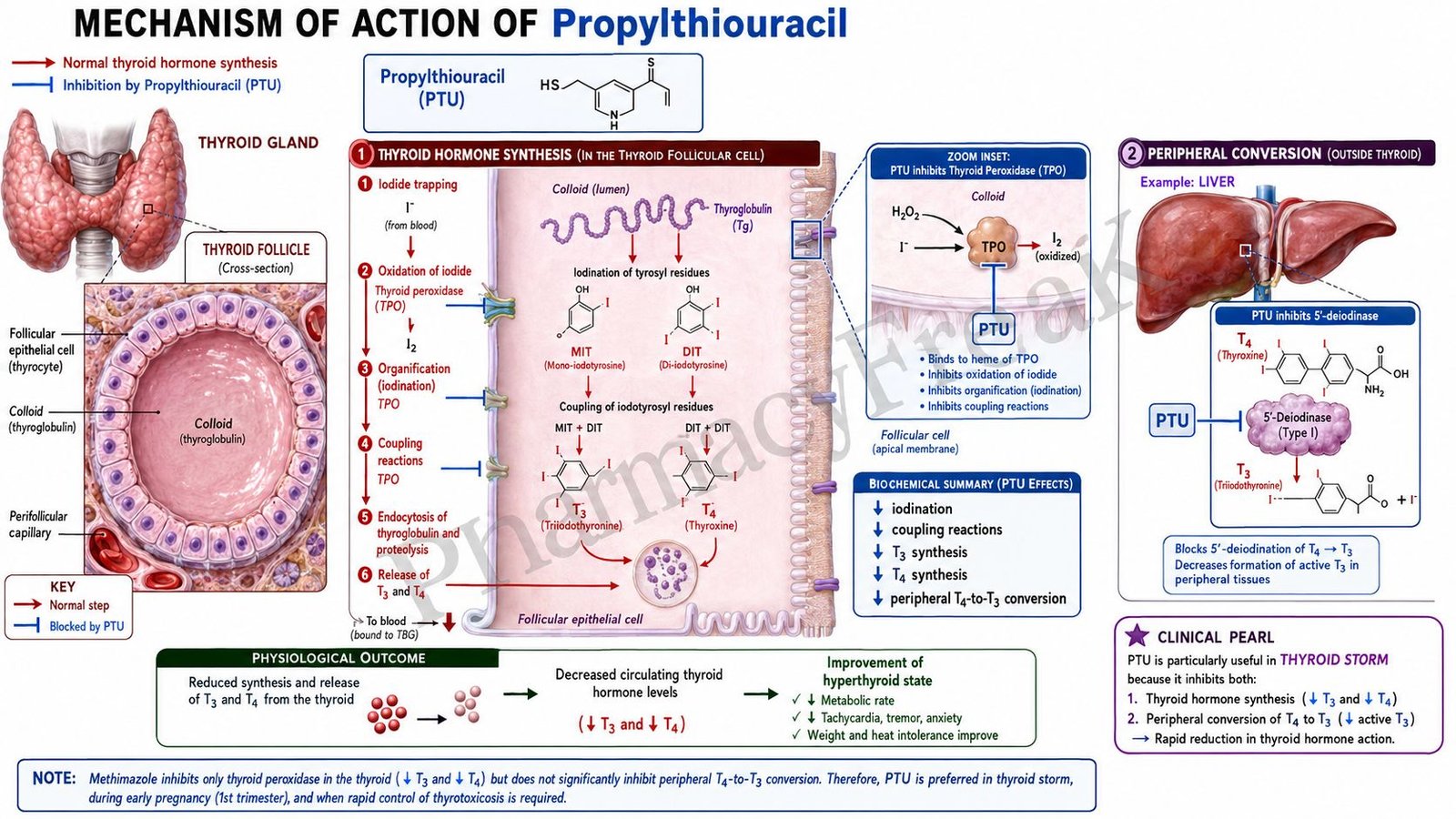
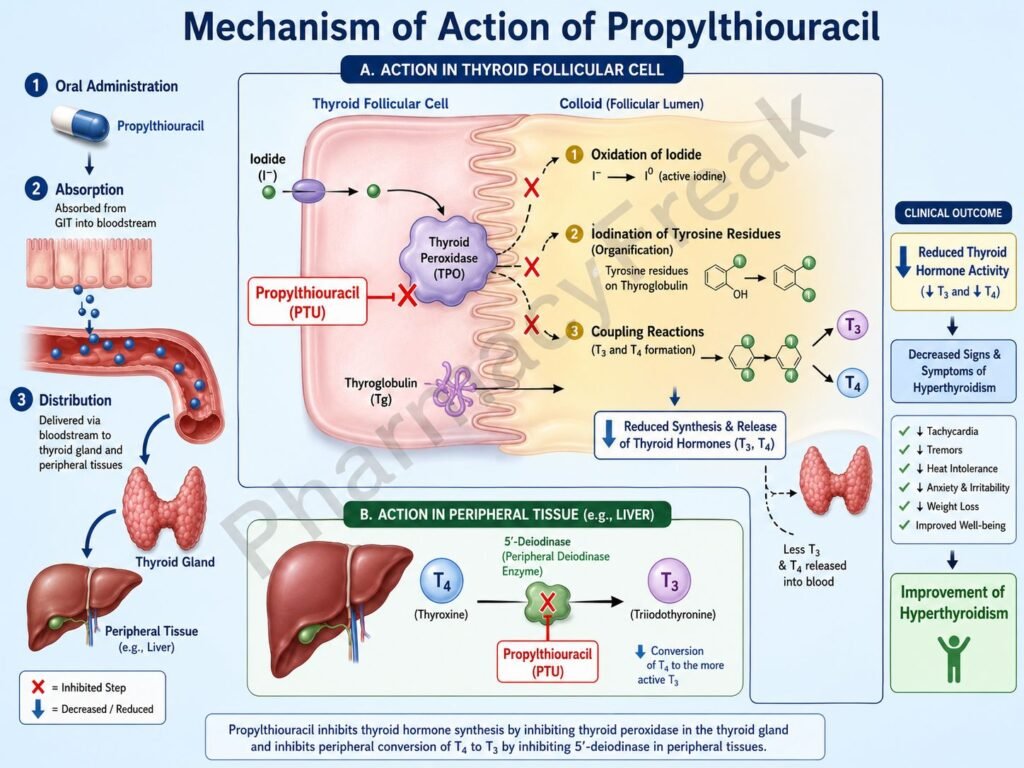
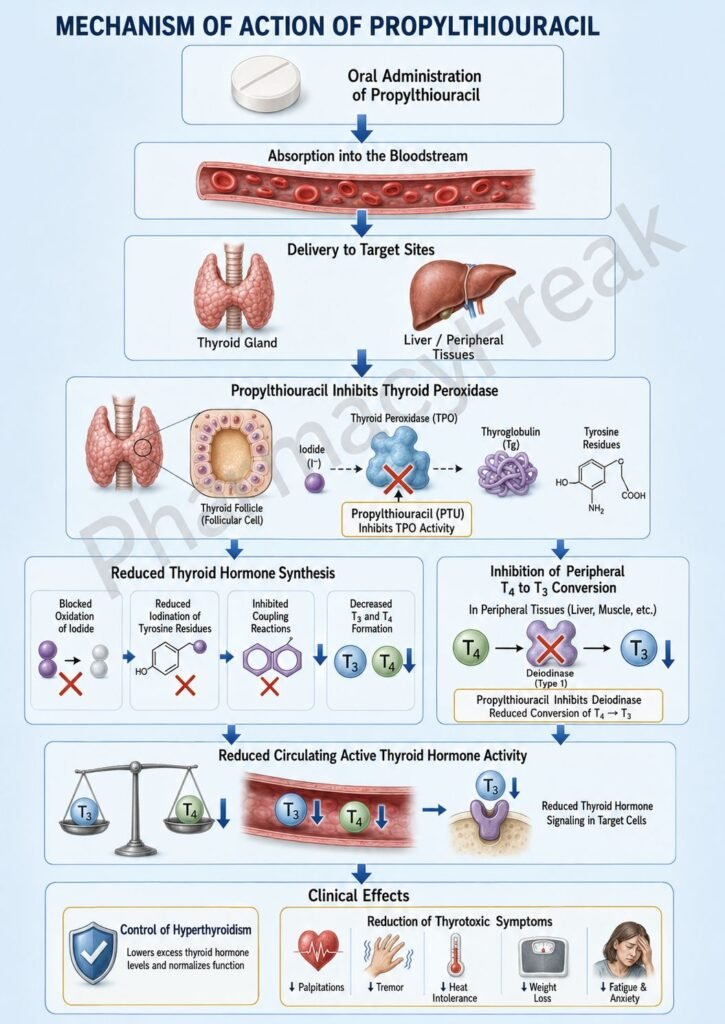
Mechanism of Action (Step-wise)
- Propylthiouracil enters thyroid follicular cells after administration.
- It inhibits the enzyme thyroid peroxidase (TPO).
- TPO normally catalyzes oxidation of iodide (I⁻) to iodine.
- TPO also mediates organification, where iodine binds to tyrosine residues on thyroglobulin.
- Inhibition of organification prevents formation of monoiodotyrosine (MIT) and diiodotyrosine (DIT).
- PTU additionally inhibits coupling reactions between MIT and DIT.
- This decreases synthesis of thyroxine (T4) and triiodothyronine (T3).
- PTU also inhibits peripheral 5′-deiodinase enzyme activity.
- Inhibition of 5′-deiodinase decreases conversion of T4 to the more active T3 in peripheral tissues.
- Reduced thyroid hormone levels decrease metabolic activity and sympathetic symptoms of hyperthyroidism.
- The overall effect is suppression of thyroid hormone synthesis and activity.
A key exam point is that PTU inhibits thyroid peroxidase and peripheral conversion of T4 to T3.
Pharmacokinetics
Propylthiouracil is administered orally and is rapidly absorbed. It is highly protein bound and concentrated in the thyroid gland. PTU undergoes hepatic metabolism and is excreted mainly via the kidneys. It has a shorter duration of action compared with methimazole, requiring multiple daily doses.
Clinical Uses
PTU is used in hyperthyroidism, Graves disease, and thyroid storm. It is preferred during the first trimester of pregnancy because methimazole has teratogenic potential. Due to inhibition of peripheral T4-to-T3 conversion, PTU is especially useful in severe thyrotoxicosis.
Adverse Effects
Common adverse effects include rash, arthralgia, and gastrointestinal upset. Serious adverse effects include agranulocytosis and hepatotoxicity. Liver toxicity may be severe and requires careful monitoring. Patients should report fever or sore throat immediately because of the risk of agranulocytosis.
Comparative Analysis
| Feature | Propylthiouracil | Methimazole | Radioactive Iodine |
|---|---|---|---|
| Main mechanism | TPO inhibition + ↓ T4→T3 conversion | TPO inhibition | Thyroid tissue destruction |
| Peripheral T4→T3 inhibition | Yes | No | No |
| Pregnancy use | Preferred in 1st trimester | Preferred later | Contraindicated |
| Duration | Shorter | Longer | Permanent effect |
| Hepatotoxicity risk | Higher | Lower | Minimal |
| Thyroid storm use | Yes | Less preferred | No |
PTU differs from methimazole because it additionally inhibits peripheral conversion of T4 to T3. Compared with radioactive iodine, PTU suppresses hormone synthesis without destroying thyroid tissue.
MCQs
- Propylthiouracil inhibits which enzyme?
a) Cyclooxygenase
b) Thyroid peroxidase
c) Monoamine oxidase
d) ATP synthase
Answer: b) Thyroid peroxidase
- PTU inhibits conversion of:
a) T3 to T4
b) T4 to T3
c) TSH to T3
d) Iodine to iodide
Answer: b) T4 to T3
- PTU belongs to which drug class?
a) β blockers
b) Thioamides
c) Calcium channel blockers
d) Corticosteroids
Answer: b) Thioamides
- Organification in the thyroid involves binding iodine to:
a) Histidine
b) Tyrosine
c) Glycine
d) Alanine
Answer: b) Tyrosine
- PTU decreases synthesis of:
a) Cortisol
b) Thyroid hormones
c) Insulin
d) Aldosterone
Answer: b) Thyroid hormones
- PTU is mainly used in:
a) Hypothyroidism
b) Hyperthyroidism
c) Diabetes mellitus
d) Asthma
Answer: b) Hyperthyroidism
- PTU is particularly useful in:
a) Thyroid storm
b) Renal failure
c) Migraine
d) Heart block
Answer: a) Thyroid storm
- A serious adverse effect is:
a) Hyperglycemia
b) Agranulocytosis
c) Bradycardia
d) Hypercalcemia
Answer: b) Agranulocytosis
- PTU may cause severe:
a) Lung fibrosis
b) Hepatotoxicity
c) Cataracts
d) Hypernatremia
Answer: b) Hepatotoxicity
- PTU is preferred in which pregnancy period?
a) Third trimester
b) First trimester
c) Entire pregnancy only
d) Never in pregnancy
Answer: b) First trimester
- PTU inhibits peripheral enzyme:
a) 5′-deiodinase
b) Carbonic anhydrase
c) Acetylcholinesterase
d) Xanthine oxidase
Answer: a) 5′-deiodinase
- Compared to methimazole, PTU has:
a) Longer duration
b) Additional T4→T3 inhibition
c) Lower hepatotoxicity
d) No thyroid effect
Answer: b) Additional T4→T3 inhibition
FAQs
What is the mechanism of action of propylthiouracil?
PTU inhibits thyroid peroxidase and peripheral conversion of T4 to T3.
Why is PTU useful in thyroid storm?
Because it rapidly decreases formation of active T3.
What is the major serious adverse effect of PTU?
Hepatotoxicity and agranulocytosis.
Why is PTU preferred in early pregnancy?
Because methimazole has teratogenic risk during the first trimester.
How does PTU reduce thyroid hormone synthesis?
By inhibiting iodination and coupling reactions in the thyroid gland.
What symptoms may indicate agranulocytosis?
Fever and sore throat.
References
Goodman & Gilman’s The Pharmacological Basis of Therapeutics – Antithyroid Drugs
https://accessmedicine.mhmedical.com/book.aspx?bookid=3191
Katzung: Basic and Clinical Pharmacology – Thyroid and Antithyroid Drugs
https://accessmedicine.mhmedical.com/content.aspx?bookid=3382
Tripathi: Essentials of Medical Pharmacology – Thyroid Drugs
https://www.jaypeedigital.com
Harrison’s Principles of Internal Medicine – Hyperthyroidism and Thyrotoxicosis
https://accessmedicine.mhmedical.com