Table of Contents
Introduction
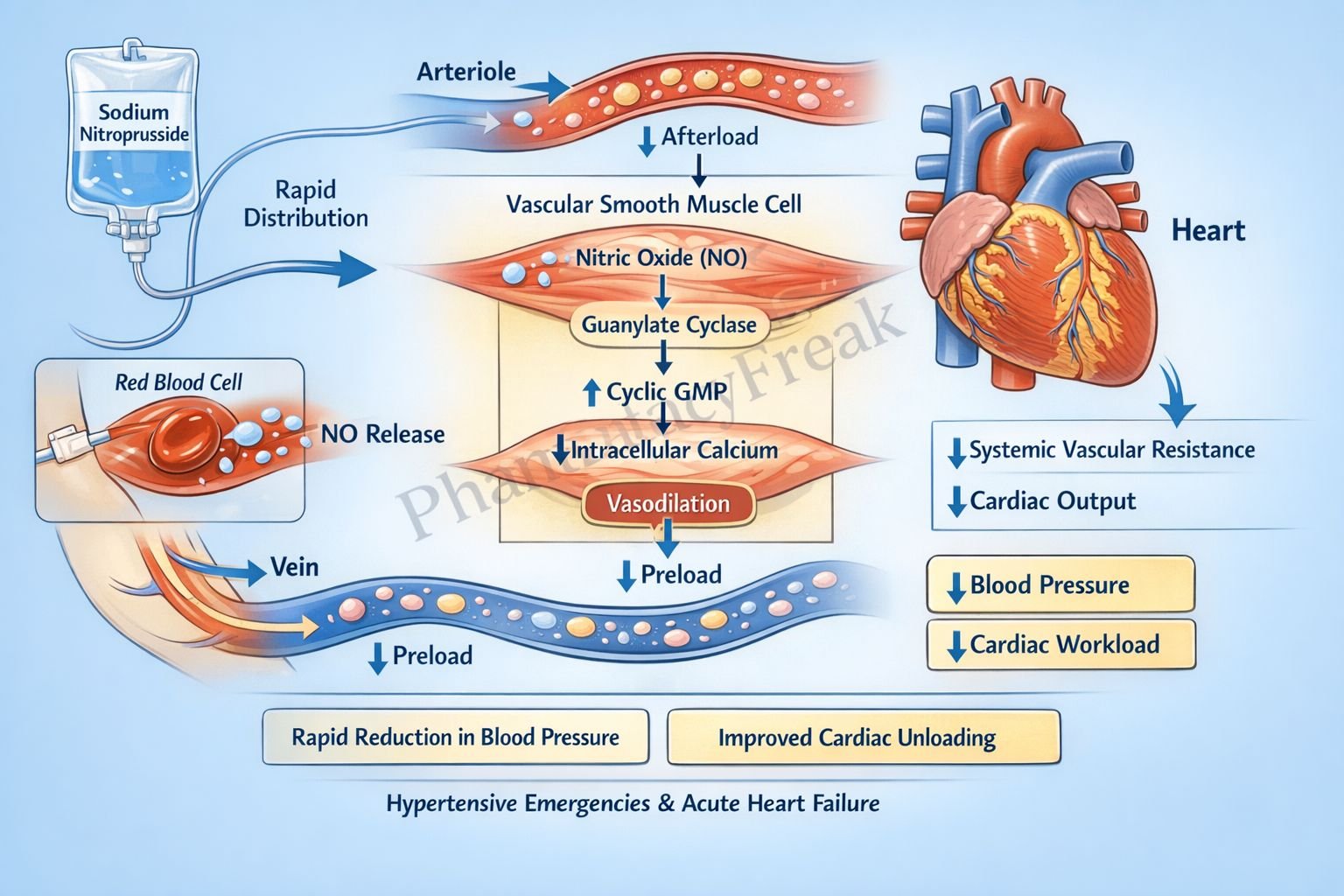
Sodium nitroprusside is a potent, rapid-acting vasodilator used primarily in hypertensive emergencies and acute heart failure. It produces both arterial and venous dilation, leading to a significant reduction in blood pressure. Due to its immediate onset and short duration of action, it is administered intravenously under close monitoring.
Mechanism of Action (Step-wise)
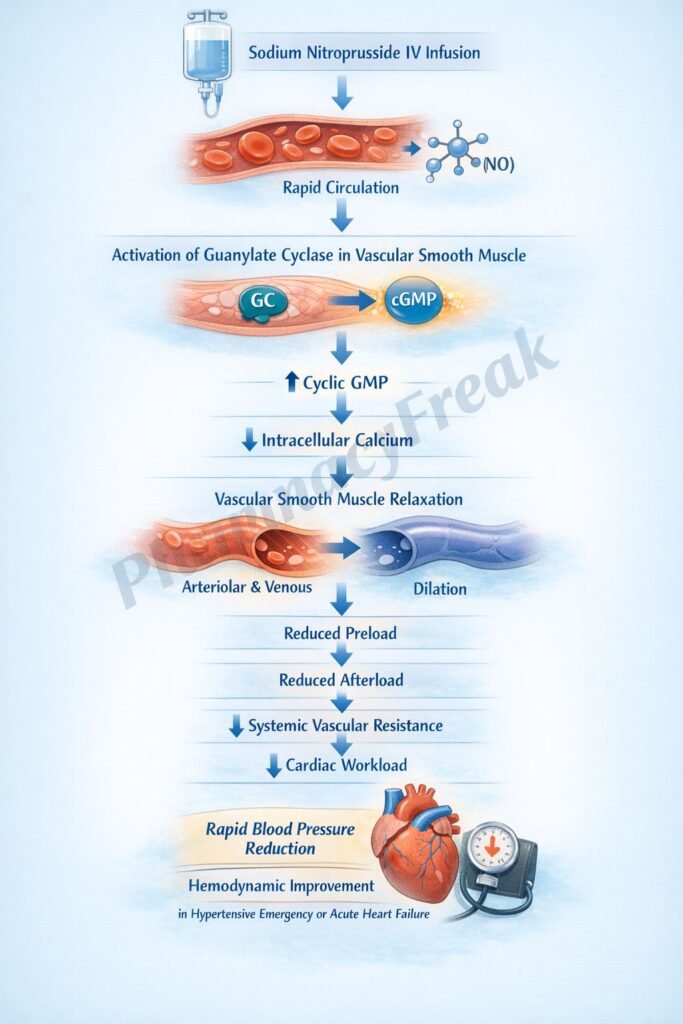
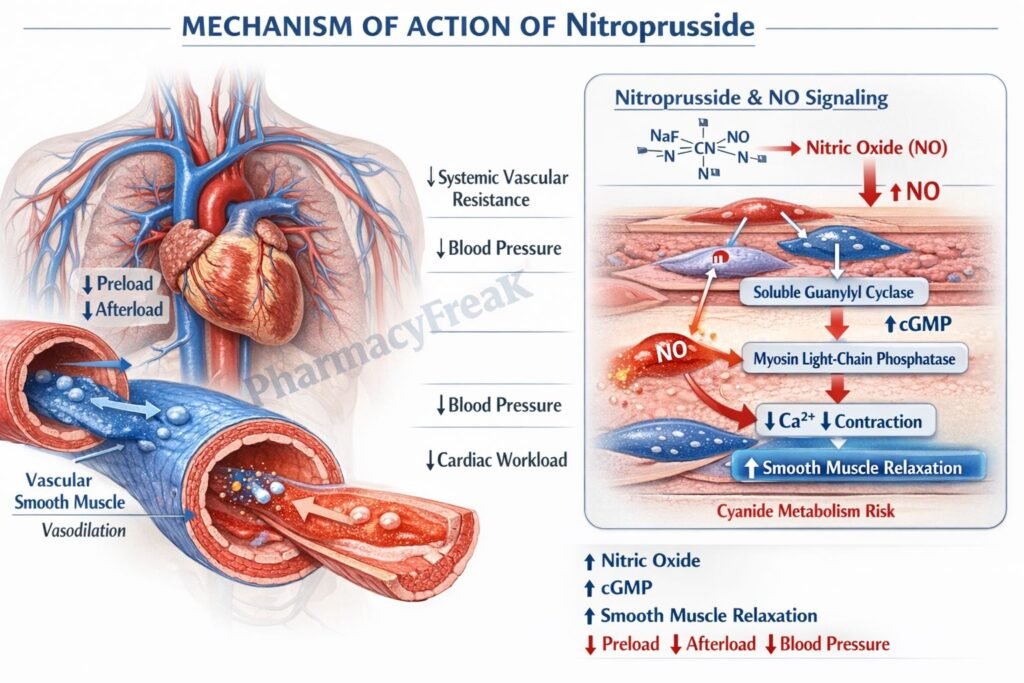
- Sodium nitroprusside releases nitric oxide (NO) spontaneously in the bloodstream.
- Nitric oxide diffuses into vascular smooth muscle cells.
- It activates soluble guanylate cyclase.
- This increases cyclic GMP (cGMP) levels.
- Elevated cGMP activates protein kinase G (PKG).
- PKG promotes dephosphorylation of myosin light chains.
- This leads to relaxation of vascular smooth muscle.
- Both arterioles and venules dilate.
- Arterial dilation reduces systemic vascular resistance (afterload).
- Venous dilation reduces venous return (preload).
- The combined effect is a rapid decrease in blood pressure.
- This reduces myocardial oxygen demand and improves cardiac output in heart failure.
A key exam point is that sodium nitroprusside directly releases nitric oxide, causing both arterial and venous vasodilation.
Pharmacokinetics
Sodium nitroprusside is administered intravenously as a continuous infusion. It has an immediate onset of action and a very short duration, allowing precise titration. It is metabolized to cyanide and then to thiocyanate in the liver. These metabolites are excreted via the kidneys. Prolonged use or high doses can lead to cyanide toxicity, which is a critical clinical consideration.
Clinical Uses
Sodium nitroprusside is used in hypertensive emergencies to rapidly lower blood pressure. It is also used in acute heart failure to reduce preload and afterload. Additionally, it may be used during surgical procedures to control blood pressure.
Adverse Effects
Common adverse effects include hypotension and reflex tachycardia. The most serious adverse effect is cyanide toxicity, especially with prolonged infusion or high doses. Thiocyanate accumulation can also occur, particularly in renal impairment. Symptoms of toxicity include metabolic acidosis, confusion, and arrhythmias.
Comparative Analysis
| Feature | Sodium Nitroprusside | Nitroglycerin | Hydralazine |
|---|---|---|---|
| Mechanism | Direct NO donor | NO donor (enzymatic activation) | Direct arteriolar dilator |
| Vasodilation | Arterial + venous | Mainly venous | Mainly arterial |
| Onset | Immediate | Rapid | Moderate |
| Duration | Very short | Short | Longer |
| Use | Hypertensive emergency | Angina | Hypertension |
| Toxicity | Cyanide risk | Tolerance | Lupus-like syndrome |
Sodium nitroprusside differs from nitroglycerin by producing balanced arterial and venous dilation and having a direct NO-releasing mechanism. Compared to hydralazine, it acts more rapidly and affects both preload and afterload.
MCQs
- Sodium nitroprusside releases:
a) Dopamine
b) Nitric oxide
c) Serotonin
d) Histamine
Answer: b) Nitric oxide
- Nitric oxide increases:
a) cAMP
b) cGMP
c) ATP
d) ADP
Answer: b) cGMP
- cGMP causes:
a) Contraction
b) Relaxation
c) Sodium influx
d) Calcium influx
Answer: b) Relaxation
- Sodium nitroprusside dilates:
a) Arteries only
b) Veins only
c) Both arteries and veins
d) Capillaries only
Answer: c) Both arteries and veins
- Venodilation reduces:
a) Afterload
b) Preload
c) Heart rate
d) Calcium
Answer: b) Preload
- Arterial dilation reduces:
a) Preload
b) Afterload
c) Sodium
d) Potassium
Answer: b) Afterload
- Sodium nitroprusside is used in:
a) Asthma
b) Hypertensive emergency
c) Diabetes
d) Anemia
Answer: b) Hypertensive emergency
- A major adverse effect is:
a) Hypoglycemia
b) Cyanide toxicity
c) Hypercalcemia
d) Bradycardia
Answer: b) Cyanide toxicity
- Sodium nitroprusside is given:
a) Orally
b) Intravenously
c) Intramuscularly
d) Sublingually
Answer: b) Intravenously
- It has which onset of action?
a) Slow
b) Moderate
c) Immediate
d) Delayed
Answer: c) Immediate
- Sodium nitroprusside reduces blood pressure by:
a) Increasing cardiac output
b) Vasodilation
c) Increasing sodium
d) Increasing heart rate
Answer: b) Vasodilation
- Thiocyanate accumulation occurs in:
a) Liver failure
b) Renal impairment
c) Lung disease
d) Brain injury
Answer: b) Renal impairment
FAQs
What is the mechanism of action of sodium nitroprusside?
It directly releases nitric oxide, increasing cGMP and causing vasodilation of arteries and veins.
Why is sodium nitroprusside used in emergencies?
Because of its rapid onset and easy titration.
What is the major toxicity concern?
Cyanide toxicity.
How does it differ from nitroglycerin?
It dilates both arteries and veins equally.
Why is monitoring required during use?
Due to risk of severe hypotension and toxicity.
How is sodium nitroprusside eliminated?
Via metabolism to thiocyanate and renal excretion.
References
Goodman & Gilman’s The Pharmacological Basis of Therapeutics – Antihypertensives
https://accessmedicine.mhmedical.com/book.aspx?bookid=3191
Katzung: Basic and Clinical Pharmacology – Vasodilators
https://accessmedicine.mhmedical.com/content.aspx?bookid=3382
Tripathi: Essentials of Medical Pharmacology – Antihypertensives
https://www.jaypeedigital.com
Harrison’s Principles of Internal Medicine – Hypertensive Emergencies
https://accessmedicine.mhmedical.com