Table of Contents
Introduction
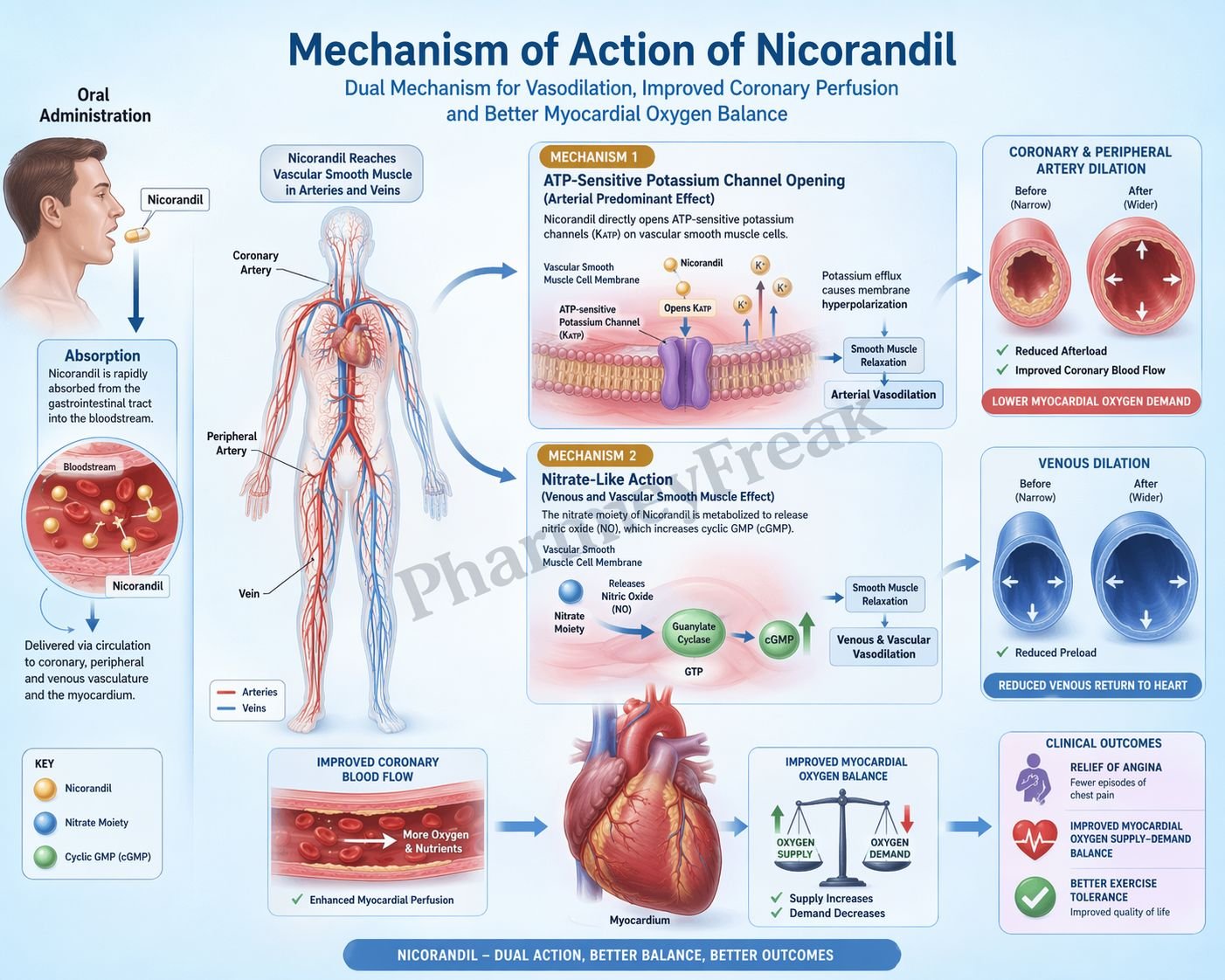
Nicorandil is an antianginal drug with a dual mechanism of action, combining nitrate-like properties with potassium channel–opening activity. It is used in the management of chronic stable angina to improve myocardial oxygen balance. By causing both arterial and venous vasodilation, nicorandil reduces cardiac workload and improves coronary blood flow.
Mechanism of Action (Step-wise)
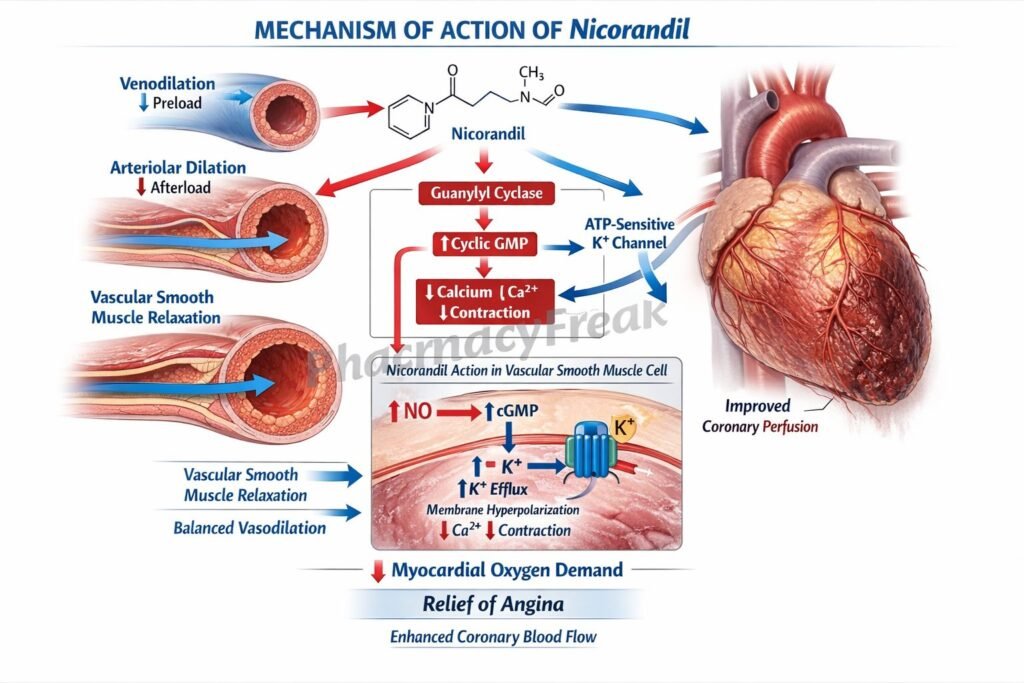
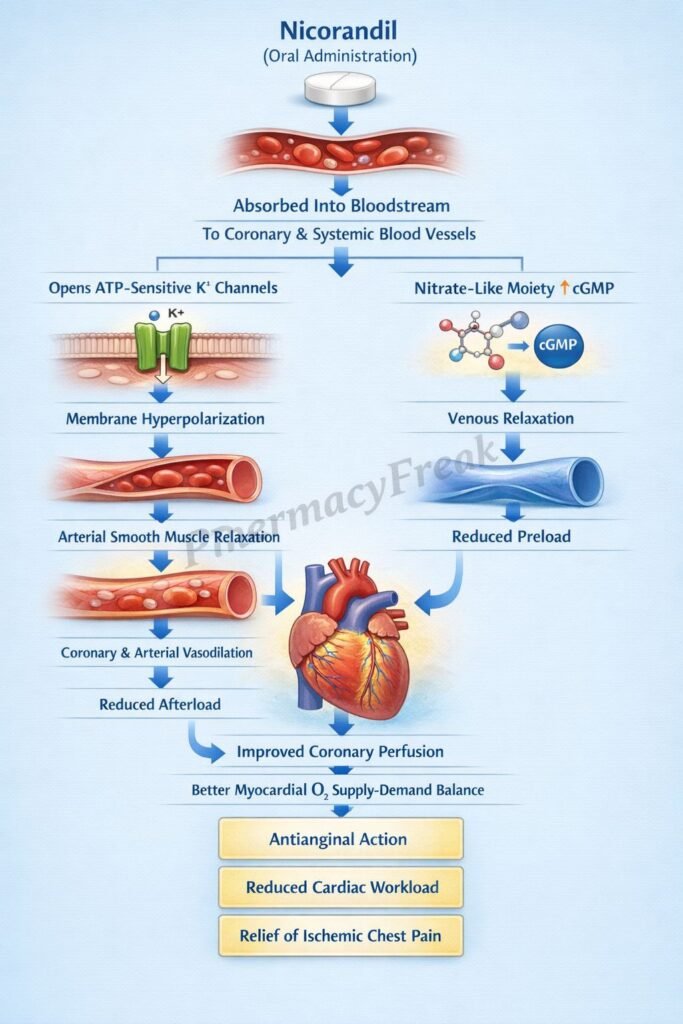
- Nicorandil acts as a potassium (K⁺ATP) channel opener in vascular smooth muscle.
- Opening of K⁺ATP channels leads to potassium efflux from cells.
- This causes hyperpolarization of the smooth muscle cell membrane.
- Hyperpolarization closes voltage-gated calcium channels.
- Reduced calcium influx leads to relaxation of vascular smooth muscle.
- This results in arterial vasodilation, reducing afterload.
- Nicorandil also acts as a nitric oxide (NO) donor.
- NO activates guanylate cyclase in vascular smooth muscle.
- This increases cyclic GMP (cGMP) levels.
- Increased cGMP leads to further smooth muscle relaxation.
- Venodilation reduces preload by decreasing venous return.
- The combined effects reduce myocardial oxygen demand and improve coronary perfusion.
A key exam point is that nicorandil acts as a K⁺ channel opener and nitric oxide donor.
Pharmacokinetics
Nicorandil is administered orally and is well absorbed. It has moderate bioavailability and is distributed widely in tissues. It is metabolized in the liver and excreted via urine. It has a relatively moderate half-life and is usually administered twice daily. Its effects on vascular smooth muscle contribute to sustained antianginal activity.
Clinical Uses
Nicorandil is used in the treatment of chronic stable angina. It improves symptoms by reducing myocardial oxygen demand and increasing coronary blood flow. It is particularly useful in patients who are intolerant to other antianginal drugs or require additional therapy.
Adverse Effects
Common adverse effects include headache, flushing, dizziness, and hypotension due to vasodilation. Rare but serious adverse effects include gastrointestinal and mucocutaneous ulceration. Excessive vasodilation may lead to syncope. Patients should be monitored for blood pressure changes.
Comparative Analysis
| Feature | Nicorandil | Nitroglycerin | Nifedipine |
|---|---|---|---|
| Mechanism | K⁺ channel opener + NO donor | NO donor | Calcium channel blocker |
| Vasodilation | Arterial + venous | Mainly venous | Mainly arterial |
| Effect on preload | Decreases | Decreases | Minimal |
| Effect on afterload | Decreases | Mild | Significant |
| Use | Chronic angina | Acute angina | Hypertension, angina |
| Unique feature | Dual mechanism | Rapid action | Strong arterial dilation |
Nicorandil differs from nitroglycerin by having an additional potassium channel–opening effect. Compared to nifedipine, it combines both preload and afterload reduction through dual mechanisms.
MCQs
- Nicorandil acts as a:
a) Calcium channel blocker
b) Potassium channel opener
c) Beta blocker
d) ACE inhibitor
Answer: b) Potassium channel opener
- Opening of K⁺ channels leads to:
a) Depolarization
b) Hyperpolarization
c) No change
d) Calcium influx
Answer: b) Hyperpolarization
- Hyperpolarization reduces:
a) Sodium
b) Calcium
c) Potassium
d) Chloride
Answer: b) Calcium
- Nicorandil also acts as a:
a) Dopamine agonist
b) Nitric oxide donor
c) Histamine blocker
d) Serotonin agonist
Answer: b) Nitric oxide donor
- NO increases:
a) cAMP
b) cGMP
c) ATP
d) ADP
Answer: b) cGMP
- Nicorandil reduces preload by:
a) Increasing venous return
b) Decreasing venous return
c) Increasing heart rate
d) Increasing calcium
Answer: b) Decreasing venous return
- Nicorandil reduces afterload by:
a) Vasodilation
b) Vasoconstriction
c) Increasing sodium
d) Increasing potassium
Answer: a) Vasodilation
- Nicorandil is used in:
a) Asthma
b) Angina
c) Diabetes
d) Anemia
Answer: b) Angina
- A common adverse effect is:
a) Hypoglycemia
b) Headache
c) Hypercalcemia
d) Bradycardia
Answer: b) Headache
- Nicorandil causes:
a) Vasoconstriction
b) Vasodilation
c) No vascular effect
d) Arrhythmia
Answer: b) Vasodilation
- Compared to nitroglycerin, nicorandil:
a) Has single mechanism
b) Has dual mechanism
c) Has no effect
d) Is less effective
Answer: b) Has dual mechanism
- Nicorandil lowers oxygen demand by:
a) Increasing heart rate
b) Reducing preload and afterload
c) Increasing calcium
d) Increasing sodium
Answer: b) Reducing preload and afterload
FAQs
What is the mechanism of action of nicorandil?
It opens potassium channels and donates nitric oxide, causing vasodilation.
Why is nicorandil effective in angina?
It reduces myocardial oxygen demand and improves coronary blood flow.
What is the role of nitric oxide in nicorandil action?
It increases cGMP, leading to smooth muscle relaxation.
What is a key adverse effect of nicorandil?
Headache due to vasodilation.
How does nicorandil differ from nitrates?
It also opens potassium channels in addition to NO donation.
Does nicorandil affect both preload and afterload?
Yes, due to venous and arterial dilation.
References
Goodman & Gilman’s The Pharmacological Basis of Therapeutics – Cardiovascular Drugs
https://accessmedicine.mhmedical.com/book.aspx?bookid=3191
Katzung: Basic and Clinical Pharmacology – Antianginal Drugs
https://accessmedicine.mhmedical.com/content.aspx?bookid=3382
Tripathi: Essentials of Medical Pharmacology – Antianginal Drugs
https://www.jaypeedigital.com
Harrison’s Principles of Internal Medicine – Ischemic Heart Disease
https://accessmedicine.mhmedical.com