Table of Contents
Introduction
Pramipexole is a dopamine agonist primarily used in the treatment of Parkinson disease and restless legs syndrome (RLS). It directly stimulates dopamine receptors in the brain, helping compensate for dopamine deficiency in the nigrostriatal pathway. Compared to levodopa, pramipexole has a lower risk of motor fluctuations early in therapy but may produce behavioral adverse effects.
Mechanism of Action (Step-wise)
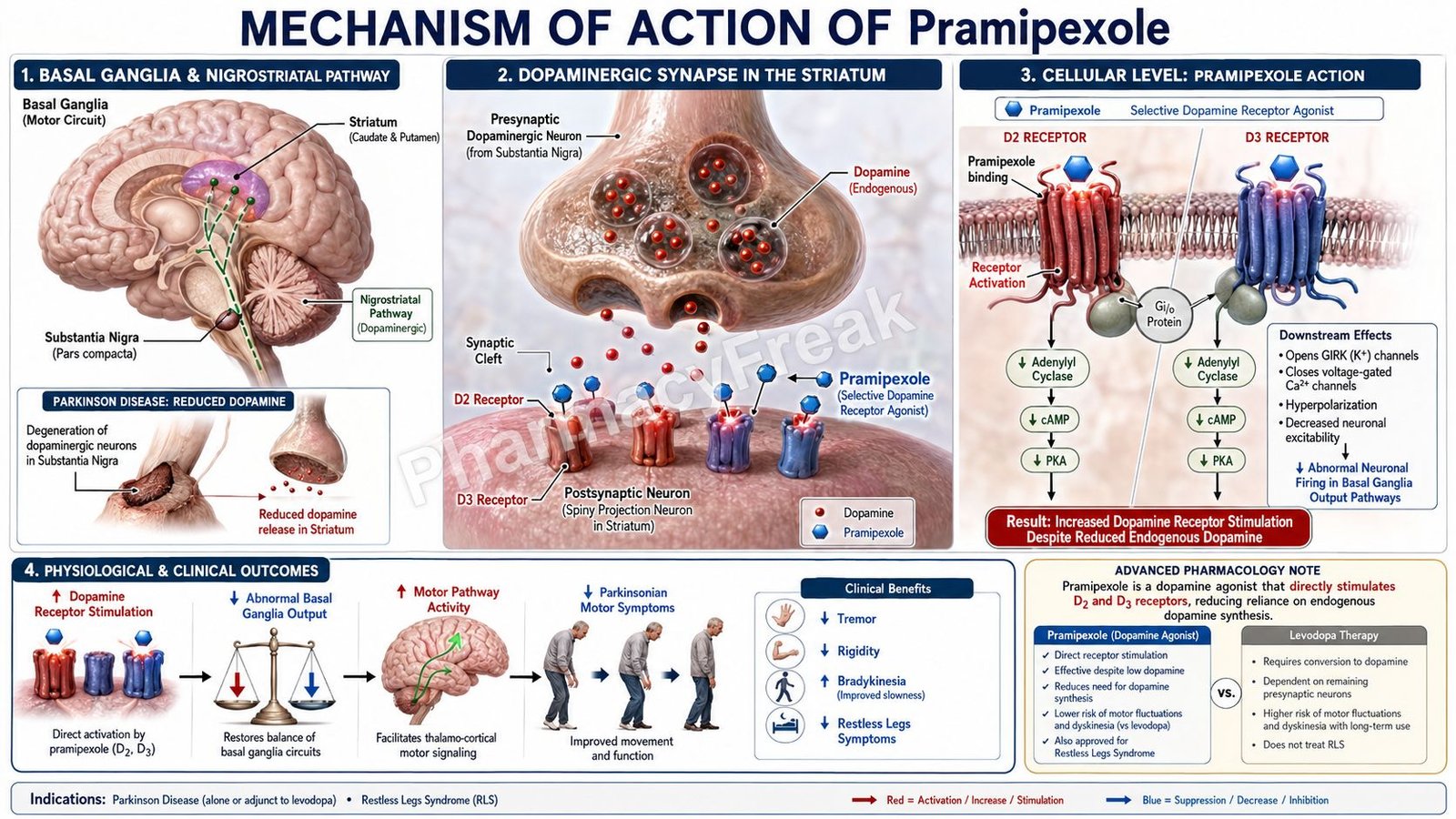
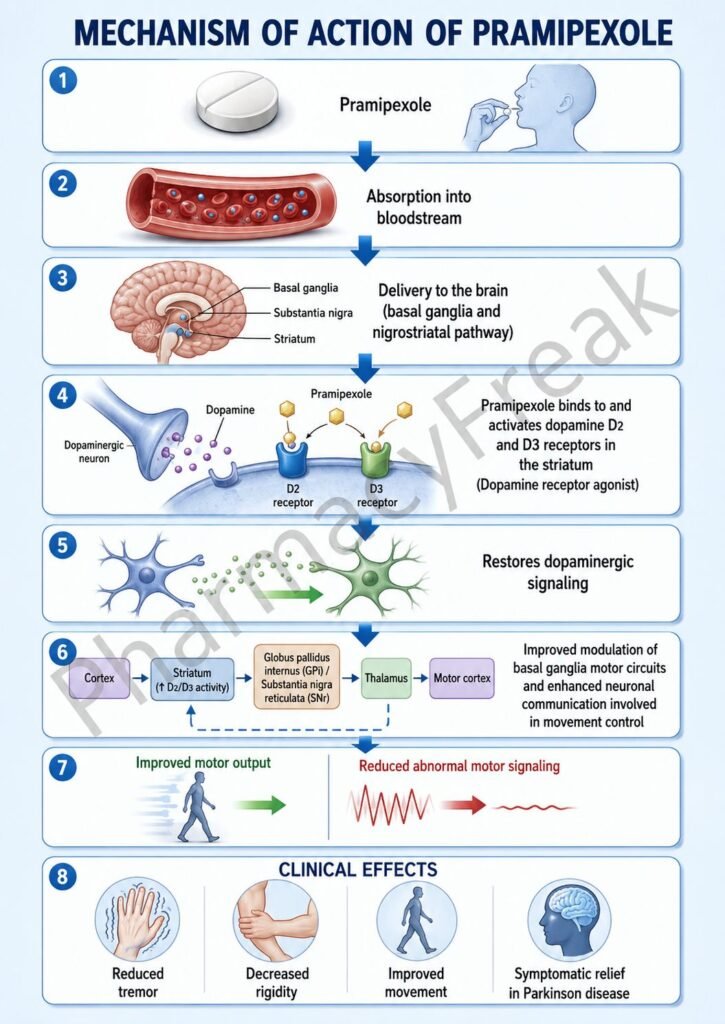
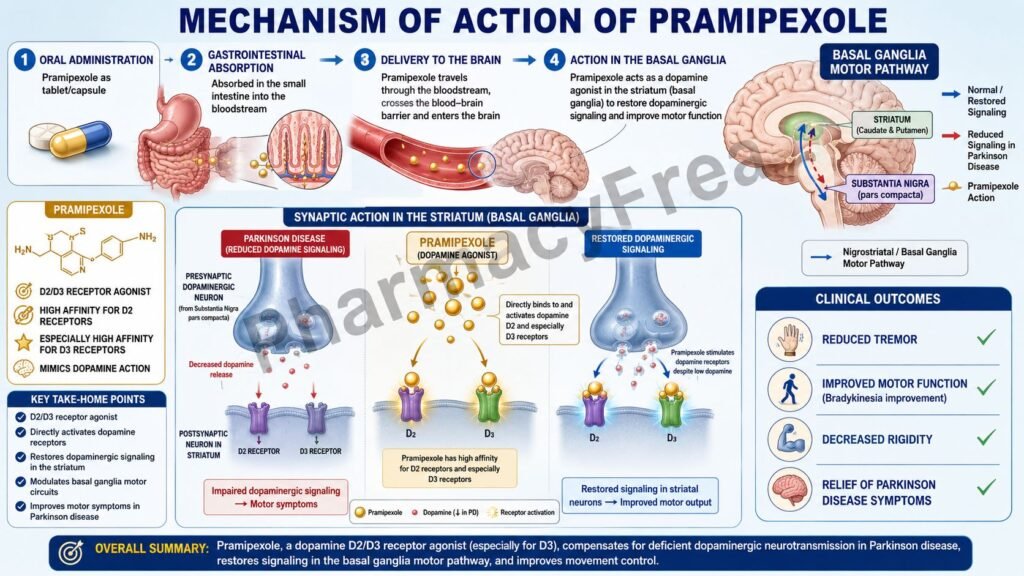
- Pramipexole directly stimulates dopamine receptors in the central nervous system.
- It has high selectivity for D2-like receptors, especially D3 receptors.
- Dopamine receptors are G-protein coupled receptors linked mainly to Gi proteins.
- Activation of these receptors inhibits adenylate cyclase activity.
- This reduces intracellular cyclic AMP (cAMP) levels.
- Dopaminergic stimulation in the striatum improves basal ganglia motor control.
- Increased dopaminergic signaling compensates for dopamine deficiency in Parkinson disease.
- This reduces motor symptoms such as rigidity, bradykinesia, and tremor.
- In restless legs syndrome, dopaminergic stimulation reduces abnormal sensory and motor symptoms.
- The overall effect is improved motor function and reduction of dopaminergic deficiency symptoms.
A key exam point is that pramipexole is a dopamine D2/D3 receptor agonist used in Parkinson disease and restless legs syndrome.
Pharmacokinetics
Pramipexole is administered orally and is well absorbed. It has high bioavailability and minimal hepatic metabolism. It is excreted largely unchanged by the kidneys, so dose adjustment is required in renal impairment. It has a relatively long half-life, allowing convenient dosing schedules.
Clinical Uses
Pramipexole is used in Parkinson disease either as monotherapy in early disease or in combination with levodopa in advanced disease. It is also commonly used in restless legs syndrome to reduce unpleasant limb sensations and urge to move the legs.
Adverse Effects
Common adverse effects include nausea, dizziness, somnolence, hallucinations, and orthostatic hypotension. Impulse control disorders such as gambling, hypersexuality, and compulsive shopping may occur due to dopaminergic stimulation. Sudden sleep attacks are also an important adverse effect.
Comparative Analysis
| Feature | Pramipexole | Levodopa | Ropinirole |
|---|---|---|---|
| Mechanism | Dopamine receptor agonist | Dopamine precursor | Dopamine receptor agonist |
| Receptor preference | D3 > D2 | Converted to dopamine | D2 selective |
| Use | Parkinson disease, RLS | Parkinson disease | Parkinson disease, RLS |
| Motor fluctuations | Lower early risk | Higher with long-term use | Lower early risk |
| Impulse control disorders | Possible | Less common | Possible |
| Metabolism | Minimal hepatic | Peripheral and central conversion | Hepatic metabolism |
Pramipexole differs from levodopa because it directly stimulates dopamine receptors instead of being converted into dopamine. Compared to ropinirole, it has stronger D3 receptor affinity.
MCQs
- Pramipexole primarily stimulates which receptors?
a) Serotonin receptors
b) Dopamine receptors
c) Histamine receptors
d) Muscarinic receptors
Answer: b) Dopamine receptors
- Pramipexole has high affinity for which receptor subtype?
a) D1
b) D2
c) D3
d) D5
Answer: c) D3
- Dopamine receptors activated by pramipexole are mainly coupled to:
a) Gs proteins
b) Gi proteins
c) Gq proteins
d) None
Answer: b) Gi proteins
- Activation of Gi proteins causes:
a) Increased cAMP
b) Decreased cAMP
c) Increased calcium
d) Increased sodium
Answer: b) Decreased cAMP
- Pramipexole is mainly used in:
a) Asthma
b) Parkinson disease
c) Hypertension
d) Diabetes
Answer: b) Parkinson disease
- Pramipexole improves:
a) Bradykinesia
b) Hyperglycemia
c) Hypotension
d) Hypercalcemia
Answer: a) Bradykinesia
- Another major indication is:
a) Migraine
b) Restless legs syndrome
c) Epilepsy
d) Heart failure
Answer: b) Restless legs syndrome
- A common adverse effect is:
a) Hallucinations
b) Hyperactivity
c) Hypercalcemia
d) Hypertension
Answer: a) Hallucinations
- Pramipexole may cause:
a) Impulse control disorders
b) Renal failure directly
c) Hypoglycemia
d) Ototoxicity
Answer: a) Impulse control disorders
- Pramipexole is excreted mainly via the:
a) Liver
b) Kidney
c) Lung
d) Skin
Answer: b) Kidney
- Compared to levodopa, pramipexole:
a) Is a dopamine precursor
b) Directly stimulates dopamine receptors
c) Blocks dopamine receptors
d) Inhibits MAO only
Answer: b) Directly stimulates dopamine receptors
- Sudden sleep attacks are associated with:
a) Aspirin
b) Pramipexole
c) Omeprazole
d) Metformin
Answer: b) Pramipexole
FAQs
What is the mechanism of action of pramipexole?
It directly stimulates dopamine D2/D3 receptors in the brain.
Why is pramipexole used in Parkinson disease?
Because it compensates for dopamine deficiency in the nigrostriatal pathway.
What receptor subtype does pramipexole prefer?
D3 receptors.
Can pramipexole cause behavioral changes?
Yes, impulse control disorders may occur.
What is another important use besides Parkinson disease?
Restless legs syndrome.
Does pramipexole require renal dose adjustment?
Yes, because it is mainly excreted by the kidneys.
References
Goodman & Gilman’s The Pharmacological Basis of Therapeutics – Drugs for Parkinson Disease
https://accessmedicine.mhmedical.com/book.aspx?bookid=3191
Katzung: Basic and Clinical Pharmacology – Antiparkinsonian Drugs
https://accessmedicine.mhmedical.com/content.aspx?bookid=3382
Tripathi: Essentials of Medical Pharmacology – Antiparkinsonian Drugs
https://www.jaypeedigital.com
Harrison’s Principles of Internal Medicine – Parkinson Disease
https://accessmedicine.mhmedical.com