Table of Contents
Introduction
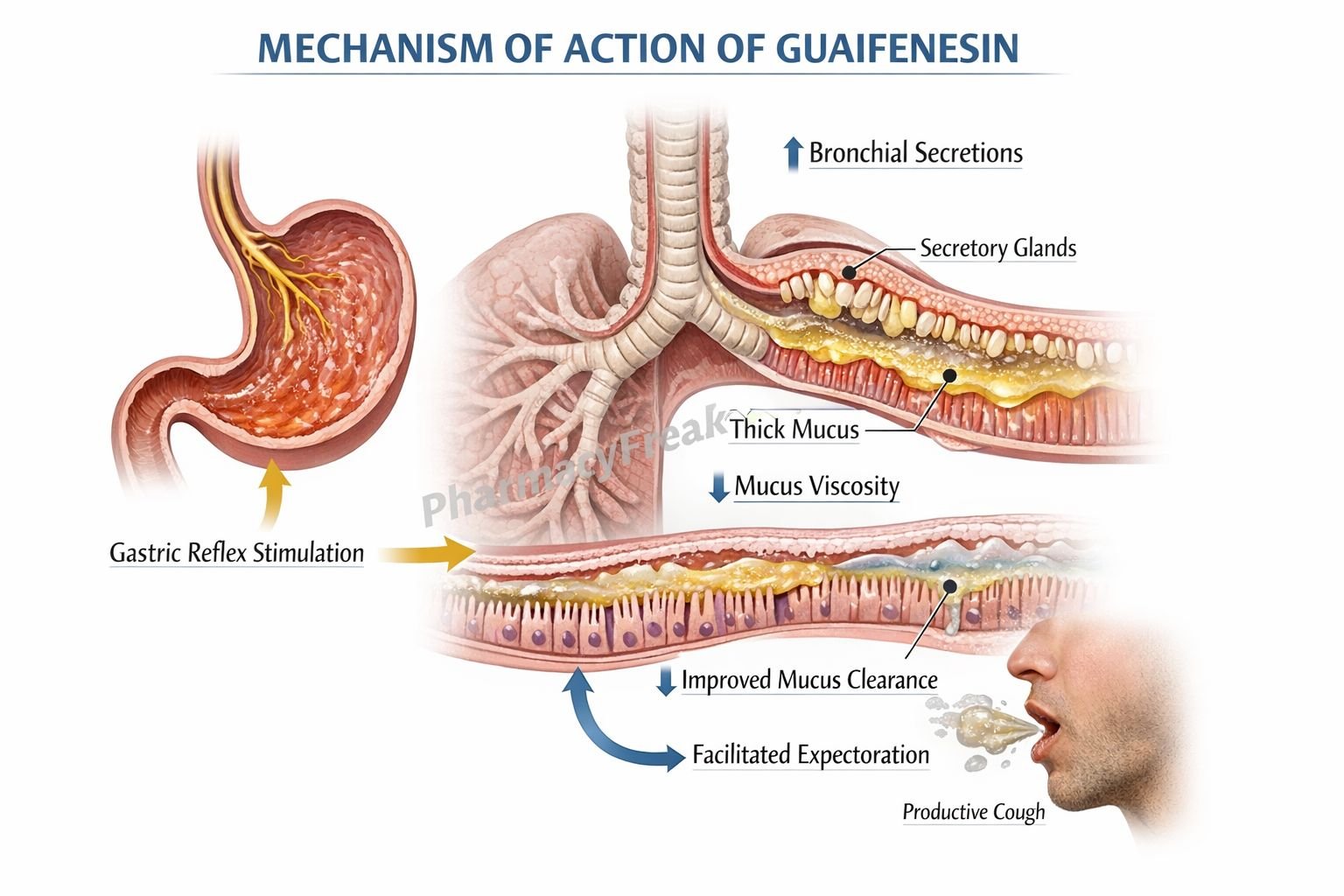
Guaifenesin is an expectorant commonly used in the treatment of productive cough associated with respiratory tract infections such as bronchitis, the common cold, and other respiratory conditions. It works by reducing the viscosity of bronchial secretions, making mucus easier to clear from the airways.
Unlike antitussive drugs that suppress cough reflexes, guaifenesin facilitates mucus clearance by improving airway secretion hydration and promoting effective coughing. Because of this mechanism, it is widely included in cough and cold formulations.
Understanding its mechanism is important in pharmacology and clinical medicine examinations such as USMLE, NEET PG, FMGE, PLAB, INICET, NCLEX, and MCCQE.
Mechanism of Action (Step-wise)
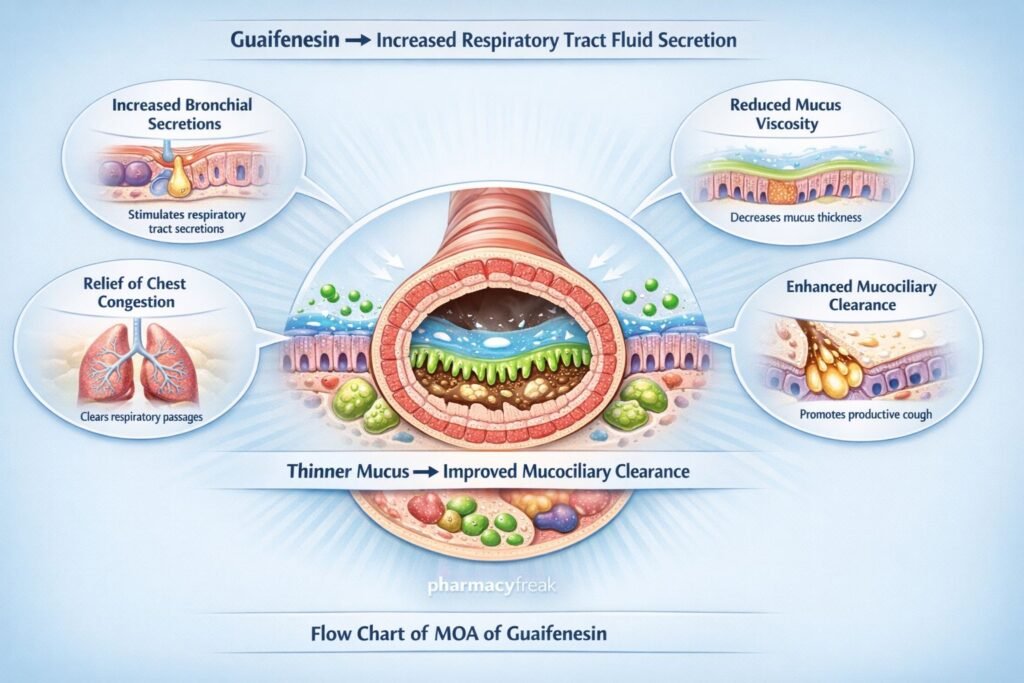
Guaifenesin acts primarily as an expectorant by increasing respiratory tract fluid secretion and decreasing mucus viscosity.
Step 1: Gastrointestinal irritation reflex
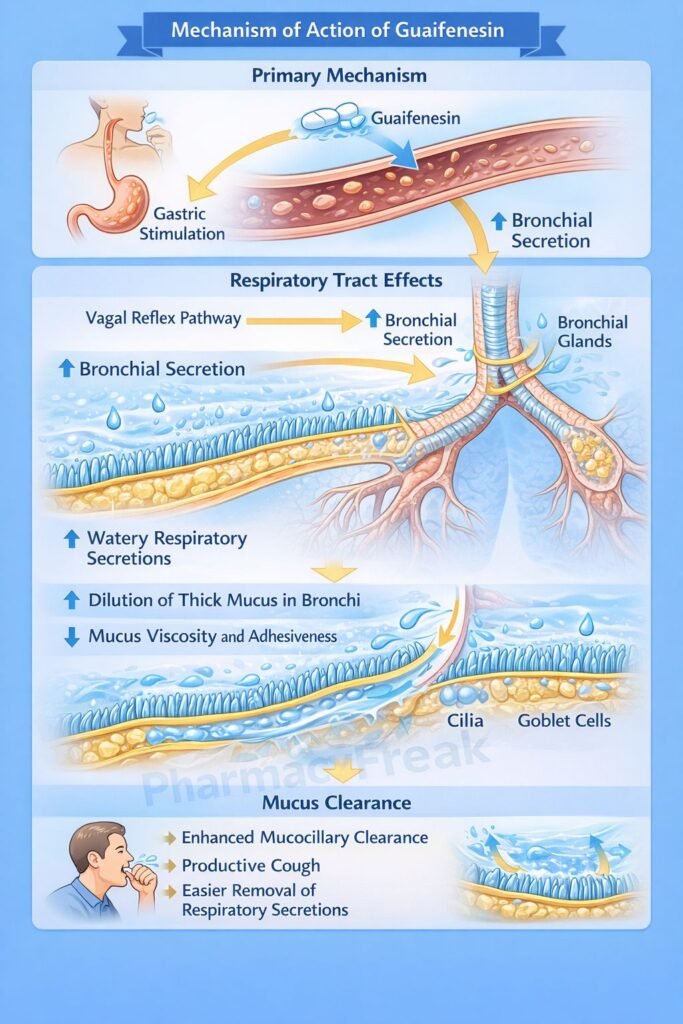
After oral administration, guaifenesin mildly irritates the gastric mucosa.
Step 2: Vagal reflex stimulation
This irritation triggers a vagally mediated reflex that stimulates respiratory tract secretory glands.
Step 3: Increased bronchial secretions
The reflex increases secretion of fluid in the respiratory tract.
Step 4: Reduction of mucus viscosity
Increased hydration of airway mucus reduces its thickness and stickiness.
Step 5: Enhanced mucociliary clearance
Thinner mucus is more easily transported by ciliary movement and expelled through coughing.
Overall effect:
Facilitates removal of mucus from the respiratory tract and improves productive cough.
Important pharmacology concept:
Guaifenesin does not suppress cough but promotes effective clearance of airway secretions.
Pharmacokinetics
Absorption:
Rapidly absorbed from the gastrointestinal tract after oral administration.
Distribution:
Widely distributed in body fluids.
Metabolism:
Metabolized in the liver to inactive metabolites.
Excretion:
Excreted mainly through urine.
Duration:
Short half life; therefore dosing may be repeated several times daily depending on formulation.
Extended release formulations provide longer duration of action.
Clinical Uses
- Productive cough associated with respiratory infections
- Acute bronchitis
- Upper respiratory tract infections such as the common cold
- Adjunct therapy in chronic respiratory conditions with thick mucus
Guaifenesin is frequently combined with other agents such as antihistamines, decongestants, or antitussives in cough preparations.
Adverse Effects
Guaifenesin is generally well tolerated.
Common adverse effects:
- Nausea
- Vomiting
- Gastrointestinal discomfort
Less common adverse effects:
- Dizziness
- Headache
- Skin rash
These effects are usually mild and dose related.
Comparative Analysis
| Feature | Guaifenesin | Acetylcysteine | Dextromethorphan |
|---|---|---|---|
| Drug class | Expectorant | Mucolytic | Antitussive |
| Mechanism | Increases airway secretions | Breaks disulfide bonds in mucus | Suppresses cough center |
| Effect on mucus | Thins mucus indirectly | Directly liquefies mucus | No effect on mucus |
| Main use | Productive cough | Thick mucus disorders | Dry cough |
| Site of action | Respiratory secretory glands | Bronchial mucus | Medullary cough center |
Explanation:
Guaifenesin acts by increasing respiratory tract fluid secretion, which thins mucus and promotes its clearance. Acetylcysteine directly breaks disulfide bonds within mucus glycoproteins, reducing viscosity more directly. Dextromethorphan acts centrally in the brainstem to suppress the cough reflex and is used mainly for non productive cough.
MCQs
- Guaifenesin belongs to which drug class?
a) Antitussive
b) Expectorant
c) Antihistamine
d) Bronchodilator
Answer: b) Expectorant
- Primary action of guaifenesin:
a) Suppresses cough center
b) Increases airway secretions
c) Blocks histamine receptors
d) Dilates bronchi
Answer: b) Increases airway secretions
- Guaifenesin improves cough by:
a) Decreasing mucus production
b) Thickening mucus
c) Reducing mucus viscosity
d) Blocking vagal reflex
Answer: c) Reducing mucus viscosity
- Main therapeutic use:
a) Dry cough
b) Productive cough
c) Asthma
d) Tuberculosis
Answer: b) Productive cough
- Guaifenesin acts primarily on:
a) Cough center in brain
b) Respiratory secretory glands
c) Alveolar macrophages
d) Bronchial smooth muscle
Answer: b) Respiratory secretory glands
- Increased hydration of mucus leads to:
a) Increased viscosity
b) Reduced viscosity
c) Bronchoconstriction
d) Reduced secretion
Answer: b) Reduced viscosity
- Guaifenesin is commonly combined with:
a) Antihistamines and decongestants
b) Insulin
c) Anticoagulants
d) Antibiotics only
Answer: a) Antihistamines and decongestants
- Common adverse effect:
a) Severe hypotension
b) Nausea
c) Bradycardia
d) Hyperglycemia
Answer: b) Nausea
- Compared to dextromethorphan, guaifenesin:
a) Suppresses cough reflex
b) Promotes mucus clearance
c) Causes bronchodilation
d) Reduces airway inflammation
Answer: b) Promotes mucus clearance
- Mechanism involves stimulation of:
a) Respiratory secretory glands
b) Central cough center
c) Cardiac muscle
d) Renal tubules
Answer: a) Respiratory secretory glands
FAQs
- How does guaifenesin help relieve cough?
It thins respiratory mucus and promotes clearance through coughing. - Is guaifenesin used for dry cough?
No, it is mainly used for productive cough. - Does guaifenesin suppress cough reflex?
No, it facilitates mucus removal rather than suppressing cough. - Why is hydration important when taking guaifenesin?
Adequate fluids enhance mucus thinning and expectoration. - Is guaifenesin safe for most patients?
Yes, it is generally well tolerated with mild side effects. - Can guaifenesin be used with other cough medicines?
Yes, it is often combined with antihistamines, decongestants, or antitussives.
References
Goodman & Gilman’s Pharmacological Basis of Therapeutics
https://accessmedicine.mhmedical.com/book.aspx?bookID=2189
Katzung BG. Basic and Clinical Pharmacology
https://accessmedicine.mhmedical.com/book.aspx?bookID=2249
Tripathi KD. Essentials of Medical Pharmacology
https://jaypeedigital.com/book/9789354651970
Harrison’s Principles of Internal Medicine
https://accessmedicine.mhmedical.com/book.aspx?bookID=3095