Table of Contents
Introduction
Chlorpromazine is a first-generation (typical) antipsychotic, belonging to the phenothiazine class. It is used for schizophrenia, acute psychosis, bipolar mania, severe agitation, intractable hiccups, nausea, and tetanus-associated agitation.
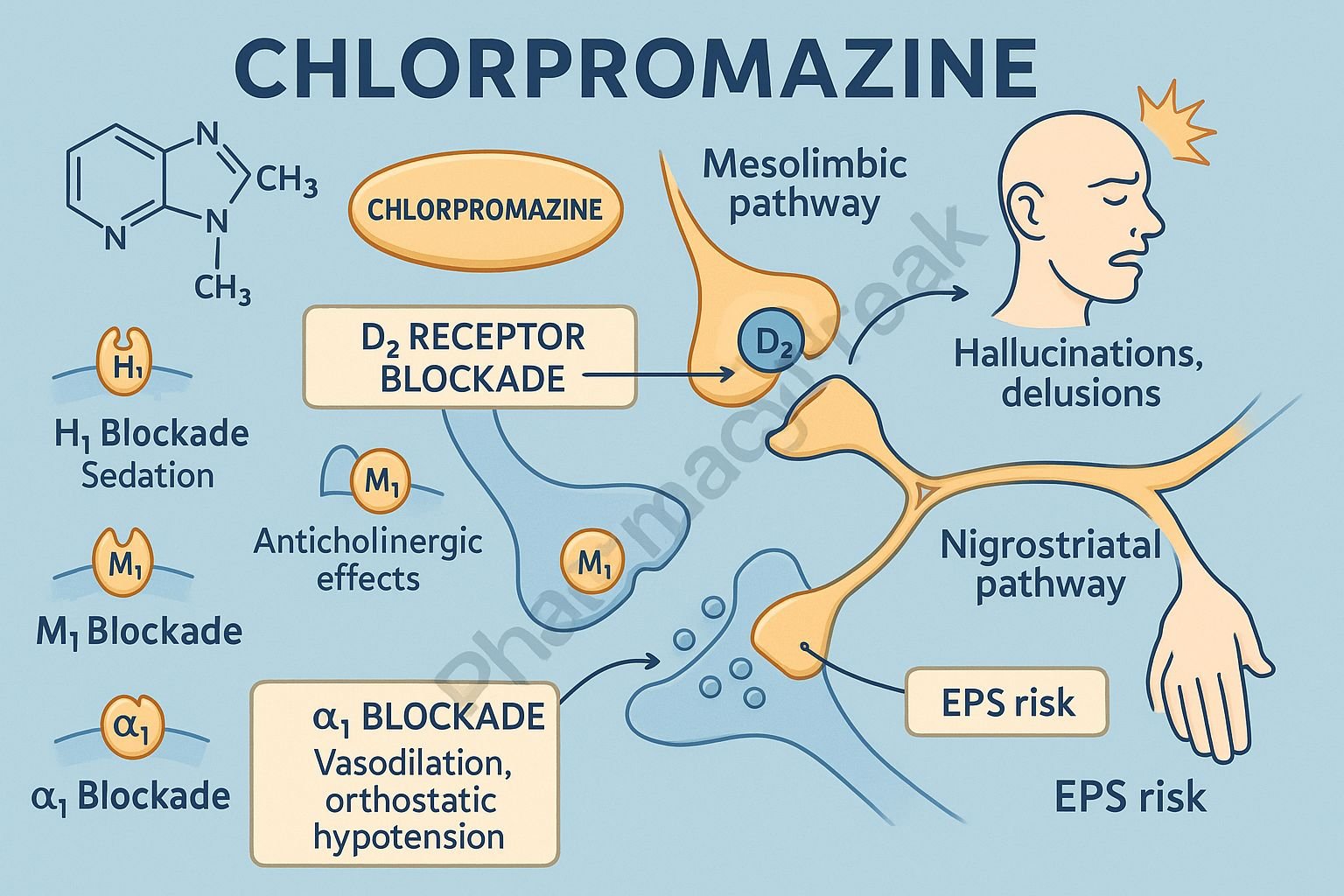
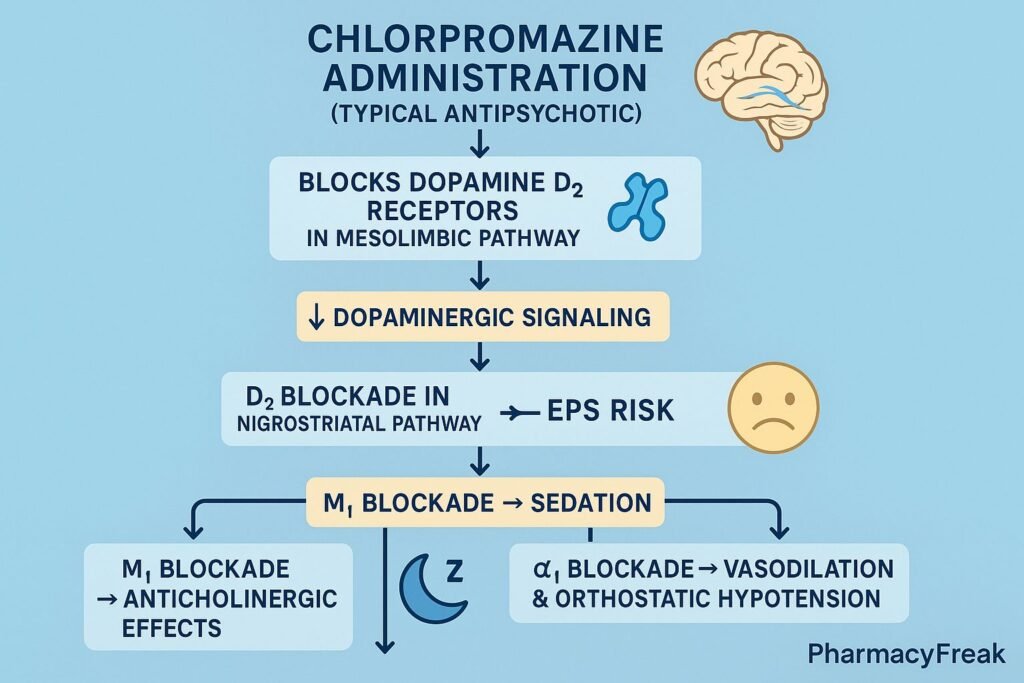
The Mechanism of Action of Chlorpromazine centers on dopamine D2 receptor antagonism in the mesolimbic system, along with additional blockade of histamine, muscarinic, and alpha-1 adrenergic receptors, producing both its therapeutic and adverse effects.

Mechanism of Action (Step-wise)
1. Dopamine D2 Receptor Blockade – Primary Mechanism
Chlorpromazine strongly blocks D2 receptors in the mesolimbic pathway.
Effects:
- ↓ Positive symptoms of schizophrenia (delusions, hallucinations)
- ↓ Agitation and aggression
- Antipsychotic and sedative actions
However, D2 blockade in other pathways causes side effects:
Nigrostriatal pathway → Extrapyramidal symptoms
Tuberoinfundibular pathway → Hyperprolactinemia
Mesocortical pathway → Possible cognitive dulling
2. Alpha-1 Adrenergic Blockade
Chlorpromazine blocks peripheral α1 receptors.
Effects:
- Vasodilation
- Orthostatic hypotension
- Reflex tachycardia
- Sedation
3. Histamine H1 Receptor Blockade
Potent antihistaminic activity.
Effects:
- Sedation
- Weight gain
- Antiemetic effect
4. Muscarinic (M1) Receptor Blockade
Anticholinergic effects include:
- Dry mouth
- Blurred vision
- Constipation
- Urinary retention
- Cognitive impairment
These effects may reduce extrapyramidal symptoms but increase anticholinergic burden.
5. Anti-Dopaminergic Effect in the Chemoreceptor Trigger Zone (CTZ)
Chlorpromazine blocks D2 receptors in the CTZ.
Effects:
- Strong antiemetic action
- Useful for severe nausea and vomiting
6. Anti-Hiccup Effect
Chlorpromazine is effective for intractable hiccups due to CNS depressant and dopamine-blocking properties.
7. Summary of Mechanism
| Mechanism | Effect |
|---|---|
| D2 receptor blockade | Antipsychotic effect; EPS; hyperprolactinemia |
| α1 blockade | Orthostatic hypotension |
| H1 blockade | Sedation; weight gain |
| M1 blockade | Anticholinergic effects |
| D2 blockade in CTZ | Antiemetic effect |
Pharmacokinetics
- Absorption: Variable orally
- Distribution: Highly lipid-soluble
- Half-life: 24–48 hours
- Metabolism: Hepatic via CYP2D6
- Excretion: Renal and biliary
Clinical Uses
- Schizophrenia (positive symptoms)
- Mania and acute agitation
- Severe nausea/vomiting
- Intractable hiccups
- Tetanus (adjunct sedative)
- Behavioral disorders
Adverse Effects
Extrapyramidal Symptoms (EPS)
- Acute dystonia
- Akathisia
- Parkinsonism
- Tardive dyskinesia (long-term)
Endocrine
- ↑ Prolactin → galactorrhea, gynecomastia, infertility
Cardiovascular
- Orthostatic hypotension
- QT prolongation
Metabolic
- Weight gain
- Hyperglycemia (mild)
Anticholinergic
- Dry mouth
- Urinary retention
- Constipation
Others
- Neuroleptic malignant syndrome (rare but life-threatening)
- Photosensitivity
- Jaundice (cholestatic)
Contraindications
- Severe CNS depression
- Bone marrow suppression
- Pheochromocytoma
- Parkinson’s disease
- Glaucoma and prostatic hypertrophy (due to anticholinergic effects)
- Use with QT-prolonging drugs
Comparative Analysis
| Feature | Chlorpromazine | Haloperidol | Risperidone |
|---|---|---|---|
| Class | Typical | Typical | Atypical |
| Sedation | High | Low | Moderate |
| EPS risk | Moderate | High | Low–moderate |
| Anticholinergic effects | High | Low | Low |
| Alpha-1 blockade | High | Moderate | Moderate |
MCQs
1. Chlorpromazine produces its antipsychotic effect mainly by blocking:
a) 5-HT2 receptors
b) D2 receptors
c) GABA receptors
d) NMDA receptors
Answer: b) D2 receptors
2. Orthostatic hypotension from chlorpromazine is due to:
a) H1 blockade
b) M1 blockade
c) Alpha-1 blockade
d) Beta-2 blockade
Answer: c) Alpha-1 blockade
3. Extrapyramidal symptoms occur because of dopamine blockade in:
a) Mesolimbic pathway
b) Nigrostriatal pathway
c) Tuberoinfundibular pathway
d) Mesocortical pathway
Answer: b) Nigrostriatal pathway
4. A unique use of chlorpromazine is for:
a) Night terrors
b) Intractable hiccups
c) Hypertension
d) Insomnia
Answer: b) Intractable hiccups
5. Hyperprolactinemia results from blockade of dopamine in the:
a) Mesolimbic system
b) Mesocortical pathway
c) Tuberoinfundibular pathway
d) Nigrostriatal system
Answer: c) Tuberoinfundibular pathway
FAQs
Q1. Does chlorpromazine cause sedation?
Yes—mainly due to H1 histamine receptor blockade.
Q2. Why does chlorpromazine cause EPS?
Due to D2 blockade in the nigrostriatal pathway.
Q3. Does it help negative symptoms of schizophrenia?
Not significantly; mainly improves positive symptoms.
Q4. Can chlorpromazine cause jaundice?
Yes—rare cholestatic jaundice may occur.
Q5. Why is chlorpromazine avoided in Parkinson’s disease?
Because dopamine blockade worsens motor symptoms.
References
Goodman & Gilman’s Pharmacological Basis of Therapeutics
https://accesspharmacy.mhmedical.com/book.aspx?bookid=2189
Katzung: Basic and Clinical Pharmacology
https://accessmedicine.mhmedical.com/book.aspx?bookid=2464
Tripathi: Essentials of Medical Pharmacology
https://jaypeebrothers.com/
Harrison’s Principles of Internal Medicine
https://accessmedicine.mhmedical.com/book.aspx?bookid=2129