
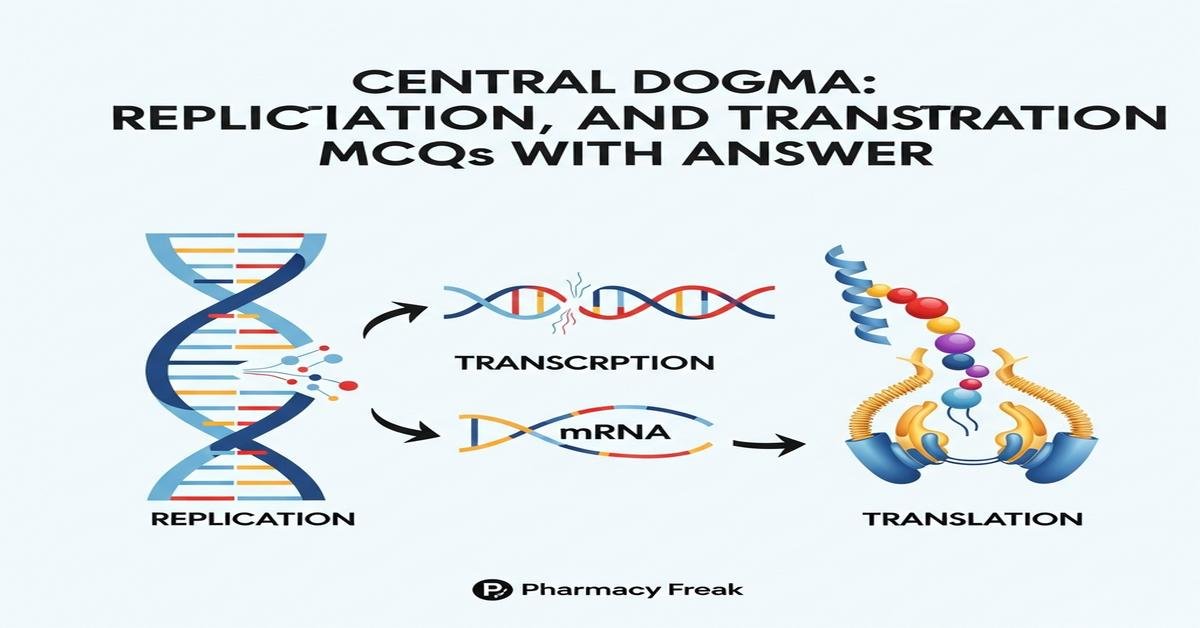
Introduction: Central dogma: replication, transcription and translation MCQs With Answer is a focused study aid tailored for M.Pharm students preparing for Microbial and Cellular Biology (MPB102T). This set of questions explores the molecular mechanisms that govern information flow from DNA to RNA to protein, emphasizing enzyme functions, regulatory elements, fidelity mechanisms and pharmaceutical relevance such as antibiotic targets and repair pathways. Questions are designed to deepen conceptual understanding and bridge basic molecular biology with applied pharmacological perspectives. Use these MCQs to test knowledge, identify areas needing review, and reinforce connections between central dogma processes and drug action or therapeutic interventions.
Q1. Which model of DNA replication was demonstrated by the Meselson-Stahl experiment?
- Conservative replication
- Semiconservative replication
- Dispersive replication
- Random replication
Correct Answer: Semiconservative replication
Q2. Which enzyme synthesizes RNA primers necessary for DNA replication in prokaryotes?
- DNA polymerase III
- Primase
- Helicase
- Ligase
Correct Answer: Primase
Q3. Which activity provides the 3’→5′ proofreading ability during DNA replication?
- DNA polymerase sliding clamp
- Helicase unwinding
- 3’→5′ exonuclease activity of DNA polymerase
- DNA ligase sealing activity
Correct Answer: 3’→5′ exonuclease activity of DNA polymerase
Q4. Okazaki fragments are a feature of which strand synthesis and why?
- Leading strand, because it is synthesized continuously
- Lagging strand, because it is synthesized discontinuously in short fragments
- Both strands equally, due to symmetric replication forks
- Mitochondrial DNA only, due to circular genome structure
Correct Answer: Lagging strand, because it is synthesized discontinuously in short fragments
Q5. In bacteria, the promoter consensus sequences recognized by RNA polymerase holoenzyme include which two regions?
- Poly-A tail and 5′ cap
- TATA box and BRE element
- ‑35 and ‑10 (Pribnow) boxes
- Enhancer and silencer
Correct Answer: ‑35 and ‑10 (Pribnow) boxes
Q6. Which subunit of bacterial RNA polymerase is primarily responsible for promoter recognition?
- Beta subunit
- Sigma factor
- Alpha subunit
- Omega subunit
Correct Answer: Sigma factor
Q7. Which mechanism terminates transcription in bacteria independent of Rho protein?
- Rho-dependent termination mediated by helicase
- Intrinsic termination by GC-rich hairpin followed by U-rich tract
- Cleavage by RNase P
- Transcriptional attenuation via riboswitch
Correct Answer: Intrinsic termination by GC-rich hairpin followed by U-rich tract
Q8. Which processing step is characteristic of eukaryotic pre-mRNA but not bacterial mRNA?
- 5′ capping with 7-methylguanosine
- Transcription by a single RNA polymerase for all RNAs
- Direct translation from unprocessed transcript
- Formation of polycistronic messages
Correct Answer: 5′ capping with 7-methylguanosine
Q9. What is the primary function of tRNA synthetases in translation?
- Recognize stop codons during termination
- Attach the correct amino acid to its cognate tRNA (charging)
- Catalyze peptide bond formation
- Proofread mRNA codons for accuracy
Correct Answer: Attach the correct amino acid to its cognate tRNA (charging)
Q10. Which ribosomal subunit sizes are typical for bacterial ribosomes?
- 40S and 60S
- 50S and 30S
- 70S and 80S
- 30S and 40S
Correct Answer: 50S and 30S
Q11. Which antibiotic specifically binds the 30S subunit and prevents the attachment of aminoacyl-tRNA to the A site?
- Chloramphenicol
- Tetracycline
- Erythromycin
- Rifampicin
Correct Answer: Tetracycline
Q12. Which factor is essential for initiation of translation in prokaryotes by facilitating fMet-tRNAfMet binding to the P site?
- IF-1
- IF-2
- EF-Tu
- Release factor RF1
Correct Answer: IF-2
Q13. Wobble at the third position of a codon allows what important biological property?
- Strict one-to-one codon–amino acid mapping
- Reduced number of tRNAs required to decode all codons
- Prevention of frameshift mutations
- Increased transcriptional fidelity
Correct Answer: Reduced number of tRNAs required to decode all codons
Q14. Telomerase extends telomeres using which template and activity?
- Uses DNA template and DNA polymerase activity
- Uses an RNA template and reverse transcriptase activity
- Uses protein template and ligase activity
- Uses tRNA template and primase activity
Correct Answer: Uses an RNA template and reverse transcriptase activity
Q15. Which DNA repair pathway corrects single-stranded mismatches created during replication?
- Nucleotide excision repair (NER)
- Base excision repair (BER)
- Mismatch repair (MMR)
- Non-homologous end joining (NHEJ)
Correct Answer: Mismatch repair (MMR)
Q16. Which process allows transcription and translation to be coupled in prokaryotes?
- Separation of nucleus and cytoplasm
- Simultaneous binding of ribosomes to nascent mRNA while RNA polymerase is still transcribing
- Splicing of introns before translation
- mRNA capping and polyadenylation prior to export
Correct Answer: Simultaneous binding of ribosomes to nascent mRNA while RNA polymerase is still transcribing
Q17. In the lac operon, which molecule acts as the inducer by binding the repressor and causing it to release operator DNA?
- cAMP
- lactose or allolactose
- glucose
- tryptophan
Correct Answer: lactose or allolactose
Q18. Which enzymatic activity of RNA polymerase is directly responsible for chain elongation during transcription?
- 3’→5′ exonuclease
- DNA helicase unwinding
- RNA-dependent RNA polymerization
- RNA polymerase-mediated NTP polymerization (phosphodiester bond formation)
Correct Answer: RNA polymerase-mediated NTP polymerization (phosphodiester bond formation)
Q19. Frameshift mutations most commonly arise from which type of error?
- Substitution of one base with another
- Insertion or deletion of nucleotides not in multiples of three
- Misincorporation corrected by 3’→5′ exonuclease
- Synonymous codon usage
Correct Answer: Insertion or deletion of nucleotides not in multiples of three
Q20. Which mechanism increases translation accuracy by proof-reading amino acid selection before peptide bond formation?
- Ribosomal peptidyl transferase rejecting incorrect tRNAs after A-site accommodation
- tRNA synthetase double-sieve editing of aminoacyl-AMP intermediates
- mRNA secondary structure blocking ribosome access
- Ribosome recycling factor (RRF) surveillance
Correct Answer: tRNA synthetase double-sieve editing of aminoacyl-AMP intermediates

