
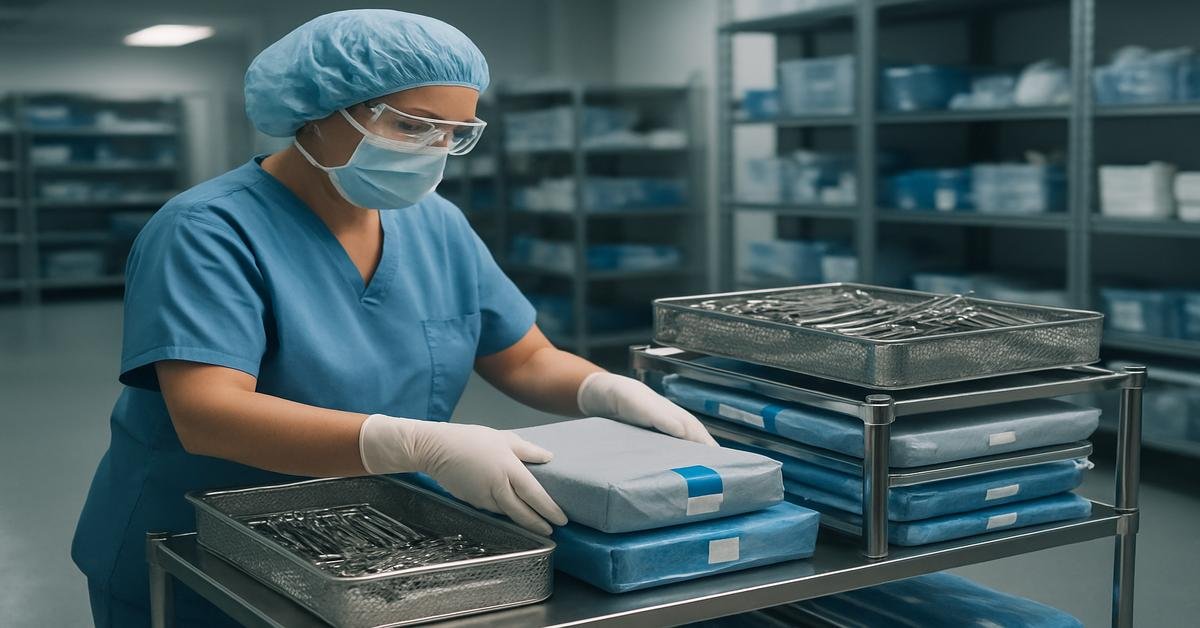
Every surgery, wound dressing, catheter insertion, and bedside procedure depends on one simple fact: the right instrument must be clean, sterile, complete, and available at the right time. That does not happen by luck. It happens because trained professionals manage one of the most sensitive parts of a hospital’s supply chain. Certified Sterile Processing and Distribution Technicians, often called CSPDTs, sit at the center of that work. They clean, inspect, assemble, sterilize, store, and distribute medical instruments and devices. Their job affects patient safety, operating room efficiency, infection prevention, compliance, and cost control. In practical terms, they make sure care teams can trust the tools in their hands.
What CSPDT logistics means in a hospital
Hospital supply chains are not only about buying products and moving boxes. They also include the safe handling of reusable medical devices. That is where sterile processing logistics becomes different from a standard warehouse operation.
A hospital can order ten boxes of gauze and place them on a shelf. Reusable surgical instruments are more complex. A tray used in the morning may return contaminated, need to be disassembled, cleaned to precise standards, inspected for damage, reassembled in the correct set, sterilized using the right cycle, documented, stored properly, and delivered back for the next case. If any step fails, the item may be unsafe or unavailable.
CSPDT logistics covers this full movement of instruments and devices through the hospital. It includes:
- Decontamination of used instruments
- Inspection and testing for cleanliness, function, and wear
- Assembly of trays and procedural sets
- Sterilization using approved methods and correct cycle parameters
- Storage under conditions that protect package integrity
- Distribution to operating rooms, procedure areas, clinics, and patient units
- Documentation and traceability for quality control and recall response
This is logistics with clinical consequences. The “supply” is not only inventory. It is a safety-critical asset that must be processed correctly every time.
Why certification matters
Many people outside healthcare assume sterile processing is basic cleaning work. It is not. It requires technical knowledge, attention to detail, and an understanding of microbiology, device design, chemistry, workflow, and regulations.
Certification matters because hospitals need proof that technicians understand the standards behind the work. A certified technician is trained in how to interpret manufacturer instructions, prepare loads correctly, choose the proper sterilization process, identify defects, and maintain documentation. That knowledge reduces variation. In hospitals, less variation usually means fewer errors.
Certification also creates a shared professional baseline. In a busy department, different technicians may work on the same tray across different shifts. Certification helps ensure they follow the same principles rather than personal habits. That consistency is vital when patient safety depends on small details, such as whether a hinged instrument was opened during sterilization or whether a lumen was dried fully before packaging.
Hospitals benefit because certified staff are better prepared to:
- Recognize risk points before they become patient care problems
- Follow standards consistently under workload pressure
- Document correctly for audits, investigations, and quality reviews
- Support infection prevention goals with evidence-based practice
- Protect expensive instruments by using correct handling methods
Certification does not guarantee perfection. But it gives hospitals a stronger foundation than informal, on-the-job learning alone.
They protect patients in ways most people never see
The clearest reason CSPDTs matter is patient safety. A sterile instrument is not simply one that “looks clean.” Blood, tissue, bone fragments, bioburden, detergent residue, and moisture can remain on devices if processing is rushed or done incorrectly. Some instruments have tiny channels, joints, insulation layers, or moving parts that make cleaning difficult. If contamination remains, sterilization may fail or be less effective.
That means the technician’s work directly influences infection risk. It also affects other types of harm. A cracked laparoscopic instrument, a dull scissor, a missing clamp, or an incorrectly assembled power tool can disrupt care and create safety issues during a procedure.
For example, imagine an orthopedic tray returned after a long trauma case. The set may contain dozens of heavy instruments with joints, cannulations, and detachable parts. A CSPDT must know how to disassemble each item, remove gross soil safely, clean internal channels, inspect for wear, test function, and rebuild the tray exactly as required. If one piece is assembled wrong or one instrument is missing, the surgeon may not have what is needed when time matters most.
This is why sterile processing is not a back-room support task in the casual sense. It is part of direct patient protection, just without the patient seeing it.
They keep operating rooms and procedure areas running
Hospital supply chains are judged by reliability. In sterile processing, reliability means the right tray reaches the right location at the right time in usable condition. CSPDTs are essential to that outcome.
Operating rooms are expensive environments. Delays cost money, frustrate surgeons and staff, and can push back care for multiple patients in one day. One unavailable instrument set can create a chain reaction: a delayed case, overtime labor, upset patients, rushed turnover, and higher stress across departments.
CSPDTs reduce that risk by managing instrument flow with precision. They monitor tray turnaround, prioritize urgent requests, communicate with perioperative teams, and make judgment calls when schedules change. This is logistics work in real time.
Consider a day when a hospital adds emergency cases on top of a full elective schedule. The sterile processing team may need to fast-track specific sets, identify substitutions, verify sterilizer capacity, and coordinate with the OR so the most critical trays are processed first. A skilled certified technician understands not just the mechanics of sterilization, but also how to make the workflow support patient care without cutting corners.
That balance matters. Speed without control creates safety problems. Control without responsiveness creates delays. CSPDTs help hospitals manage both.
They are a key part of infection prevention
Infection prevention is often associated with hand hygiene, environmental cleaning, isolation precautions, and antibiotic stewardship. Sterile processing belongs in that same conversation. Reusable instruments move from one patient to another. If they are not processed correctly, they can become a transmission route.
Certified technicians help break that chain by applying standards consistently. They understand why each step matters:
- Point-of-use treatment helps prevent soil from drying and becoming harder to remove
- Correct cleaning chemistry supports removal of organic material without damaging the device
- Proper rinsing and drying prevents residue and package compromise
- Accurate packaging allows sterilant to reach surfaces while maintaining sterility afterward
- Load configuration affects sterilizer performance and cycle success
- Monitoring and documentation confirm that conditions were met and support investigation if a problem arises
The “why” is simple. Sterility is a system result, not a single machine result. A sterilizer cannot fix poor cleaning, damaged packaging, overloaded trays, or wrong assembly. Technicians understand that each upstream step affects the final outcome.
This system view is one reason they are so valuable. Hospitals cannot prevent device-related infections by focusing only on the last step.
They improve traceability and recall response
Modern hospitals need strong documentation. If a sterilization load fails, a biological monitor is positive, or a device manufacturer issues a correction notice, the hospital must know what was processed, when, how, and where it went.
CSPDTs support this traceability. They record load details, cycle data, tray contents, and distribution information. In many hospitals, this is done through instrument tracking systems. Those records are not mere paperwork. They allow the organization to act quickly if there is a concern.
For example, if a sterilization issue is discovered after items have been distributed, the hospital needs to identify affected trays fast. Strong tracking reduces the time needed to quarantine items, review exposure risk, notify the right teams, and decide on next steps. Without accurate records, response becomes slower and less certain, which increases operational and clinical risk.
Certified technicians tend to understand the importance of documentation because they are trained to see sterile processing as a controlled process, not a loose collection of tasks.
They help control costs, even though their work is often underestimated
Some leaders look at sterile processing mainly as a labor center. That is too narrow. Skilled CSPDTs save money in several ways, even if those savings are not always obvious on a spreadsheet.
First, they help avoid preventable surgical delays and cancellations. That protects revenue and reduces overtime. Second, they extend instrument life by using correct cleaning methods, handling devices carefully, and identifying damage early. Surgical instruments are expensive, and repeated misuse shortens their lifespan.
Third, they reduce waste. A poorly organized department may open unnecessary sets, lose components, duplicate inventory, or use flash sterilization as a routine crutch. Those practices drive up costs and create risk. A strong sterile processing team manages sets more carefully and supports better case preparation.
Fourth, they help avoid the costs of infection events, compliance failures, and emergency replacement purchases. One processing breakdown can trigger far more expense than the department’s training budget for an entire year.
In short, certified technicians are not only safety assets. They are operational and financial assets too.
They manage growing complexity in devices and procedures
Hospitals are using more specialized devices than ever. Robotic instruments, flexible scopes, power equipment, microsurgical tools, and multi-part sets all require careful handling. Manufacturer instructions can be detailed and strict. Some devices need leak testing. Others need exact drying times, inspection steps, or special cycle parameters.
This complexity changes the job. Sterile processing is no longer just about wrapping standard trays and running loads. It now requires technicians who can interpret instructions, recognize device-specific risks, and adapt workflows to a broader range of equipment.
Certification helps prepare technicians for this environment. It supports the habit of asking the right questions:
- Was this device cleaned according to its exact instructions?
- Are all parts present and assembled correctly?
- Is this package method appropriate for the item?
- Does this sterilization cycle match the device requirements?
- Is the item still functional and safe to use?
As devices become more advanced, the value of technicians who can handle complexity rises with them.
They depend on teamwork, but their expertise is distinct
CSPDTs do not work alone. Their success depends on coordination with operating room staff, infection prevention teams, materials management, biomedical staff, vendors, and department leaders. But their role should not be blurred into general support work.
Their expertise is distinct because they understand the reprocessing life cycle in depth. They know how instrument design affects cleaning. They know where errors usually happen. They know which shortcuts create hidden risk. That perspective is different from the viewpoint of a circulating nurse, supply chain manager, or purchaser.
Hospitals work best when this expertise is respected. For example, if an OR team wants a faster turnaround on a complex tray, a certified technician can explain what is possible, what is unsafe, and what alternatives may work. That kind of informed pushback protects both patients and staff. It also prevents the department from becoming a pressure point where unrealistic demands override process control.
What strong hospitals do differently
Hospitals that treat sterile processing as a strategic function usually perform better than those that treat it as an afterthought. They invest in certified staff, ongoing education, clear workflow design, modern tracking systems, and close coordination with clinical departments.
They also pay attention to practical issues that shape daily performance:
- Tray standardization so staff are not rebuilding the same set in different ways
- Accurate count sheets so missing items are caught quickly
- Preventive maintenance for washers, sterilizers, and inspection equipment
- Realistic staffing levels so quality does not collapse during peak demand
- Training on new devices before they enter active use
- Shared metrics for turnaround time, defects, missing items, and wet packs
These steps matter because sterile processing quality is built through system design. Even the best technician will struggle in a department with poor documentation, broken equipment, unclear priorities, and constant understaffing.
Why their role will only become more important
Healthcare is under pressure to do more with less, while managing stricter safety expectations and more complex technology. That combination makes the role of the certified sterile processing technician more important, not less.
Hospitals need dependable supply chains. But in clinical settings, dependability is not only about inventory levels. It is about trust. Surgeons need to trust that a tray is complete. Nurses need to trust that a packaged instrument is truly ready for patient use. Infection prevention teams need to trust the process controls behind the department. Patients need to trust a system they may never see.
CSPDTs help create that trust every day. They turn used, contaminated devices into safe, available clinical tools through disciplined process control. They protect schedules, support compliance, reduce waste, and help prevent harm. Most importantly, they make the hospital’s reusable device supply chain function in a way that care teams can rely on.
That is why Certified Sterile Processing and Distribution Technicians are vital to hospital supply chains: they connect logistics with patient safety. Without them, the system may still move, but it cannot move safely or consistently.

