
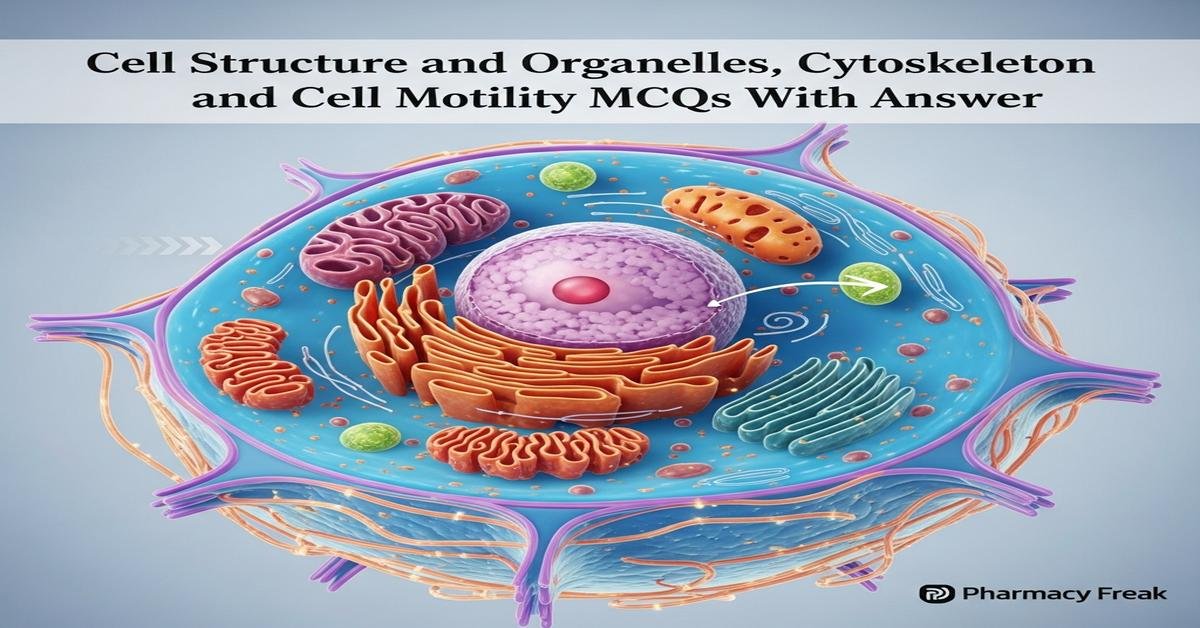
Introduction: This quiz set on Cell Structure and Organelles, Cytoskeleton and Cell Motility is designed for M.Pharm students preparing for advanced coursework and exams in Microbial and Cellular Biology (MPB102T). The questions emphasize functional details, intracellular trafficking, organelle specialization, and molecular mechanisms of cytoskeletal dynamics and cell movement. Expect items on protein targeting, membrane trafficking machinery, organelle-specific biochemical pathways, motor proteins, and pharmacological agents that affect the cytoskeleton. These MCQs will help consolidate core concepts needed for drug development, cell biology experiments, and understanding disease mechanisms related to organelle dysfunction and altered cell motility.
Q1. Which organelle is the primary site of ATP production by oxidative phosphorylation in eukaryotic cells?
- Mitochondrion
- Chloroplast
- Golgi apparatus
- Endoplasmic reticulum
Correct Answer: Mitochondrion
Q2. The N-terminal signal peptide that directs a nascent polypeptide to the endoplasmic reticulum is recognized cotranslationally by which factor?
- Signal recognition particle (SRP)
- Rab GTPase
- SNARE complex
- Ubiquitin ligase
Correct Answer: Signal recognition particle (SRP)
Q3. Which coat protein complex facilitates vesicle budding from the rough endoplasmic reticulum toward the Golgi apparatus?
- COPII-coated vesicles
- COPI-coated vesicles
- Clathrin-coated vesicles
- Caveolin-coated vesicles
Correct Answer: COPII-coated vesicles
Q4. Which Golgi compartment is primarily responsible for sorting and packaging proteins into distinct vesicles for delivery to their final destinations?
- Trans-Golgi network (TGN)
- Cis-Golgi network (CGN)
- Medial Golgi
- Golgi cisterna periphery
Correct Answer: Trans-Golgi network (TGN)
Q5. Which organelle is the major cellular site for detoxification of hydrogen peroxide and very-long-chain fatty acid β-oxidation in eukaryotic cells?
- Peroxisome
- Lysosome
- Mitochondrion
- Smooth endoplasmic reticulum
Correct Answer: Peroxisome
Q6. Which component of the cytoskeleton is primarily composed of tubulin heterodimers and exhibits dynamic instability essential for mitosis and intracellular transport?
- Microtubules
- Microfilaments (actin filaments)
- Intermediate filaments
- Focal adhesions
Correct Answer: Microtubules
Q7. Which motor protein moves cargo toward the plus end of microtubules, typically toward the cell periphery?
- Kinesin
- Dynein
- Myosin II
- Myosin V
Correct Answer: Kinesin
Q8. Which drug stabilizes microtubules and is commonly used as an anti-cancer agent by preventing microtubule depolymerization?
- Paclitaxel (Taxol)
- Colchicine
- Cytochalasin D
- Latrunculin A
Correct Answer: Paclitaxel (Taxol)
Q9. The classical “9+2” arrangement of microtubules is characteristic of which cellular structures responsible for motility?
- Cilia and eukaryotic flagella
- Centrosomes
- Stress fibers
- Desmosomes
Correct Answer: Cilia and eukaryotic flagella
Q10. Which enzyme complex in the inner mitochondrial membrane synthesizes ATP using the proton gradient generated by the electron transport chain?
- ATP synthase (F1F0-ATPase)
- Succinate dehydrogenase
- Citrate synthase
- ATP phosphatase
Correct Answer: ATP synthase (F1F0-ATPase)
Q11. In the secretory pathway, which proteins on vesicles and target membranes mediate the final membrane fusion event by forming a tight four-helix bundle?
- v-SNAREs and t-SNAREs
- Rab GTPases and tethering factors
- Clathrin and adaptins
- COP complexes and Sar1
Correct Answer: v-SNAREs and t-SNAREs
Q12. Which cellular degradation pathway requires the covalent attachment of ubiquitin chains to target proteins for recognition by the 26S proteasome?
- Ubiquitin–proteasome system (UPS)
- Lysosomal autophagy
- Endocytosis-mediated degradation
- Peroxisomal degradation
Correct Answer: Ubiquitin–proteasome system (UPS)
Q13. Which cytoskeletal filaments are primarily responsible for generating contractile force in muscle cells through interaction with myosin-II?
- Actin filaments (microfilaments)
- Microtubules
- Intermediate filaments
- Keratin filaments
Correct Answer: Actin filaments (microfilaments)
Q14. Which protein complex provides active acidification inside lysosomes required for optimal hydrolase activity?
- Vacuolar-type H+-ATPase (V-ATPase)
- F-type ATP synthase
- Na+/K+ ATPase
- Cytochrome c oxidase
Correct Answer: Vacuolar-type H+-ATPase (V-ATPase)
Q15. Which cellular process involves the formation of a double-membrane autophagosome that engulfs cytoplasmic material and later fuses with lysosomes?
- Macroautophagy (autophagy)
- Endocytosis
- Exocytosis
- Proteasomal degradation
Correct Answer: Macroautophagy (autophagy)
Q16. Which intermediate filament protein family is characteristic of epithelial cells and often used as a diagnostic marker in pathology?
- Keratin
- Vimentin
- Neurofilament proteins
- Lamins
Correct Answer: Keratin
Q17. Which small GTPase family controls specificity of vesicle targeting and docking on membranes by recruiting tethering and fusion machinery?
- Rab GTPases
- Ras GTPases
- Ran GTPases
- Arf GTPases
Correct Answer: Rab GTPases
Q18. Which molecular event best describes the mechanism of dynein-driven movement along microtubules?
- ATP-dependent power strokes of dynein that move cargo toward microtubule minus ends
- Actin polymerization pushing the cargo forward
- ATP hydrolysis by kinesin moving toward plus ends
- GTP hydrolysis coupled to tubulin polymerization
Correct Answer: ATP-dependent power strokes of dynein that move cargo toward microtubule minus ends
Q19. Which post-translational modification commonly begins in the rough endoplasmic reticulum and is later trimmed and modified in the Golgi apparatus during secretory protein maturation?
- N-linked glycosylation
- Phosphorylation
- Ubiquitination
- Palmitoylation
Correct Answer: N-linked glycosylation
Q20. Which statement best explains the endosymbiotic origin of mitochondria?
- Mitochondria originated from an ancestral α-proteobacterium that was engulfed by a precursor eukaryotic cell
- Mitochondria formed by invagination of the plasma membrane in early eukaryotes
- Mitochondria evolved from Golgi-derived vesicles acquiring metabolic enzymes
- Mitochondria are formed de novo in each cell from cytosolic ribosomes
Correct Answer: Mitochondria originated from an ancestral α-proteobacterium that was engulfed by a precursor eukaryotic cell

