Table of Contents
Introduction
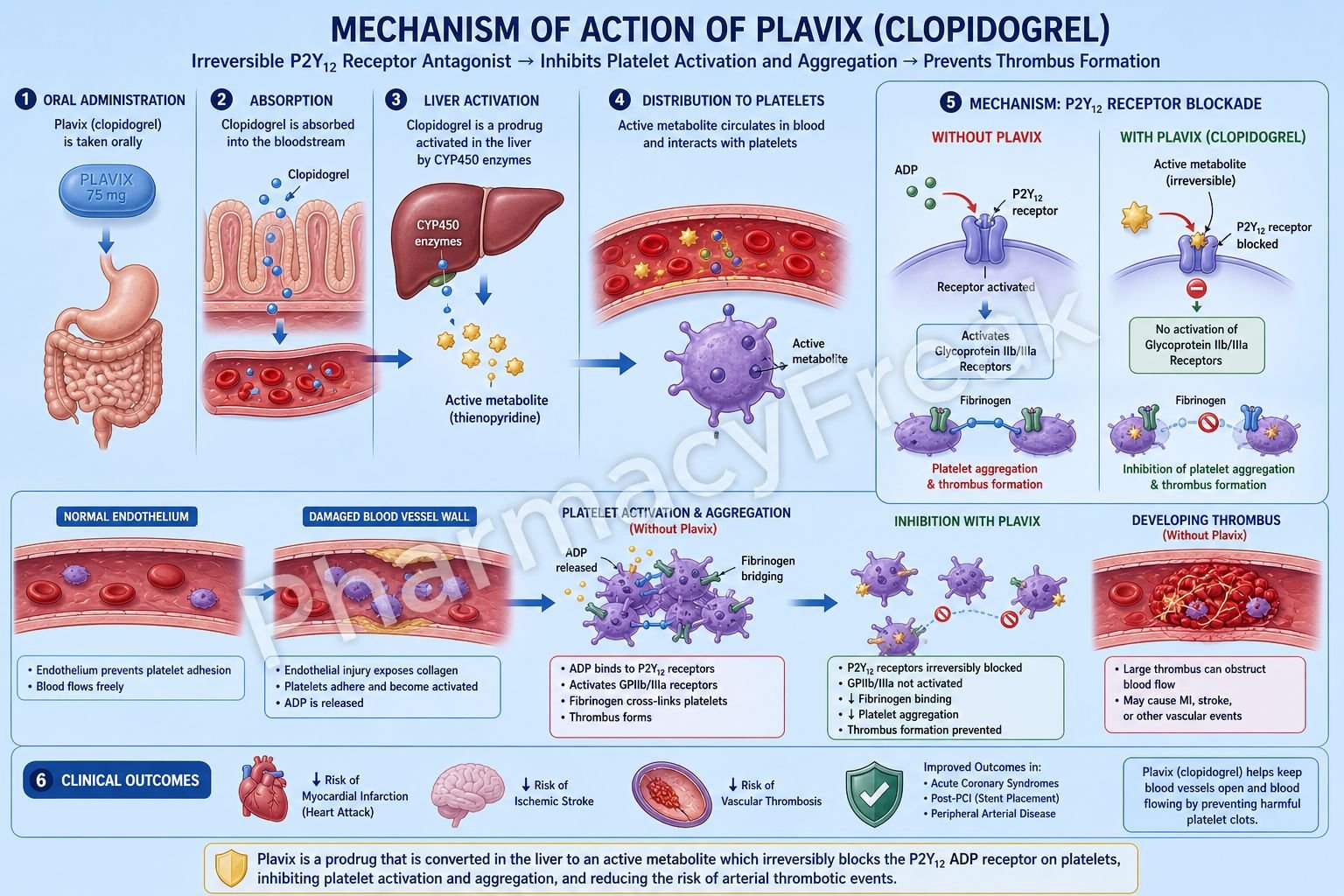
Plavix is the brand name for clopidogrel, an antiplatelet drug widely used in the prevention of thrombotic cardiovascular events. It inhibits platelet aggregation by blocking ADP-mediated platelet activation. Clopidogrel is commonly prescribed in patients with acute coronary syndrome, myocardial infarction, ischemic stroke, and after coronary stent placement.
Mechanism of Action (Step-wise)
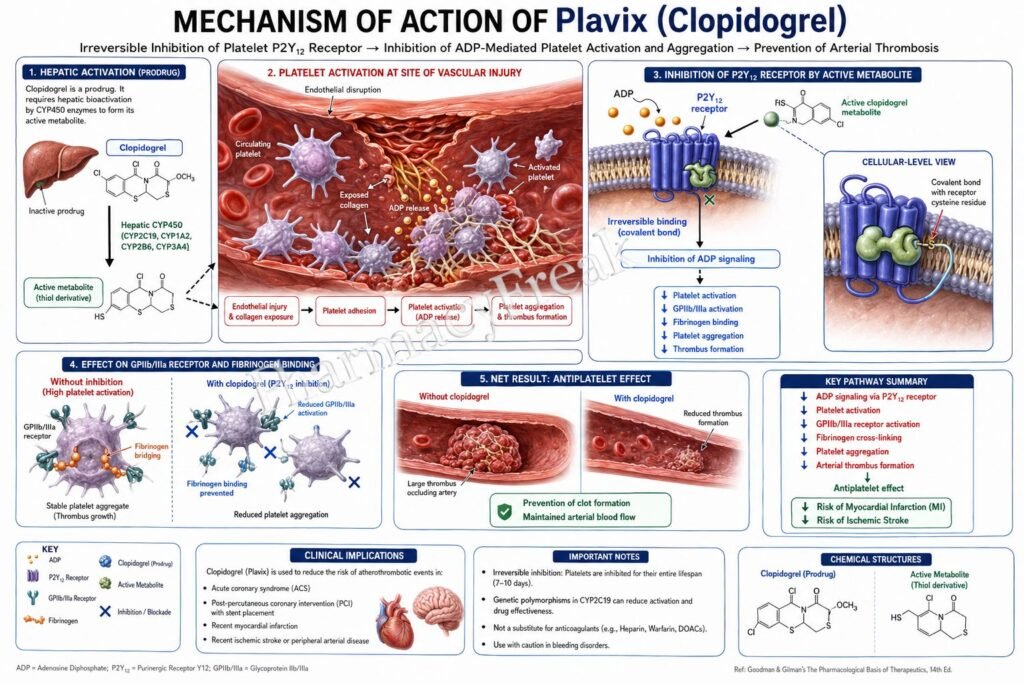
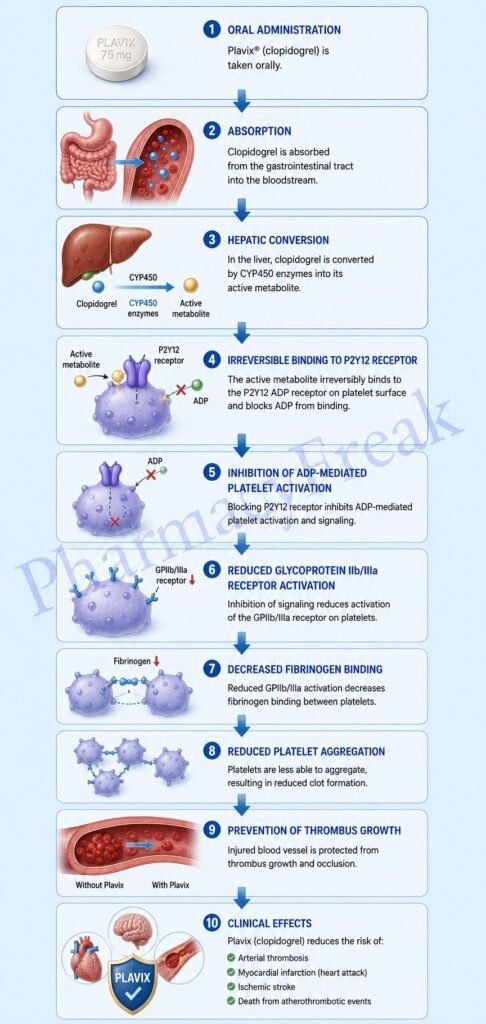
- Clopidogrel is a prodrug that requires hepatic activation.
- It is metabolized mainly by CYP2C19 into an active metabolite.
- The active metabolite irreversibly binds to platelet P2Y12 ADP receptors.
- P2Y12 receptors are Gi protein-coupled receptors on platelets.
- Normally, ADP activation of P2Y12 receptors decreases cAMP levels and promotes platelet activation.
- Clopidogrel blocks ADP binding to the P2Y12 receptor.
- This prevents activation of the GPIIb/IIIa receptor complex.
- Without GPIIb/IIIa activation, fibrinogen cannot effectively bind platelets together.
- Platelet aggregation is therefore inhibited.
- Since platelets lack nuclei, inhibition persists for the lifespan of the platelet (7–10 days).
- The overall effect is prevention of arterial thrombus formation.
A key exam point is that clopidogrel irreversibly blocks the P2Y12 ADP receptor on platelets.
Pharmacokinetics
Clopidogrel is administered orally and is well absorbed. It is a prodrug requiring hepatic activation primarily through CYP2C19. Genetic polymorphisms affecting CYP2C19 can reduce its effectiveness. The active metabolite irreversibly inhibits platelets, so antiplatelet effects persist for several days after discontinuation. It is excreted via urine and feces.
Clinical Uses
Clopidogrel is used in acute coronary syndrome, myocardial infarction, ischemic stroke, and peripheral arterial disease. It is also used after coronary stent placement to prevent stent thrombosis, usually in combination with aspirin as dual antiplatelet therapy (DAPT).
Adverse Effects
The major adverse effect is bleeding. Other effects include bruising, gastrointestinal upset, and rarely thrombotic thrombocytopenic purpura (TTP). Reduced effectiveness may occur in patients with CYP2C19 deficiency or when combined with strong CYP2C19 inhibitors.
Comparative Analysis
| Feature | Clopidogrel (Plavix) | Aspirin | Ticagrelor |
|---|---|---|---|
| Mechanism | P2Y12 receptor blockade | COX-1 inhibition | Reversible P2Y12 blockade |
| Effect on platelets | ↓ ADP-mediated aggregation | ↓ Thromboxane A2 | ↓ ADP-mediated aggregation |
| Binding | Irreversible | Irreversible | Reversible |
| Prodrug | Yes | No | No |
| CYP2C19 dependence | Yes | No | Minimal |
| Main use | ACS, stents | Cardiovascular prevention | ACS |
Clopidogrel differs from aspirin by blocking ADP-mediated platelet activation instead of thromboxane A2 synthesis. Compared to ticagrelor, it is an irreversible prodrug dependent on CYP2C19 activation.
MCQs
- Plavix contains which drug?
a) Ticagrelor
b) Clopidogrel
c) Aspirin
d) Warfarin
Answer: b) Clopidogrel
- Clopidogrel blocks which receptor?
a) GPIIb/IIIa
b) P2Y12
c) β1 receptor
d) H1 receptor
Answer: b) P2Y12
- The P2Y12 receptor is activated normally by:
a) ATP
b) ADP
c) Calcium
d) Serotonin
Answer: b) ADP
- Clopidogrel is classified as a:
a) Anticoagulant
b) Antiplatelet drug
c) Thrombolytic
d) Vasodilator
Answer: b) Antiplatelet drug
- Clopidogrel prevents activation of:
a) Sodium channels
b) GPIIb/IIIa receptors
c) Calcium pumps
d) Histamine receptors
Answer: b) GPIIb/IIIa receptors
- Clopidogrel inhibits:
a) Platelet aggregation
b) RBC production
c) Insulin secretion
d) Sodium excretion
Answer: a) Platelet aggregation
- Clopidogrel is a:
a) Direct active drug
b) Prodrug
c) Hormone
d) Steroid
Answer: b) Prodrug
- Clopidogrel is activated mainly by:
a) CYP1A2
b) CYP2C19
c) CYP3A5
d) CYP2E1
Answer: b) CYP2C19
- The major adverse effect is:
a) Hyperglycemia
b) Bleeding
c) Bradycardia
d) Hypercalcemia
Answer: b) Bleeding
- Clopidogrel inhibition of platelets is:
a) Reversible
b) Irreversible
c) Competitive only
d) Temporary for minutes
Answer: b) Irreversible
- Clopidogrel is commonly used after:
a) Cataract surgery
b) Coronary stent placement
c) Appendectomy only
d) Thyroid surgery
Answer: b) Coronary stent placement
- Compared to ticagrelor, clopidogrel:
a) Is not a prodrug
b) Requires CYP2C19 activation
c) Has reversible action
d) Does not affect ADP receptors
Answer: b) Requires CYP2C19 activation
FAQs
What is the mechanism of action of Plavix?
Clopidogrel irreversibly blocks platelet P2Y12 ADP receptors, preventing platelet aggregation.
Why is clopidogrel called a prodrug?
Because it must be activated in the liver before becoming effective.
What is the major side effect of clopidogrel?
Bleeding.
Why is clopidogrel used after coronary stenting?
To prevent platelet-mediated stent thrombosis.
How long does platelet inhibition last?
For the lifespan of affected platelets, about 7–10 days.
How does clopidogrel differ from aspirin?
It blocks ADP-mediated platelet activation, whereas aspirin inhibits thromboxane A2 synthesis.
References
Goodman & Gilman’s The Pharmacological Basis of Therapeutics – Antiplatelet Drugs
https://accessmedicine.mhmedical.com/book.aspx?bookid=3191
Katzung: Basic and Clinical Pharmacology – Drugs Affecting Coagulation
https://accessmedicine.mhmedical.com/content.aspx?bookid=3382
Tripathi: Essentials of Medical Pharmacology – Antiplatelet Drugs
https://www.jaypeedigital.com
Harrison’s Principles of Internal Medicine – Acute Coronary Syndromes
https://accessmedicine.mhmedical.com