Table of Contents
Introduction
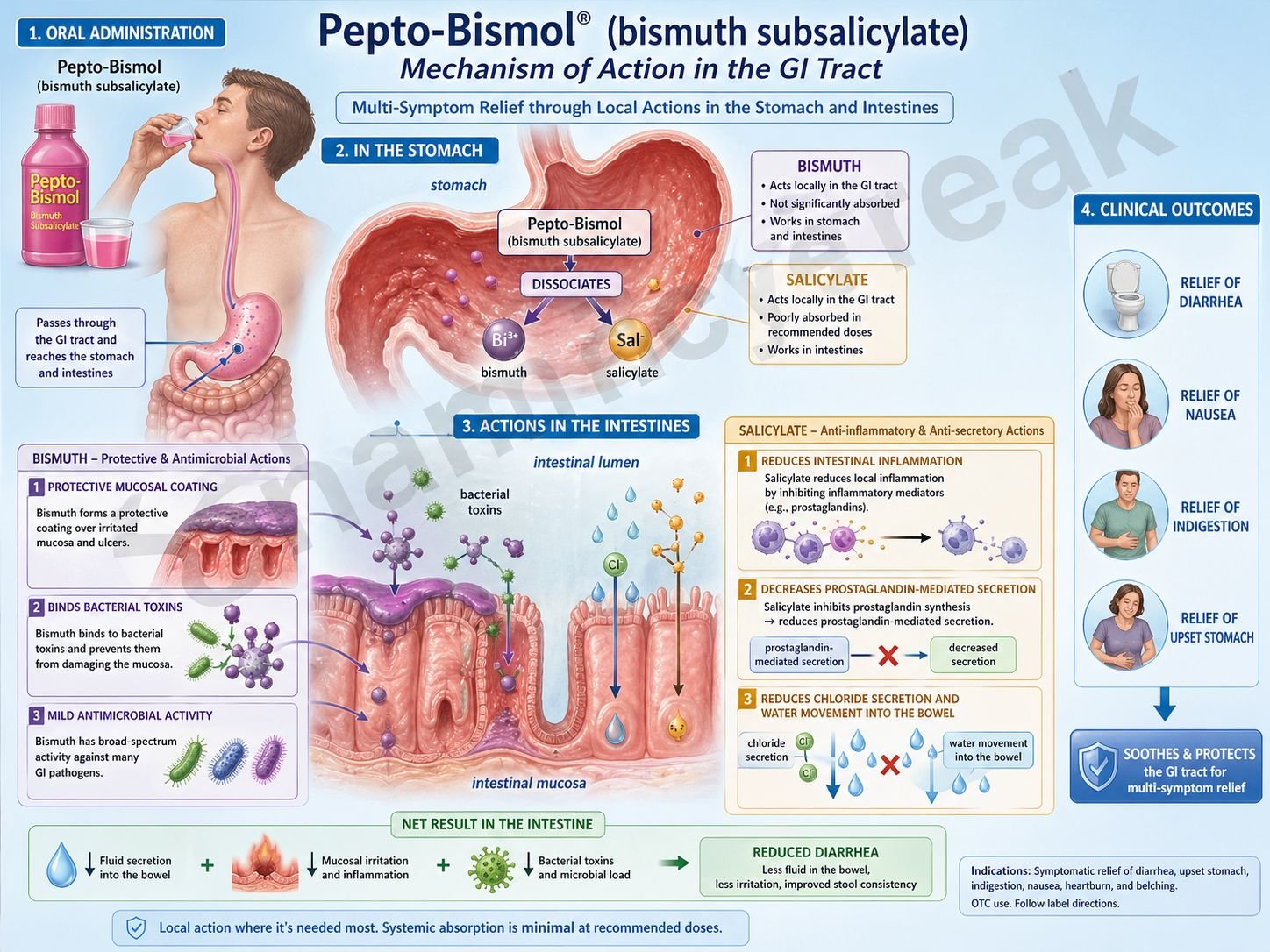
Pepto-Bismol contains bismuth subsalicylate, an over-the-counter medication used for the treatment of diarrhea, dyspepsia, nausea, and upset stomach. It has multiple mechanisms of action including antimicrobial, anti-secretory, and mucosal protective effects. Its combination of bismuth and salicylate components contributes to its broad therapeutic activity in gastrointestinal disorders.
Mechanism of Action (Step-wise)
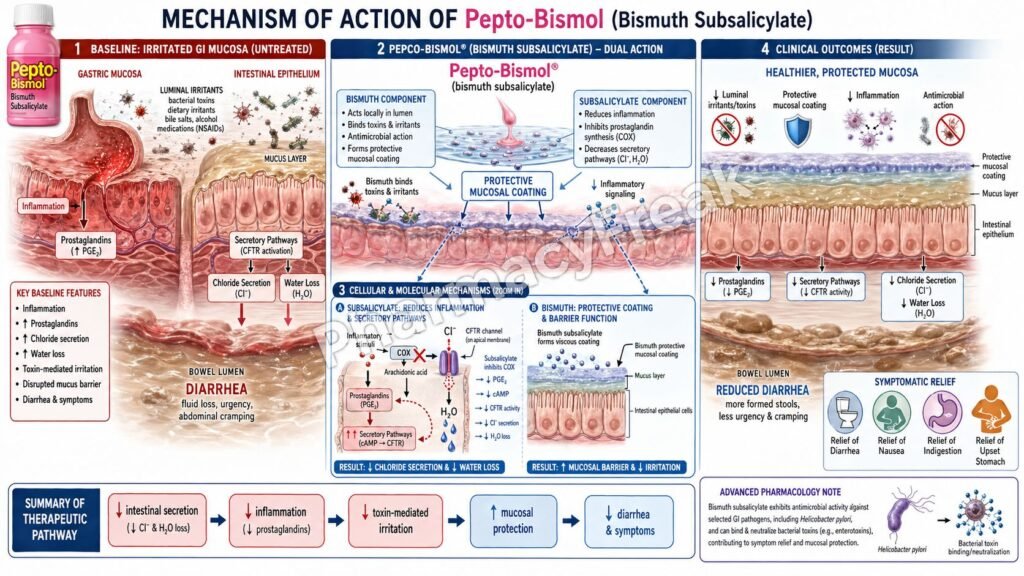
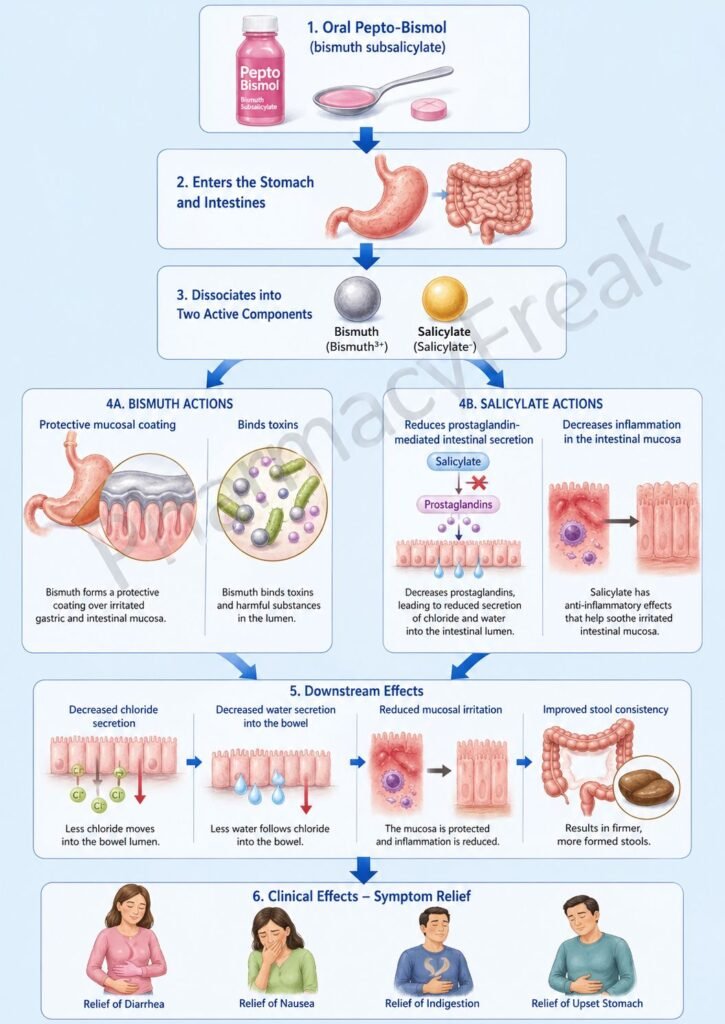
- Bismuth subsalicylate dissociates in the gastrointestinal tract into bismuth and salicylate components.
- The salicylate portion inhibits cyclooxygenase (COX) enzymes.
- This reduces prostaglandin synthesis in the intestinal mucosa.
- Decreased prostaglandins lead to reduced intestinal inflammation and secretion.
- This results in decreased fluid and electrolyte loss in diarrhea.
- The bismuth component coats the gastric and intestinal mucosa.
- This forms a protective barrier over ulcers and irritated mucosa.
- Bismuth also binds enterotoxins produced by bacteria.
- It has mild antimicrobial activity against organisms such as Helicobacter pylori.
- Bismuth may reduce intestinal motility and fluid secretion.
- The combined effects reduce diarrhea and protect the gastrointestinal lining.
A key exam point is that bismuth subsalicylate acts through anti-secretory, antimicrobial, and mucosal protective mechanisms.
Pharmacokinetics
Bismuth subsalicylate is administered orally. The salicylate component is absorbed systemically, while most of the bismuth remains in the gastrointestinal tract. Absorbed salicylate is metabolized in the liver and excreted via the kidneys. Bismuth is minimally absorbed and excreted in feces. Black discoloration of stool may occur due to bismuth sulfide formation.
Clinical Uses
Pepto-Bismol is used in the treatment of acute diarrhea, traveler’s diarrhea, dyspepsia, nausea, and indigestion. It is also used as part of combination therapy for Helicobacter pylori infection. It provides symptomatic relief and reduces gastrointestinal irritation.
Adverse Effects
Common adverse effects include black discoloration of stool and tongue due to bismuth sulfide formation. Salicylate-related toxicity may occur with excessive use, especially in children. It should be avoided in children with viral infections due to the risk of Reye syndrome. Constipation and nausea may also occur.
Comparative Analysis
| Feature | Bismuth Subsalicylate | Loperamide | Oral Rehydration Salts |
|---|---|---|---|
| Mechanism | Anti-secretory + protective + antimicrobial | Opioid receptor agonist (↓ motility) | Fluid and electrolyte replacement |
| Effect on motility | Mild decrease | Significant decrease | None |
| Antimicrobial effect | Yes | No | No |
| Use | Diarrhea, dyspepsia | Diarrhea | Dehydration |
| Stool discoloration | Yes | No | No |
| Special concern | Salicylate toxicity | Constipation | Electrolyte balance |
Bismuth subsalicylate differs from loperamide by having antimicrobial and mucosal protective actions rather than primarily reducing motility. Compared to oral rehydration salts, it provides symptomatic relief rather than fluid replacement.
MCQs
- Pepto-Bismol contains:
a) Loperamide
b) Bismuth subsalicylate
c) Omeprazole
d) Metoclopramide
Answer: b) Bismuth subsalicylate
- Bismuth subsalicylate dissociates into:
a) Sodium and potassium
b) Bismuth and salicylate
c) Calcium and magnesium
d) Iron and zinc
Answer: b) Bismuth and salicylate
- Salicylate inhibits:
a) DNA polymerase
b) Cyclooxygenase
c) RNA polymerase
d) ATP synthase
Answer: b) Cyclooxygenase
- COX inhibition reduces:
a) Calcium
b) Prostaglandins
c) Sodium
d) Potassium
Answer: b) Prostaglandins
- Bismuth provides:
a) Hormonal action
b) Mucosal protection
c) Insulin secretion
d) Calcium absorption
Answer: b) Mucosal protection
- Pepto-Bismol is used in:
a) Asthma
b) Diarrhea
c) Diabetes
d) Hypertension
Answer: b) Diarrhea
- A common harmless side effect is:
a) Bradycardia
b) Black stool
c) Hypoglycemia
d) Hypercalcemia
Answer: b) Black stool
- Bismuth has antimicrobial activity against:
a) Influenza virus
b) Helicobacter pylori
c) HIV
d) Hepatitis B
Answer: b) Helicobacter pylori
- Pepto-Bismol should be avoided in:
a) Adults
b) Children with viral illness
c) Elderly
d) Athletes
Answer: b) Children with viral illness
- Bismuth reduces diarrhea by:
a) Increasing secretion
b) Decreasing secretion
c) Increasing sodium
d) Increasing potassium
Answer: b) Decreasing secretion
- The salicylate component is:
a) Not absorbed
b) Absorbed systemically
c) Excreted unchanged
d) Stored in fat
Answer: b) Absorbed systemically
- Compared to loperamide, bismuth subsalicylate:
a) Stronger motility inhibition
b) Has antimicrobial action
c) Same effect
d) No effect
Answer: b) Has antimicrobial action
FAQs
What is the mechanism of action of Pepto-Bismol?
It combines anti-secretory, antimicrobial, and mucosal protective actions through bismuth and salicylate components.
Why does it turn stool black?
Due to formation of bismuth sulfide in the gut.
Can it be used in children?
It should be avoided in children with viral infections due to risk of Reye syndrome.
Does it kill bacteria?
It has mild antimicrobial activity, including against H. pylori.
How does it help diarrhea?
By reducing secretion and protecting intestinal mucosa.
Is it an antidiarrheal like loperamide?
It works differently, with additional protective and antimicrobial effects.
References
Goodman & Gilman’s The Pharmacological Basis of Therapeutics – Gastrointestinal Drugs
https://accessmedicine.mhmedical.com/book.aspx?bookid=3191
Katzung: Basic and Clinical Pharmacology – Drugs for Diarrhea
https://accessmedicine.mhmedical.com/content.aspx?bookid=3382
Tripathi: Essentials of Medical Pharmacology – Gastrointestinal Drugs
https://www.jaypeedigital.com
Harrison’s Principles of Internal Medicine – Diarrheal Diseases
https://accessmedicine.mhmedical.com