Table of Contents
Introduction
Mesalamine (5-aminosalicylic acid, 5-ASA) is an anti-inflammatory drug primarily used in the treatment of inflammatory bowel diseases such as ulcerative colitis and, in some cases, Crohn disease. It acts locally on the intestinal mucosa to reduce inflammation. Unlike systemic anti-inflammatory drugs, mesalamine exerts its effect mainly within the gastrointestinal tract with minimal systemic absorption.
Mechanism of Action (Step-wise)
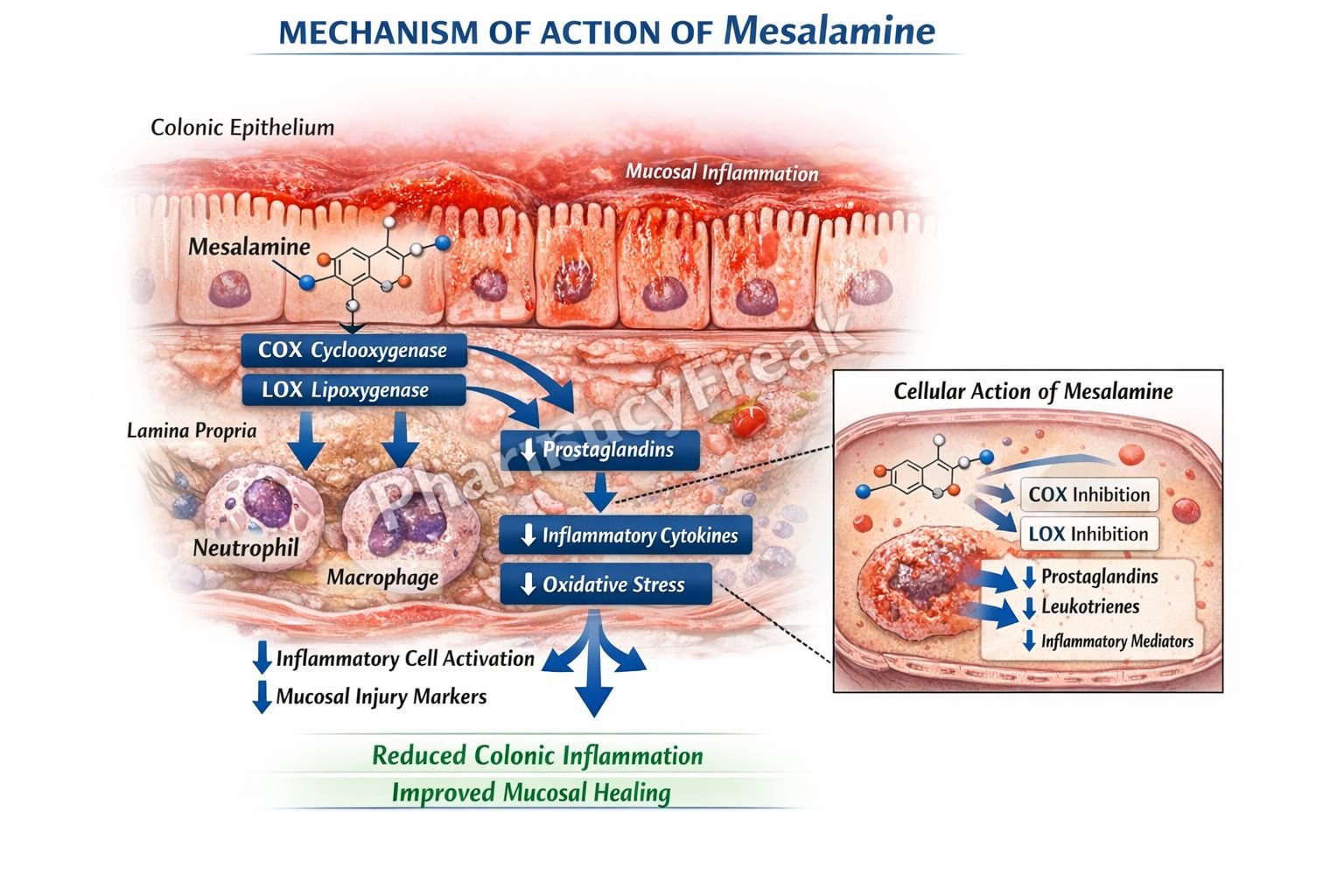
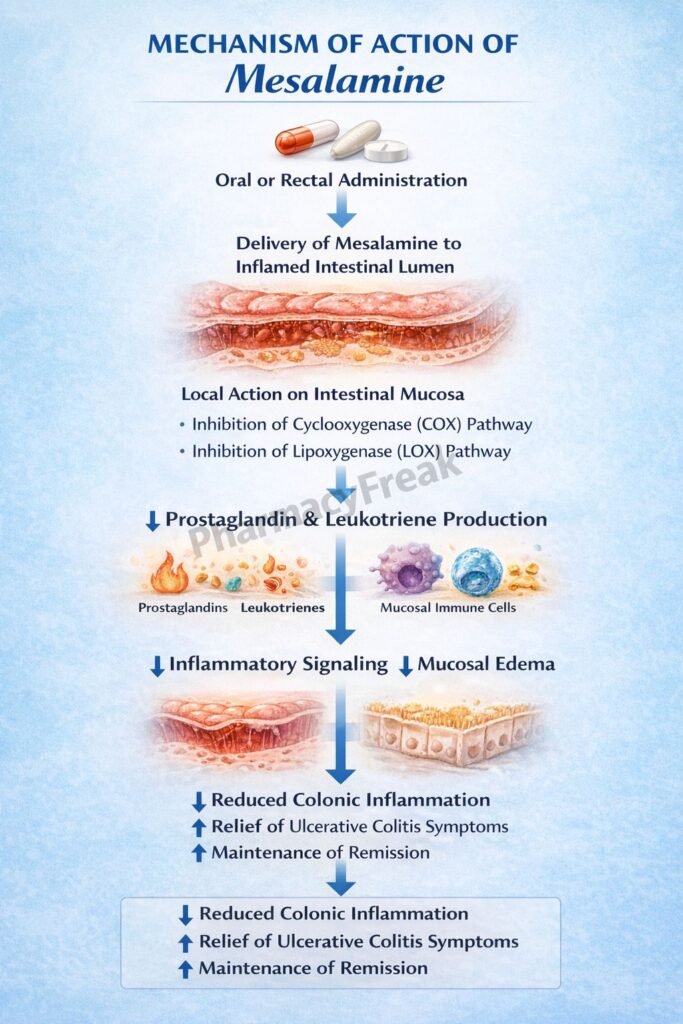
- Mesalamine acts locally on the colonic mucosa after release from its formulation.
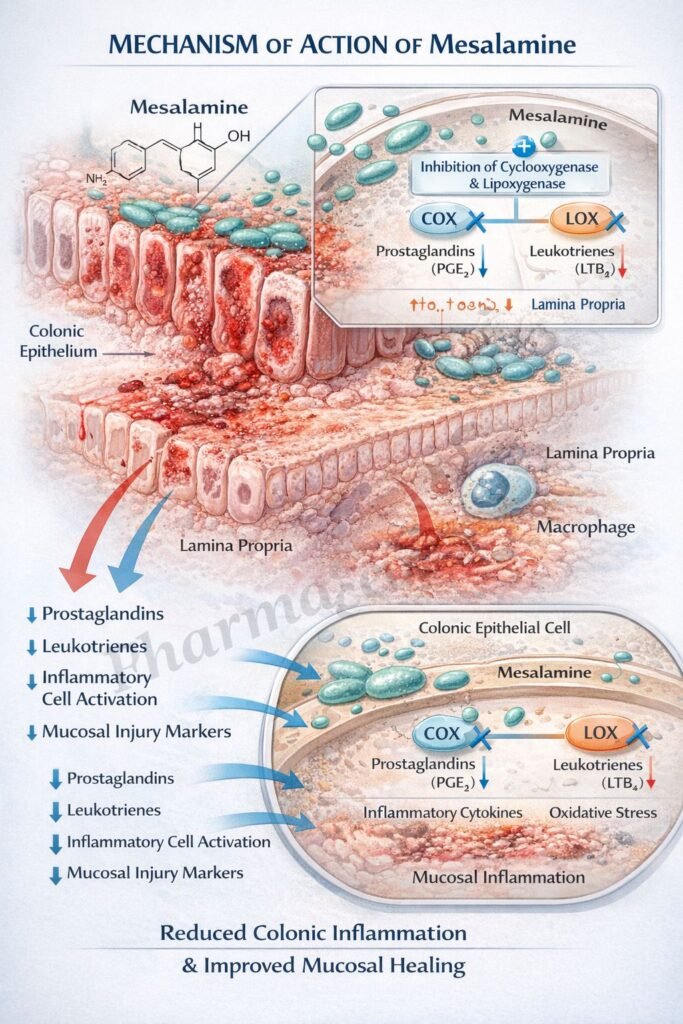
- It inhibits cyclooxygenase (COX) enzymes, reducing prostaglandin synthesis.
- It also inhibits lipoxygenase pathways, decreasing leukotriene production.
- Reduced prostaglandins and leukotrienes decrease inflammatory signaling.
- Mesalamine scavenges free radicals and reactive oxygen species.
- It inhibits activation of nuclear factor-kappa B (NF-κB), a key transcription factor in inflammation.
- This leads to reduced expression of pro-inflammatory cytokines such as TNF-α and interleukins.
- It helps maintain mucosal integrity and promotes healing of the intestinal lining.
- The net effect is reduction of inflammation in the bowel.
A key exam point is that mesalamine acts locally in the gut by inhibiting prostaglandins, leukotrienes, and inflammatory cytokines.
Pharmacokinetics
Mesalamine is administered orally or rectally (enema or suppository). Oral formulations are designed with special coatings or delivery systems to release the drug in the intestine or colon. It undergoes partial absorption and is acetylated in the intestinal mucosa and liver to inactive metabolites. Excretion occurs via urine and feces. Because of its local action, systemic bioavailability is relatively low, reducing systemic adverse effects.
Clinical Uses
Mesalamine is primarily used in ulcerative colitis for both induction and maintenance of remission. It is also used in mild to moderate Crohn disease, particularly when the colon is involved. Rectal formulations are especially effective for distal disease such as proctitis. It helps reduce inflammation, relieve symptoms, and prevent relapse.
Adverse Effects
Mesalamine is generally well tolerated. Common adverse effects include headache, nausea, abdominal pain, and diarrhea. Rare but important adverse effects include nephrotoxicity (interstitial nephritis), pancreatitis, and hypersensitivity reactions. Monitoring of renal function is recommended during long-term therapy.
Comparative Analysis
| Feature | Mesalamine | Sulfasalazine | Corticosteroids |
|---|---|---|---|
| Class | 5-ASA derivative | 5-ASA + sulfapyridine | Anti-inflammatory steroid |
| Mechanism | Local anti-inflammatory | Same as mesalamine | Broad immunosuppression |
| Site of action | Intestinal mucosa | Intestinal mucosa | Systemic |
| Side effects | Mild | More (due to sulfapyridine) | Significant |
| Use | Mild–moderate IBD | Mild–moderate IBD | Moderate–severe IBD |
| Systemic effects | Minimal | Moderate | High |
Mesalamine differs from sulfasalazine in that it lacks the sulfapyridine component, resulting in fewer adverse effects. Compared to corticosteroids, it has a more localized action with fewer systemic side effects, making it suitable for long-term maintenance therapy.
MCQs
- Mesalamine is also known as:
a) 4-ASA
b) 5-ASA
c) 6-ASA
d) 3-ASA
Answer: b) 5-ASA
- Mesalamine primarily acts in:
a) Liver
b) Brain
c) Intestinal mucosa
d) Kidney
Answer: c) Intestinal mucosa
- Mesalamine inhibits:
a) DNA synthesis
b) Protein synthesis
c) Prostaglandin synthesis
d) Glucose metabolism
Answer: c) Prostaglandin synthesis
- Which pathway is also inhibited by mesalamine?
a) Glycolysis
b) Lipoxygenase
c) Krebs cycle
d) Urea cycle
Answer: b) Lipoxygenase
- Mesalamine reduces inflammation by inhibiting:
a) NF-κB
b) DNA polymerase
c) ATP synthase
d) RNA polymerase
Answer: a) NF-κB
- Mesalamine is mainly used in:
a) Asthma
b) Ulcerative colitis
c) Hypertension
d) Diabetes
Answer: b) Ulcerative colitis
- Mesalamine acts primarily:
a) Systemically
b) Locally
c) In CNS
d) In blood
Answer: b) Locally
- A common adverse effect is:
a) Severe hypotension
b) Headache
c) Hyperglycemia
d) Bradycardia
Answer: b) Headache
- A serious adverse effect is:
a) Nephrotoxicity
b) Hypokalemia
c) Hyperlipidemia
d) Arrhythmia
Answer: a) Nephrotoxicity
- Mesalamine reduces which mediators?
a) Prostaglandins and leukotrienes
b) Insulin and glucagon
c) Dopamine and serotonin
d) Calcium and sodium
Answer: a) Prostaglandins and leukotrienes
- Compared to sulfasalazine, mesalamine has:
a) More side effects
b) Fewer side effects
c) Same side effects
d) No effect
Answer: b) Fewer side effects
- Mesalamine promotes:
a) Infection
b) Inflammation
c) Mucosal healing
d) Fibrosis
Answer: c) Mucosal healing
FAQs
What is the mechanism of action of mesalamine?
It reduces intestinal inflammation by inhibiting prostaglandins, leukotrienes, and inflammatory cytokines.
Why does mesalamine act locally?
It is designed to release in the intestine and has minimal systemic absorption.
What conditions is mesalamine used for?
Ulcerative colitis and mild Crohn disease.
How does mesalamine differ from sulfasalazine?
It lacks the sulfapyridine component and has fewer side effects.
What is a serious adverse effect of mesalamine?
Nephrotoxicity.
Why is renal monitoring required?
Because mesalamine can affect kidney function during long-term use.
References
Goodman & Gilman’s The Pharmacological Basis of Therapeutics – Anti-inflammatory Drugs
https://accessmedicine.mhmedical.com/book.aspx?bookid=3191
Katzung: Basic and Clinical Pharmacology – GI Anti-inflammatory Drugs
https://accessmedicine.mhmedical.com/content.aspx?bookid=3382
Tripathi: Essentials of Medical Pharmacology – Anti-inflammatory Drugs
https://www.jaypeedigital.com
Harrison’s Principles of Internal Medicine – Inflammatory Bowel Disease
https://accessmedicine.mhmedical.com