Table of Contents
Introduction
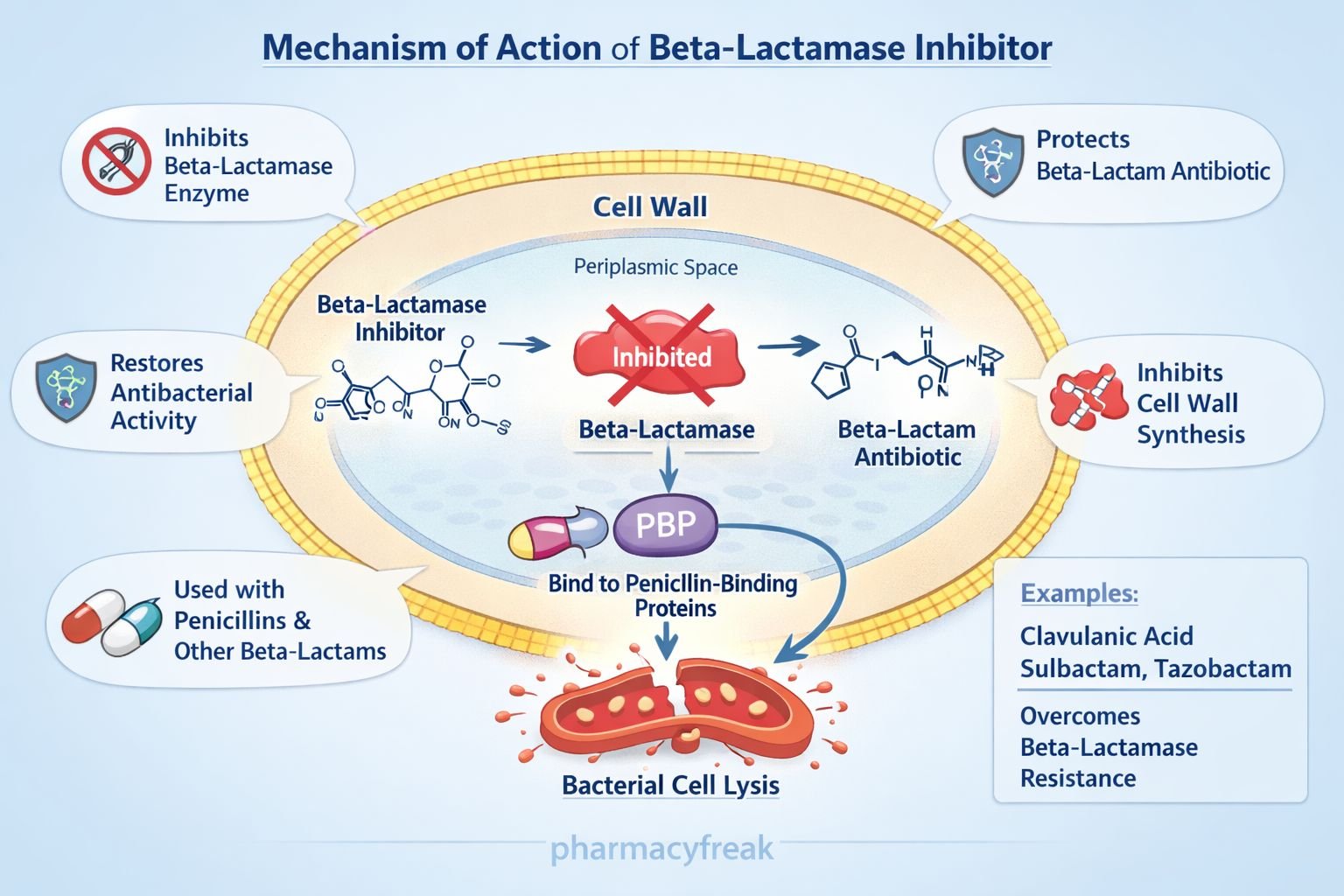
β-Lactamase inhibitors are a class of drugs used in combination with β-lactam antibiotics to overcome bacterial resistance. Many bacteria produce β-lactamase enzymes that hydrolyze the β-lactam ring, rendering antibiotics like penicillins and cephalosporins ineffective. β-Lactamase inhibitors protect these antibiotics by inhibiting the enzyme, thereby restoring their antibacterial activity.
Mechanism of Action (Step-wise)
- Binding to β-Lactamase Enzyme
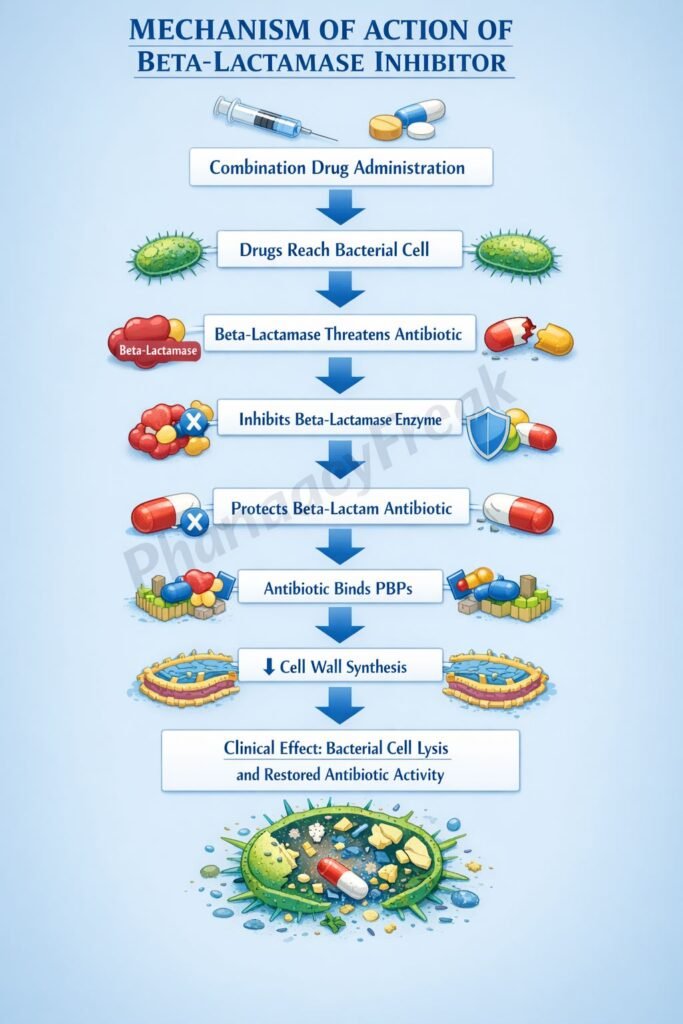
β-lactamase inhibitors structurally resemble β-lactam antibiotics and bind to bacterial β-lactamase enzymes. - Formation of Stable Enzyme-Inhibitor Complex
They form a covalent, often irreversible complex with the β-lactamase enzyme (suicide inhibition). - Inactivation of β-Lactamase
The enzyme is permanently or functionally inactivated and cannot degrade β-lactam antibiotics. - Protection of β-Lactam Antibiotics
The co-administered antibiotic remains intact and can reach its target. - Restoration of Antibacterial Activity
The protected β-lactam antibiotic inhibits bacterial cell wall synthesis by binding to penicillin-binding proteins (PBPs). - Expanded Spectrum of Activity
This combination extends activity against β-lactamase-producing organisms.
Pharmacokinetics
- Administration: Oral and parenteral (depending on agent)
- Absorption: Varies (e.g., clavulanic acid orally active)
- Distribution: Wide tissue distribution
- Metabolism: Hepatic
- Excretion: Renal
Clinical Uses
- Combination therapy with β-lactam antibiotics
- Respiratory tract infections
- Urinary tract infections
- Skin and soft tissue infections
- Intra-abdominal infections
Common combinations:
- Amoxicillin + Clavulanic acid
- Piperacillin + Tazobactam
- Ceftazidime + Avibactam
Adverse Effects
- Gastrointestinal upset (nausea, diarrhea)
- Hypersensitivity reactions
- Hepatotoxicity (especially with clavulanic acid)
- Rare allergic reactions
Comparative Analysis
| Feature | Clavulanic Acid | Tazobactam | Avibactam |
|---|---|---|---|
| Type | β-lactam | β-lactam | Non-β-lactam |
| Inhibition | Irreversible | Irreversible | Reversible |
| Spectrum | Narrow | Moderate | Broad (including some resistant enzymes) |
| Use | With amoxicillin | With piperacillin | With cephalosporins |
| Activity vs ESBL | Limited | Limited | Better |
Clavulanic acid and tazobactam are classical β-lactam inhibitors that act irreversibly, while avibactam is a newer non-β-lactam inhibitor with broader activity, including against some resistant β-lactamases.
MCQs
- β-Lactamase inhibitors act by:
a) Inhibiting ribosomes
b) Blocking DNA synthesis
c) Inhibiting β-lactamase enzymes
d) Disrupting cell membrane
Answer: c) Inhibiting β-lactamase enzymes - These drugs are usually used:
a) Alone
b) With antivirals
c) With β-lactam antibiotics
d) With antifungals
Answer: c) With β-lactam antibiotics - Clavulanic acid is an example of:
a) Macrolide
b) β-lactamase inhibitor
c) Aminoglycoside
d) Fluoroquinolone
Answer: b) β-lactamase inhibitor - Mechanism involves:
a) Competitive inhibition
b) Suicide inhibition
c) Enzyme activation
d) DNA binding
Answer: b) Suicide inhibition - β-Lactamase enzymes:
a) Synthesize proteins
b) Break β-lactam ring
c) Produce ATP
d) Form DNA
Answer: b) Break β-lactam ring - Avibactam differs because it is:
a) A β-lactam
b) A non-β-lactam inhibitor
c) An antibiotic
d) A steroid
Answer: b) A non-β-lactam inhibitor - Main benefit of these inhibitors:
a) Increase toxicity
b) Prevent resistance
c) Kill bacteria directly
d) Increase metabolism
Answer: b) Prevent resistance - Common combination:
a) Penicillin alone
b) Amoxicillin + clavulanic acid
c) Tetracycline + rifampicin
d) Ciprofloxacin alone
Answer: b) Amoxicillin + clavulanic acid - Target of β-lactam antibiotics:
a) Ribosomes
b) DNA
c) PBPs
d) Mitochondria
Answer: c) PBPs - Inhibitors restore activity by:
a) Increasing absorption
b) Protecting antibiotics
c) Enhancing excretion
d) Reducing metabolism
Answer: b) Protecting antibiotics
FAQs
- What is the mechanism of action of β-lactamase inhibitors?
They inhibit β-lactamase enzymes, preventing degradation of β-lactam antibiotics. - Do β-lactamase inhibitors have antibacterial activity alone?
Minimal or none; they mainly protect antibiotics. - Why are they combined with antibiotics?
To overcome bacterial resistance. - What is suicide inhibition?
Irreversible binding that permanently inactivates the enzyme. - Which is a newer inhibitor?
Avibactam with broader activity. - Do they work against all β-lactamases?
No, activity varies depending on enzyme type.