Table of Contents
Introduction
Protease inhibitors are antiviral drugs primarily used in the treatment of human immunodeficiency virus (HIV) infection and, in some cases, hepatitis C virus (HCV) infection. In HIV therapy, these drugs inhibit the viral protease enzyme required for maturation of infectious viral particles. Protease inhibitors are an important component of highly active antiretroviral therapy (HAART) and significantly reduce viral replication and disease progression.
Mechanism of Action (Step-wise)
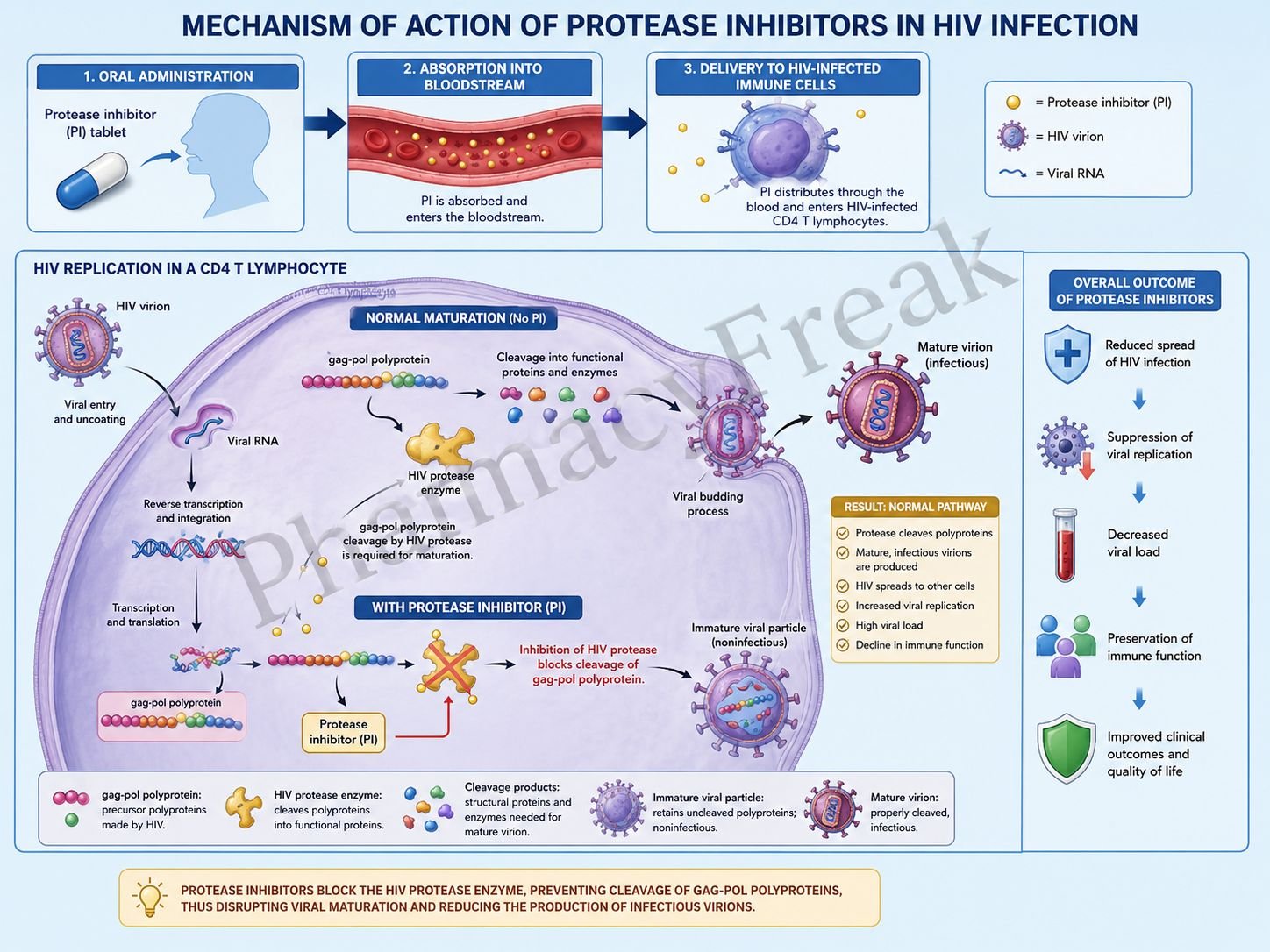
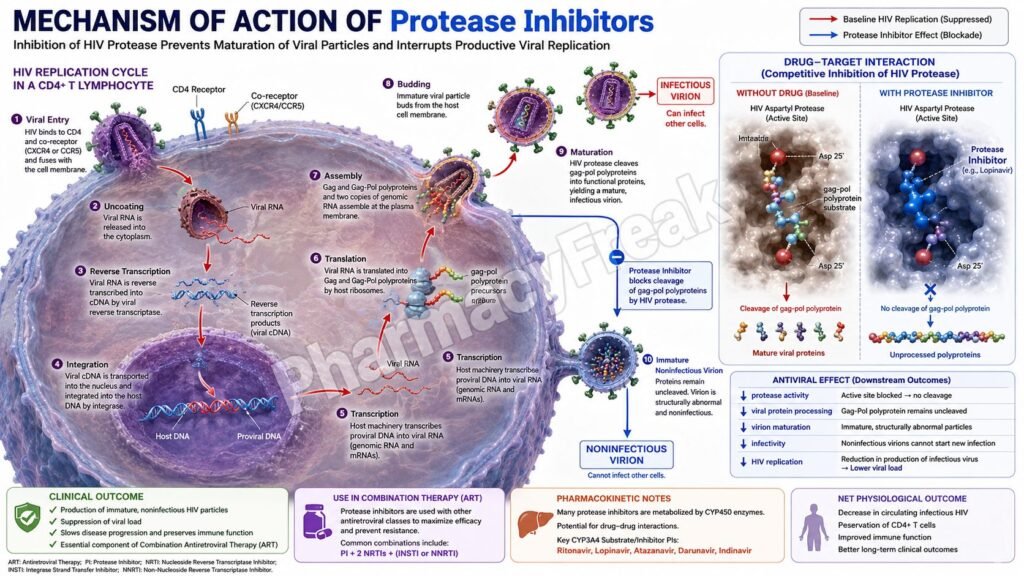
- HIV synthesizes viral proteins as large polyprotein precursors after replication inside host cells.
- These polyproteins must be cleaved into functional viral proteins.
- HIV protease enzyme performs this cleavage process.
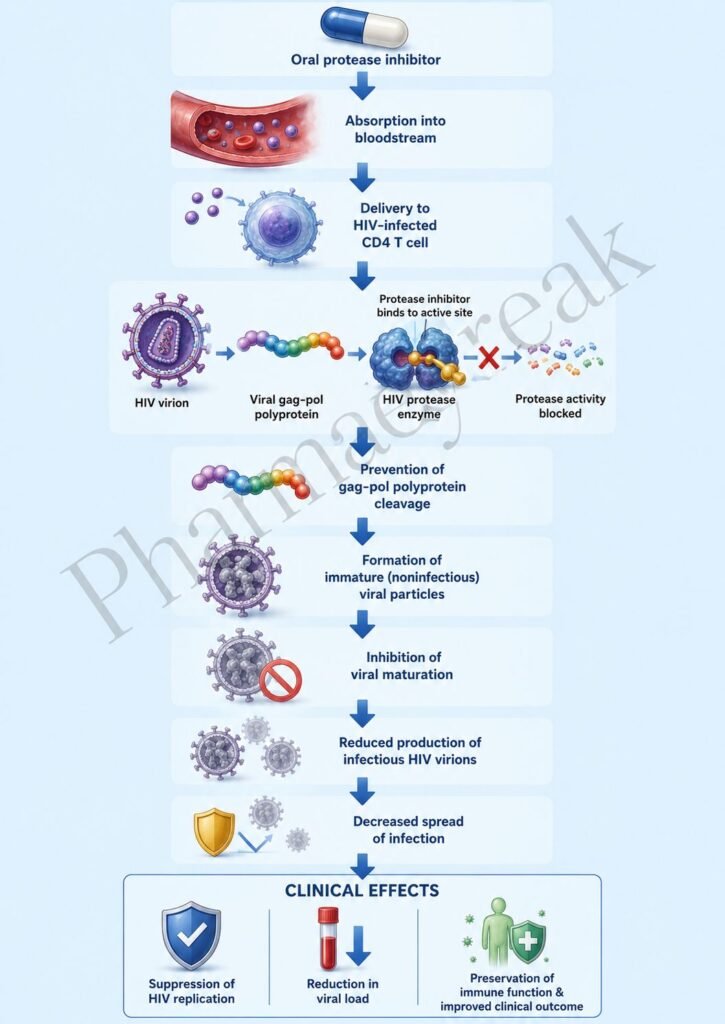
- Protease inhibitors bind competitively to the active site of HIV protease.
- This prevents cleavage of gag-pol polyprotein precursors.
- Without proteolytic cleavage, viral structural proteins and enzymes remain immature.
- Immature viral particles are produced but are noninfectious.
- Viral maturation and replication are therefore inhibited.
- Reduction in viral replication lowers plasma viral load.
- CD4 T-cell destruction decreases, improving immune function.
- The overall effect is suppression of HIV progression and opportunistic infections.
A key exam point is that HIV protease inhibitors prevent cleavage of viral polyproteins, producing immature noninfectious virions.
Pharmacokinetics
Most protease inhibitors are administered orally. Many undergo hepatic metabolism through CYP3A4 enzymes. Ritonavir is commonly used in low doses as a pharmacokinetic booster because it strongly inhibits CYP3A4 and increases levels of other protease inhibitors. Drug interactions are common due to CYP450 involvement.
Clinical Uses
Protease inhibitors are used in combination antiretroviral therapy for HIV infection. Common agents include ritonavir, lopinavir, atazanavir, darunavir, and indinavir. Some protease inhibitors are also used in hepatitis C treatment regimens targeting HCV protease enzymes.
Adverse Effects
Common adverse effects include nausea, diarrhea, lipodystrophy, hyperglycemia, insulin resistance, and dyslipidemia. Certain drugs may cause hepatotoxicity or nephrolithiasis. Drug interactions are significant because of CYP3A4 inhibition.
Comparative Analysis
| Feature | Protease Inhibitors | NRTIs | NNRTIs |
|---|---|---|---|
| Main target | HIV protease enzyme | Reverse transcriptase | Reverse transcriptase |
| Mechanism | Prevent viral maturation | Chain termination | Noncompetitive RT inhibition |
| Viral stage affected | Post-translational processing | Viral DNA synthesis | Viral DNA synthesis |
| Resistance risk | Present | Present | Present |
| Major adverse effects | Metabolic disturbances | Mitochondrial toxicity | Rash, hepatotoxicity |
| CYP interactions | Significant | Minimal | Moderate |
Protease inhibitors differ from NRTIs and NNRTIs because they act after viral protein synthesis by blocking maturation of viral particles rather than reverse transcription.
MCQs
- Protease inhibitors primarily target which virus?
a) Influenza virus
b) HIV
c) Rabies virus
d) Rotavirus
Answer: b) HIV
- Protease inhibitors block which enzyme?
a) Reverse transcriptase
b) HIV protease
c) Integrase
d) DNA polymerase
Answer: b) HIV protease
- HIV protease normally cleaves:
a) DNA strands
b) Viral polyproteins
c) Host chromosomes
d) RNA primers
Answer: b) Viral polyproteins
- Inhibition of HIV protease produces:
a) Mature infectious virions
b) Immature noninfectious virions
c) Increased viral integration
d) Increased host immunity directly
Answer: b) Immature noninfectious virions
- Protease inhibitors mainly prevent viral:
a) Entry
b) Maturation
c) Attachment
d) Adsorption
Answer: b) Maturation
- Ritonavir is commonly used as a:
a) Vaccine
b) Pharmacokinetic booster
c) Corticosteroid
d) Antifungal agent
Answer: b) Pharmacokinetic booster
- Protease inhibitors are metabolized mainly by:
a) CYP3A4
b) CYP2D6
c) MAO
d) Xanthine oxidase
Answer: a) CYP3A4
- A common adverse effect is:
a) Lipodystrophy
b) Hypoglycemia
c) Bradycardia
d) Hypercalcemia
Answer: a) Lipodystrophy
- Protease inhibitors may cause:
a) Dyslipidemia
b) Hypotension only
c) Mydriasis
d) Bone marrow stimulation
Answer: a) Dyslipidemia
- Protease inhibitors are usually used in:
a) Monotherapy only
b) Combination antiretroviral therapy
c) Radiation therapy
d) Antifungal therapy only
Answer: b) Combination antiretroviral therapy
- Compared with NRTIs, protease inhibitors act at which stage?
a) Viral attachment
b) Viral maturation
c) Reverse transcription only
d) Host DNA synthesis
Answer: b) Viral maturation
- Drug interactions with protease inhibitors are mainly due to:
a) Renal excretion only
b) CYP450 inhibition
c) Histamine release
d) Sodium channel blockade
Answer: b) CYP450 inhibition
FAQs
What is the mechanism of action of protease inhibitors?
They inhibit viral protease enzymes, preventing cleavage of viral polyproteins and maturation of infectious virions.
Why are protease inhibitors important in HIV treatment?
They significantly reduce viral replication and improve immune function.
What is ritonavir boosting?
Low-dose ritonavir inhibits CYP3A4 to increase concentrations of other protease inhibitors.
What are common adverse effects of protease inhibitors?
Lipodystrophy, hyperglycemia, dyslipidemia, and gastrointestinal upset.
How do protease inhibitors differ from NRTIs?
Protease inhibitors block viral maturation, whereas NRTIs inhibit reverse transcription.
Why are drug interactions common with protease inhibitors?
Because many inhibit CYP3A4 metabolism.
References
Goodman & Gilman’s The Pharmacological Basis of Therapeutics – Antiretroviral Agents
https://accessmedicine.mhmedical.com/book.aspx?bookid=3191
Katzung: Basic and Clinical Pharmacology – Antiviral Drugs
https://accessmedicine.mhmedical.com/content.aspx?bookid=3382
Tripathi: Essentials of Medical Pharmacology – Antiretroviral Drugs
https://www.jaypeedigital.com
Harrison’s Principles of Internal Medicine – HIV Infection and AIDS
https://accessmedicine.mhmedical.com