Table of Contents
Introduction
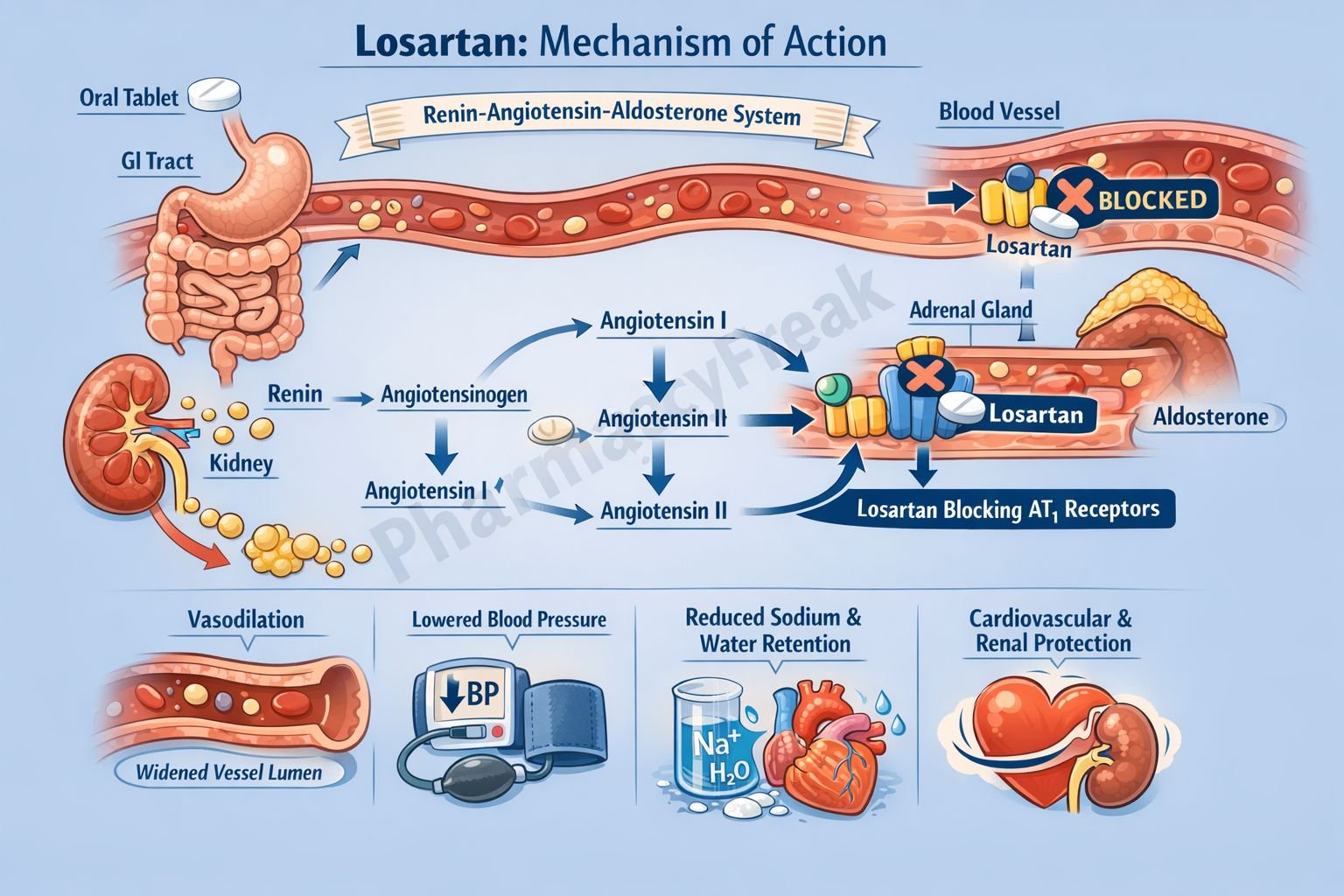
Losartan is an angiotensin II receptor blocker (ARB) widely used in the management of hypertension, heart failure, and diabetic nephropathy. Unlike ACE inhibitors, losartan directly blocks the effects of angiotensin II at its receptor rather than inhibiting its formation. This results in vasodilation, reduced aldosterone secretion, and decreased blood pressure without significantly affecting bradykinin metabolism, thereby reducing the risk of cough.
Mechanism of Action (Step-wise)
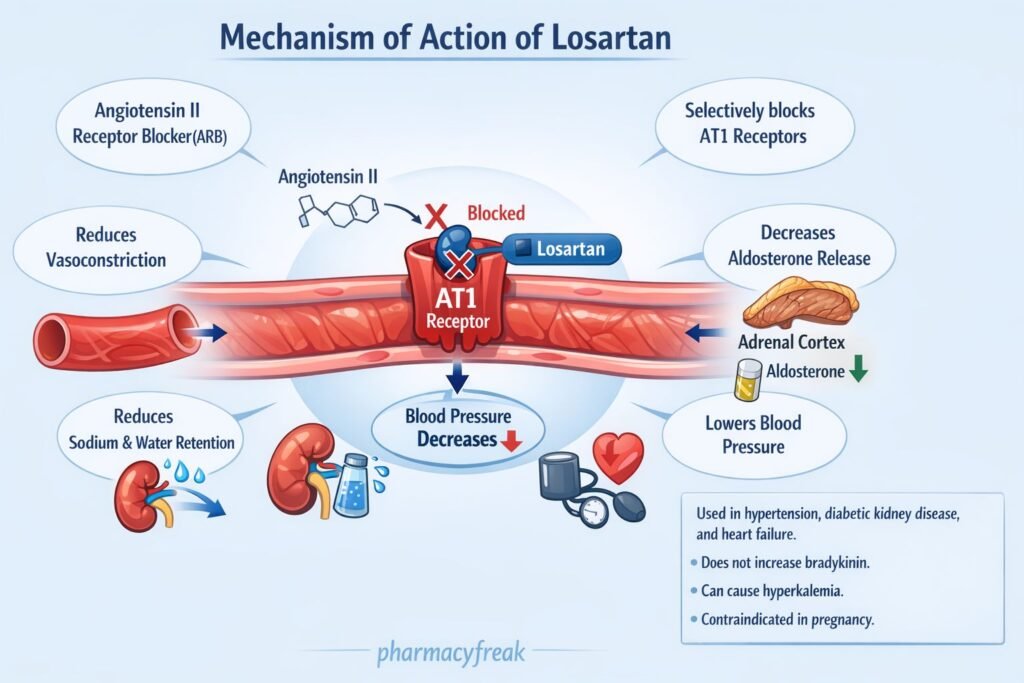
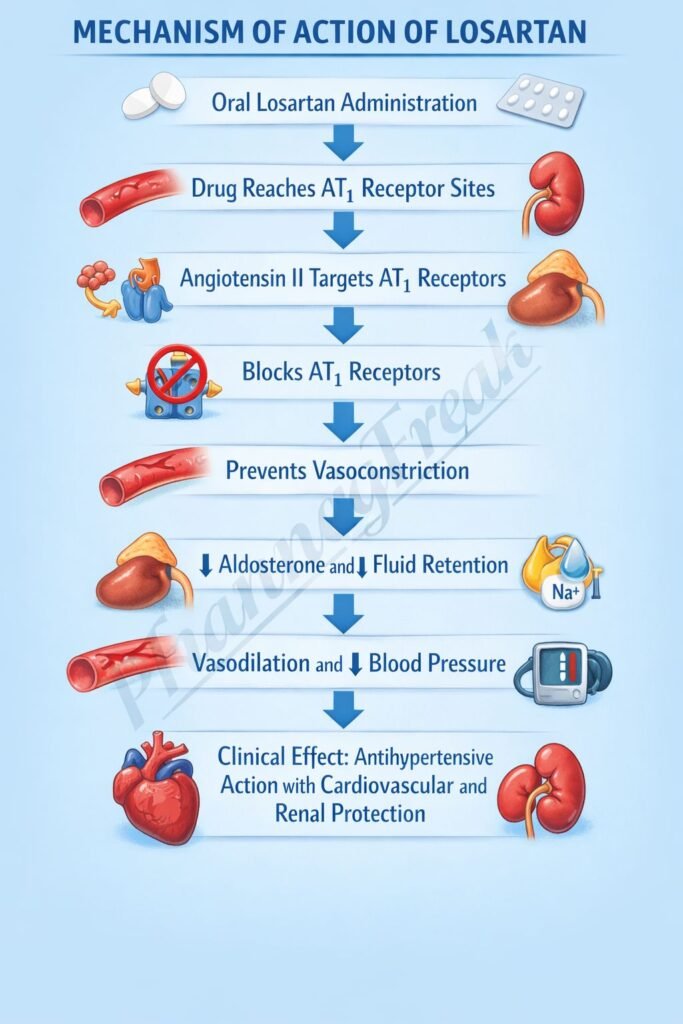
- Losartan selectively blocks angiotensin II type 1 (AT1) receptors.
- These receptors are located in vascular smooth muscle, adrenal glands, kidneys, and heart.
- By blocking AT1 receptors, losartan prevents angiotensin II–mediated vasoconstriction.
- This leads to vasodilation and reduced systemic vascular resistance.
- It inhibits aldosterone secretion from the adrenal cortex.
- Reduced aldosterone decreases sodium and water retention.
- This lowers blood volume and blood pressure.
- Blocking AT1 receptors also reduces sympathetic activation and vasopressin release.
- Since angiotensin II formation is not blocked, bradykinin levels remain unaffected, reducing cough risk.
A key exam point is that ARBs block the receptor (AT1), whereas ACE inhibitors block angiotensin II formation.
Pharmacokinetics
Losartan is administered orally and undergoes first-pass metabolism in the liver. It is converted into an active metabolite (EXP3174), which is more potent and contributes significantly to its pharmacological effects. Peak plasma concentrations occur within 1 hour for losartan and 3–4 hours for its metabolite. It is highly protein-bound and eliminated via both renal and biliary routes. The presence of an active metabolite prolongs its duration of action.
Clinical Uses
Losartan is used in hypertension to lower blood pressure and reduce cardiovascular risk. It is particularly beneficial in patients with diabetic nephropathy, where it helps reduce proteinuria and slows progression of kidney disease. It is also used in heart failure, especially in patients who cannot tolerate ACE inhibitors. Additionally, losartan may reduce the risk of stroke in hypertensive patients with left ventricular hypertrophy.
Adverse Effects
Losartan is generally well tolerated. Common adverse effects include dizziness, hypotension, and hyperkalemia. Unlike ACE inhibitors, it rarely causes dry cough or angioedema because it does not increase bradykinin levels. However, it can still cause renal impairment, especially in patients with renal artery stenosis. Like other drugs acting on the renin-angiotensin system, it is contraindicated in pregnancy due to risk of fetal toxicity.
Comparative Analysis
| Feature | Losartan | Lisinopril | Enalapril |
|---|---|---|---|
| Drug class | ARB | ACE inhibitor | ACE inhibitor |
| Mechanism | AT1 receptor blocker | ACE inhibition | ACE inhibition |
| Effect on bradykinin | No increase | Increased | Increased |
| Cough | Rare | Common | Common |
| Active metabolite | Yes | No | Yes |
| Use in ACE intolerance | Yes | No | No |
| Pregnancy | Contraindicated | Contraindicated | Contraindicated |
Losartan differs from ACE inhibitors like lisinopril and enalapril in that it blocks the angiotensin II receptor directly without affecting bradykinin metabolism. This makes it a preferred alternative in patients who develop cough with ACE inhibitors.
MCQs
- Losartan belongs to which class of drugs?
a) Beta blockers
b) ACE inhibitors
c) ARBs
d) Calcium channel blockers
Answer: c) ARBs
- Losartan blocks which receptor?
a) AT2 receptor
b) AT1 receptor
c) Beta receptor
d) Alpha receptor
Answer: b) AT1 receptor
- The main effect of losartan is:
a) Increased vasoconstriction
b) Decreased vasodilation
c) Vasodilation
d) Increased heart rate
Answer: c) Vasodilation
- Losartan reduces secretion of:
a) Insulin
b) Aldosterone
c) Cortisol
d) Thyroxine
Answer: b) Aldosterone
- Compared to ACE inhibitors, losartan causes:
a) More cough
b) Less cough
c) Same cough
d) Severe cough
Answer: b) Less cough
- Losartan is converted into:
a) Inactive metabolite
b) Active metabolite
c) Toxic metabolite
d) No metabolite
Answer: b) Active metabolite
- Losartan is useful in:
a) Diabetes insipidus
b) Diabetic nephropathy
c) Hyperthyroidism
d) Asthma
Answer: b) Diabetic nephropathy
- A common adverse effect is:
a) Hypoglycemia
b) Hyperkalemia
c) Hypercalcemia
d) Hypokalemia
Answer: b) Hyperkalemia
- Losartan affects which system?
a) CNS
b) RAAS
c) Respiratory system
d) GI tract
Answer: b) RAAS
- Losartan is contraindicated in:
a) Hypertension
b) Pregnancy
c) Diabetes
d) Heart failure
Answer: b) Pregnancy
- Which hormone’s effect is blocked by losartan?
a) Angiotensin II
b) Insulin
c) Glucagon
d) ADH
Answer: a) Angiotensin II
- Losartan reduces blood pressure by:
a) Increasing sodium retention
b) Blocking angiotensin II effects
c) Increasing renin inhibition directly
d) Increasing heart rate
Answer: b) Blocking angiotensin II effects
FAQs
What is the mechanism of action of losartan?
Losartan blocks AT1 receptors, preventing angiotensin II–mediated vasoconstriction and aldosterone secretion.
Why does losartan not cause cough?
Because it does not increase bradykinin levels.
What is the active metabolite of losartan?
EXP3174.
Can losartan be used in ACE inhibitor intolerance?
Yes, it is commonly used when ACE inhibitors cause cough.
What electrolyte imbalance can occur with losartan?
Hyperkalemia.
Is losartan safe in pregnancy?
No, it is contraindicated due to risk of fetal harm.
References
Goodman & Gilman’s The Pharmacological Basis of Therapeutics – Antihypertensives
https://accessmedicine.mhmedical.com/book.aspx?bookid=3191
Katzung: Basic and Clinical Pharmacology – RAAS Inhibitors
https://accessmedicine.mhmedical.com/content.aspx?bookid=3382
Tripathi: Essentials of Medical Pharmacology – Antihypertensives
https://www.jaypeedigital.com
Harrison’s Principles of Internal Medicine – Hypertension
https://accessmedicine.mhmedical.com