Table of Contents
Introduction
Loperamide is a peripherally acting opioid agonist widely used as an antidiarrheal agent. It effectively reduces intestinal motility and secretion without producing significant central nervous system effects at therapeutic doses. Unlike other opioids, loperamide has minimal abuse potential because it does not readily cross the blood-brain barrier due to active efflux mechanisms. It is commonly used in acute and chronic diarrhea, including traveler’s diarrhea and diarrhea associated with inflammatory bowel disease.

Mechanism of Action (Step-wise)
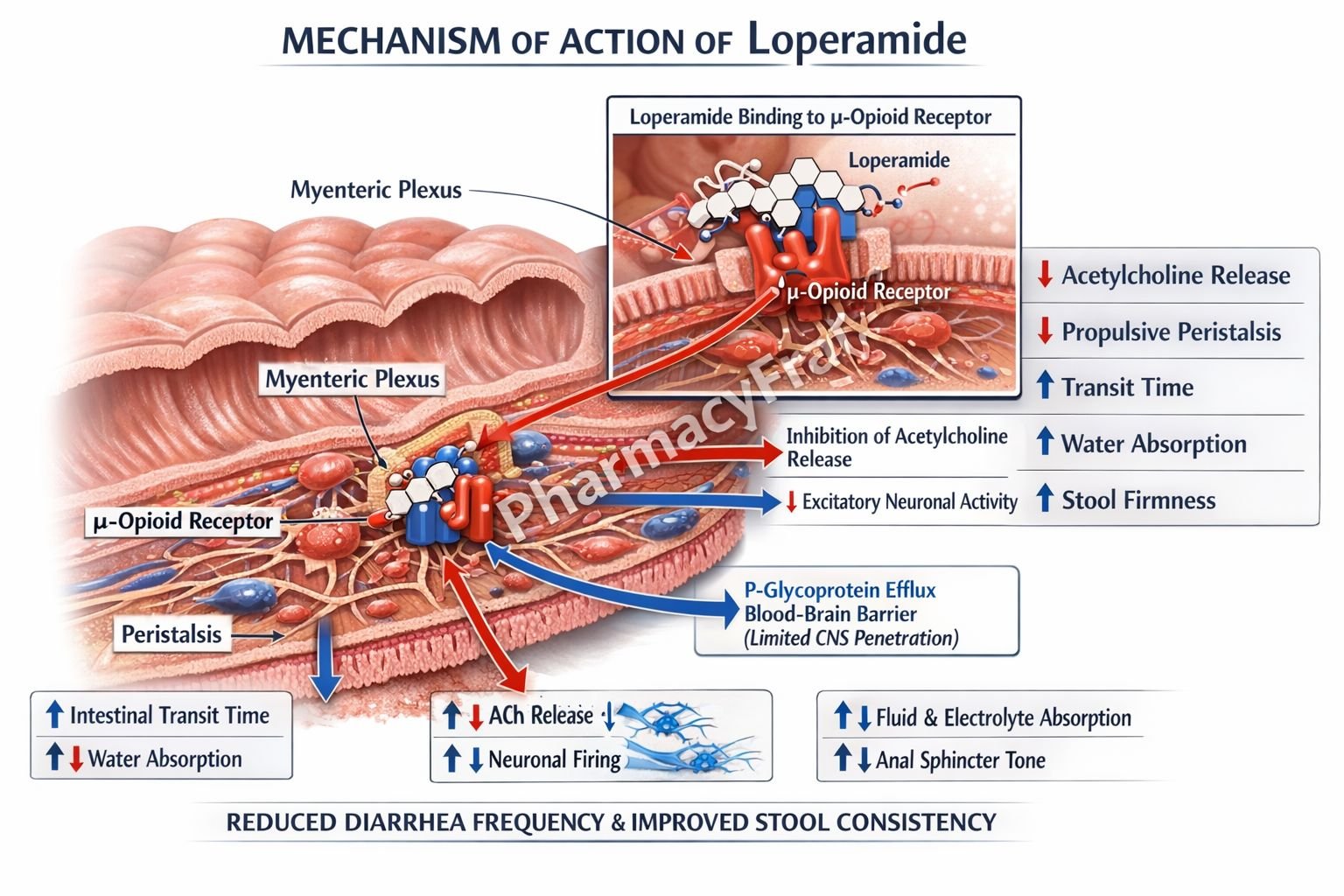
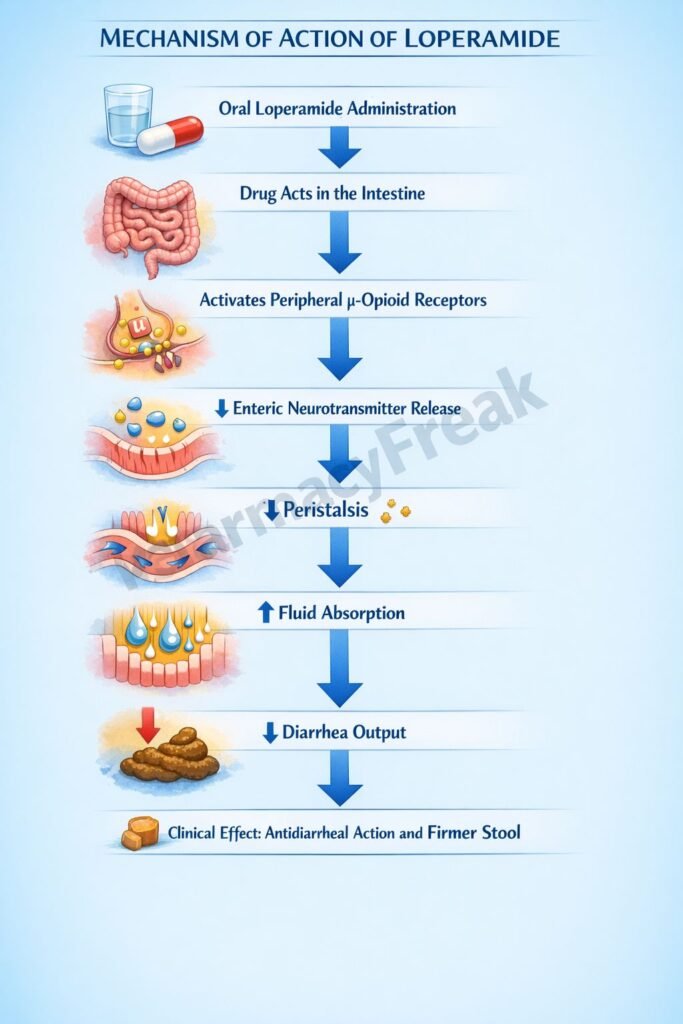
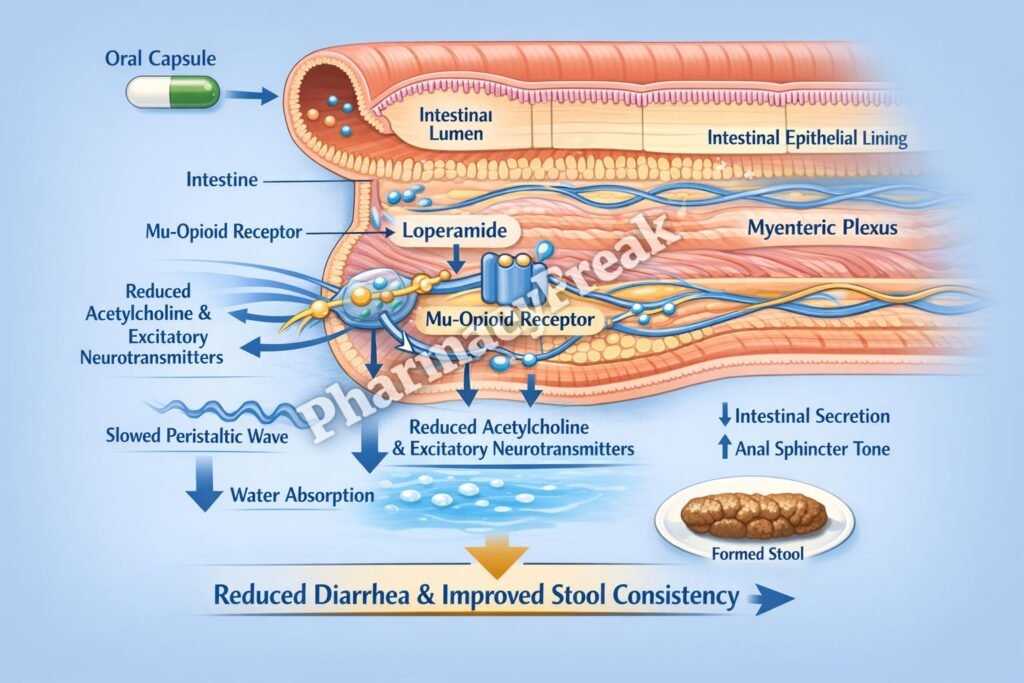
- Loperamide acts as an agonist at μ-opioid receptors located in the enteric nervous system.
- It binds to receptors in the myenteric (Auerbach’s) plexus of the intestinal wall.
- Activation of μ-opioid receptors inhibits the release of excitatory neurotransmitters such as acetylcholine.
- This reduces peristaltic activity and intestinal motility.
- Slowing of intestinal transit time increases water and electrolyte absorption.
- Loperamide also increases tone of the anal sphincter, reducing fecal urgency and incontinence.
- It decreases intestinal secretion by inhibiting secretory processes.
- Due to P-glycoprotein–mediated efflux, loperamide does not significantly enter the central nervous system at therapeutic doses.
A key exam concept is that loperamide acts peripherally on opioid receptors and does not produce analgesia or respiratory depression at normal doses.
Pharmacokinetics
Loperamide is administered orally and undergoes extensive first-pass metabolism in the liver. Its bioavailability is low due to this metabolism and P-glycoprotein efflux. It is highly protein-bound and primarily eliminated in feces. The onset of action is relatively quick, and its duration supports multiple daily dosing. Because it does not significantly cross the blood-brain barrier, central opioid effects are minimal under normal conditions.
Clinical Uses
Loperamide is primarily used in the management of diarrhea. It is effective in acute nonspecific diarrhea, traveler’s diarrhea, and chronic diarrhea associated with inflammatory bowel disease or other conditions. It is also used to reduce ileostomy output. It provides symptomatic relief but does not treat the underlying cause of diarrhea, particularly in infectious cases.
Adverse Effects
Loperamide is generally well tolerated. Common adverse effects include constipation, abdominal cramps, nausea, and dizziness. Excessive use can lead to severe constipation or paralytic ileus. At very high doses, especially with misuse, loperamide can cross the blood-brain barrier and may cause central opioid effects and serious cardiac toxicity, including QT prolongation and arrhythmias. It should be avoided in cases of acute dysentery with bloody diarrhea or bacterial infections where slowing gut motility may worsen the condition.
Comparative Analysis
| Feature | Loperamide | Diphenoxylate | Morphine |
|---|---|---|---|
| Drug class | Peripheral opioid | Opioid antidiarrheal | Central opioid analgesic |
| CNS penetration | Minimal | Moderate (with atropine added) | High |
| Primary use | Diarrhea | Diarrhea | Pain |
| Risk of abuse | Low | Moderate | High |
| Effect on motility | Decreases | Decreases | Decreases |
| Analgesic effect | No | Minimal | Yes |
| Key safety feature | P-glycoprotein efflux | Atropine discourages abuse | None |
Loperamide differs from diphenoxylate and morphine in that it acts primarily in the gut with minimal CNS penetration. This makes it safer and more suitable for routine use in diarrhea. Diphenoxylate has some CNS effects and is combined with atropine to reduce abuse potential, while morphine has strong central effects and is not used as a standard antidiarrheal.
MCQs
- Loperamide acts primarily on which receptors?
a) Dopamine receptors
b) μ-opioid receptors
c) Serotonin receptors
d) Histamine receptors
Answer: b) μ-opioid receptors
- The main site of action of loperamide is:
a) Brain cortex
b) Spinal cord
c) Enteric nervous system
d) Liver
Answer: c) Enteric nervous system
- Loperamide reduces diarrhea by:
a) Increasing motility
b) Decreasing motility
c) Increasing secretion
d) Blocking absorption
Answer: b) Decreasing motility
- Why does loperamide have minimal CNS effects?
a) It is rapidly metabolized
b) It is highly protein-bound
c) It is expelled by P-glycoprotein
d) It is inactive
Answer: c) It is expelled by P-glycoprotein
- Loperamide increases absorption of:
a) Glucose only
b) Water and electrolytes
c) Proteins
d) Vitamins
Answer: b) Water and electrolytes
- Which of the following is a clinical use of loperamide?
a) Asthma
b) Hypertension
c) Diarrhea
d) Depression
Answer: c) Diarrhea
- A common adverse effect of loperamide is:
a) Hypoglycemia
b) Constipation
c) Hypertension
d) Bradycardia
Answer: b) Constipation
- High doses of loperamide may cause:
a) CNS stimulation
b) Cardiac arrhythmias
c) Hyperthyroidism
d) Renal failure
Answer: b) Cardiac arrhythmias
- Loperamide increases tone of:
a) Esophagus
b) Stomach
c) Anal sphincter
d) Bladder
Answer: c) Anal sphincter
- Which drug is combined with atropine to reduce abuse?
a) Loperamide
b) Diphenoxylate
c) Morphine
d) Codeine
Answer: b) Diphenoxylate
- Loperamide should be avoided in:
a) Viral infections
b) Mild diarrhea
c) Bloody diarrhea
d) Traveler’s diarrhea
Answer: c) Bloody diarrhea
- Loperamide primarily affects:
a) Renal function
b) Cardiac output
c) Intestinal motility
d) Pulmonary function
Answer: c) Intestinal motility
FAQs
What is the mechanism of action of loperamide?
It acts on μ-opioid receptors in the gut to decrease motility and increase absorption of fluids and electrolytes.
Why does loperamide not cause central opioid effects?
It is actively pumped out of the brain by P-glycoprotein transporters.
Is loperamide safe for all types of diarrhea?
No, it should be avoided in infectious diarrhea with blood or high fever.
Can loperamide cause serious toxicity?
Yes, at very high doses it can cause cardiac arrhythmias and CNS effects.
How does loperamide reduce urgency?
By increasing anal sphincter tone and slowing intestinal transit.
Is loperamide addictive?
At therapeutic doses, it has very low abuse potential.
References
Goodman & Gilman’s The Pharmacological Basis of Therapeutics – Gastrointestinal Drugs
https://accessmedicine.mhmedical.com/book.aspx?bookid=3191
Katzung: Basic and Clinical Pharmacology – Antidiarrheal Agents
https://accessmedicine.mhmedical.com/content.aspx?bookid=3382
Tripathi: Essentials of Medical Pharmacology – Drugs for Diarrhea
https://www.jaypeedigital.com
Harrison’s Principles of Internal Medicine – Diarrheal Diseases
https://accessmedicine.mhmedical.com