Table of Contents
Introduction
Glyceryl Trinitrate (GTN), commonly known as nitroglycerin, is an organic nitrate widely used in the treatment of angina pectoris and acute coronary syndromes. It acts primarily as a vasodilator by releasing nitric oxide (NO), which relaxes vascular smooth muscle.
GTN reduces myocardial oxygen demand by decreasing preload and also improves coronary blood flow through vasodilation. Because of its rapid onset of action, it is frequently used in sublingual formulations for acute angina relief.
Understanding the mechanism of glyceryl trinitrate is important for pharmacology examinations such as USMLE, NEET PG, FMGE, PLAB, INICET, NCLEX, and MCCQE.
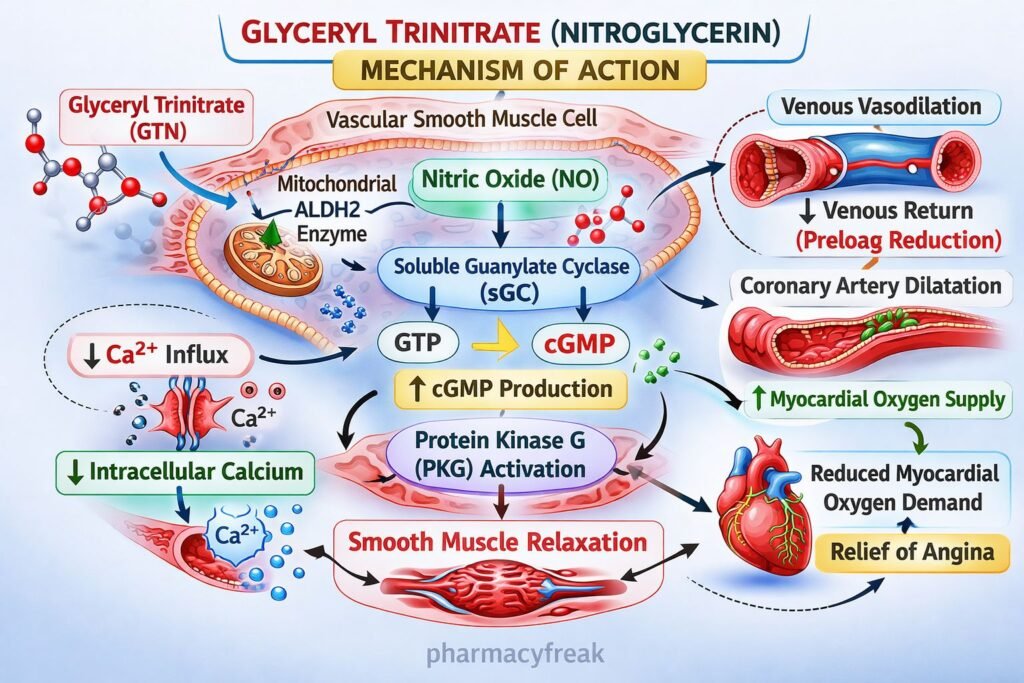
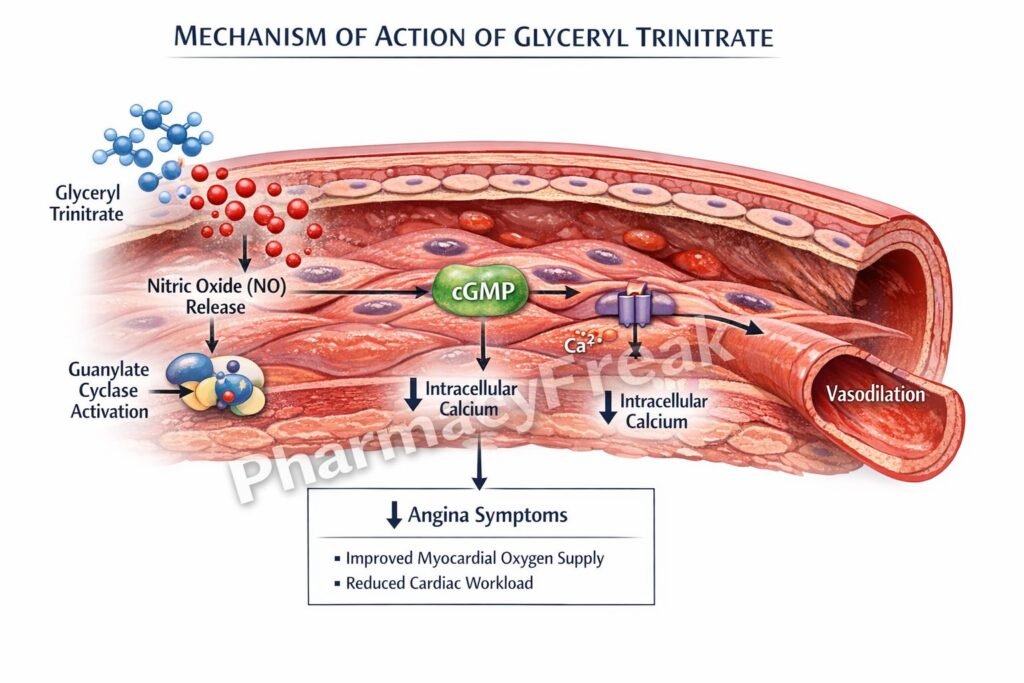
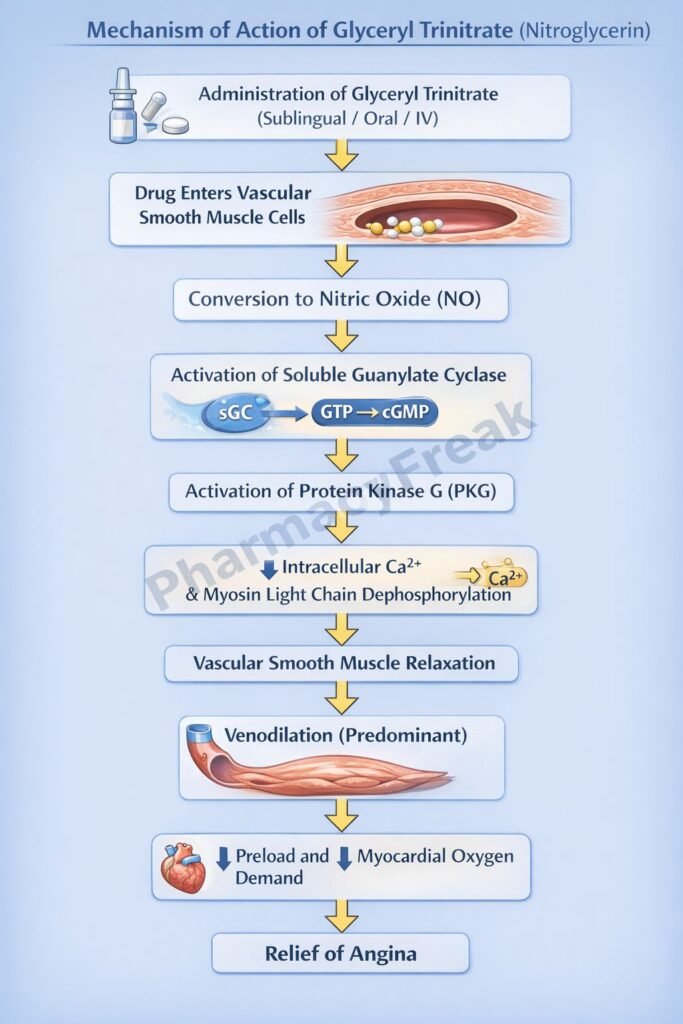
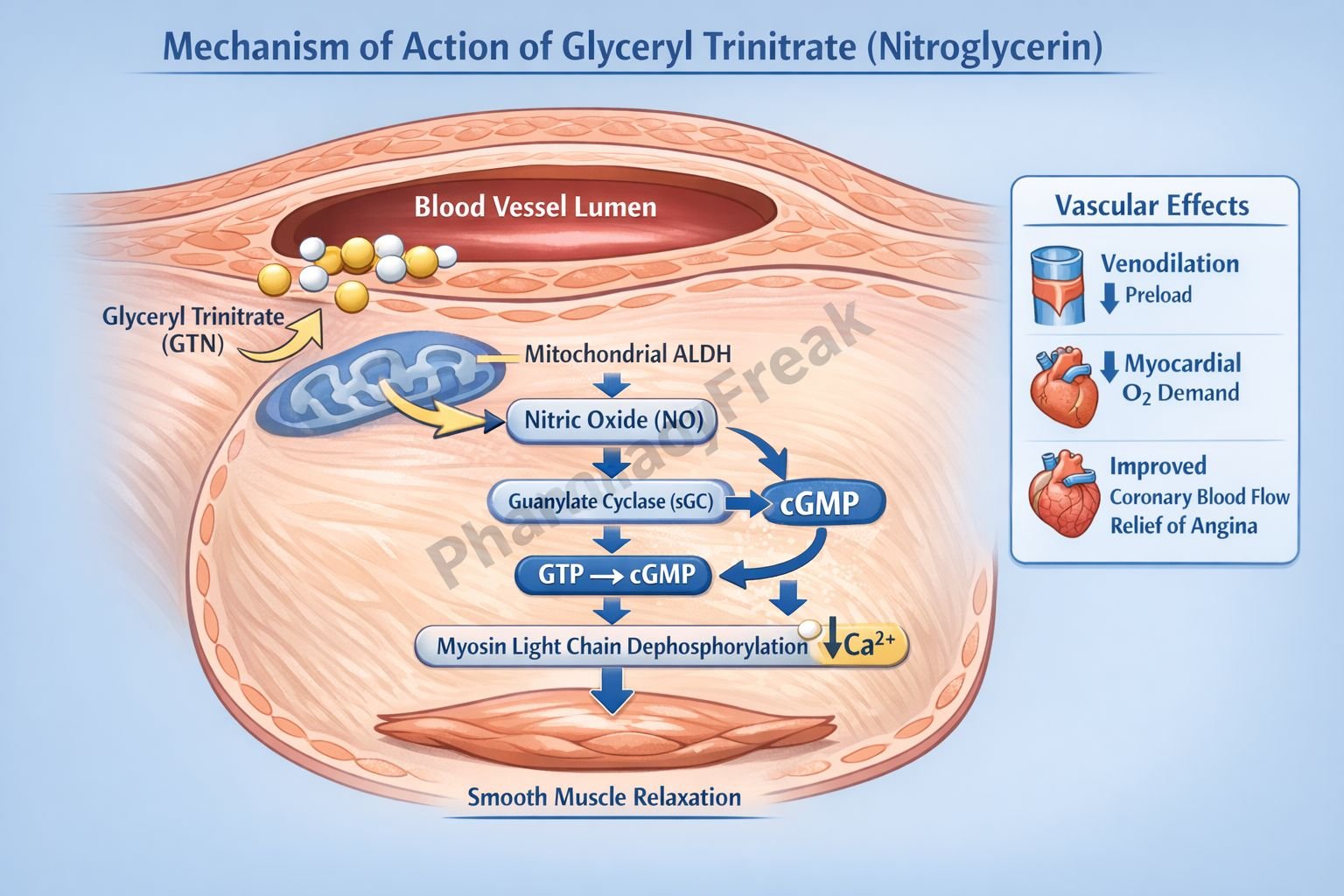
Mechanism of Action (Step-wise)
Glyceryl trinitrate produces vasodilation through nitric oxide mediated smooth muscle relaxation.
Step 1: Enzymatic conversion to nitric oxide
Glyceryl trinitrate is converted within vascular smooth muscle cells to nitric oxide (NO), primarily by mitochondrial aldehyde dehydrogenase.
Step 2: Activation of guanylate cyclase
Nitric oxide activates soluble guanylate cyclase in vascular smooth muscle cells.
Step 3: Increase in cyclic GMP
Activation of guanylate cyclase increases intracellular cyclic guanosine monophosphate (cGMP).
Step 4: Smooth muscle relaxation
Elevated cGMP activates protein kinase G, leading to decreased intracellular calcium and relaxation of vascular smooth muscle.
Step 5: Venous vasodilation predominance
GTN predominantly dilates veins, reducing venous return to the heart.
Step 6: Reduction of cardiac workload
Reduced venous return decreases preload and myocardial oxygen demand.
Overall effect:
Vasodilation leading to decreased preload, improved coronary perfusion, and relief of angina.
Important pharmacology concept:
Organic nitrates mainly reduce myocardial oxygen demand rather than significantly increasing oxygen supply.
Pharmacokinetics
Absorption:
Rapidly absorbed through sublingual mucosa, transdermal patches, and oral formulations.
First pass metabolism:
Extensive hepatic metabolism when taken orally.
Distribution:
Widely distributed in vascular tissues.
Metabolism:
Metabolized mainly in the liver by nitrate reductases.
Excretion:
Metabolites are excreted in urine.
Onset and duration:
- Sublingual: onset within minutes
- Transdermal: prolonged action
Clinical Uses
- Acute angina pectoris
- Chronic stable angina
- Acute coronary syndromes
- Acute heart failure with pulmonary edema
- Hypertensive emergencies (intravenous form)
Sublingual nitroglycerin is commonly used for immediate relief of anginal pain.
Adverse Effects
Common adverse effects:
- Headache due to cerebral vasodilation
- Flushing
- Hypotension
- Dizziness
Serious adverse effects:
- Reflex tachycardia
- Severe hypotension
Important interaction:
- Concomitant use with phosphodiesterase-5 inhibitors (e.g., sildenafil) can cause life threatening hypotension.
Tolerance:
Continuous nitrate exposure may lead to nitrate tolerance.
Comparative Analysis
| Feature | Glyceryl Trinitrate | Beta Blockers | Calcium Channel Blockers |
|---|---|---|---|
| Mechanism | NO mediated vasodilation | Reduce heart rate and contractility | Reduce calcium influx |
| Primary effect | Reduce preload | Reduce myocardial oxygen demand | Vasodilation and reduced contractility |
| Onset | Rapid (sublingual) | Moderate | Moderate |
| Use in acute angina | Yes | No | Limited |
| Major adverse effect | Headache, hypotension | Bradycardia | Peripheral edema |
Explanation:
Glyceryl trinitrate reduces myocardial oxygen demand primarily by venous vasodilation and reduction of preload. Beta blockers reduce oxygen demand by lowering heart rate and contractility. Calcium channel blockers act by decreasing calcium entry into cardiac and vascular smooth muscle, leading to vasodilation and reduced myocardial workload.
MCQs
- Glyceryl trinitrate acts mainly by releasing:
a) Dopamine
b) Nitric oxide
c) Serotonin
d) Acetylcholine
Answer: b) Nitric oxide
- Nitric oxide activates:
a) Adenylate cyclase
b) Guanylate cyclase
c) Phospholipase C
d) Protein kinase A
Answer: b) Guanylate cyclase
- Increased cGMP leads to:
a) Smooth muscle contraction
b) Smooth muscle relaxation
c) Increased calcium influx
d) Increased sodium influx
Answer: b) Smooth muscle relaxation
- Glyceryl trinitrate mainly causes:
a) Arterial constriction
b) Venous dilation
c) Bronchoconstriction
d) Increased heart rate directly
Answer: b) Venous dilation
- Reduction of preload decreases:
a) Cardiac output only
b) Myocardial oxygen demand
c) Renal blood flow
d) Blood viscosity
Answer: b) Myocardial oxygen demand
- Sublingual nitroglycerin is used for:
a) Hypertension only
b) Acute angina attack
c) Diabetes
d) Asthma
Answer: b) Acute angina attack
- Common adverse effect of nitrates:
a) Headache
b) Bradycardia
c) Hyperglycemia
d) Hypokalemia
Answer: a) Headache
- Concomitant use with sildenafil may cause:
a) Severe hypertension
b) Severe hypotension
c) Hyperglycemia
d) Renal failure
Answer: b) Severe hypotension
- GTN reduces myocardial oxygen demand mainly by:
a) Increasing heart rate
b) Increasing contractility
c) Reducing preload
d) Increasing blood viscosity
Answer: c) Reducing preload
- Enzyme involved in GTN bioactivation:
a) Aldehyde dehydrogenase
b) Cyclooxygenase
c) Lipoxygenase
d) Monoamine oxidase
Answer: a) Aldehyde dehydrogenase
FAQs
- How does glyceryl trinitrate relieve angina?
By releasing nitric oxide, which relaxes vascular smooth muscle and reduces cardiac workload. - Why is sublingual administration preferred for acute angina?
Because it bypasses first pass metabolism and produces rapid onset of action. - Why do nitrates cause headache?
Due to dilation of cerebral blood vessels. - What causes nitrate tolerance?
Continuous exposure reduces responsiveness of vascular smooth muscle to nitrates. - Why should nitrates not be combined with sildenafil?
Because both increase cGMP levels, causing severe hypotension. - Do nitrates increase oxygen supply to the heart?
Their primary effect is reducing oxygen demand rather than significantly increasing supply.
References
Goodman & Gilman’s Pharmacological Basis of Therapeutics
https://accessmedicine.mhmedical.com/book.aspx?bookID=2189
Katzung BG. Basic and Clinical Pharmacology
https://accessmedicine.mhmedical.com/book.aspx?bookID=2249
Tripathi KD. Essentials of Medical Pharmacology
https://jaypeedigital.com/book/9789354651970
Harrison’s Principles of Internal Medicine
https://accessmedicine.mhmedical.com/book.aspx?bookID=3095