Table of Contents
Introduction
Glipizide is a second generation sulfonylurea used in the management of type 2 diabetes mellitus. It functions as an insulin secretagogue, lowering blood glucose by stimulating pancreatic beta cells to release insulin. Compared with first generation sulfonylureas, glipizide has greater potency, improved safety, and fewer drug interactions.
It is a high yield drug in pharmacology examinations such as USMLE, NEET PG, FMGE, PLAB, INICET, NCLEX, and MCCQE, particularly in questions involving ATP sensitive potassium channels and insulin secretion pathways.
Glipizide clinical pharmacology
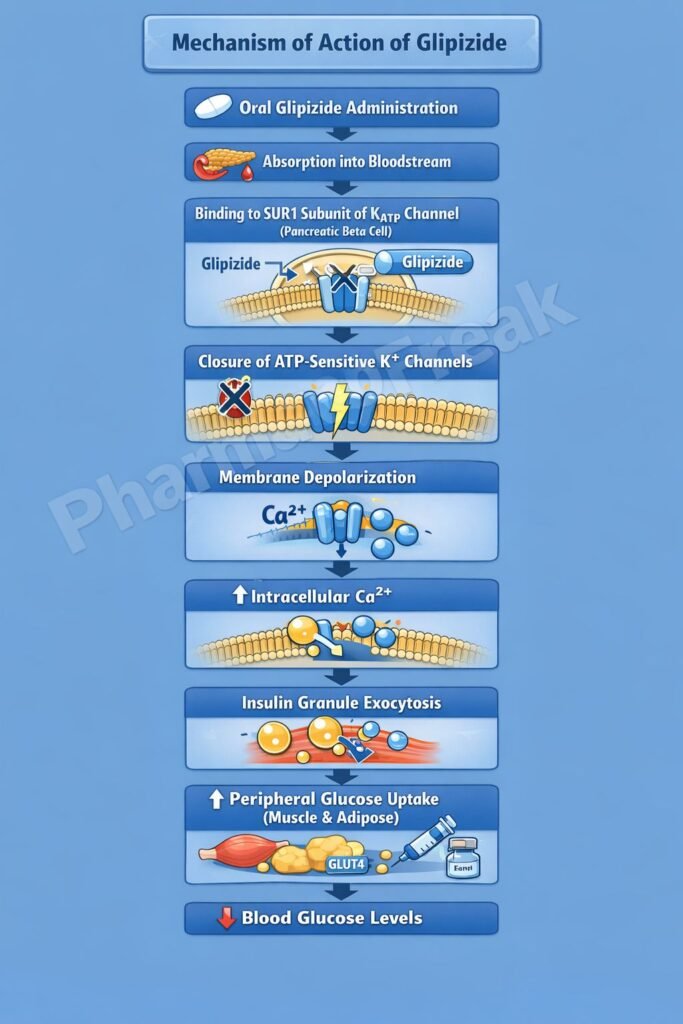
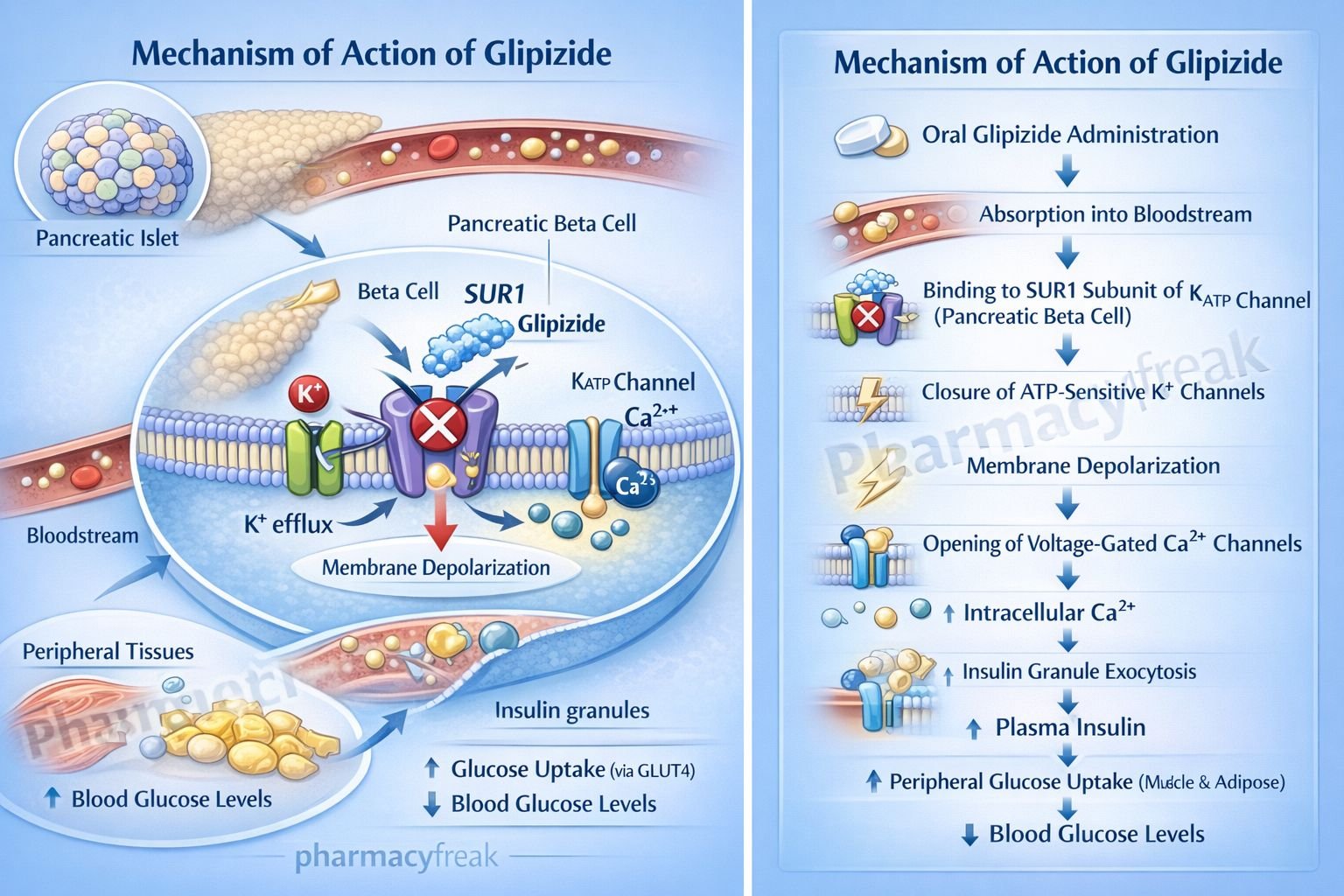
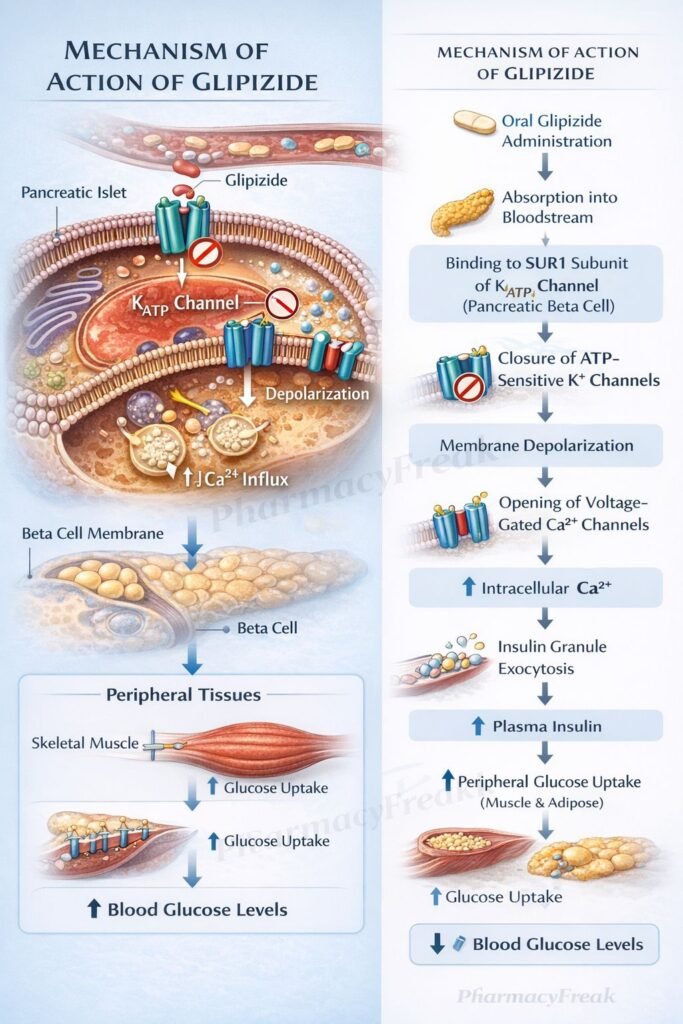
Mechanism of Action (Step-wise)
Glipizide lowers blood glucose by increasing endogenous insulin secretion.
Step 1: Binding to sulfonylurea receptor
Glipizide binds to sulfonylurea receptor 1 (SUR1), which is a regulatory subunit of ATP sensitive potassium (K ATP) channels on pancreatic beta cells.
Step 2: Closure of K ATP channels
Binding results in closure of K ATP channels, decreasing potassium efflux.
Step 3: Membrane depolarization
Reduced potassium efflux leads to depolarization of the beta cell membrane.
Step 4: Opening of voltage gated calcium channels
Depolarization triggers opening of voltage dependent calcium channels.
Step 5: Insulin granule release
Calcium influx stimulates exocytosis of insulin containing vesicles into circulation.
Overall effect:
Increased plasma insulin levels leading to enhanced glucose uptake by peripheral tissues and decreased blood glucose concentration.
Important concept:
Sulfonylureas act independently of ambient glucose concentration, increasing risk of hypoglycemia.
Pharmacokinetics
Absorption:
Rapidly absorbed after oral administration.
Distribution:
Highly protein bound.
Metabolism:
Metabolized in the liver to inactive or weakly active metabolites.
Excretion:
Primarily excreted in urine.
Duration:
Short to intermediate duration of action. Extended release formulations allow once daily dosing.
Clinical Uses
- Type 2 diabetes mellitus
- Patients inadequately controlled on lifestyle modification
- Combination therapy with metformin
- Alternative to other sulfonylureas when shorter duration is desired
It is ineffective in type 1 diabetes mellitus because functional beta cells are required.
Adverse Effects
Common adverse effects:
- Hypoglycemia
- Weight gain
- Gastrointestinal discomfort
Risk factors for hypoglycemia:
- Elderly patients
- Renal impairment
- Missed meals
Rare adverse effects:
- Allergic reactions
- Hematologic disturbances
Comparative Analysis
| Feature | Glipizide | Glimepiride | Metformin |
|---|---|---|---|
| Drug class | Sulfonylurea | Sulfonylurea | Biguanide |
| Mechanism | Closes K ATP channels | Closes K ATP channels | Decreases hepatic gluconeogenesis |
| Hypoglycemia risk | Moderate | Moderate | Minimal |
| Weight gain | Yes | Yes | Neutral or weight loss |
| Requires beta cells | Yes | Yes | No |
Explanation:
Glipizide and glimepiride share the same primary mechanism of stimulating insulin secretion by closing K ATP channels. However, pharmacokinetic differences influence duration and hypoglycemia risk. Metformin acts differently by reducing hepatic glucose production and improving insulin sensitivity without stimulating insulin release.
MCQs
- Glipizide belongs to which class?
a) Biguanide
b) Sulfonylurea
c) SGLT2 inhibitor
d) DPP 4 inhibitor
Answer: b) Sulfonylurea
- Primary molecular target of glipizide:
a) GLUT4
b) SUR1
c) PPAR gamma
d) NMDA receptor
Answer: b) SUR1
- Closure of ATP sensitive potassium channels causes:
a) Hyperpolarization
b) Depolarization
c) Decreased calcium entry
d) Reduced insulin secretion
Answer: b) Depolarization
- Insulin release is triggered by increased:
a) Sodium influx
b) Potassium efflux
c) Calcium influx
d) Chloride influx
Answer: c) Calcium influx
- Glipizide is ineffective in:
a) Type 2 diabetes
b) Prediabetes
c) Type 1 diabetes
d) Obesity
Answer: c) Type 1 diabetes
- Major adverse effect:
a) Hyperglycemia
b) Hypoglycemia
c) Hypernatremia
d) Bradycardia
Answer: b) Hypoglycemia
- Primary site of action:
a) Liver
b) Skeletal muscle
c) Pancreatic beta cells
d) Kidney
Answer: c) Pancreatic beta cells
- Compared to metformin, glipizide:
a) Does not affect insulin
b) Stimulates insulin secretion
c) Reduces gluconeogenesis
d) Causes weight loss
Answer: b) Stimulates insulin secretion
- Mechanism involves:
a) Opening K ATP channels
b) Closing K ATP channels
c) Blocking SGLT2
d) Inhibiting DPP 4
Answer: b) Closing K ATP channels
- Weight gain with glipizide is due to:
a) Increased glucagon
b) Increased insulin
c) Dehydration
d) Reduced appetite
Answer: b) Increased insulin
FAQs
- How does glipizide lower blood glucose?
By stimulating insulin release through closure of ATP sensitive potassium channels in pancreatic beta cells. - Why can glipizide cause hypoglycemia?
Because insulin secretion occurs even when blood glucose levels are low. - Can glipizide be combined with metformin?
Yes, combination therapy is common in type 2 diabetes management. - Does glipizide work in type 1 diabetes?
No, it requires functional pancreatic beta cells. - Does glipizide cause weight gain?
Yes, due to increased insulin mediated anabolic effects. - Which patients are at higher risk of hypoglycemia?
Elderly individuals, those with renal impairment, or those who skip meals.
References
Goodman & Gilman’s Pharmacological Basis of Therapeutics
https://accessmedicine.mhmedical.com/book.aspx?bookID=2189
Katzung BG. Basic and Clinical Pharmacology
https://accessmedicine.mhmedical.com/book.aspx?bookID=2249
Tripathi KD. Essentials of Medical Pharmacology
https://jaypeedigital.com/book/9789354651970
Harrison’s Principles of Internal Medicine
https://accessmedicine.mhmedical.com/book.aspx?bookID=3095