Table of Contents
Introduction
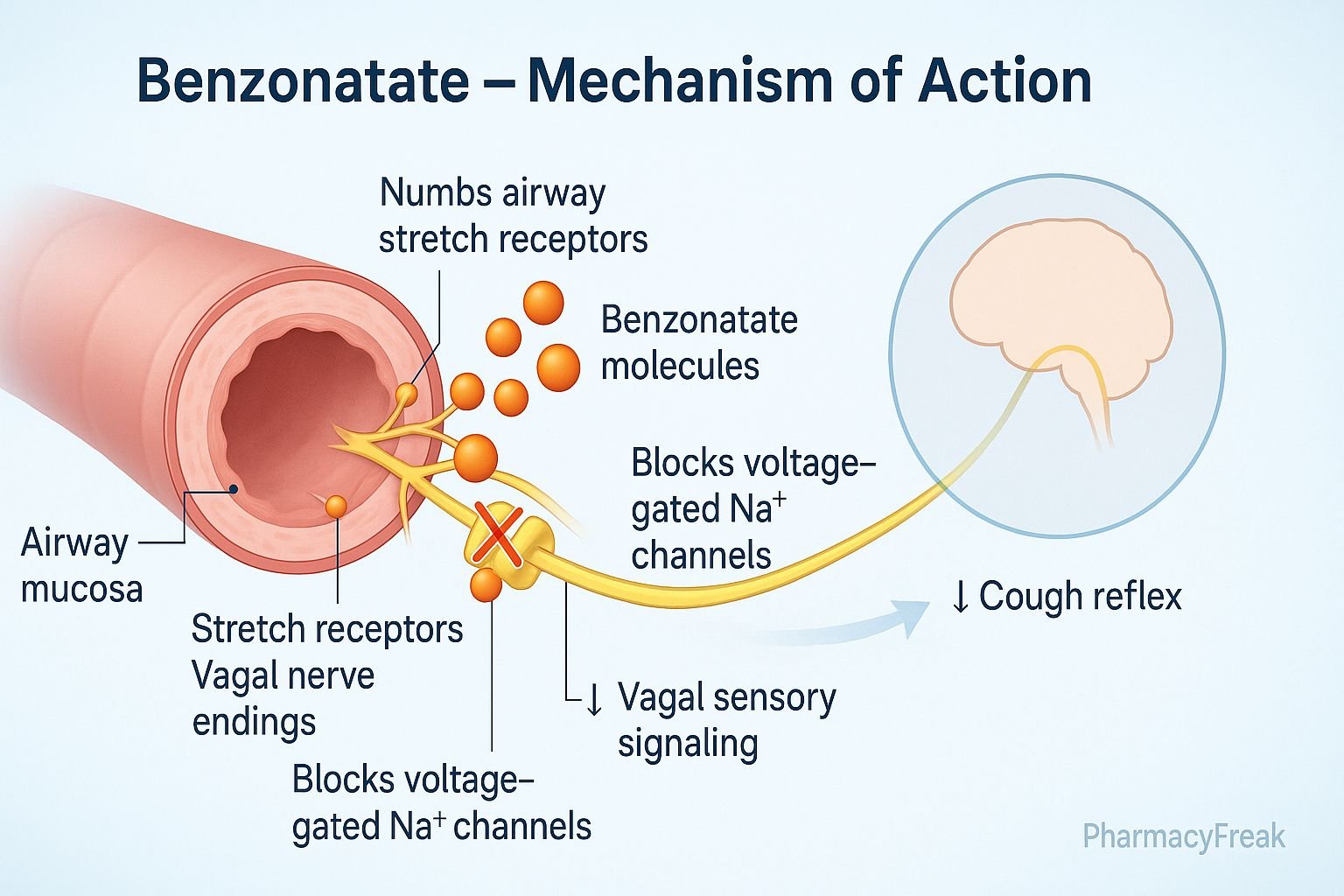
Benzonatate is a non-narcotic antitussive (cough suppressant) commonly prescribed for symptomatic relief of acute cough in respiratory infections such as bronchitis, pneumonia, and influenza. Structurally related to ester-type local anesthetics like tetracaine, benzonatate works by numbing stretch receptors in the respiratory tract and reducing cough reflex sensitivity.
Its unique mechanism provides cough relief without the sedative, addictive, or respiratory depressant effects seen with opioid antitussives such as codeine or hydrocodone.
Mechanism of Action (Step-wise)
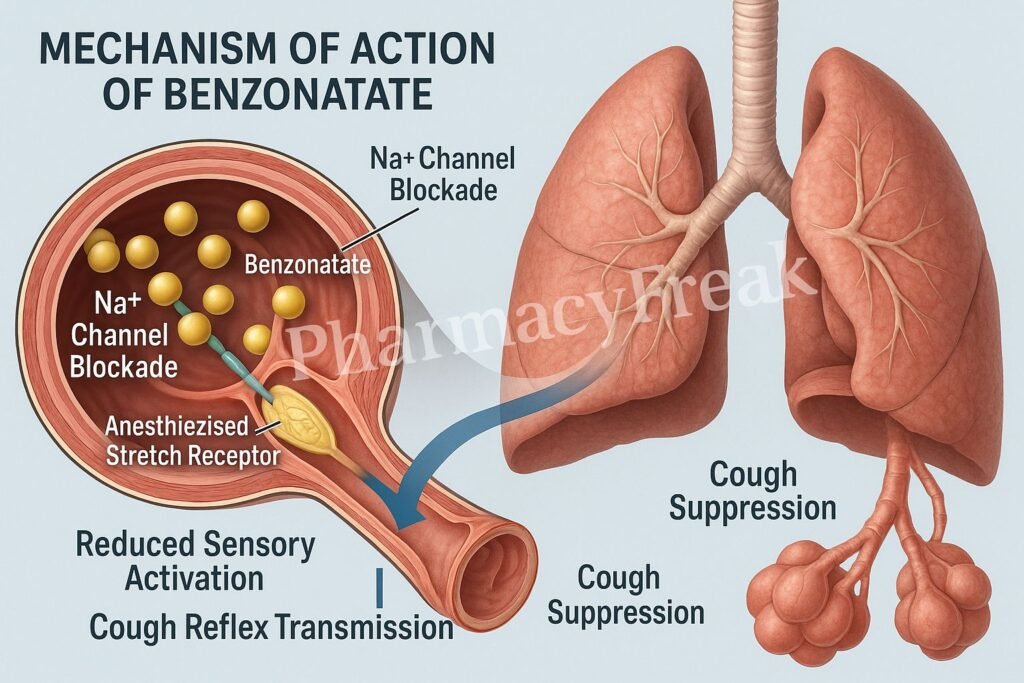
1. Anesthetic Action on Airway Stretch Receptors
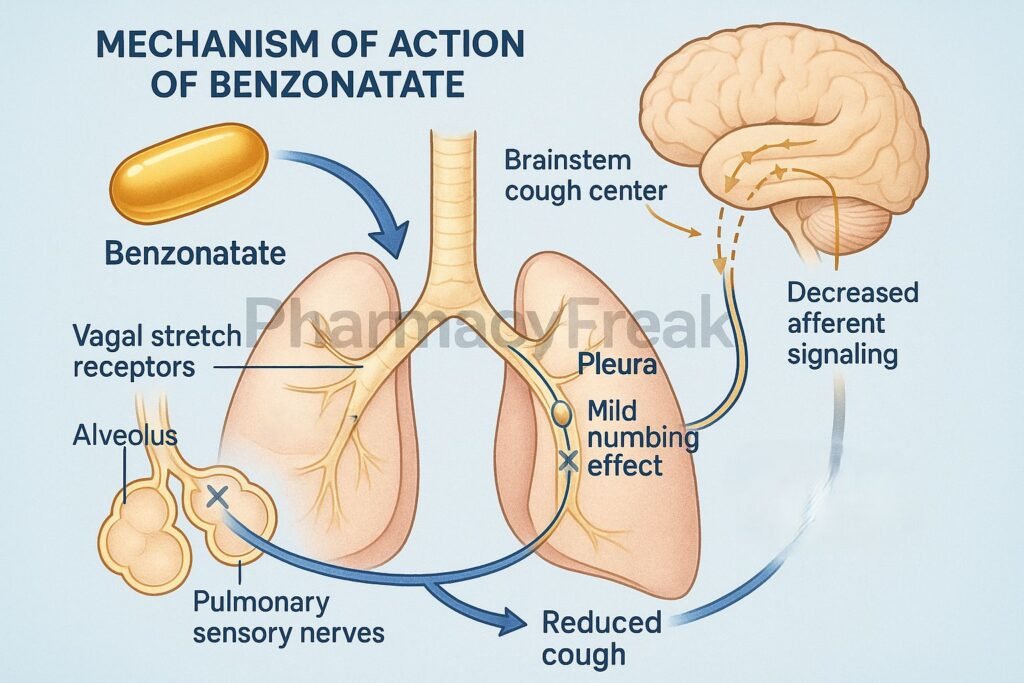
- Benzonatate acts on vagal afferent stretch receptors located in the:
- Bronchi
- Alveoli
- Pleura
- These receptors detect mechanical stimuli and trigger the cough reflex.
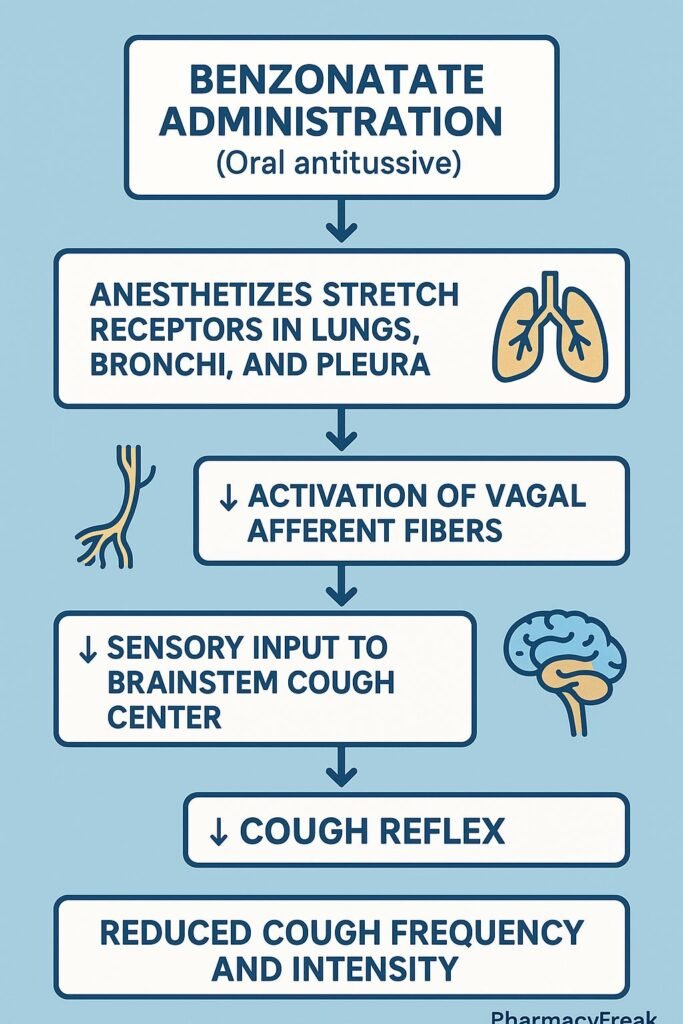
- Benzonatate blocks voltage-gated sodium channels, producing a local anesthetic effect that numbs the sensory receptors.
- Result: Reduced ability of the lung to transmit cough impulses to the medullary cough center.
2. Suppression of Cough Reflex Transmission
- By anesthetizing peripheral cough receptors, fewer signals reach the medulla’s cough control center.
- This reduces both:
- Cough frequency
- Cough intensity
- Unlike opioids, benzonatate does not act centrally and therefore avoids respiratory depression.
3. Inhibition of Vagal Mediated Reflexes
- Benzonatate reduces the excitability of vagal pathways in the airway.
- This dampens reflex bronchospasm and cough response, especially during respiratory infections or airway irritation.
4. Onset and Duration
- Onset: 15–20 minutes after oral administration
- Duration: 3–8 hours of cough suppression
5. Summary of Mechanism
| Target Site | Mechanism | Effect |
|---|---|---|
| Bronchial stretch receptors | Sodium channel blockade | Reduced cough receptor activation |
| Vagal afferent fibers | Local anesthetic action | Blunted reflex cough transmission |
| Medullary cough center | Indirect reduction of signals | Cough suppression |
Pharmacokinetics
- Absorption: Rapid after oral administration (must NOT be chewed).
- Distribution: Widely distributed; exerts local anesthetic effect on airway.
- Metabolism: Hydrolyzed by plasma esterases.
- Excretion: Renal elimination.
- Half-life: Approximately 3–6 hours.
Clinical Uses
- Dry, non-productive cough
- Postoperative cough
- Cough in respiratory infections (bronchitis, pneumonia, influenza)
- Adjunct therapy for chronic cough conditions
Adverse Effects
- Dizziness
- Sedation (mild, rare)
- Headache
- Nausea
- Constipation
- Nasal congestion
Severe Effects (if capsules are chewed or dissolved):
- Laryngospasm
- Bronchospasm
- Seizures
- Cardiac arrest
Important:
Chewing or sucking capsules can cause oropharyngeal anesthesia, choking, and life-threatening reactions.
Comparative Analysis
| Feature | Benzonatate | Codeine | Dextromethorphan |
|---|---|---|---|
| Action site | Peripheral (airway receptors) | Central (medulla) | Central (NMDA suppression) |
| Sedation | Minimal | High | Mild |
| Addiction potential | None | Yes | Low |
| Respiratory depression | None | Significant | Minimal |
| Onset | Fast | Slow | Moderate |
MCQs
1. Benzonatate suppresses cough primarily by acting on:
a) Medullary cough center
b) Opioid receptors
c) Bronchial stretch receptors
d) Serotonin receptors
Answer: c) Bronchial stretch receptors
2. The main molecular action of benzonatate is:
a) Blocking NMDA receptors
b) Blocking sodium channels
c) Stimulating µ-receptors
d) Increasing serotonin release
Answer: b) Blocking sodium channels
3. Chewing benzonatate capsules can cause:
a) Bradycardia
b) Oropharyngeal anesthesia and laryngospasm
c) Severe diarrhea
d) Hyperglycemia
Answer: b) Oropharyngeal anesthesia and laryngospasm
4. Benzonatate is structurally related to:
a) Phenothiazines
b) Local anesthetics
c) Penicillins
d) Beta blockers
Answer: b) Local anesthetics
5. Benzonatate differs from codeine because it:
a) Causes respiratory depression
b) Has addictive potential
c) Acts peripherally
d) Is an opioid derivative
Answer: c) Acts peripherally
FAQs
Q1. Does benzonatate work on the brain?
No, it works peripherally on airway receptors, not the CNS.
Q2. Is benzonatate safe in children?
No, it is contraindicated in children under 10 years due to risk of fatal overdose.
Q3. Can benzonatate be chewed?
Never. Chewing causes rapid absorption leading to seizures, laryngospasm, and collapse.
Q4. How long does benzonatate take to work?
Relief begins within 15–20 minutes and lasts up to 8 hours.
Q5. Is benzonatate addictive?
No, it has no abuse potential unlike opioid cough suppressants.
References
Goodman & Gilman’s Pharmacological Basis of Therapeutics
Katzung Basic & Clinical Pharmacology
Tripathi Essentials of Medical Pharmacology
Harrison’s Principles of Internal Medicine