
Introduction
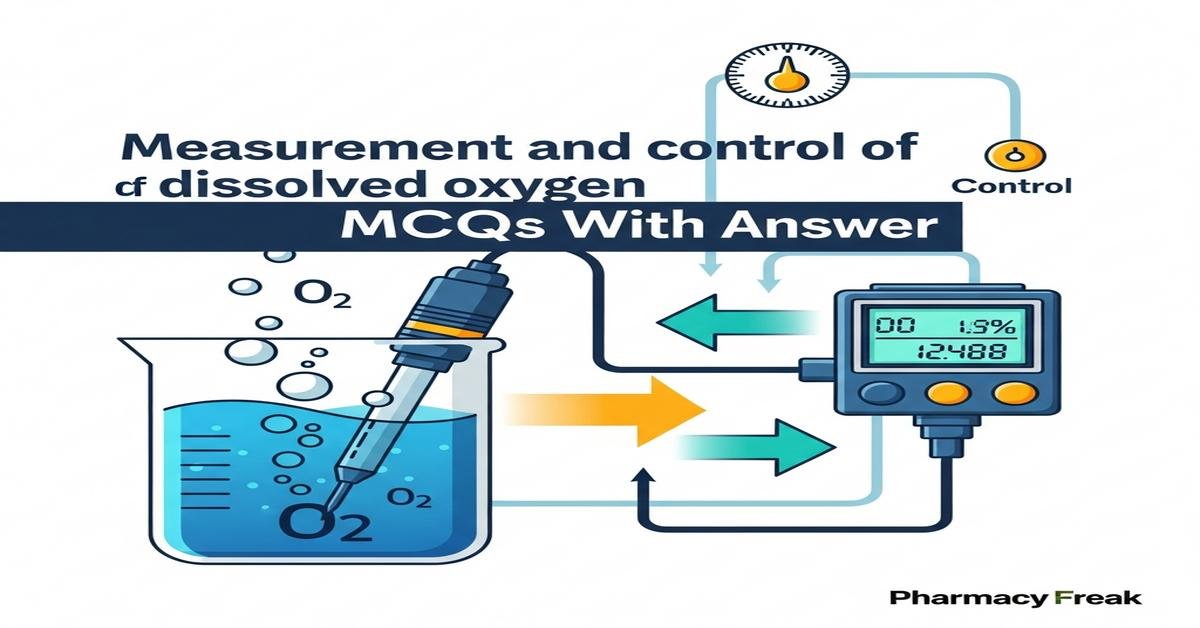
Understanding measurement and control of dissolved oxygen (DO) is essential for bioprocess design, monitoring and scale-up in M.Pharm programs. This set of MCQs focuses on the physical chemistry of oxygen transfer, instrumentation (electrochemical and optical sensors), calibration and maintenance, mass transfer parameters such as kLa and OTR, and practical control strategies used in fermenters and bioreactors. Questions are designed to deepen conceptual knowledge and problem-solving skills relevant to lab practice and process development. Answers include concise, precise options so students can evaluate their readiness for examinations and practical work in bioprocess engineering and technology.
Q1. What does Henry’s law state regarding dissolved oxygen in aqueous systems?
- The solubility of a gas is independent of its partial pressure above the liquid
- Gas solubility is proportional to its partial pressure above the liquid (Henry’s law)
- Gas solubility increases with temperature according to Henry’s law
- The solubility is proportional to the square root of pressure
Correct Answer: Gas solubility is proportional to its partial pressure above the liquid (Henry’s law)
Q2. The two-film model of gas–liquid mass transfer assumes which primary resistance to transfer?
- Resistance only in the gas phase, liquid is assumed well mixed
- No resistance; instantaneous equilibrium at the interface
- Mass transfer occurs through thin stagnant films on gas and liquid sides
- Resistance only at the stirring impeller surface
Correct Answer: Mass transfer occurs through thin stagnant films on gas and liquid sides
Q3. How is the volumetric oxygen transfer coefficient (kLa) commonly defined?
- kLa is the gas-side mass transfer coefficient multiplied by gas velocity
- kLa = kL * a (liquid-side transfer coefficient times interfacial area per unit volume)
- kLa is only dependent on solubility and temperature
- kLa equals the oxygen uptake rate divided by biomass concentration
Correct Answer: kLa = kL * a (liquid-side transfer coefficient times interfacial area per unit volume)
Q4. What is the sensing principle of a Clark (polarographic) dissolved oxygen electrode?
- Optical fluorescence quenching by oxygen molecules
- Electrochemical reduction of oxygen at a cathode producing a current proportional to DO
- Thermal conductivity change of gas above liquid
- Change in pH due to dissolved oxygen
Correct Answer: Electrochemical reduction of oxygen at a cathode producing a current proportional to DO
Q5. Which statement best describes optical (luminescent) DO sensors?
- They consume oxygen during measurement and require frequent electrolyte replacement
- They measure DO by luminescent dye quenching and do not consume oxygen
- They require polarization voltage like polarographic sensors
- They are inaccurate at high temperatures and therefore rarely used
Correct Answer: They measure DO by luminescent dye quenching and do not consume oxygen
Q6. What is the standard two-point calibration for most DO probes?
- Calibration at 0°C and 100°C
- Single-point calibration at the process setpoint only
- Air-saturated water (100% saturation) and a zero-oxygen solution (sodium sulfite)
- Calibration against a pH standard buffer
Correct Answer: Air-saturated water (100% saturation) and a zero-oxygen solution (sodium sulfite)
Q7. In DO sensor specifications, the response time t90 refers to:
- The time to reach 10% of final value after a step change
- The time to reach 50% of final value after a step change
- The time to reach 90% of final value after a step change
- The sensor lifetime in months under continuous use
Correct Answer: The time to reach 90% of final value after a step change
Q8. The oxygen transfer rate (OTR) in a reactor is expressed by which relation?
- OTR = Henry’s constant × temperature
- OTR = kLa × (C* – CL)
- OTR = agitation speed × aeration rate
- OTR = dissolved CO2 concentration × kLa
Correct Answer: OTR = kLa × (C* – CL)
Q9. How is the oxygen uptake rate (OUR) commonly measured experimentally in a bioreactor?
- By recording airflow only, ignoring exhaust composition
- Using a dynamic (gassing-out) method where aeration is stopped and DO decline rate is used
- By measuring pH change over time
- By directly measuring biomass dry weight and using a fixed specific rate
Correct Answer: Using a dynamic (gassing-out) method where aeration is stopped and DO decline rate is used
Q10. Which operational change will typically increase kLa in a stirred tank reactor?
- Reducing agitation speed while keeping aeration constant
- Adding antifoam to maximum recommended concentration
- Increasing agitation speed and introducing fine-bubble sparging
- Decreasing aeration and using larger bubbles
Correct Answer: Increasing agitation speed and introducing fine-bubble sparging
Q11. What effect do antifoaming agents often have on oxygen transfer?
- They always increase kLa by stabilizing bubble surfaces
- They decrease kLa by causing bubble coalescence and reducing interfacial area
- They have no effect on mass transfer but change sensor calibration
- They convert oxygen into more soluble compounds, increasing DO
Correct Answer: They decrease kLa by causing bubble coalescence and reducing interfacial area
Q12. Which control strategy is commonly used to maintain DO at a setpoint in fermentation?
- Open-loop control with fixed aeration regardless of DO
- Pseudo-random adjustment of rpm to observe effects
- PID controller adjusting agitation speed and/or aeration to maintain DO
- Manual adjustment of temperature to control DO
Correct Answer: PID controller adjusting agitation speed and/or aeration to maintain DO
Q13. Off-gas analysis for estimating OUR relies on measuring which parameters?
- Liquid conductivity and turbidity
- O2 and CO2 concentration difference between inlet and outlet gas streams
- Only inlet oxygen concentration
- pH and dissolved ammonia concentration
Correct Answer: O2 and CO2 concentration difference between inlet and outlet gas streams
Q14. How does temperature typically affect oxygen solubility in water?
- Oxygen solubility increases with increasing temperature
- Temperature has no effect on oxygen solubility
- Oxygen solubility decreases with increasing temperature
- Oxygen solubility oscillates unpredictably with temperature
Correct Answer: Oxygen solubility decreases with increasing temperature
Q15. What is a common consequence of membrane fouling on a Clark DO electrode?
- Faster response time and improved accuracy
- Signal drift, slower response and underestimation of true DO
- Complete immunity to calibration errors
- No effect because membrane fouling does not impact electrochemical sensors
Correct Answer: Signal drift, slower response and underestimation of true DO
Q16. What distinguishes a galvanic DO sensor from a polarographic (Clark) sensor?
- Galvanic sensors require an external polarization voltage, Clark sensors do not
- Galvanic sensors generate current spontaneously and do not need an external polarization voltage
- Galvanic sensors measure DO optically while Clark sensors are thermal
- There is no practical difference; both are optical sensors
Correct Answer: Galvanic sensors generate current spontaneously and do not need an external polarization voltage
Q17. Best practice when sterilizing DO probes for aseptic fermentations is to:
- Autoclave the entire probe including electronics at 134°C for 60 minutes
- Never sterilize DO probes; always use them unsterilized
- Follow the manufacturer’s instructions; many probe tips/bodies are autoclavable, protect or remove electronics and inspect membranes/O-rings
- Immerse probe in concentrated acid to sterilize quickly
Correct Answer: Follow the manufacturer’s instructions; many probe tips/bodies are autoclavable, protect or remove electronics and inspect membranes/O-rings
Q18. Bubble coalescence in the sparger zone primarily affects which parameter linked to oxygen transfer?
- It increases the Henry’s constant
- It reduces the interfacial area ‘a’, thereby lowering kLa
- It increases the liquid diffusion coefficient
- It changes the oxygen molecular weight
Correct Answer: It reduces the interfacial area ‘a’, thereby lowering kLa
Q19. Which units are commonly used to report dissolved oxygen in bioprocess monitoring?
- mg/L, % saturation and partial pressure (kPa or mmHg)
- molarity only (M)
- liters per minute (L/min)
- Reynolds number
Correct Answer: mg/L, % saturation and partial pressure (kPa or mmHg)
Q20. A known limitation of Clark-type DO electrodes compared to optical sensors is:
- They never require calibration once installed
- They consume oxygen during measurement and can exhibit polarization drift and require electrolyte/membrane maintenance
- They provide instantaneous non-invasive measurements through the vessel wall
- They are completely unaffected by temperature and pressure changes
Correct Answer: They consume oxygen during measurement and can exhibit polarization drift and require electrolyte/membrane maintenance

